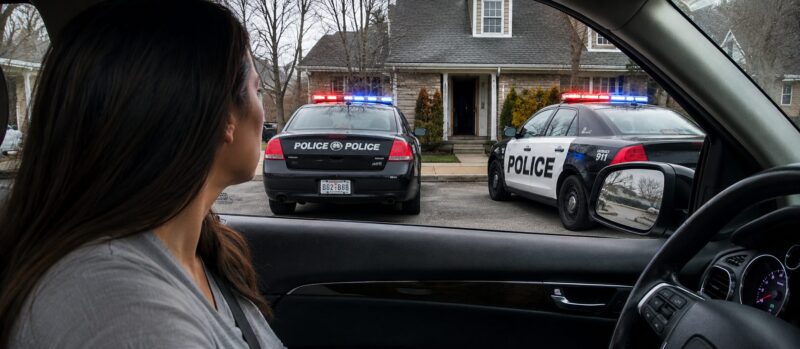
The first thing I saw was the open front door.
The second was a police cruiser.
The third was my mother, smiling.
At exactly 3:18 on Thursday afternoon, I turned into my driveway with a stuffed fox sitting on the passenger seat. My business trip to Denver had wrapped up a day early, and I hadn’t told a soul. I wanted to surprise my five-year-old daughter, Lily.
Instead, two police cruisers were parked in front of my house.
My mother, Evelyn, stood on the porch with her arms crossed tightly. Beside her, my older sister, Melissa, was recording everything on her phone.
Then I heard a child screaming.
“Lily!”
I sprinted inside.
Lily was curled up on the living room rug in her pink dinosaur pajamas, clutching her blanket. One officer stood near the hallway while Officer Daniels crouched a few feet away, speaking to her in a gentle voice.
The moment Lily saw me, she launched herself into my arms.
“Mommy, don’t let them take me!” she sobbed. “Grandma said bad girls get taken away forever.”
Her whole body was shaking.
Behind me, Evelyn let out an irritated sigh. “Oh, Natalie, stop encouraging the dramatics.”
I held Lily tighter. “What happened?”
Melissa lowered her phone. “She got violent. She locked herself in your bedroom and wouldn’t come out. Mom thought she might hurt herself.”
Officer Daniels stood up. “Ma’am, we received a report of an uncontrollable child creating a potentially dangerous situation.”
Then I caught sight of the bright red mark across Lily’s left cheek. It looked unmistakably like a handprint.
I touched it carefully. Lily flinched.
The room went dead silent.
“Who hit her?”
My mother actually laughed. “No one. She threw herself against the door.”
Lily tightened her grip on my shirt.
I had spent my entire childhood learning every variation of Evelyn’s lies—the calm lie, the play-the-victim lie, and her absolute favorite: the lie that made everyone else look unhinged.
I carried Lily over to the sofa and sat down with her in my lap. Then I looked straight at Officer Daniels.
“I want the incident number. I want the 911 recording preserved. And I want today’s report to clearly state that my five-year-old believed the police were here to take her away because her grandmother told her they would.”
Evelyn rolled her eyes. “You always overreact.”
“No,” I said calmly. “I’m taking action.”
For the first time all afternoon, her smile completely vanished.
After the officers left, I ordered Evelyn and Melissa to get out of my house.
My mother glared at me. “You asked us to watch her.”
“For three days. Not to terrorize her.”
“She needed discipline.”
“She needed safety.”
Melissa stepped closer, her voice dropping. “Be careful, Nat. You travel. You leave her with other people. You’re emotionally unstable. This could look really bad for you in court.”
There it was. Not genuine concern—a threat.
I opened the door wide. “Get out.”
Evelyn’s face hardened. “You’ll regret humiliating us like this.”
“No,” I replied. “You will.”
That night, Lily slept right beside me, holding onto my sleeve. Every time a car drove past, she startled awake.
Around midnight, she whispered into the dark, “Grandma said Daddy went away because he didn’t listen, either.”
My blood ran cold.
My husband, Daniel, had been killed eighteen months earlier in a hit-and-run. His car was sideswiped on a rain-slicked road by a black SUV that never slowed down. Police recovered pieces of a shattered front grille, but they never tracked down the driver.
Lily had adored her father. Evelyn, on the other hand, had despised him.
“What exactly did Grandma say, sweetie?”
“She said people who make the family angry disappear.”
I didn’t sleep a wink the rest of the night.
The next morning, our pediatrician documented and photographed the mark on Lily’s cheek.
By noon, I had changed every lock on the house.
By 2:00 PM, I was sitting in the office of family-law attorney Maya Chen. She listened intently as I laid out the entire story.
When I finished, she looked up. “Has your mother ever threatened to sue for custody?”
“Not directly.”
“Has she questioned your fitness as a parent?”
“Since the day Lily was born.”
Maya’s expression darkened. “Assume yesterday was a setup.”
By 3:00 PM, Maya was proven completely right.
A process server arrived at my door with a petition for emergency guardianship.
Evelyn claimed I was unfit, neglectful, frequently absent, and incapable of controlling a “violent and emotionally disturbed child.” Melissa had signed a sworn affidavit stating she personally watched Lily attack Evelyn, destroy property, and threaten to jump out of an upstairs bedroom window.
There was just one major problem with her story.
My house is a single-story ranch.
The emergency hearing was set for the following Thursday.
“They drew this up well before yesterday,” Maya pointed out.
“So the 911 call was pure theater.”
“It was evidence manufacturing.”
Later that afternoon, Officer Daniels called my cell. “We reviewed the 911 recording per your preservation request. Ma’am, there’s something you need to hear.”
At the police station, Daniels played the audio. Melissa’s frantic voice filled the room, telling the dispatcher that a dangerous child had barricaded herself in a bedroom. In the background, you could hear Lily crying, “I want my mommy!”
Then Evelyn shouted off-mic, “Put down the lamp, Lily!”
No lamp had been broken.
The dispatcher instructed Melissa to stay on the line while officers dispatched. A few minutes later, Melissa clearly thought she had hung up the phone.
She hadn’t.
The recording kept rolling for another forty-seven seconds.
You could hear ambient rustling, followed by Evelyn saying, “Stop filming. You have enough.”
Melissa whispered, “The room looks too clean.”
A drawer slammed open.
“Kick the toy box over,” my mother instructed.
My hands went completely numb.
Then Lily’s terrified voice cut through: “Please don’t call them! I’ll be good!”
Evelyn’s cold response followed: “It’s too late. They take bad children away.”
Officer Daniels paused the audio. “I’m sorry you had to hear that.”
“Keep playing it,” I said softly.
Melissa spoke next on the recording. “What if Natalie comes back early?”
“She won’t,” Evelyn dismissed. “Once the judge sees a police report, we get temporary emergency custody. After that, we can move the trust.”
Melissa let out a nervous laugh. “Daniel made sure Natalie couldn’t touch a single dime.”
“Daniel is dead,” Evelyn replied flatly. “And soon, legally speaking, Natalie won’t have Lily either.”
The audio cut out.
When Daniel died, his life insurance policy was structured into a protected trust worth nearly two million dollars for Lily. I was the trustee, but the principal was completely untouchable until Lily turned twenty-five.
Evidently, Evelyn assumed that securing legal guardianship of Lily would hand her the keys to the money.
Maya leaned forward. “Did she say ‘move the trust’?”
“Yes,” Daniels confirmed. “And there’s more.”
Detective Lena Ortiz walked into the room carrying a manila file. She laid a photograph of a black SUV with heavy front-end damage on the table.
I recognized the vehicle instantly.
Melissa used to drive the exact same make and model. She had reported it stolen two days before Daniel’s fatal crash, and it was later found torched in an abandoned lot miles away.
Ortiz crossed her arms. “The open line on that 911 call gave us cause to re-examine the hit-and-run file. We pulled your sister’s cell tower records from that night.”
My mouth went bone-dry.
“Her phone pinged a tower less than a mile from the crash site when it happened.”
“That doesn’t automatically prove she hit him,” I whispered.
“No,” Ortiz agreed. “But this does.”
She played an audio-enhanced clip from the tail end of the 911 recording. Beneath the sound of the drawer slamming, Melissa’s distinct whisper emerged:
“I didn’t run Daniel off the road just for Mom to lose everything over some scared kid.”
The floor felt like it was shifting beneath me.
Detective Ortiz explained that grille fragments recovered from Daniel’s crash site carried a partial serial stamp matching a limited replacement batch. Receipts showed Melissa had purchased that exact replacement grille six weeks before Daniel was killed.
“Why wasn’t that found during the original investigation?” I asked, trembling.
“Because the purchase was billed to your mother’s credit card,” Ortiz replied.
Suddenly, the guardianship scheme wasn’t just about custody—it was a desperate attempt to cover up a murder. But I still didn’t understand why they were pulling the trigger on this right now.
Ortiz slid a document toward me. A recent trust audit had flagged three separate attempted wire transfers using forged signatures. If the attempts continued, the bank was legally required to report the fraud to both me and law enforcement.
The signatures on those transfer forms were supposed to be mine.
“They knew the audit was about to blow their cover,” Maya realized. “If they got emergency custody of Lily first, they could claim you initiated the fraudulent transfers and frame you as an unstable parent wasting trust funds.”
“They were going to steal my daughter, steal her money, and pin a crime on me.”
Ortiz met my eyes. “That’s exactly what it looks like.”
The following Thursday, Evelyn walked into family court looking impeccably put-together in a cream suit and pearls. Melissa wore a tailored navy dress, clutching a leather dossier.
They looked respectable. Concerned. Maternal.
What they didn’t know was that detectives had searched Evelyn’s garage the previous evening and discovered a scorched metal license plate hidden behind a false wall.
And they had no idea that Lily had remembered one final detail.
Evelyn took the stand first. She put on a masterclass performance, dabbing at tears as she painted me as an emotionally unstable widow completely overwhelmed since my husband’s death.
Then Melissa testified, swearing under oath that Lily had slapped Evelyn, shattered a lamp, and threatened to jump out of a bedroom window.
Maya stood up for cross-examination. “Which window, exactly?”
“The bedroom window.”
“Upstairs?”
“Yes, upstairs.”
Maya calmly projected a photo of my single-story house onto the courtroom screen.
A murmur rippled through the gallery.
Then, Maya played the 911 audio over the courtroom speakers.
Evelyn staging the crime scene.
The toy box hitting the floor.
Her cold voice telling my five-year-old that the cops take bad kids away.
Their step-by-step plan to seize control of the trust.
My mother’s face drained of all color.
Then came the audio-enhanced whisper that shattered the entire courtroom:
“I didn’t run Daniel off the road just for Mom to lose everything over some scared kid.”
Evelyn jumped up and shrieked, “That recording is doctored!”
Melissa stood up so fast her chair flipped backward onto the floor.
Two plainclothes detectives stepped out from the back row and moved down the aisle.
The judge slammed her gavel down hard. “Order in the court! Sit down!”
But Melissa wasn’t listening. She was staring wide-eyed at Lily, who was sitting beside me holding the stuffed fox I had brought home from Denver.
Melissa pointed a shaking finger at her. “She doesn’t know anything! She was asleep!”
The entire courtroom went dead silent.
Maya asked softly, “What doesn’t she know, Melissa?”
Melissa opened her mouth, but no words came out.
That’s when Lily tugged gently on my sleeve.
“Mommy,” she whispered into the quiet room, “that’s what Aunt Mel said when Grandma washed Daddy’s coat.”
I looked down at her. “What coat, baby?”
“The wet coat. The night Daddy went to heaven.”
Evelyn made a sickening, strangled sound.
My mind flashed back to that horrific night. Evelyn had arrived at my house long before the police, fussing around, washing blankets, running the laundry, and taking out the trash while I sat on the floor, completely numb.
But Daniel hadn’t died at our home. Why would there have been a wet coat in the laundry?
Lily’s voice trembled. “Aunt Mel came through the back door crying. Grandma told me it was just a bad dream. Aunt Mel had Daddy’s red scarf. She said it got stuck on the broken car.”
Melissa lunged toward Lily.
Officer Daniels intercepted her before she even crossed the barrier. She collapsed into hysterics, screaming at Evelyn to do something, to fix it. My mother just stared blankly at the floor.
Detective Ortiz produced a sealed evidence bag. Inside was Daniel’s faded red scarf—recovered the night before from behind Evelyn’s garage wall, right beside the scorched license plate.
Forensic testing had already confirmed the fibers contained black automotive paint transfer and Daniel’s DNA.
Melissa completely broke down.
She started blubbering that it was an accident—that Daniel had uncovered the forged trust documents and threatened to go to the authorities. She claimed she only followed him to scare him into keeping quiet, but the roads were slick, he swerved, and his car went over the embankment.
Then Evelyn opened her mouth and spat, “You stupid girl. You were supposed to burn that scarf!”
With a single sentence, my mother sealed her own fate as an accessory to murder.
Detectives cuffed them both right there in the middle of the courtroom. As the steel closed around her wrists, Evelyn’s calm facade shattered into pure rage.
“You ungrateful little brat!” she screamed at me, her face contorted. “Everything I did, I did for this family!”
I picked Lily up and pulled her close.
“No,” I said quietly. “Everything you did was to control it.”
The emergency guardianship petition was dismissed with prejudice. Permanent protective orders were granted immediately.
Months later, Melissa pleaded guilty to second-degree murder, insurance fraud, and child endangerment. She was sentenced to thirty-five years without parole.
Evelyn was convicted of conspiracy, evidence tampering, attempted grand theft, and filing a false police report. She will spend the rest of her life behind bars.
Yet, out of everything that happened, the memory that haunts me most isn’t the courtroom or the handcuffs. It’s the sight of my five-year-old girl curled up on the living room rug, terrified because she thought she was inherently bad.
Little kids believe the adults they love. It’s the purest part of their innocence—and sometimes, the most dangerous.
Six months after the trial, Lily and I moved to a charming small house on a quiet street in a new neighborhood. No spare keys for anyone. No surprise visits.
Officer Daniels stopped by on Lily’s sixth birthday, holding a small wrapped box containing a toy police cruiser.
At first, Lily ducked behind my leg.
Officer Daniels didn’t push. He simply knelt down, set the box gently on the porch floor, and waited patiently.
After a long moment, Lily took a timid step forward.
“Police don’t take good kids away?” she asked quietly.
“No, sweetheart,” he said gently. “Never. And being scared doesn’t make you bad.”
Lily thought about that for a second. Then, she reached into her pocket and handed him her stuffed fox.
“You can hold him,” she offered. “He helps when you’re nervous.”
I had to turn my head away so they wouldn’t see me cry.
My husband once told me that true strength isn’t loud. It isn’t anger, and it isn’t revenge. It’s the quiet moment when fear finally loses its grip, and you choose to open your heart to the world again.
My mother called the cops to manufacture a crime against me. Instead, that call recorded her own downfall. She tried to teach my daughter that frightened children are powerless.
She was wrong.
Because one frightened little girl remembered a red scarf—and that memory brought the truth home.