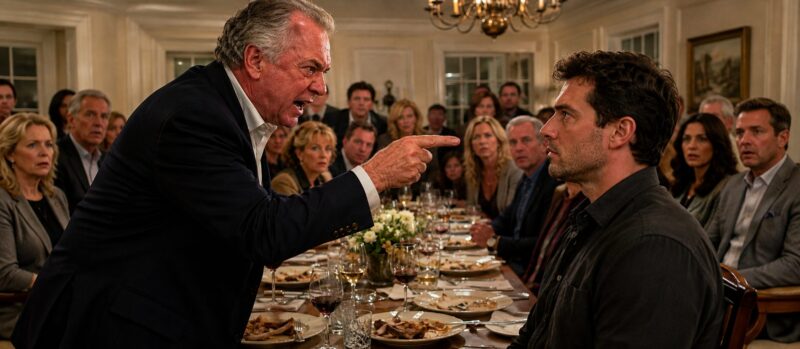
Thirty people were gathered around the long dining table at my parents’ Connecticut home when my father decided to explain why I hadn’t been invited to my sister’s wedding.
He didn’t bother lowering his voice.
“You weren’t important enough to be invited to your sister’s wedding.”
The room went dead silent—so quiet I could hear the ice shifting in someone’s glass.
My name is Ethan Mercer, and I was thirty-two that night. My younger sister, Claire, had married Ryan Cole three weeks earlier at a vineyard outside Napa Valley.
I found out through Instagram.
Not from Claire.
Not from Mom or Dad.
Instagram.
Mom later insisted it had been «small.»
There were 146 guests.
Still, when she called twice begging me to come to Dad’s sixtieth birthday dinner—saying, “Please don’t make this family any more divided than it already is”—I showed up. I even brought Dad a $900 watch.

Now he sat at the head of the table wearing that familiar, smug half-smile while Claire stared down at her napkin.
Several relatives looked uncomfortable. Nobody spoke up for me.
Dad leaned back. “Claire wanted people there who’ve actually been a part of her life.”
My throat tightened.
For six years, I had paid Claire’s health insurance while she freelanced. After a bad breakup in 2022, I covered three months of her rent. When Ryan wanted to launch his construction company, I personally acted as the guarantor for his business line of credit because Dad refused to risk his own money.
Nobody mentioned a word of that.
Dad drove the knife in further. “Sometimes people just need to realize where they stand.”
That was the line that did it.
I took a slow look around the room. Uncle Mark. Aunt Susan. My cousins. Mom. Claire. Ryan. Every single one of them had known about the wedding. Every single one had attended. Some had even posted photos while ignoring my messages asking what was going on.
Then Ryan whispered something to Claire. She let out a small smile. Dad saw it, and his grin widened.
Something inside me went completely calm.
I stood up.
Dad raised an eyebrow. “Leaving already?”
“No.”
I pulled out my phone. Ryan’s smug expression finally flickered into panic.
I opened the banking app for Mercer Development Holdings—the company I had spent nine years building from the ground up while my family let everyone believe Dad had «helped me get started.»
Then I looked directly at Claire.
“I’m canceling every dollar keeping all of you afloat.”
Dad’s smile vanished first.
Ryan shot to his feet so fast his chair screeched against the floor. “What does that mean?”
I turned the phone toward him. “It means your company’s credit guarantee ends Monday.”
Claire turned ghost-white.
Then the color drained from Dad’s face, too. Unlike Claire, he immediately realized Ryan wasn’t the only person at the table whose lifestyle was underwritten by my signature.
“The house,” Mom whispered.
Dad stared at me in disbelief.
I gave a single nod. “Yes.”
Suddenly, the entire room erupted. And for the first time all evening, nobody was ignoring me.
Ryan followed me out into the hallway.
“Ethan, stop.” His hand clamped around my forearm.
I looked down at his grip. He let go instantly.
“This isn’t something you can just cancel because you’re upset.”
“I’m not upset anymore.”
That frightened him far more than if I had started shouting.
Claire appeared behind him. “What are you talking about? What guarantee?”
Ryan didn’t answer. Apparently, she knew even less about her husband’s finances than I thought.
Dad pushed back his chair and stepped into the hall. “Everyone calm down.”
I almost laughed. Dad had spent twenty years using volume as authority. Anyone who disagreed with him was labeled “dramatic,” “ungrateful,” or “too sensitive.”
Now he wanted calm.
“Sit down, Ethan.”
“No.”
His jaw tightened. “There are guests here.”
“There were guests here when you humiliated me.”
“What exactly are you threatening?”
“Nothing. I’m informing you.” I held up my phone. “Ryan’s company owes $380,000 on a revolving line I personally guaranteed. It renews next month and requires my signature. I won’t be signing.”
Ryan went pale. “You said you were staying on for another year.”
“That was before I learned my sister could invite 146 people to her wedding and somehow forget the man guaranteeing her husband’s entire livelihood.”
Claire finally spoke up. “Ethan, the wedding wasn’t about money.”
“Apparently, neither is this.”
Mom whimpered my name.
Then Dad asked the real question everyone was waiting for: “And the house?”
From the street, my parents’ home looked impressive—six bedrooms, a stone facade, a pool, and four sprawling acres. What almost nobody knew was that Dad had refinanced it twice after his commercial real estate investments crashed.
Three years ago, foreclosure proceedings were looming. My company’s property division bought the mortgage, restructured the debt, and set up a private repayment agreement so my parents could stay.
Dad had told the extended family he had «handled it.» What he actually did was call me at 1:14 a.m. begging me to save him.
“The agreement stays as written,” I said. “But the grace period is over. Payments resume September first.”
Mom covered her mouth.
Dad turned bright red. “You wouldn’t throw your own mother out of her home.”
“There it is.”
“What?”
“You make the call, you insult me, and suddenly the consequences are my fault.”
He slammed his hand against the wall. “You think because you have money you can control this family?”
Even Uncle Mark winced from the dining room.
“No, Dad. I think I’ve spent years using my money to protect a family that doesn’t respect me.”
Claire started crying—quietly, the way she had done since childhood. Whenever Dad got angry with her, her tears would shift the focus until someone rescued her or turned into the new target. Usually me.
“Ethan,” she sobbed. “I wanted to invite you.”
I waited.
“But Dad thought—”
“Claire,” Dad snapped.
She froze.
I looked between the two of them. “What did Dad think?”
Silence. Ryan stared at the floor. Mom closed her eyes.
Suddenly, the wedding felt like a small piece of a much larger lie.
I put my phone away. “You have until tomorrow morning.”
Dad narrowed his eyes. “For what?”
“For one person in this room to tell me the real reason I wasn’t invited. Because we both know it wasn’t because I wasn’t ‘important.’”
Claire’s tears stopped instantly. Dad’s expression confirmed it.
There was another reason—and everyone knew enough to keep their mouths shut.
I turned and walked toward the front door.
Dad yelled after me, “If you walk out that door right now, don’t expect to come back!”
I opened the door, then paused and looked over my shoulder. “That threat worked a lot better when you owned the house.”
Nobody followed me outside, but before I even hit the driveway, my phone went crazy with texts, calls, and voicemails.
Then a message from my cousin Natalie made me stop in my tracks:
You need to know what your father told everyone about you before the wedding. None of it was true.
A second text popped up:
I have proof.
Natalie lived twenty minutes away. I told her to meet me at a 24-hour diner off I-95.
When I walked in, she was sitting in a corner booth with an open laptop and an untouched cup of coffee. Natalie was thirty-four, my uncle’s daughter, and one of the few relatives who occasionally stood up to Dad.
Except tonight.
I sat across from her. “You stayed silent.”
She kept her eyes on her mug. “I know.”
“Why?”
“Because I believed him.”
That stung worse than any bad excuse.
“What did he tell you?”
Natalie turned the laptop screen toward me. “Before I show you this, you need to understand something. Claire didn’t originally decide to leave you out.”
I stared at her. “What?”
“Your father did.”
She opened a string of screenshots from a family group chat created four months before the wedding—a chat I wasn’t in, named Claire’s Wedding Family.
Dad had written:
Ethan has been making things difficult again. Claire feels his presence would create unnecessary drama.
Then:
Please don’t bring up wedding plans around him. She wants to avoid a confrontation.
And another:
He’s threatening to pull his financial support from Ryan if Claire doesn’t let him dictate the guest list.
I stared at the screen in disbelief. “None of that ever happened.”
“I know that now.”
“How?”
She pulled up an email chain between Claire and Dad from five months prior.
Claire had written: Dad, I’m inviting Ethan. I don’t care if you two are at odds.
Dad replied: Then understand I won’t be there.
Claire: Why are you forcing me to choose?
Dad: Because he’ll hijack the whole day. He always makes everything about himself.
I almost laughed out loud. Dad had hijacked Claire’s college graduation speech to praise his own parenting. At my thirtieth birthday, he announced his retirement plans before we even got to dessert. At Mom’s charity gala, he threw a fit and swapped the seating charts because he didn’t like his table.
Yet I was the one who made things about myself.
Natalie scrolled further. Dad had claimed I looked down on Ryan, that I planned to embarrass him publicly, and that I had threatened to expose issues with his company during the wedding weekend.
Every single word was a lie.
I had critiqued Ryan’s business once—after he asked me to look at his books. His company was overextended, taking on low-margin projects, and taking out loans just to meet payroll. I gave him straight advice and helped him fix it. Dad had spun that into a weapon.
“Why would he pull something like this?” I asked.
Natalie hesitated. “There’s more.”
She pulled up an email between Dad and Ryan.
Dad wrote: Once Ethan is out of the picture, we can sit down and discuss transitioning those development opportunities we talked about.
I read it twice. “What development opportunities?”
Natalie didn’t know, but the picture was starting to clear.
For eighteen months, Mercer Development Holdings had been quietly negotiating the purchase of several industrial properties in Fairfield County for mixed-use redevelopment. Dad had been in commercial real estate for thirty years; he knew what I was tracking. Six months ago, he had asked me to bring Ryan in on the deal. I refused—Ryan’s company was overleveraged and completely out of its depth for a project that size.
Dad had taken my refusal as a personal slight.
“You think this is all about business?” Natalie asked.
“With my father, everything eventually comes down to business.”
My phone rang. Mom. I rejected it.
Claire. Rejected.
Dad. Sent straight to voicemail.
Natalie leaned in. “There’s one more thing.”
Dad had told the extended family that I was the one who turned down the invitation. His story was that Claire had invited me in private, but I threw a fit and refused to come if Ryan was going to be there.
“That doesn’t even make sense.”
“It didn’t have to,” Natalie said softly. “Nobody bothered to ask you.”
Nobody bothered to ask you.
Thirty relatives at the dinner table. One hundred forty-six wedding guests. Months of planning. And not a single person had picked up the phone to hear my side of the story. They just bought into the easiest narrative.
“What proof do you have that Claire went along with this?”
Natalie’s face fell. She pulled up one last screenshot.
Three weeks before the wedding, Claire had texted her: I feel terrible about Ethan.
Natalie: Then invite him.
Claire: Dad said if I back down now, everyone will think Ethan bullied me into it.
Natalie: Did he?
Claire: No.
I closed the laptop.
There it was. Dad had manipulated her, sure—but three weeks before walking down the aisle, Claire knew I had never threatened anyone. And she still let me take the fall.
Natalie whispered, “I’m so sorry.”

I stood up. “Send me all of it.”
“What are you going to do?”
“Go home.”
“That’s it?”
I checked my watch. 12:07 a.m. “No. I have work in the morning.”
By 9:00 a.m., Ryan had called seventeen times. At 9:22, security pinged me to say he was waiting in the lobby of my Stamford office. I told them to send him up.
He walked into my office looking like he hadn’t slept a wink.
“Claire told me what happened.”
“I was there.”
“You know what I mean.” He slumped into a chair without asking. “Ethan, we have to separate family drama from business.”
“I agree.”
A wave of relief swept over his face. “So the guarantee—”
“Will not be renewed.”
His relief evaporated. “You just said—”
“I said we should separate emotion from business. Business-wise, your debt ratio is a disaster, you’re behind on two major schedules, and your top client is contesting an $80,000 change order.”
Ryan stared at me. “How do you even know about that?”
“I guaranteed your credit line. I inspect the risk.” I leaned back. “If the bank pulls it, you’re in trouble.”
“Trouble? I’m ruined. I’ll have to refinance.”
“Then refinance.”
“Nobody will touch me without collateral!”
“That’s unfortunate.”
His face hardened. “You’re enjoying this, aren’t you?”
“Not at all.” I meant it. I had backed Ryan because Claire loved him, and I wanted them to succeed. “What did my father promise you?”
His eyes shifted. “Nothing.”
“Try again.”
“I don’t know what you’re talking about.”
I spun my monitor around, displaying the email from Dad.
Ryan read it, and the color drained from his face. “Jesus.”
“What development opportunities?”
He stayed silent.
“Last chance, Ryan.”
He swallowed hard. “Your dad said you were moving the company.”
“Where?”
“Florida.”
I let out a dry laugh. “I’ve never once considered moving the company to Florida.”
“He said you were sick of Connecticut taxes and that once you relocated, you’d start liquidating local properties.”
The full scheme hit me. Dad assumed I’d sell off my Connecticut portfolio and was positioning Ryan to sweep in and take over.
“He told you he could hand you my properties?”
“Not hand them over,” Ryan stammered. “Management contracts. Redevelopment work. Referrals.”
“And freezing me out of Claire’s wedding helped how?”
Ryan looked down at his hands. “He said you needed a reality check. That you needed to see the family could operate fine without you.”
There it was. Dad had turned my sister’s wedding into a power play—and it had worked.
For three weeks, I had questioned my own worth, wondering what I had done to deserve being cast aside, wondering if my success had turned me into a stranger to my own family. Dad knew exactly how much that exclusion would cut me.
Ryan leaned forward. “I swear I didn’t know he lied about the invitation.”
“No, but you knew he was trying to isolate me, and you played along.”
Silence.
“We’re done here.” I picked up my desk phone. “Michelle, please have security escort Mr. Cole out.”
Ryan stood up, panic returning. “Ethan, come on. Claire is beside herself.”
“Claire has my number.”
“She’s tried calling!”
“Then she can keep trying.”
At the door, Ryan paused. “For what it’s worth… I told her we should have invited you.”
“For what it’s worth, you still enjoyed the party without me.”
Claire showed up at my apartment that evening. I watched her on the door camera for a long moment before unlocking it.
Her eyes were bloodshot and swollen. “Can I come in?”
I stepped aside. For the first time in her life, she didn’t look like Dad’s golden child. She looked like my little sister—the girl who used to hide in my room during thunderstorms, the teenager who called me to pick her up when parties got out of hand, the college kid who drove three hours to my apartment after failing a midterm because she was terrified of telling Dad.
“I’m sorry,” she whispered.
I said nothing.
She started crying. I waited.
Eventually, she realized the tears weren’t going to bail her out this time.
“I knew Dad was lying,” she admitted.
“I know.”
“Not right away, but… eventually.”
“And you still went along with it.”
Her lip trembled. “Yes.”
“Why?”
She sank onto the edge of the couch. “Everything was spiraling. Dad threatened to boycott the wedding, Mom was having panic attacks, Ryan said we couldn’t afford to lose Dad’s industry connections—”
“Claire.” I cut her off. “Why?”
She looked up at me, finally dropping the excuses. “I was scared of him.”
I believed her. It didn’t make it right, but I believed it.
“He told me if I sided with you, I was turning my back on the family.”
“And you believed that?”
“No.” A tear fell down her cheek. “I just obeyed.”
At least that was honest.
“Do you have any idea what you did?”
“I know—”
“No, you don’t.” I kept my voice measured. “You didn’t just leave me off a guest list. You let Dad drag my name through the mud. You let dozens of our relatives believe I was blackmailing you. You let me find out my only sister got married by scrolling through Instagram.”
She looked away, ashamed.
“And last night, while he sat there telling me I wasn’t important enough, you just sat there.”
Her shoulders shook. “I’m so sorry…”
“You smiled, Claire.”
She buried her face in her hands. “I wasn’t smiling at you! I was just nervous—”
“It doesn’t matter.”
After a long pause, she looked up. “Are you really going to ruin Ryan’s business?”
“I’m going to make Ryan’s business Ryan’s problem.”
“And Mom and Dad?”
“The mortgage terms stand.”
“Dad says you’re kicking them out!”
“Dad lies,” I said flatly. “I’m not evicting anyone. I’m simply ending the payment holiday I granted them after his surgery. They owe what the contract states.”
“He can’t afford that right now!”
“Then they can downsize.”
“That house has been in our family for twenty-three years!”
“And my company has carried the mortgage for three.”
She had no counter to that.
“I didn’t buy control over this family, Claire,” I said softly. “I spent years shielding all of you from the consequences of your own choices.”
Ryan’s reckless expansion. Dad’s failed investments. Her health insurance. Every time someone stumbled, I was the net that caught them.
Claire wiped her eyes. “Where does this leave us?”
I knew she wasn’t talking about money.
“I don’t know.”
“I love you, Ethan.”
“I love you too.”
She looked momentarily relieved, but I continued: “Love doesn’t fix broken trust. You chose Dad because you were more afraid of making him mad than breaking my heart. Until that changes, nothing else will.”
At the door, she turned around. “Dad’s telling everyone you’re destroying the family.”
“Of course he is.”
“What am I supposed to tell them?”
“Try telling them the truth for once.”
Dad lasted four days before barging into my office without an appointment. He walked in with the unearned confidence of a man who assumed every situation would eventually bend to his will.
“You’ve made your point.”
“What point is that?”
“This little retaliation.”
“It’s not retaliation. It’s business.”
He threw the mortgage agreement onto my desk. “You honestly expect me to pay this?”
“You signed it.”
“I’m your father!”
“And?”
His jaw clenched. “I built the foundation for everything you have!”
There it was. Dad had introduced me to my first employer right out of college—that part was true. In his mind, that single introduction meant he created my entire career. He completely erased the nine years that followed: the eighty-hour workweeks, my first business failing, picking myself back up, finding my own investors, negotiating deals, building a team.
“You introduced me to Martin Shaw,” I said.
“Damned right I did.”
“And I thanked you.”
“You owe me a hell of a lot more than a thank you!”
“What exactly do I owe you, Dad?”
He opened his mouth, but nothing came out. An invisible, undefined debt was a convenient tool—because it meant you could never finish paying it off.
“I gave you opportunities,” he muttered.
“And over the last six years, I’ve given you $1.8 million in financial support.”
His eyes widened. I slid a printout across the desk.
Mortgage bailouts. Medical bills. Tax debt settlements. Home repairs. Insurance coverage. Loans that magically turned into gifts.
Dad stared at the grand total. “That’s what family does.”
“Exactly. So why are you keeping score?”
He flushed. “You humiliated me in front of everyone!”
“You told thirty people I wasn’t important enough to attend my sister’s wedding.”
“That was different!”
“How?”
“I was angry!”
“So was I.”
“I am your father!”
When I was sixteen, that phrase was absolute authority. At thirty-two, it just sounded desperate.
“You are,” I said calmly. “But you don’t own me.”
He stood up, towering over the desk. “You’re going to regret this.”
“Maybe.”
“You think anyone in that room respects you now?”
“I’m not doing this for their respect.”
“They’re going to say you abandoned your family.”
“Some of them already are.”
“And you don’t care?”
I thought about it for a moment. “I cared so much that I let all of you step on me for years.”
For a second, Dad looked lost. But he quickly recovered. “Your mother will never forgive you if we lose that house.”
“That’s between Mom and me.”
He reached for the door handle.
“Dad.”
He paused without turning around.
“You were wrong about one thing.”
“What’s that?”
“I did understand where I stood.” I looked him dead in the eye. “I just finally stopped standing there.”
He walked out without another word.
My parents sold the house four months later.
They didn’t end up on the street—they bought a nice three-bedroom townhouse ten minutes away for $740,000. Dad, predictably, continued telling relatives I had forced them into poverty.
Ryan refinanced his company through a regional bank at a much higher interest rate. He sold his boat and laid off two administrative staff members. Surprisingly, without my financial safety net to lean on, his business actually stabilized because he stopped taking on projects he couldn’t handle.
Claire started going to therapy. For months, our relationship was limited to the occasional text message. There was no big, cinematic reconciliation. She apologized repeatedly, but eventually stopped asking if I had forgiven her—which meant more to me than the apologies ever did.
Mom and I managed to heal things much faster. She admitted she knew Dad was manipulating the situation, but confessed that «keeping the peace» had become her survival mechanism after decades of marriage. I told her that any peace requiring one person to take all the damage isn’t peace at all. She cried, but she agreed.
Dad and I barely spoke for a year. Some relatives took his side; Aunt Susan claimed money had «changed» me. Uncle Mark later privately admitted that Dad had borrowed $40,000 from him, too, and never paid it back.
Natalie became one of my closest confidantes.
Then, on the one-year anniversary of Claire’s wedding, she came over to my apartment carrying a small box. Inside was an old framed photo: Claire was seventeen, I was twenty-one, and we were standing behind the bride at our cousin’s wedding in Maryland, making ridiculous faces at the camera.
On the back, Claire had written: I should have remembered who always showed up, even before anyone asked.
I stared at the picture for a long time.
“I don’t expect this to make everything okay,” she said quietly.
“It doesn’t.”
“I know.”
I walked over and placed the frame on my bookshelf. “You can stay for dinner, though.”
A small, genuine smile broke across her face. “Okay.”
It wasn’t instant forgiveness—not yet. But it was real. And reality was far better than the fake family dynamic Dad had spent years enforcing.
The strangest part was realizing that walking away from my family hadn’t ruined my life. There had never actually been a place for me at that table—only a role: the reliable son, the endless checkbook, the scapegoat who was expected to swallow every insult and still pick up the phone when they needed something.
Once I stopped playing that role, the conditional relationships evaporated, while the genuine ones slowly found their way back.
Eighteen months after that fateful dinner, Dad finally called me.
He didn’t explicitly apologize, but he did say, “I could have handled Claire’s wedding better.”
For my father, that was as close to a confession as I’d ever get.
“Yes,” I said. “You could have.”
He waited for me to make the moment comfortable for him. I stayed quiet.
After a long pause, he asked, “Do you want to grab a coffee sometime?”
“Sure,” I replied.
Not because everything was magically fixed, but because setting boundaries had finally given me a choice.
That was the lesson Dad missed when he tried to put me in my place. He thought locking me out would make me beg for a seat at his table.
Instead, it taught me how to build my own.