When I broke my arm, I thought the hardest part would be caring for my five-month-old twins while I healed. I was wrong. The real painful part was realizing how little my husband understood about everything I carried every day, and how far I’d have to go to make him see it.
“Brianna?”
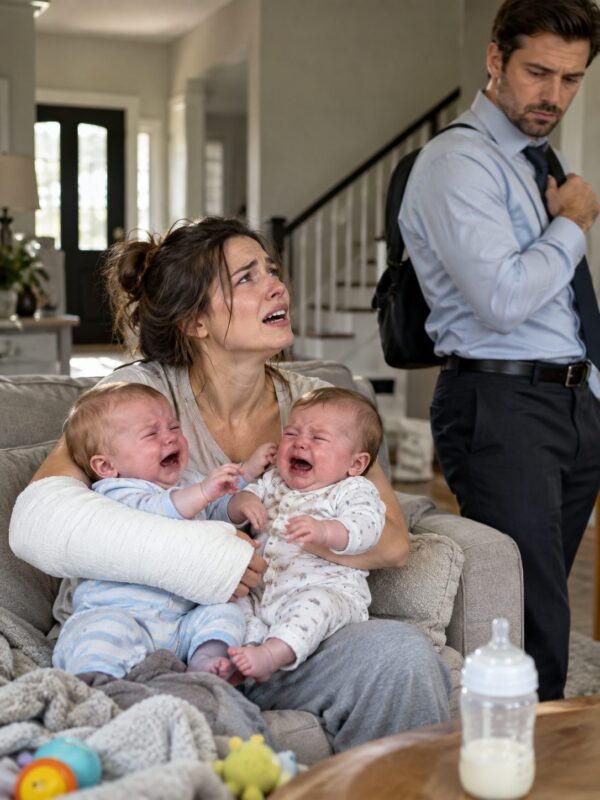
I didn’t answer right away. Mason stood in the doorway of my mother’s living room, staring at Liam in her arms, Noah in mine, and the diaper bag I had packed for more than a single night. His face fell the moment he took in the scene.
“Brianna?” he asked again, his tone tightening. “Why are the boys staying here?”
I looked him dead in the eye, dropping all pretense. “Because my arm is broken, Mason.”
“I know that,” he snapped back.
“Clearly, you don’t,” I replied, keeping my voice steady. “You don’t even understand that I need help.”
Mason blinked, glancing around before circling back to his main question. “Why are the boys staying here?”
His eyes flicked to the folded sheet of paper sitting on the coffee table. It was the exact schedule he had refused to follow the night before. He looked back at me, his brows pulling together in disbelief.
“You took my kids and left?” he asked.
“Our kids,” I corrected softly.
“Bring them home,” he demanded.
“No.”
“You took my kids and left?” he repeated, his anger flaring. He took a step forward, jaw tight. “Brianna.”
“No,” I said firmly.
For five months, I had spent every single day solving problems before Mason even noticed they existed. Then I broke my arm, and for the first time, I couldn’t carry his half of the load anymore.
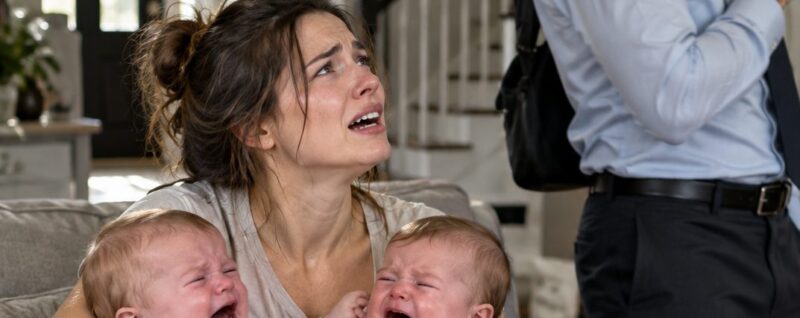
Two days before I moved into my mom’s place, I was sitting on the nursery floor trying to button Liam’s sleeper with my left hand. My right arm was completely trapped in a heavy white cast. Behind me on the play mat, Noah was starting to fuss, and my tea sat cold and untouched on the changing table.
Mason walked in, stepped right over a basket of laundry, and loosened his tie. “What’s for dinner, Brianna?”
I stopped fumbling with the tiny metal snaps. “My arm is broken.”
He glanced down at the cast for a brief second. “I know.”
I waited for him to offer an alternative, but he just stood there. “What’s for dinner?” he asked again.
“So?” I said.
“So what?”
I stared up at him from the floor. “I was hoping you’d remember what kitchens are for—or at least figure out how takeout works.”
He didn’t find my sarcasm funny. “I worked ten hours today.”
“So what?” I shot back. “I fell down the stairs yesterday.”
The doctor had put my arm in a cast and explicitly warned me not to lift Liam or Noah while it healed. I looked toward Noah, who was kicking his legs harder now.
“Can you pick him up?” I asked softly.
Mason checked his phone without moving. “I haven’t even changed yet.”
“I fell down the stairs yesterday,” I reminded him.
“He doesn’t care what you’re wearing,” Mason snapped.
“Mason, please.”
“What? I just got home.”
“So did you stop being their father the second you pulled into the driveway?”
His mouth tightened into a thin line. “I just got home. I pay the bills.”
“And?” I pressed.
“And I’m not coming home to start another shift.”
That word hung heavy in the air. Another shift. Like fatherhood was nothing more than unpaid overtime.
“I pay the bills,” he reiterated, as if that settled everything.
“I need help for a few weeks,” I said, keeping my voice level. “Come home an hour earlier when you can. Take a day off if you have one. See if you can work from home once in a while.”
“I have a job,” he said defensively.
“So did I before maternity leave,” I replied.
“Exactly,” Mason countered instantly. “You’re home now.”
“With two babies.”
“You’re better at this anyway,” he said, waving a dismissive hand toward the nursery.
“I’m better at it because I’m the one doing it!”
Noah started crying harder in the corner. Mason let out a heavy sigh, as if the noise were a personal insult.
“Can’t you just handle him?”
“With one arm?”
“You have another one,” he blurted out.
I went dead silent, staring at him in utter disbelief. He just shrugged.
“You’re the one who wanted kids,” he muttered.
My head snapped up. “We wanted them. You were showing me nursery designs before I was even pregnant!”
“You know what I mean,” he grumbled.
“No, I don’t, Mason,” I said, feeling tears prick my eyes. “I don’t even know who you are right now.”
He rubbed his forehead with his palm. “I’m exhausted, Brianna. Moms don’t get sick days.”
I looked down at my cast. “I’m injured.”
“That’s not my problem,” he said flatly. He turned around and walked straight out of the nursery.
Noah kept crying, and Liam reached out, grabbing the rough edge of my cast with his tiny hands. I gently freed myself from his grip and whispered, “Okay. I’ve got you.”
I had been telling myself I was fine and keeping it together for far too long.
My mom, Nora, came over the very next afternoon. She found me frantically wiping spilled formula off the kitchen counter with my good hand while Liam kicked in his bouncer.
“Brianna,” she said gently from the doorway.
“I’m almost done,” I muttered, scrubbing harder.
She walked over and took the cloth right out of my hand. “Sit.”
“Mom, the counter is sticky.”
“It’ll still be sticky in five minutes,” she said firmly.
I collapsed into a chair at the table. She opened the microwave and found my mug. “You reheated this already?”
“Twice,” I admitted.
Mom knew I cleaned frantically whenever I was drowning. She dumped the lukewarm tea, brewed a fresh cup, and set it in front of me.
“Where’s Mason?” she asked casually.
“Work.”
“And when he gets home?”
“He’ll be tired, obviously.”
Mom gave me a long, knowing look over the counter. I took a slow sip.
“I’m fine,” I added.
“There’s that voice you use when you’re lying to me,” she said softly.
I looked away. Mom didn’t lecture me. Instead, she stepped right in—helping with the boys, washing dirty bottles, making dinner, and only leaving after everything was taken care of.
That night, Noah woke up crying first, quickly followed by Liam. I nudged Mason with my knee.
“Can you take Liam?”
He rolled onto his stomach, burying his face in his pillow. “I have work.”
“So?”
“I have to be up in four hours,” he mumbled.
Liam’s cries grew louder down the hall.
“So do I,” I said.
Silence filled the room. Then Mason spoke, his voice dropping into a desperate, furious whisper. “You’re humiliating me.”
That was the moment I finally saw his entire worldview for what it was.
“You weren’t embarrassed when you said it,” I reminded him.
“What?”
“You weren’t embarrassed when I was begging you for help,” I said firmly. “You’re just embarrassed that someone else might find out.”
My hand was shaking so badly I had to end the call right there. Mom noticed the tension in my shoulders immediately and reached toward my lap.
“Give him to me,” she said, pointing to Noah.
“I can hold him,” I insisted out of habit.
“I know you can,” she said quietly.
Hearing “I know you can” instead of “You can’t” broke something open inside me. I took a deep breath and handed him over.
Mason showed up at my mom’s front door the very next evening, looking furious.
“My mother called me,” he said abruptly the second I stepped onto the porch. “She wanted to drop by and see you and the boys, so I had to tell her you weren’t home.”
“And?”
“She asked why,” he muttered, rubbing the back of his neck.
“What did you tell her?”
“The truth, apparently.”
I was genuinely surprised. Mason glanced past my shoulder into the living room.
“She asked if I’d been helping you since you broke your arm.”
“What did you say?”
“I told her you were home with the boys and I was at work all day.”
I stood there, waiting for the rest. Mason shifted uncomfortably, unable to meet my eyes.
“Then she asked why you had to leave your own house just to get help,” he admitted softly.
“And what did you tell her?”
“Nothing.”
“Why not?”
His jaw worked. “Because I knew how it sounded.”
Before I could reply, Noah started crying inside. Mason instinctively turned toward me, panic flaring in his eyes. “Brianna?”
I stayed planted on the porch step. “You’ve got him.”
“I don’t know what he wants!”
“Neither do I yet.”
“You usually know,” he argued.
“No, I usually figure it out.”
He hesitated for a long moment before stepping inside and lifting Noah from his crib. The crying instantly got louder and sharper.
“See?” Mason called out, frustrated. “I’m making it worse!”
“You’ve been holding him for ten seconds,” I said, walking in slowly.
“What do I do?” he asked frantically.
A dozen quick instructions rushed to my mind, but I forced myself to stay quiet. “Start paying attention.”
He began pacing across the carpet far too quickly, which only made Noah cry harder against his chest. Catching himself, Mason slowed down, settling into a gentle, rhythmic sway. Within a minute, Noah’s crying died down to soft whimpers.
“He stopped,” Mason said, sounding stunned.
“Yeah.”
Mason looked down at the tiny baby in his arms. “You make this look so easy.”
“You told me I do nothing all day,” I reminded him quietly.
“I know,” he whispered, lowering his head.
“Why did you say that, Mason?”
He swallowed hard, his shoulders slumping. “Because every time I came home, you already knew what they needed, and I didn’t.”
“You could’ve learned.”
“I know.”
“Then why didn’t you?”
His voice dropped to a whisper. “Because I felt useless. Every time you asked for help, it just reminded me that I didn’t know what I was doing.”
“So you wanted me to stop asking.”
He nodded slowly, watching Noah curl a tiny fist into his shirt.
“Feeling insecure doesn’t excuse the way you treated me,” I said firmly.
“I know.”
For five long months, I had wanted nothing more than to see Mason hold our son like that—with quiet, present care. And now he finally was.
A few days later, Mason sent me a picture of our sparkling, immaculate kitchen counters at home.
“Cleaned everything. Come home?” the text read.
I looked at the screen for a moment, then typed back: “What time does Noah usually take his last bottle?”
The typing dots appeared, stopped, appeared again, and then vanished. No answer came.
That evening, Mason drove straight over to my mom’s.
“What do you want me to do, Brianna?” he asked as soon as he walked in.
“I want you to stop waiting for instructions,” I said simply.
“I’m trying!” he said, sounding exhausted.
“Then try without making me your manager.”
He sat down across from me. “I cleaned the whole house, Brianna. I really thought you’d be happy about that.”
“I’d be much happier if you knew why Noah cries differently than Liam.”
Mason looked down at his hands. “Then teach me.”
I almost gave in right then. The old me would have grabbed a notepad and made another detailed checklist. Instead, I shook my head.
“No,” I said softly. “Watch them. Learn them. Be here long enough to actually know them.”
His face fell. “What if I mess up?”
“You will.”
He looked up, caught off guard.
“So do I,” I added gently.
I looked down at the heavy plaster cast wrapping my arm. “I’ve spent weeks feeling like a failure because I can’t even lift my own babies.”
“Brianna—”
“Let me finish,” I said, stopping him. “When this cast comes off, I get another chance to feel like their mother again. You can have a second chance, too.”
Mason leaned in. “At us?”
“At being better than you’ve been,” I clarified, meeting his gaze. “But I’m not going to drag you there.”
Over the next few weeks, Mason started stepping up without being asked. He left work on time twice a week, added the twins’ doctor appointments to his work calendar, and learned through trial and error that Liam liked to be held snug against his chest, while Noah needed a constant bounce to fall asleep. He still messed up sometimes, but I stopped stepping in to fix everything for him.
Three weeks later, my arm was healing well, so I brought a few things back to our house. But I didn’t bring everything, and Mason noticed the extra bags right away.
“You’re leaving clothes at your mom’s?” he asked carefully.
“Yes.”
“Because you don’t trust me?”
“Because I’m learning to trust myself,” I said calmly. “If things ever fall apart like that again, I’m not going to wait until I’m completely broken to protect myself.”
Late that night, Noah started crying from the nursery down the hall. Out of habit, I started to sit up, cradling my healing arm close.
Before I could even get out of bed, Mason threw off the covers. “I’ve got him,” he said smoothly. “That’s his tired cry.”
He disappeared down the dark hallway. A minute later, the crying stopped completely.
I reached over to the nightstand and picked up my mug of tea. It was still hot.
For months, I thought being a good mother meant carrying every single load alone until I snapped. It took a broken arm to realize the truth: good mothers don’t have to prove how much pain they can endure—and fathers shouldn’t have to be begged to be fathers.