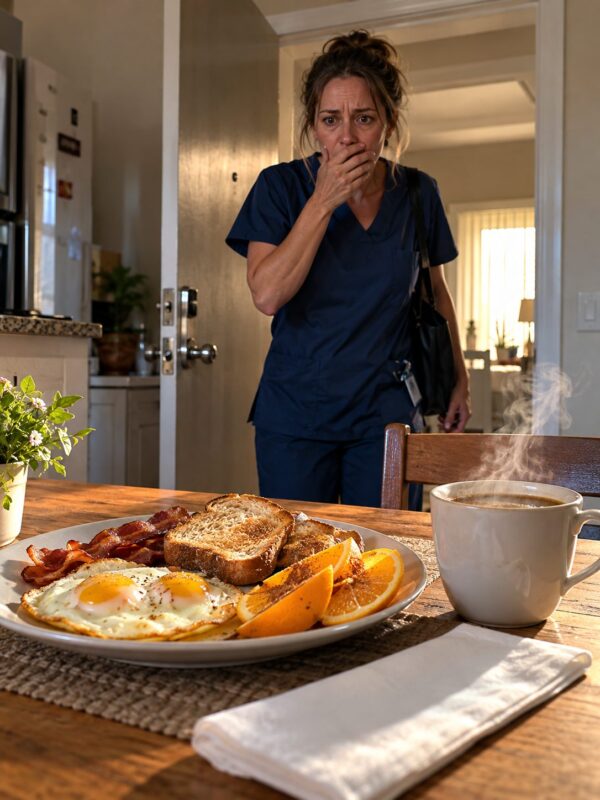
For seven mornings in a row, I returned from my night shift to a warm breakfast waiting on my table.
A fresh plate. Hot coffee. Food prepared precisely the way I liked it.
And every single morning, the same terrifying truth hung over me: I lived completely alone.
The hospital had become my whole world after I lost everything. I had structured my entire life around long, exhausting shifts, a quiet apartment, and a strict routine that required almost no human interaction.
I thought I had finally buried the past. Then someone found a way to drag it right back into my home.
My dashboard clock read 5:47 a.m. when I pulled into my building’s parking lot. My nurse’s badge was still clipped to my scrubs. Twelve-hour shifts, six nights a week, for fifteen long years—that was the exact shape of my life. Painfully small on purpose, because small felt safe.
My phone buzzed in my pocket as I got out of the car. I didn’t even need to look to know what the screen said: a Michigan area code. It was the second time that week.
«Not today,» I muttered to no one. «Not ever.»
Inside the foyer, the mail table held its usual clutter of grocery flyers and credit card offers. But something in my slot caught my eye—a forwarded envelope. The cramped handwriting across the front felt deeply, uncomfortably familiar.
A Michigan postmark was stamped across the top. I left it sitting there, telling myself I’d deal with it later. I didn’t.
On the second-floor landing, I passed the small window overlooking the corner bodega and its outdoor fruit stand. Just like that, I wasn’t in my hallway anymore. I was somewhere else—somewhere a lifetime away.
I heard Bobby’s laugh. I was back in a kitchen three states away, pregnant with our son Gordon, eating my third pear of the afternoon at the sink and refusing to apologize for it.
I hadn’t bought a pear in fifteen years. I hadn’t said my ex-husband Bobby’s name out loud in almost as long. Or Marianne’s—his older sister. The woman who lived just a mile from that riverbank, yet never picked up the phone after the accident. She never sent flowers. She never called. She simply vanished from my life.
I kept walking up the stairs, letting the memory of Gordon wash over me, because eventually, it always did.
My son was six years old when the car went through the ice. Bobby was behind the wheel. He made it out alive; my little boy did not. Divers searched for three agonizing days—three days of praying and convincing myself they would find him. When they finally called off the search, an officer with kind eyes told me the current must have carried his body away.
There was no funeral. No grave to visit. Just a death certificate I kept folded inside a shoebox on the top shelf of my closet.
Our marriage lasted exactly six more months before I signed the divorce papers, packed my life into an old Honda, and drove three states away. I wanted to start over where no one knew my name or my tragedy. My marriage hadn’t survived the crushing guilt.
I had no family here, no close friends with spare keys, and certainly no partner. That was the deal I made with the world: Stay small. Stay quiet. Stay alive.
Which is why what happened that Monday terrified me.
On the third-floor landing, I fished my keys out of their hiding place. The hallway smelled faintly of my landlord Mr. Ramirez’s Sunday cooking. I unlocked the door, pushed it open, and completely froze.
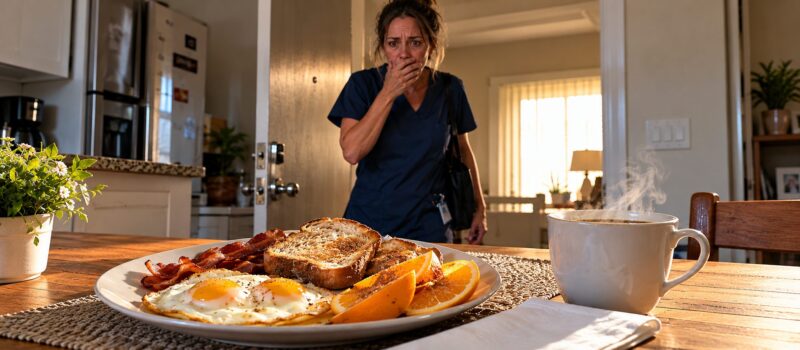
The apartment I had left empty twelve hours earlier smelled unmistakably of freshly brewed coffee.
At first, I told myself the scent was drifting in from another unit. But the second I stepped into my kitchen, my heart stopped.
A single breakfast plate was set on the table.
There were warm eggs and hot coffee in my chipped blue mug, clouded with a splash of oat milk. I took a cautious sip—two sugars, exactly how I’d taken it for years. Orange slices were fanned across the plate, lightly dusted with a pinch of cinnamon—a peculiar little habit I thought was entirely my own.
Folded beside the fork was a plain white napkin. Across it, written in careful, unfamiliar handwriting, were two words:
«Take care.»
I didn’t move for a full minute. I listened intently. No footsteps. No running water. No breathing. Just the hum of the refrigerator.
«Hello?» My voice came out as a thin whisper.
I checked the bathroom, the closet, behind the shower curtain. The windows were all locked tight. I called Mr. Ramirez before I even took off my coat.
«Did someone accidentally enter the wrong apartment?» I asked.
«Nobody else has a key, Maureen,» he replied. «Do you want me to come up?»
«No. No… I’m just checking.»
«Are you sure? You sound off.»
«I’m sure.»
After hanging up, I stood at the counter staring at breakfast I hadn’t made. Resting on the stack of mail I’d dropped beside the toaster was that envelope with the Michigan postmark. I shoved it into the junk drawer without opening it, but not before noticing the postmark date: Thursday—days before the first breakfast appeared.
I called a locksmith, but the earliest appointment was Sunday.
«Nothing sooner?» I pleaded.
«Ma’am, it’s a crazy week for us. If a slot opens up, I’ll call you.»
Desperate, I drove to the hardware store, bought a deadbolt, and tried installing it myself. I couldn’t figure it out, and I was simply too exhausted to care.
Tuesday morning brought homemade blueberry pancakes.
Wednesday brought a mushroom omelet—the mushrooms sliced paper-thin, exactly how I liked them.
Thursday was French toast.
Every morning, I walked through my front door braced for horror. Every morning, it was just breakfast. That was the most terrifying part. A burglar would have made a mess, stolen something, or broken a lock. But this intruder wasn’t behaving like a criminal.
They knew I liked two sugars. They knew I drank oat milk. They knew about the thin mushrooms and the cinnamon on my oranges. Every meal was tailored precisely to my tastes.
I sank onto the kitchen tile and sobbed—the first time I had cried in over a year. Then I got furious with myself for breaking down.
My phone lit up again. Michigan area code. I declined the call.
At the hospital on Thursday night, my coworker Kelly caught me by the medication cart. «Hey,» she said softly. «Some guy called the switchboard yesterday asking for you.»
I set the chart down very carefully. «What guy?»
«He didn’t leave a name. Sounded older, real careful with his words.» She frowned at me. «Maureen, are you okay?»
«What did you tell him?»
«That I couldn’t confirm staff—standard protocol.» She paused, her voice dropping. «Seriously, Maureen. Call the police.»
«I will,» I lied.
In the break room, I got as far as typing 911 into my screen, but my thumb froze. How could I explain it? Someone was breaking in to make me breakfast. Someone was calling my job. Someone knew my routine, and I had zero proof. I cleared the screen and went back to my floor.
Friday morning brought another warm meal. I walked straight to the kitchen, pulled the Michigan letter from the junk drawer, and saw Bobby’s handwriting on the return address.
I stared at it. Reading that letter meant opening a door to the past, and I already had one door in my life I couldn’t keep shut. I dropped the envelope into the sink, struck a match, and set the paper ablaze. I watched it burn to ash and told myself that was the end of it.
It wasn’t.
That same afternoon, I hid a small security camera on top of the refrigerator. If someone was coming inside, I was going to get proof.
Saturday morning, I returned from my shift. Breakfast was waiting on the counter.
My heart pounded as I went to check the feed, only to find the camera completely unplugged and wiped clean. Whoever was doing this had found the device and erased everything.
I stared at the black screen for a long time. Then I called in sick for my next shift. I was done being confused; I was terrified.
That night, I didn’t sleep. Instead, I hid in the dark utility alcove across the hall from my apartment. The building was silent. The city was still. I waited.
Just after sunrise, I saw movement.
A shadow moved down the hall, and someone quietly inserted a key into my lock. My heart practically stopped.
A young man stepped into the doorway, a paper grocery bag tucked against his hip.
I stepped out from the shadows holding a baseball bat and flicked on the hallway light. «Don’t move!»
He froze, the bag slipping down his arm before he caught it against his chest. He turned around, and my knees nearly buckled.
He had Bobby’s eyes. My mother’s mouth.
I screamed.
The young man didn’t run. Instead, he said my name softly, like a word he had been practicing for weeks.
«I’m sorry,» he whispered. «I kept rehearsing how to knock, but I just… couldn’t do it.»
I gripped the doorframe to steady myself. «Letting yourself into a stranger’s apartment for a week isn’t a smart move!»
He didn’t flinch. «I thought making breakfast was softer than a cold knock on the door.» He swallowed hard. «I was afraid if I knocked, you’d slam the door in my face before I could explain.»
«Well, you terrified me!»
«I know. I’m sorry.»
«Get out,» I rasped. «Leave the bag and the key on the counter. I need you to leave.»
He nodded once, placed the grocery bag on the counter, and set a small brass key beside it. Then he walked past me, pulled the door shut, and headed down the stairs.
I stood frozen for what felt like an eternity. Finally, I reached out and picked up the key—it was still warm from his hand. I put it down, then picked it up again.
Slowly, I looked at the grocery bag. The top was rolled down twice and creased perfectly flat. I knew that exact fold—I used to pack lunch sacks that way for a six-year-old boy who insisted on carrying his own bag to preschool.
My hands began to shake as I opened it.
Inside was a waxed-paper packet of orange slices dusted with cinnamon, alongside a single ripe pear. Tucked between them was a napkin folded into quarters.
Unfolding it, I saw a single word written in blue ink: «Mama-bee.»
My breath caught in my throat. I hadn’t bought pears in fifteen years. No one in my current life knew about pears. No one knew that silly nickname. Not Marianne, not anyone. It belonged strictly to a sunlit kitchen in Michigan—Bobby laughing at me over the sink before our baby was even born.
Strangely, my hands stopped shaking.
I stared at the open doorway, and suddenly I understood why I hadn’t called the police, why I had let him walk away. I was the one who got to decide what happened next. Not Bobby. Not Marianne. Me.
I bolted out the door, taking the stairs two at a time in my scrubs.
I caught up with the young man outside standing near the crosswalk, his hands shoved deep in his pockets, looking utterly lost.
«Come back,» I called out.
He turned around.
«Come upstairs,» I said, my voice steady. «We’re going to sit down and talk.»
His eyes widened, and he stared down at his hands. Something inside him seemed to break. «I didn’t realize how terrifying it was,» he said softly, «until I saw your face in that doorway. I am so sorry for every morning you came home scared.»
«Come back upstairs,» I repeated.
Back in my kitchen, he sat where I pointed, holding a cup of coffee with both hands. For a long time, neither of us spoke.
Finally, he looked up at me. «My name is Gordon.»
My chest shattered. Gordon. My son’s name—the name I had carried like a wound for fifteen years.
He told me about Marianne. She had raised him, but she had passed away six months ago. While going through her belongings, he found a sealed letter addressed to him, containing my name and current address. He explained that he had grown up believing I was dead.
To prove it, he pushed up his eyebrow with his thumb, showing me a tiny, faint scar. I stared at it—the exact scar my little boy got at age four after falling off the porch. I had kissed that exact spot to make it better.
Then he pulled a laminated, faded photograph from his wallet. It showed me holding him as a toddler on my hip at the beach—a picture I hadn’t seen in decades.
«The napkin,» I whispered. «Mama-bee.»
Gordon nodded. «Marianne’s letter mentioned that word. She said you were the only person who ever called me that.»
«How?» I stammered, tears streaming down my face. «Gordon, how did you get in here?»
«The key,» he said gently. «I sat in my car across the street for four days watching you. On Tuesday, I followed you up and saw you reach along the top of the doorframe to hide your key. The next day, after you left for work, I checked the spot… and the key dropped right into my palm.»
I closed my eyes in disbelief. Fifteen years in this building, and I had never once changed that hiding spot—a habit Bobby had taught me back in Michigan.
«A friend of mine is a locksmith,» Gordon continued. «He made a copy for me before I put your original key back. The rest of the details were in Marianne’s letter.»
He reached into his jacket. «I brought it with me. But before I came here, Mom… I called Dad.»
My heart stopped.
«I needed to talk to him before facing you,» Gordon said, his voice trembling. «He knew I was coming. He knew I found you. I think those phone calls to you were him trying to warn you—or stop me.»
He slid the letter across the table. «Dad knew everything. Please read it.»
I refilled our mugs while Gordon carefully smoothed the letter flat on the table, pressing open each fold with the side of his hand.
«Dad knew,» Gordon repeated quietly.
Then he began to read, and I forced myself to hear every single word.
The truth was far more monstrous than anything I had imagined.
Bobby had been drinking on that terrible day. After the car went into the river, drunk and consumed by overwhelming guilt, he dragged our son from the wreckage and called his sister.
Gordon hadn’t drowned. He had survived.
Panicked and unfit to face what he’d done, Bobby begged Marianne to take the boy, claiming he couldn’t bear to raise him alone. When the police arrived, Bobby lied and told them the icy current had carried our son away.
I stared blindly at the table. Fifteen years. Fifteen years spent mourning a child who was alive. Fifteen years believing there was no grave because the river had stolen him.
«Dad told Marianne that you died a few years after the accident,» Gordon explained, his voice breaking. «My aunt raised me believing that. Dad visited as ‘Uncle Danny’ for birthdays and holidays. He was… kind enough to me, I guess.»
We sat in heavy silence as the reality settled between us. Then we spent the rest of the day talking. We talked about Michigan, about Marianne, about his childhood, about Bobby, and about all the lost years. We talked until the sun went down and there was nothing left to say.
Two days later, Gordon and I drove to a diner halfway between our cities to meet Bobby.
When we arrived, my ex-husband couldn’t even lift his eyes from his coffee cup.
«I thought he was safer with her, Maureen,» Bobby stammered, his hands trembling. «I was going to tell you. Every single year I thought, ‘This is the year I tell her.'»
I stared at him with cold detachment. «You allowed your son to grow up thinking you were a distant uncle, while letting me believe he was dead? All because you had a drinking problem?»
«You weren’t well after the accident!» he pleaded, finally looking up. «If I had told you the truth in that hospital, it would have destroyed you. You wouldn’t have survived it.»
I felt the last remnants of my past heartbreak burn away into pure anger.
Before I could speak, Gordon leaned forward. «Look at me, Dad.»
Bobby’s eyes shifted to his son.
«Say out loud to me right now why you never told me the truth,» Gordon demanded.
My ex-husband opened his mouth, but no sound came out.
I looked Bobby in the eye and told him I would be taking legal action for what he had done, and that he was never to come near Gordon again unless our son explicitly chose it.
Then we stood up and walked out, never looking back.
Weeks later, I woke up before my alarm sounded. For the first time in fifteen years, I didn’t feel that crushing heaviness in my chest when I opened my eyes.
Gordon was fast asleep on the pull-out couch in the living room, home from college for the weekend. My son—alive, safe, and under my roof.
I walked into the kitchen and prepared two plates: orange slices sprinkled with cinnamon, and hot coffee with two sugars and oat milk. I folded a white napkin beside his mug and wrote five words across it:
«I’m glad you took care.»
I sat down across from the empty chair in the quiet apartment. For years, I believed that cold silence was the only way I could survive—that staying small meant staying safe. I had built a solitary life out of avoiding memories, avoiding people, avoiding Michigan, and avoiding the name Gordon.
But that morning, I wasn’t afraid anymore. I wasn’t alone, and I was no longer running from the past.
My son was sleeping in the next room. The coffee was warm. Breakfast was ready.
For the first time in fifteen years, I wasn’t returning home to an empty life. I was coming home to my son—and for once, I was in no rush for the morning to end.