Lily went to bed complaining of a headache.
Nothing about that evening suggested my life was about to become a living nightmare. She had eaten half a grilled cheese sandwich, turned her nose up at tomato soup because it smelled weird, and curled up beside me under the faded yellow blanket she’d loved since kindergarten.
At nine-thirty, I checked her temperature: 101.8°F.
I gave her the fever reducer our pediatrician recommended, brought her a glass of water, and stayed by her side while she whimpered that the hallway light was hurting her eyes.
By midnight, her fever spiked past 104°F.
At 12:26 a.m., she threw up.
At 12:41 a.m., she could barely sit upright.
At 12:53 a.m., she sobbed when I gently asked her to tuck her chin toward her chest.
My blood ran cold.
I immediately called the pediatrician’s after-hours line. The triage nurse listened for less than thirty seconds before cutting in: «Mrs. Vance, take her to the emergency room right now.»
I threw on clothes over my pajamas, wrapped Lily in her winter coat, and carried her barefoot out to the garage because her legs were too weak to stand. She weighed forty-seven pounds. I remembered the exact number because six months earlier, she’d proudly stood on our bathroom scale and shouted, «I’m almost fifty pounds, Mommy!»
That night, those forty-seven pounds felt impossibly heavy.
At the hospital outside Chicago, everything happened in a blur. A nurse rushed Lily out of my arms. A doctor began firing questions. Another nurse sliced open her pajama sleeve to start an IV. Someone mentioned a lumbar puncture. Someone else whispered bacterial meningitis.
Then came the ICU.
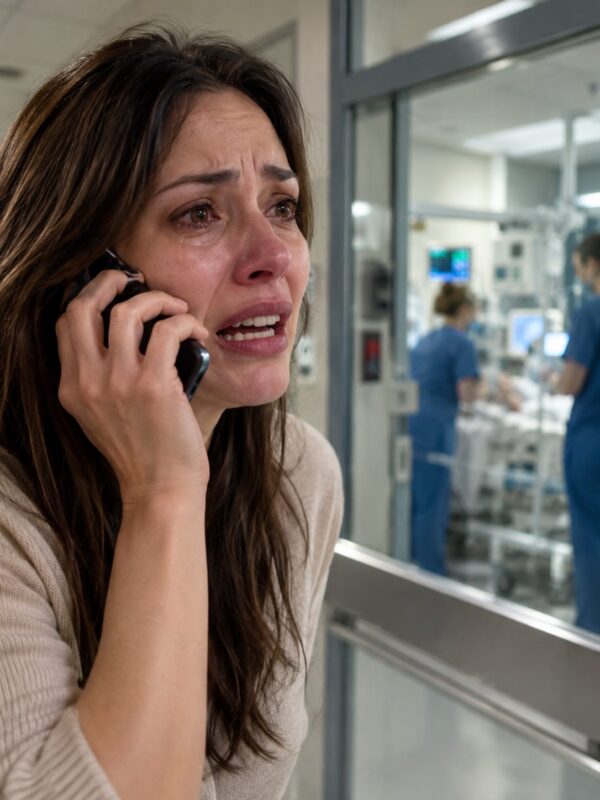
I tried calling David for the first time at 1:18 a.m.
Straight to voicemail.
I called again at 1:21.
Then 1:24.
And 1:29.
His phone rang twice before cutting off.
David was in the Bahamas. Officially, he was taking time away because he was «burned out»—a phrase he had been tossing around constantly since Christmas. He was exhausted by work, exhausted by responsibility, and exhausted by everyone needing something from him. He especially resented my gentle reminders that fatherhood wasn’t something you could take a temporary leave of absence from.
Two weeks earlier, he had announced a private yacht trip—a «reset,» he called it. He insisted he was going alone: no business calls, no social media, and no family interruptions. When I questioned whether two weeks away was excessive with a seven-year-old at home, he looked at me like I was being completely unreasonable.
«This is exactly why I need to get away, Sarah. You don’t let me breathe.»
Julianne was twenty-five and had been his personal fitness instructor for eight months. The first time we met, she rested her hand on David’s shoulder while laughing and left it there just a beat too long. When I brought it up later, David just laughed it off.
«She touches everyone, Sarah. It’s her job.»
As it turned out, sleeping with married clients was just another service she offered.
At 2:47 a.m., Dr. Patel led me into a small consultation room.
I found myself noticing the stranger details about him—funny how grief preserves the little things, even when they don’t matter. The smudges on his glasses. The coffee stain on his white coat. An untied shoelace.
«Your daughter is critically ill,» he said carefully.
«I know,» I replied. «What do you need me to do?»
«We’re treating her aggressively. But if there’s another parent—»
«I’m calling him.»
David deliberately rejected my next three calls. My phone screen confirmed it: Call Rejected. Unlike a call that simply rings out, this meant he saw my name flash across his screen and consciously chose to hit decline.
I typed out a message:
LILY IS IN THE ICU. CALL ME NOW.
Nothing.
I sent a photo: Lily swallowed up by stark white hospital blankets, hooked to IV lines, oxygen tubes, and heart monitors—with the tiny purple bracelet she’d made at summer camp still wrapped around her wrist.
Still, dead silence.
By 4:00 a.m., I had called twenty-six times.
By 5:00 a.m., thirty-nine times.
Finally, at 5:38 a.m., David texted back:
Sarah, stop.
I stared at those words until my eyes blurred. I pressed call again.
Rejected.
At 5:41 a.m., another text popped up:
I told you I’m doing a digital detox. This constant need to reach me is exactly what I meant when I said I feel suffocated. Unless someone is literally dying, handle it until I get back.
I couldn’t stop staring at that single phrase: Unless someone is literally dying.
Twenty feet away, behind a glass partition, a team of six medical professionals was frantically fighting to save his daughter’s life.
I typed back:
SHE IS.
Then:
DAVID, LILY MAY DIE.
And finally:
PLEASE CALL HER.
At 6:02 a.m., he replied. Not with a phone call, but with another cold message:
I can’t keep doing this with you. I need two weeks where every crisis isn’t made into my responsibility. I’m turning my phone off. Do not contact the yacht.
The yacht. Not his wife. Not his daughter. Not the hospital. His priority was protecting his vacation from being interrupted.
Fifteen minutes later, my older sister, Rebecca, burst into the waiting room wearing mismatched shoes and a heavy coat thrown over her pajamas. She found me sitting outside Lily’s room, staring blankly at David’s text.
She read the screen, and her entire face changed.
«Where is he?» she asked softly.
«The Bahamas.»
«With her?»
I looked up at her. «Yes.»
Rebecca sat beside me. For once, she offered no unsolicited advice about my marriage. She simply reached over and took the phone out of my hand.
«Stop calling him, Sarah.»
«I have to tell him—»
«You have told him.»
«He’s her father!»
«And you have told him.»
«What if she wakes up and asks for him?»
Rebecca swallowed hard. «Then we’ll deal with that if it happens.»
Lily woke up briefly at 10:17 that morning. She was barely conscious, her eyes opening only halfway. I immediately leaned over her bed.
«Mommy’s here, baby.»
Her lips moved faintly. I leaned in closer. «What is it, sweetie?»
«Cold,» she whispered.
Nothing more.
I gently rubbed her little hand between mine. «You’re okay. Mommy’s right here.»
Those were the last words my daughter ever spoke to me.
By lunchtime, the medical team stopped telling me to hold out hope. By four o’clock, they were discussing catastrophic brain swelling. At five-thirty, they gently asked if I wanted other family members to come say goodbye.
Rebecca called our mother. I didn’t try reaching David again. My call log stood at fifty-one rejected attempts.
At 6:14 p.m., the steady rhythm of the heart monitor changed. A nurse quietly drew the privacy curtain. Dr. Patel stood by the side of Lily’s bed. I held her right hand as the machines stopped doing what her little body no longer could.
I just kept smoothing her hair back. Whenever Lily had a bad dream, she used to crawl into my bed and whisper, «Hair, Mommy.» She wanted me to stroke her forehead until she drifted back to sleep.
So that’s what I did. I smoothed her hair. Again. And again. And again.
Until Dr. Patel softly let me know that she was gone.
I don’t remember screaming. Rebecca told me later that I didn’t. I simply rested my forehead against Lily’s and kept repeating the same words: «I’m right here.»
Eventually, the nurse pulled the sheet up to her shoulders. Her hand grew cold in mine.
At 7:03 p.m., my phone vibrated in my pocket. For one irrational second, my heart leaped, hoping it was David. Instead, it was an automated blast from Lily’s elementary school reminding parents that Friday was Pajama Day.
A hollow, terrible laugh escaped my chest. Then I turned the phone completely off.
David wasn’t going to find out his daughter had died through another phone call he could casually reject. He wanted to be unreachable.
So I decided to give him exactly what he asked for. Completely.
Chapter 2: The Funeral Without a Father
For four days, I was forced to answer questions no mother should ever have to hear.
White flowers or pink?
Open or closed casket?
Which photo should we print on the memorial card?
What outfit should Lily wear?
What was her favorite song?
Burial or cremation?
I learned that grief is buried under mountains of paperwork. Forms don’t stop to mourn a dead child. The funeral home needed signatures. The cemetery required written authorization. The school needed formal notice. The life insurance company wanted documentation.
I handled it all myself because nobody else could. Rebecca offered to step in, but choosing Lily’s dress felt like a mother’s duty. I chose her favorite light blue dress—the one embroidered with tiny daisies that she’d worn to my mother’s birthday party.
David had missed that party, too. Work, he’d claimed. Always work. Until work was no longer the reason he stayed away.
The morning after Lily passed, I sent David one final text message. Not because I needed him, but because I wanted proof—for myself—that I had done everything humanly possible.
Lily died yesterday at 6:14 p.m. Her funeral is Monday at 10:00 a.m. at St. Matthew’s. I will not contact you again.
The message marked as delivered. There was no reply.
He simply didn’t believe me. I later learned through attorneys that he had stared at his phone, turned to Julianne, and scoffed, «She’s just making things up to force me to come home.»
Monday morning brought a freezing rain. Lily’s teacher stood under a black umbrella alongside twenty-three tearful parents from her second-grade class. Her principal was there. Her soccer coach came. Even the elderly neighbor from three doors down who always saved extra peppermint candies for Lily on Halloween showed up.
Dr. Patel came, too. He stood quietly near the back of the chapel and slipped out before I had the chance to thank him.
David’s parents flew in from Arizona. His mother, Elaine, broke down and collapsed into my arms the moment she saw the small white casket.
«Where is he, Sarah?» she sobbed.
I looked at her, but I didn’t need to answer. Deep down, she already knew: her son was still on a yacht in the Bahamas. Beside her, David’s father, Richard, turned away and covered his face. Neither of them uttered a single word to defend him. That meant more to me than I can say.
At the gravesite, rain mixed with the tears streaming down my face. Once the minister finished and people began filtering back toward their cars, I stayed behind.
Rebecca touched my shoulder. «Sarah?»
«Give me five minutes,» I whispered.
«I’ll be right by the car.»
When everyone was gone, I knelt in the wet grass near the flowers. Your body has a funny way of understanding things long before your mind can process them. My arms physically ached to reach into that ground, pick Lily up, carry her back to the warm car, and tell her we could finally leave this awful place.
Instead, I placed my bare palm against the cold wood of her casket one last time.
«I’m so sorry Daddy wasn’t here,» I whispered.
The words slipped out before I could stop them. But then I caught myself.
«No,» I said aloud, wiping rain from my face. «That isn’t my apology to make.»
It was the first clear, sharp thought I had experienced in four days. David’s absence was his burden to carry. His cruelty, his choices, and his utter failure as a father belonged entirely to him. I was done spending my life making excuses for his shortfalls.
That afternoon, I returned to an empty home—a four-million-dollar estate of limestone, glass, white oak, and deafening silence. David had insisted on buying it three years prior because he lusted after the status of the address: the circular driveway, the heated garage, the wine cellar, the home gym, and the floor-to-ceiling windows overlooking the ravine.
Lily had only ever cared about one thing in that entire house: her bedroom window seat.
I went up and sat there until dark. Her favorite stuffed rabbit was still resting on her pillow. A library book lay face-down on her nightstand, left open to her page. I reached out to close it and could almost hear her little voice teasing me: «Mommy, don’t! You’re breaking the spine!»
I closed it properly anyway.
As I stood up, my eyes caught the door to David’s home office across the hall. Locked. Naturally. He always locked it when he traveled. For years, I had accepted his rationale: confidential client records, sensitive financial papers, privacy.
But grief completely strips away fear and obedience. David had abandoned our child while she was taking her last breaths; I couldn’t care less if he thought I was invading his privacy.
I retrieved his spare emergency key from its hiding spot in the drawer beneath the built-in wine fridge. I’d known it was there for years, though I’d never had a reason to use it.
The office smelled faintly of cedar and his expensive cologne. His desk was immaculate: laptop gone, files aligned, pens neatly organized. The only personal item on the desk was a framed photo of Lily.
Just Lily. Not the three of us.

For a moment, that almost shattered me. He kept her picture on his desk at work, yet couldn’t be bothered to pick up the phone while she lay dying.
I began pulling open the drawers. Tax returns, property deeds, corporate filings—nothing out of the ordinary. But then I noticed the bottom drawer didn’t slide back as far as the rest.
I pulled the drawer entirely out of its track. Built directly into the back cabinet was a narrow steel lockbox.
Using a small key from his desk ring, I opened it. Inside sat a second laptop, three burner phones, two passports, and a heavy hardcover copy of a Winston Churchill biography.
The book felt oddly heavy. When I opened it, I saw that the pages had been hollowed out. Inside lay stack after stack of bank statements—none of them from our local bank.
Cayman Islands. British Virgin Islands. Singapore.
The balances made me stop and read them twice: $814,000. $1.2 million. $463,500.
Names of unfamiliar shell companies were printed across the statements: Mariner Ridge Holdings, Blue Reef Procurement, Caldera Advisory. One document listed David as the sole beneficial owner. Another contained wire transfer instructions.
Then I found the document that made my shaking hands go completely still: a corporate guarantee carrying my name—Sarah Vance.
I had never seen this account in my life. I had certainly never signed this paperwork.
Yet the signature at the bottom looked nearly identical to mine. Almost.
For twelve years, David had watched me sign birthday cards, mortgage documents, school permission slips, and tax forms. He had mastered the curve of my S, but he always missed the tiny, distinct upward stroke I used at the end of my last name.
I sat down in his leather chair, staring back and forth between my phone, the forged documents, and Lily’s photograph.
Chapter 3: The Confrontation
Ten days later, David finally returned home.
I was watching from my neighbor Susan’s front window across the street when the black car pulled into our driveway. David stepped out wearing crisp navy trousers, white sneakers, designer sunglasses, and the luxury watch I’d bought him for our tenth anniversary. Julianne was right beside him, a woven straw hat dangling from her wrist and a oversized shopping bag in her hand.
From across the street, they looked like any wealthy couple returning from a tropical getaway—bronzed skin, duty-free bags, a driver unloading their designer luggage.
Then David turned and looked at the house. His smile instantly vanished.
No wreath on the door. No cars in the driveway. No lights on in the front rooms. He shrugged it off, tipped the driver, and unlocked the front door.
Special Agent Marcus Hale later detailed exactly what happened the moment David walked inside.
David stepped into the grand foyer and called out, «Sarah?»
Nothing.
He walked deeper into the house, only to find the living room virtually stripped bare. My mother’s paintings were gone from the walls. My grandmother’s heirloom rug had been removed. Lily’s practice piano was gone.
David reportedly stood there for a few seconds and actually laughed—that arrogant, dismissive laugh he used whenever reality didn’t bend to his expectations.
«Sarah, seriously?» he yelled up the stairs. He dropped his suitcase onto the floor. «This trip was supposed to be a reset for our marriage! If this is some dramatic separation stunt, I’m not playing along.»
That’s when Agent Hale stepped out of the hallway, flanked by two uniformed state troopers.
David froze. Hale later told me it was the first time he saw genuine panic flash across David’s face.
«Mr. Vance?»
David stared at their badges. «Yes?»
«David Michael Vance?»
«Yes… what is this?»
Hale unclipped a leather folder. «I’m Special Agent Marcus Hale with Federal Law Enforcement. We have a federal warrant for your arrest.»
David stood rooted to the spot as Hale read off the charges: wire fraud, corporate embezzlement, money laundering, and grand forgery involving offshore financial instruments.
«There’s been a massive mistake,» David stammered, his voice rising. «Do you have any idea who I am?»
Across the street, Susan sighed. «Apparently not as well as he thinks they do.»
David panicked, looking frantically around the empty foyer as if waiting for me to step out from behind a corner and fix everything—just like I always did. I was the one who fixed schedules, smoothed over ruined dinners, handled school emergencies, managed his parents’ delicate feelings, and covered up his mistakes before anyone noticed.
«Where is my wife?» David demanded.
Hale didn’t answer. Behind David, Julianne had backed up against the front door, her face pale.
«What did you do?» David spun on her, his voice sharp. «Did you say something to someone?»
«Me?!» she gasped. «I don’t even know what’s going on!»
«Blue Reef!» David snapped.
Julianne’s eyes went wide. She backed further away. «David, no…»
«Shut up!»
«Don’t you dare tell me to shut up!»
Before the handcuffs were even clicked into place, the couple who had spent the last two weeks sipping champagne at sea were already turning on each other.
Watching it unfold brought me no joy—a realization that surprised even me. For two weeks, I had built this moment up in my head as the ultimate closure. But it wasn’t. David’s arrest changed nothing. Lily was still dead. Her room was still empty. Tomorrow was still coming.
At 9:31 a.m., officers escorted a handcuffed David out the front door. His sunglasses were gone, his hair disheveled. He scanned the street frantically until his eyes caught mine standing in Susan’s driveway.
«Sarah!» he screamed.
I didn’t move an inch.
«Sarah, please!»
That word—please—nearly drove me to my knees. Not out of pity for him, but because of how desperately my daughter had deserved to hear it from him. Please answer. Please come home. Please be my dad.
Instead, the only time David Vance ever begged was to save himself.
I walked slowly across the street toward the police car. Susan gently laid a hand on my arm. «Sarah, you don’t have to do this.»
«I know,» I said. «I need to.»
David watched me approach, looking stripped of all his usual composure.
«Sarah… what happened?» he choked out.
I stared at him, confused at first, until I realized: he still didn’t know. He thought the police were here because of a domestic dispute or a messy divorce. He had no idea.
«What happened to her?» he asked, his voice trembling.
Everything inside me went stone-cold.
«Meningitis,» I said quietly.
David closed his eyes, his breathing ragged. «Oh God… oh God.»
«She woke up once,» I added.
He snapped his eyes open. «Did she… did she ask for me?»
«No.»
His jaw quivered. «No… what?»
«She didn’t ask for you, David. She just said she was cold.»
He broke down right there on the pavement, sobbing uncontrollably. In twelve years of marriage, I had only seen David cry three times: at our wedding, when his father had heart surgery, and the day Lily was born. Now, he was weeping in handcuffs in front of our neighbors.
«I didn’t know,» he sobbed. «Sarah, I swear to God, I didn’t know!»
«You did know,» I said, my voice steady. «I texted you that she was in the ICU.»
«I thought you were just exaggerating to ruin my trip!»
«I sent you a picture of our daughter hooked up to life support!»
«We were fighting! I thought you were manipulating me to force me home!»
«I was trying to get you home!» My voice finally cracked, tears spilling over. «I was trying to get her father home!»
David had nothing left to say. He dropped his head into his chest.
«I should have answered,» he whispered. «I’ll never forgive myself.»
«That isn’t my problem anymore, David.»
«Sarah, please… don’t do this. Let me explain—»
«You had twelve hours,» I interrupted. «I gave you fifty-one chances to prove that your daughter mattered more than a yacht trip.»
«I was angry! I thought you were trying to control me!»
«So you punished me by abandoning her?»
«No!»
«That is exactly what you did.»
Behind him, Julianne stood quietly by a trooper, completely silent. I looked at her directly for the very first time. She opened her mouth as if to speak, but I simply raised a hand.
«Don’t,» I said coldly. She closed her mouth and looked away.
She owed me nothing. She hadn’t made vows to me, and she hadn’t promised to protect our daughter. David had.
David looked up at me one last time, desperate. «Sarah… the money, the accounts—»
«I don’t care about the money, David.»
He blinked, stunned. «What?»
«I care that you forged my signature because my lawyers tell me I have to protect myself. I care about making sure innocent people aren’t ruined by your greed. But do you want to know what I think about whenever I hear your name?»
His face tightened.
«I think about sitting in an ICU waiting room at 5:41 in the morning,» I told him, looking him dead in the eye. «I think about reading the words ‘Unless someone is literally dying’ while my seven-year-old child was dying twenty feet away. That has nothing to do with six million dollars.»
Agent Hale gently put a hand on David’s shoulder. «It’s time to go, Mr. Vance.»
As they loaded him into the back of the unmarked cruiser, David turned back one last time. «Sarah, wait!»
«I waited,» I said softly, looking back at the empty house. «I waited for years.»
Then I turned my back and walked away.
David’s arrest dominated the local news that evening. Vance Meridian suspended him immediately and formally ousted him from the firm within a month. His business partners cooperated fully with federal prosecutors, denying any knowledge of his offshore accounts.
In total, forensic accountants traced over eight million dollars tied to David’s shell companies. Julianne was questioned extensively but ultimately never charged; her legal team successfully argued that she was merely a bystander who believed David’s payments to her were legitimate gifts. Whether that was true or not didn’t matter to me. That was her burden to carry. Mine was heavy enough.
David eventually accepted a plea bargain to avoid a lengthy federal trial.
People always assume justice happens in a single, dramatic courtroom scene with a slam of the gavel. In reality, it happens quietly across endless months of depositions, legal briefs, postponed court dates, and financial audits.
Our divorce was finalized long before his criminal sentencing. Because my family inheritance was heavily documented and David’s fraud was indisputable, the courts protected my financial standing. The house was eventually sold, and all I took with me were the boxes containing Lily’s belongings.
Years later, David’s mother told me that he still wakes up in his cell in the middle of the night, hearing a phone ringing in the dark.
Fifty-one missed calls from the wife he accused of suffocating him.
Fifty-one chances to pick up the phone.
Fifty-one opportunities to be a father when his daughter needed him most.
I don’t know if he will ever find peace, and truthfully, I no longer care to know.
Lily’s story didn’t end aboard a luxury yacht in the Bahamas, nor did it end with offshore bank accounts or federal indictments. To me, my daughter’s life will always live in a soft yellow blanket, a chipped blue mug, friendship bracelets, and the memory of a sweet little girl asking her mommy to stroke her hair after a bad dream.
For a long time, David believed the cruelest thing I could ever do was refuse to forgive him.
He was wrong. The reality was much simpler:
I just stopped waiting for him to answer.