My father was never a man of many words.
He didn’t give emotional speeches or write sappy letters. I can’t recall a single time he said “I love you” in the direct way people expect parents to.
He was a civil engineer, and he approached almost everything—emotions included—the way he approached a bridge: use only what is necessary, but make damn sure whatever you build can carry the weight.
His language was action.
He showed up.
He sat through every school play I was ever in, even when my only job was standing silently in the background. He endured Eric’s baseball games in freezing downpours, even through seasons when my brother’s team couldn’t buy a win.
And when our mother walked out on us—when I was eleven and Eric was eight—Dad completely reconfigured his life to raise us.
He didn’t deliver a grand speech about sacrifice.
He just stayed.
For thirty-two years, that was the bedrock of what I knew about my father.
He was there.
Until, suddenly, he wasn’t.
Dad was diagnosed with pancreatic cancer in March. By September, we knew the clock was running out. For six months, Eric and I flipped the script on the dynamic Dad had maintained our whole lives: we drove him to appointments, sat vigil through the brutal nights, and slowly learned what it means to watch someone slip through the hourglass.
He passed away on a Tuesday morning in October.
He was sixty-eight.
He left behind his house, the lingering scent of his coffee and aftershave, two kids who had been shaped by him far more deeply than either of us realized—and one last secret.
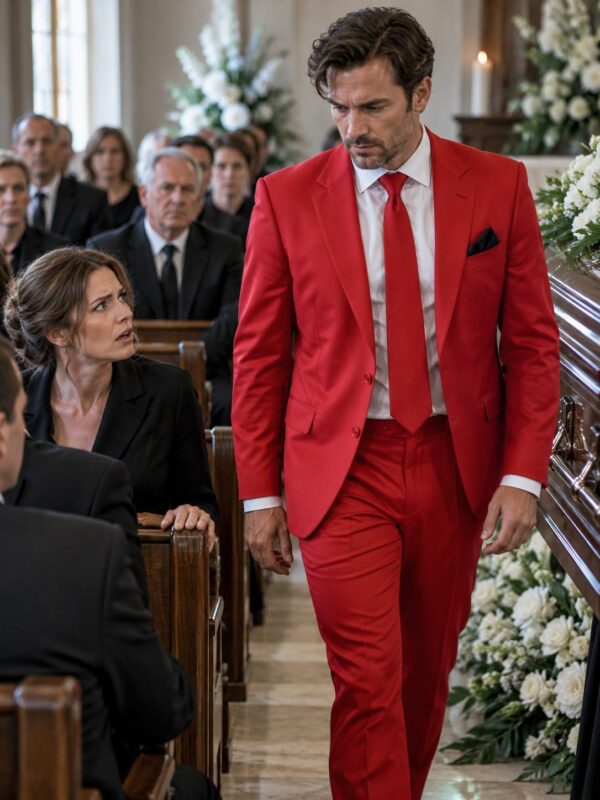
That secret walked right into his funeral wearing a blazing red suit.
My younger brother, Eric, had always been a complicated puzzle.
He was four years younger than me and had a rare gift for doing the wrong thing for all the right reasons. He was chronically late, but if you called him in a panic to say you were drowning, he’d drive four hours through a blizzard without blinking.
He was blunt. Stubborn. Fiercely loyal.
And for most of his adult life, he and Dad could barely share a room for an hour without driving each other up the wall.
The root of it was simple: they were carbon copies.
Same stubborn streak. Same pride. Same laugh.
And, unfortunately, the exact same reflex to clam up whenever they were hurt.
Five years before Dad got sick, Eric went through a brutal divorce. Somewhere in that messy fallout, he and Dad had a massive falling out. On the surface, everyone knew what the argument was about, but families know that old arguments are rarely about the spark that lit the fire.
This one had twenty years of accumulated baggage buried beneath it.
After that, Eric and Dad kept up appearances. They called on birthdays, they made an appearance at Christmas, but an invisible wall went up between them.
I knew Dad carried heavy regret over it.
Naturally, he never admitted it. But during those final six months, I caught the subtle shifts: the way his expression softened whenever Eric’s name came up, the phone calls that ended too soon, and one quiet evening when I found him sitting alone at the kitchen table, meticulously writing something on a piece of paper.
He’d write a line. Pause. Think. Scratch it out and start over.
I never asked what he was working on.
After the funeral, I’d give anything to have asked.
The morning we buried Dad was freezing and cloudless.
I arrived early, wearing the black dress I’d bought specifically for the occasion and a pair of vintage shoes Dad had gifted me two birthdays ago.
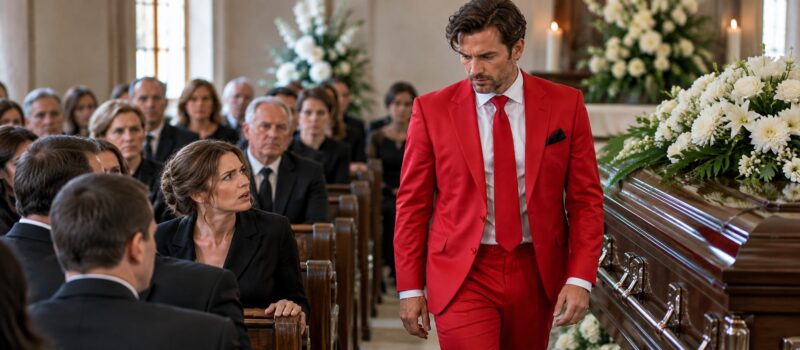
Mourners slowly filled the chapel pews. Then, just as the service was about to begin, the side doors opened.
Eric walked in.
Every head in the room whipped around.
Because my brother was wearing red.
Not a muted burgundy or a deep crimson. Bright, screaming red. A tailored, impossible-to-miss red suit.
He walked up to the casket, stood in silence for a few long seconds, and then slid into the empty seat next to me.
I leaned over, my teeth clenched.
“What on earth are you wearing?”
“Not now, Sarah.”
“Dad would have hated this.”
That finally made Eric turn his head. His expression wasn’t defensive; it was anchored in absolute certainty.
“No,” he whispered. “He wouldn’t have.”
The service started right then, cutting off any further interrogation.
Throughout the eulogies, my eyes kept drifting back to that red suit, my mind racing to figure out what temporary insanity could have driven Eric to wear it.
The answer didn’t drop until we got to the cemetery.
After the burial, our father’s longtime attorney, Herbert Lawson, made a beeline for us.
Mr. Lawson had managed Dad’s legal matters for decades. At seventy-three, he was meticulous, unflappable, and seemingly immune to shock.
Then he spotted Eric.
More specifically, he locked eyes with the red suit.
He stopped dead in his tracks. All the color drained from his face.
“Where did you get that?”
Eric frowned. “Why?”
“Please. Just tell me.”
Eric hesitated. “It was in Dad’s closet.”
I shook my head immediately. “That’s impossible.”
I had personally cleared out Dad’s primary closet and the guest room wardrobe. There had been zero red suits.
“Which closet?” I demanded.
“The downstairs one,” Eric said.
Dad had a home office downstairs. As far as I knew, it didn’t even have a closet.
Eric explained that while digging through the study for Dad’s old military paperwork ahead of the funeral, he’d run his hand along the side of the bookshelves.
That’s when he noticed something off.
A narrow section of the heavy wooden shelving didn’t sit flush. The whole unit was actually mounted on concealed heavy-duty hinges.
When he pulled on it, the entire bookcase swung outward.
Behind it was a narrow, hidden alcove.
Inside hung three garment bags. Two held standard dark suits. The third held the blazing red one Eric had on.
Pinned to the outside was a single handwritten tag bearing one name: Eric.
Mr. Lawson stared at him, breathless. Then he asked a deeply strange question:
“Did you check the pockets?”
Eric shook his head. “No.”
Mr. Lawson immediately ushered us away from the gathered crowd toward a secluded corner of the graveyard. He reached out, his hands trembling slightly, and patted the jacket pockets. Empty.
For a split second, I figured Mr. Lawson was losing his mind.
Then, his fingers ran flat against the interior chest lining.
He pressed down. A faint crinkling sound echoed back.
Mr. Lawson looked up at us, his eyes wide. “Your father told me I’d know when the right time came.”
He reached into his briefcase and pulled out a tiny pair of sewing scissors.
“Time for what?” I blurted out.
He didn’t answer. He carefully snipped a few stitches along the inner lining, parted the fabric, and extracted a folded piece of heavy cardstock.
Eric took it. His hands were shaking before he even managed to crack it open.
As he read, I watched his face fracture and reassemble. I’d known my brother my whole life, but I’d never seen that look on him before. It looked like the exact moment someone realizes they’ve finally been let back in from the cold.
Later on, Eric let me read portions of the letter. Some parts were meant for his eyes alone, and I respect that line. But the core of what Dad was trying to say became crystal clear.
He wrote about Eric’s divorce. About their explosive argument. About the heavy, suffocating silence that followed.
And then, Dad confessed.
He admitted he had failed to show up.
Not physically—Dad was always there in the physical sense. But during the absolute worst chapter of Eric’s life, my brother hadn’t needed logistical fixes or tough love.
He just needed his father to look him in the eye and say:
I see what this is costing you. I know you’re hurting. I’ve got your back.
Dad had felt all of those things. He just choked on the words.
Eric had translated that silence as cold rejection and judgment. Dad, in turn, realized too late that two stubborn men hiding behind their armor had spent two decades missing each other completely.
In the letter, Dad apologized for assuming Eric could read a heart he kept locked behind a vault door. He owned up to the fact that he was infinitely better at pouring concrete foundations and fixing engines than he was at spelling out his affection.
And since he ran out of runway to say it face-to-face, he engineered another way.
That was vintage Dad.
He built things. Bridges. Structural supports. Hidden compartments. Practical solutions.
And now, running out of time, he had built one final contraption designed to carry the heavy emotional weight he never managed to voice while breathing.
A hidden room. A crimson suit. A letter stitched into the seams. All of it rigged for Eric.
I turned to Mr. Lawson, stunned. “You knew about this?”
“Not the specifics,” he admitted.
He explained that Dad had come into his office back in August, mentioning that he had set something in motion, refusing to spoil the mechanics of it. He’d only told Lawson that when the hour struck, there would be an undeniable sign.
Mr. Lawson looked down at Eric’s striking red jacket.
Turns out, the old engineer’s math had checked out.
“What were you supposed to do?” I asked.
“Make sure Eric found what your father left him.” Lawson smiled faintly. “If he missed it, I had instructions to steer him straight to the study after the service.”
I almost laughed through the lump in my throat. “He mapped out a contingency plan for his own funeral?”
Mr. Lawson gave a knowing nod. “Your father accounted for structural loads and stress points in every single facet of his life.”
Of course he had. Dad had spent a lifetime calculating weak points, safety margins, and redundancies. He had approached emotional reconciliation with the exact same blueprint.
Later, I found Eric sitting by himself on a worn wooden bench overlooking the graveyard. The letter was clutched tightly in his hand.
I sat down next to him. For a long time, neither of us said a word.
Finally, Eric shook his head, a wry smile cutting through his grief. “He really engineered the whole thing.”
“He did.”
“That hidden bookcase alone must have taken days to frame out.”
“Probably.”
I finally asked the question that had been burning a hole in my brain. “Why red?”
Eric tapped the letter. “It’s in here.”
Dad had commissioned the suit specifically for him, built to his exact specs months prior.
Why? Because Dad had spent years watching Eric instinctively shrink himself whenever he walked into rooms where he felt like an intruder or an afterthought.
Dad refused to let him do that at his funeral.
He wanted his son seen. Impossible to ignore.
The note attached to the garment bag had essentially told Eric to throw it on and walk through those chapel doors like he owned the place—because he belonged there just as much as anyone else.
Dad had ordered it in July. He never got to watch Eric wear it.
Even so, Eric had followed the directive blindly. He had waded into a sea of corporate black and charcoal dressed like a flare in the dark, having no clue why.
He just trusted that Dad had a method to his madness.
And Dad absolutely did.
Mr. Lawson tracked us down a few minutes later, holding a second manila folder.
“There’s one more thing.”
Dad had designated certain items in his estate as non-monetary assets, splitting them specifically between the two of us.
Mr. Lawson handed us each an envelope, noting that Dad’s explicit wish was for us to open them right here at the cemetery.
Mine held a weathered photograph.
It was a younger version of Dad in a crisp military uniform, but instead of posing with stiff, stoic posture, he was caught mid-laugh. Head tilted back, eyes squeezed shut, a massive grin splitting his face. I had rarely seen him look so unburdened.
Scrawled on the back was a short note thanking me for teaching him that sometimes, just sitting quietly in the room was enough.
Tucked right beneath the photo was an old blueprint sheet: the structural engineering schematics for the pedestrian bridge he was most proud of designing early in his career. In the margin, he wrote a quick note telling me to go walk across it sometime—preferably with someone I loved.
Then I looked at Eric.
His envelope yielded just two items: a brass key and a heavy cardstock note.
The instructions pointed straight to Dad’s garage: far-left utility cabinet, hidden behind the old paint cans.
We headed straight back to the house in our funeral attire, Mr. Lawson trailing close behind.
Eric tracked down the tall metal cabinet, and the antique key turned smoothly in the lock. Shoveled behind a row of dusty paint cans was a large, flat package wrapped in brown craft paper.
He hauled it over to Dad’s heavy wooden workbench and carefully peeled back the paper.
An oil painting lay inside.
It depicted our old backyard. I immediately recognized the wooden tire swing, the sagging chain-link fence, and the sprawling oak tree.
And two kids.
Eric and me.
We were facing away from the easel, looking toward something happening off-canvas. Little Eric had one small hand planted squarely on my shoulder for balance.
Flipped over, Dad had written that he began the canvas shortly after our mother left. He could never quite get the perspective or the depth right, so he kept scrapping it and starting over.
The hardest part, he wrote, was capturing the exact quality of late-afternoon light the way he remembered it.
Apparently, after wrestling with it for decades, he had finally nailed it.
At the very bottom was his final sign-off:
We always belonged to each other. Don’t ever forget it.
Eric collapsed backward, sitting flat on the cold garage concrete, still wearing that ridiculous, beautiful red suit. He buried his face in his hands.
I dropped down beside him, not giving a single damn that my funeral dress was picking up dust and motor oil off the floor.
The garage still smelled like sawdust, WD-40, and pure, unfiltered Dad.
After a long quiet stretch, Eric whispered, “He knew all along.”
“Yeah,” I murmured, leaning my shoulder against his. “He knew.”
Bit by bit, the master plan clicked into place.
We even found a stray note inside the hidden closet detailing how Eric, back when he was a sixteen-year-old snooping around, had once accidentally brushed against the bookcase hinge and figured out the latch.
Eric had completely forgotten the incident.
Dad hadn’t.
He had engineered the entire final act around the son he actually had—flaws, quirks, and all. Not an idealized version, but the real Eric. The kid who noticed the tiny mechanical details. The man who preferred decoding puzzles on his own rather than asking for directions.
Dad had tailored his final message precisely for the person meant to receive it.
Just then, Mr. Lawson appeared in the open garage doorway.
“There is one last piece,” he said gently.
This time, Dad hadn’t trusted it to a hidden compartment or a written card. He wanted someone to actually say the words out loud.
Mr. Lawson cleared his throat.
Dad wanted us to know he was painfully aware that his brick wall of a personality had wounded the people he loved most. He deeply regretted making us dig through dirt just to feel loved.
Building things had always been his native tongue, he explained. But he deeply wished he had translated that language into plain English a lot more often.
Then came the sentence that finally broke both of us wide open:
You two were the finest things I ever built.
Mr. Lawson paused, a slight smile touching his lips. Then he added a detail that nearly made Eric laugh through his tears:
Dad had made him practice delivering that exact speech three separate times in his office. Apparently, even from the shadow of the grave, Dad was a micro-manager about delivery and pacing.
We spent that night crashing at Dad’s house, eating dry cereal straight out of the box at the kitchen table because neither of us had the energy to cook.
It felt weirdly right. When we were kids and Dad was overwhelmed, cereal was his signature emergency dinner fix.
We spent hours trading memories of him—not the sanitized funeral-parlor version, but the real man. The stubborn perfectionist. The quiet humorist. The guy who quietly fixed a toy Eric smashed as a kid without ever lecturing him, knowing Eric already felt terrible.
Eventually, our eyes drifted over to the oil painting propped against the workbench.
Dad had started it when we were just eleven and eight. He had tinkered with it, on and off, for twenty-five straight years.
A quarter of a century spent trying to get the light right.
Neither of us had words for that level of quiet devotion.
Then Eric glanced at the red jacket slung over the back of a chair.
“He told me I belonged there,” Eric murmured.
He explained that when he first stumbled on the suit in the secret alcove, the attached tag hadn’t mentioned the hidden letter. It just instructed him to put it on and wear it when the time came.
That meant Dad had set up a sheer test of blind trust.
Would Eric follow a completely bizarre instruction without demanding an explanation?
Put on a blazing red suit.
Walk straight into your father’s funeral.
Let the entire room stare.
Just trust me.
And Eric had taken that leap.
That was what Dad needed from him. One final act of faith.
And once Eric delivered, Dad unlocked the floodgates, handing over all the emotional validation that should have been spoken decades ago.
The next morning, Eric packed up to leave. Before climbing into his car, we shared a long, tight hug.
We aren’t a family of big huggers. We’re Dad’s kids—we usually just show up and let actions do the talking.
But that morning, we did both.
Eric loaded the letter, the brass key, and the painting into his car. The red suit was safely zipped back inside its garment bag.
“What are you going to do with the suit?” I asked.
Eric paused, looking out over the yard. “Wear it again.”
“When?”
“Whenever a moment calls for it. Somewhere I need a reminder that I’m allowed to walk into a room like I own it.”
I smiled, my throat tight. “Dad would love that.”
Eric nodded, his eyes bright. “I know.”
A week later, I was up on a ladder clearing out a top shelf in Dad’s bedroom when I pulled down a stack of eight worn sketchbooks.
They were packed tight with decades of charcoal and pencil sketches.
Some were raw civil engineering diagrams. But the vast majority were us.
Eric cracking up at age eight. Me sitting alone on the front porch steps at eleven, trying to swallow my tears the day Mom left. Eric at sixteen, lost in thought. Both of us gathered awkwardly around the Christmas tree.
Dozens upon dozens of stolen moments from our childhood right through adulthood.
Dad had been watching. Remembering. Preserving us.
On the very first page of the earliest sketchbook, he had written a single line:
The things I couldn’t find the words to say, I drew.
I sat down right there on his bedroom floor, completely surrounded by thirty years of unspoken love that my father had quietly poured onto paper.
And in that quiet room, I finally understood him completely.
Dad had spent his whole life constructing things strong enough to withstand heavy pressure. Bridges. Homes. Hidden alcoves. Paintings. Letters. A ridiculously bright red suit.
And in the final countdown of his life, he engineered one last masterwork—a structure built entirely to carry all the love, remorse, grace, and validation he never learned how to speak out loud.
It held up.
The bridge Dad designed all those years ago is still standing strong.
Last spring, I finally walked across it.
I made sure to bring Eric along with me.
We didn’t talk much the whole way across.
We didn’t have to.
The afternoon light hitting the water was breathtaking.
And somehow, it looked precisely the way it felt.





