At five o’clock on Thanksgiving morning, the house was cold enough that I could see my own breath over my coffee. I stood at the kitchen counter wearing my late husband’s Army T-shirt, letting the chill settle into me, because at least the cold was honest.
Frost had silvered the insides of the windows overnight.
My parents kept the thermostat low to save money they didn’t even need to save, and during the months I’d been staying there, I had learned not to touch the dial—the same way I had learned not to touch a great many things.
I was five months along.
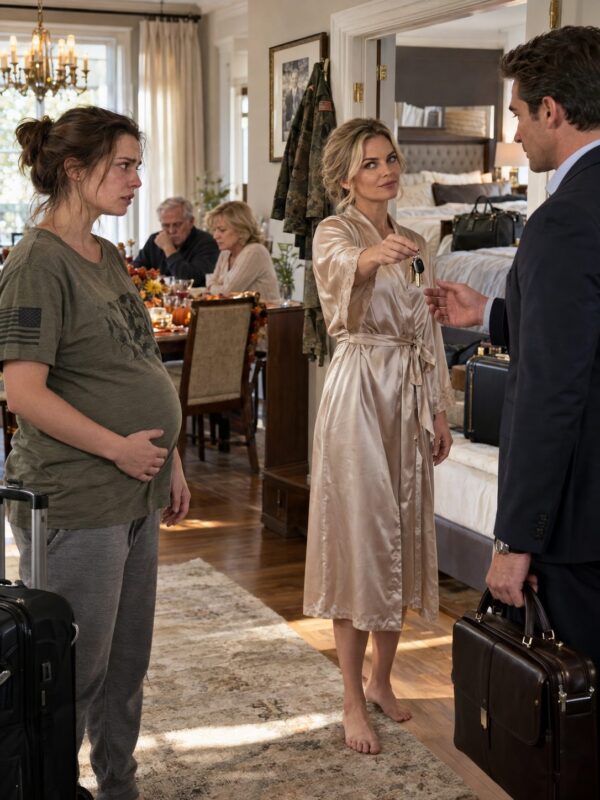
The baby had started moving over the last few weeks, small turns and presses low beneath my ribs, and I had gotten into the habit of resting one hand there without thinking, the way you guard something precious.
The T-shirt was Niko’s, faded to the gray of dishwater, the unit crest on the chest cracked and peeling from a hundred washes.
It was the only thing left in that bedroom that still carried any trace of him—not cologne, because he never wore any, just the particular warmth of a shirt that had been his. I knew it was mostly in my head, and I didn’t care.
I wore it to sleep.
I had worn it under my black dress to the funeral, tucked out of sight where no one else could see, because I wasn’t about to bury him without a piece of him against my skin.
That was where I had been just twelve hours earlier.
Standing over a folded flag.
And now it was Thanksgiving morning, standing in a freezing kitchen, with my phone buzzing against the counter. I already knew, the way you can tell by the look of the sky, that whatever was coming next wasn’t going to be kind.
People misunderstand grief.
They think it’s a storm—loud, visible, something you watch roll in and watch roll away.
Mine was quieter and far worse than that.
Mine was a sudden shift in the weight of the world, where every ordinary object had become crushing: the coffee cup, the chair, the milk carton in the fridge door. Moving through the day meant hauling all of it, every single second, while pretending my arms were empty.
I had been doing that for four months. Four months of waking up in the half-second before memory arrived—that brief, merciful blankness—followed by the inevitable crash.
Niko is dead.
Every single morning, the exact same sentence, delivered fresh, as though my body refused to log it and made me relearn the news all over again at dawn.
I had learned how to function inside of it.
I could hold a conversation, nod along, pass the dinner rolls, and let my father talk, and none of them ever guessed that an interior piece of me was standing motionless in some distant field, clutching a triangle of folded cloth.
They mistook my composure for coldness.
They always had.
It never occurred to them that maintaining that calm was the hardest thing I did all day—a discipline held together by sheer force of will, hour by hour, so I wouldn’t just collapse on their kitchen floor and give up.
«So pack your things this morning,» Victoria’s voice echoed in my mind. «You can put yourself out in the garage.»
I stared at the phone and watched a curl of my breath rise and vanish over the coffee. Somewhere in the house, a radiator ticked loudly without radiating an ounce of heat.
«The garage,» I said aloud.
It wasn’t really a question.
I just wanted to hear her say it back, to have it on the record between us, plain and undeniable.
«It’s below freezing out there, Delphina.»
A familiar, weary sigh hissed down the line—the exact same sigh she’d been directing at me since we were kids. It was the sound that signaled I was being difficult again, always the difficult one, the heavy one who made things awkward by simply having needs.
Delphina was three years older and had spent those three years, and every year since, being the daughter who made sense to my parents.
She wanted the things they understood wanting—money, status, a good address, a husband who spun his car keys—and she got them. My parents watched her collect those milestones with the smug satisfaction of people whose worldview was constantly being validated.
I was the other kind of daughter.
I was quiet where she was bright, private where she was performative. I chose a life they couldn’t casually display to neighbors: vague jobs, long absences, and a husband they found underwhelming. So, by the simple arithmetic of a family like ours, I became the disappointment.
It wasn’t outright cruelty, exactly.
It was something worse, because cruelty at least acknowledges your existence. It was a settled, low-grade disregard—a decision made so long ago that no one remembered making it—that Delphina was the success story and I was the charity case. They had all lived inside that assumption for thirty years without ever questioning it.
So when my sister called me before dawn on Thanksgiving to banish me to the garage, she wasn’t doing anything new.
She was just falling back on the oldest tradition in our family.
She was reminding me of my place.
What she didn’t know—what none of them knew—was that I had a place now that had nothing to do with them. I had earned it in rooms they would never see, and the woman she was ordering onto a concrete floor had stopped needing my sister’s approval a long time ago.
«It’s temporary,» she said defensively. «Don’t make it a whole production. There’s a space heater out there somewhere.»
There was no space heater out there; I knew that garage well enough to picture its bare studs, its oil-stained floor, and the raw cold that seeped right up through the concrete slab into your soles.
But I didn’t argue.
I had already begun doing the thing I did best in that house: I went completely still and quiet, letting them mistake my silence for surrender.
«All right,» I said.
And I hung up before she could parse any tone in my voice. There was something stirring in my voice, and it wasn’t what she expected, and I wasn’t ready to show my hand just yet.
When I walked into the kitchen proper, my father was already hidden behind his newspaper, and my mother was stirring cream into her coffee with the precise, practiced movements of a woman who had decided not to look up. Neither of them said good morning.
Failing to say good morning ran in the family. It was their favorite quiet way of letting you know you were out of favor.
I must have made some sound—I wasn’t crying, since I had gotten good at keeping my tears hidden from them, but grief has a weight that leaks out even when your eyes are dry—because my father lowered the paper an inch. He gave me a look I knew by heart, the exact same expression he’d worn graveside twelve hours prior.

Pure, unadulterated irritation, as if my dead husband were nothing more than a scheduling inconvenience.
«Marla,» he said, shaking his head. «I’m going to say this once. The whole world does not owe you a grief parade. Your carrying-on is already casting a pall over the holiday, and it isn’t even six in the morning.»
Niko had been dead for four months.
The Army had come to the door that July—two officers in full dress uniform standing on my parents’ porch with their hats in their hands—to tell me my husband had been killed on a classified mission in a place they weren’t at liberty to name.
I remember every second of that morning with a terrifying clarity.
I was standing on the porch when a plain sedan pulled up, and instantly, I knew. Every military spouse knows that sinking dread; the sight of two dress uniforms walking up your path is the one thing you spend an entire marriage praying never to see.
My knees gave out before they even reached the steps. One of them caught my elbow.
They were unbearably kind with the practiced gentleness of people who deliver devastation for a living. They spoke the words, and the words meant everything and nothing all at once. Behind me in the doorway, my mother had called out, «Oh, is everything all right?»—genuinely confused by the scene, because in her orderly version of my life, Niko was just a civilian consultant, and nobody sends two officers in blues to tell you a consultant is gone.
I had to explain it to her later in small words, and even then, I could see her struggling to force the fact into the shape of the son-in-law she’d already dismissed as unimpressive. That was the first crack in the illusion, though none of us understood it yet.
My family had spent a decade being faintly embarrassed by the modest reality of my marriage.
And now, two soldiers had arrived to declare that my modest husband had died in service to his country, and my mother’s very first question, once she finally understood, was whether there would be a government payout.
The funeral had been delayed for months—held up by classified red tape, the kind of bureaucratic hurdles my family had spent a year being annoyed they weren’t allowed to bypass—and it had finally taken place yesterday.
Yesterday.
And here was my father this morning, informing me that four months and one day was the strict limit of his patience for my sorrow. I had allegedly exceeded my allotment of mourning, and the decent thing to do would be to take my sadness somewhere it wouldn’t ruin the mood over the sweet potatoes.
I looked right at him.
I didn’t say a word.
I was thinking about the flag, folded into its sharp triangle, and the young sergeant who had pressed it into my hands and held my eyes for an extra second—soldier to soldier—while my family remained completely oblivious to what was happening.
This house was Niko’s and mine, and every single board in it had been paid for by his sacrifice.
He’d bought it eight years ago with money saved deployment by deployment: hazard pay, separation pay, and the raises that came with a rank he wasn’t allowed to discuss.
It had been a complete wreck when he bought it—dirt cheap because it was falling apart—and he had loved it for precisely that reason.
Between rotations—those strange, compressed weeks at home when he would arrive lean, quiet, and slowly thaw back into himself—he rebuilt the place with his own hands.
He tore out the ruined kitchen and installed a brand-new one, hanging cabinets level with a patience I could never muster, sealing countertops on his hands and knees at midnight because jet lag kept him awake and he might as well be productive.
He patched the drywall. He rewired the back rooms.
He would stand in the half-finished kitchen with sawdust in his hair, pointing out where a crib would go, which room caught the morning light, and how he wanted a garden out back for the kids to wreck. The kids. He always said it in the plural, full of hope, like a man laying railroad tracks toward a future he fully intended to reach.
He made every single mortgage payment from wherever he was stationed across the globe, wired on time, without fail—a man building a stronghold for a family he was mostly too far away to live alongside.
I think about those brief weeks home more than anything else now.
They had a strange, double-edged quality. He’d arrive wary and thinned out, moving quietly through the house for the first few days, sleeping poorly, flinching at sudden noises. Then, slowly, the way ice melts off a pond in spring, he’d return to himself—the man who sang terribly while sanding cabinet doors and cracked awful jokes about crown molding.
People pity that kind of marriage when they hear about it.
They shouldn’t.
We loved each other across distances most couples never have to survive, and that love grew denser and stronger under the pressure of it all.
He wrote me letters he wasn’t technically supposed to write, and I burned them after reading because I wasn’t supposed to keep them. In every single one, near the bottom, he would sketch the house—a stick-figure home with a stick-figure garden, two figures standing side by side, and in the later letters, three, four, a whole crooked row of them standing beneath a lopsided sun.
That was the future he was building toward, payment by payment, board by board, homecoming by homecoming.
He got the house finished.
He just didn’t get to live in the future.
And my parents looked at his finished house and saw nothing more than square footage.
Now he had been in the ground for four months, and my parents had looked at the home his body had paid for and decided it was essentially abandoned property—a windfall to be handed over to the son-in-law they actually liked.
It apparently never crossed their minds to check whose name was actually on the deed.
It never occurred to them to wonder much of anything about me at all. That had always been their blind spot, and it was about to become a very expensive mistake.





