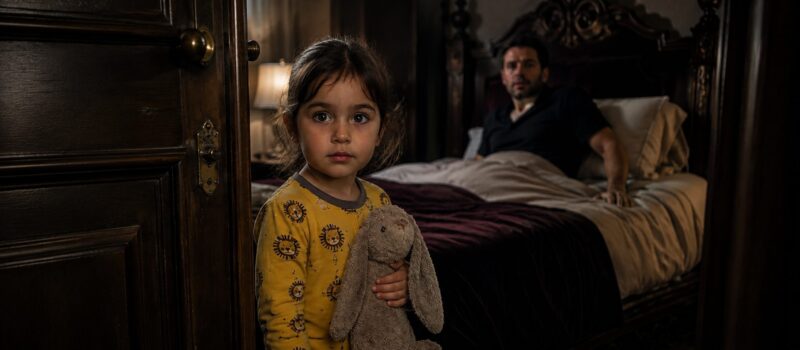
For several seconds after the call ended, Adrian stayed seated on the edge of the bed.
He had spent years training himself not to react until he fully understood what he was reacting to.
Anger made people careless.
Fear made them predictable.
And exhaustion, as he had recently discovered, made a man both.
Across the room, the porcelain cup sat untouched on his desk. The morning light caught its pale rim, making it look entirely harmless.
Adrian studied it like a man seeing a teacup for the first time in his life.
Beside him, Lily let out a small yawn. She had already completely forgotten the gravity of what she’d just said.
That, more than anything else, kept Adrian grounded.
She was three years old. She hadn’t uncovered a conspiracy; she had simply noticed something unusual and mentioned it the way children mention the rain, a missing sock, or a bird outside the window.
Adrian refused to drag her into whatever came next.

“Come on,” he said softly.
Lily hugged her stuffed rabbit tighter. “Breakfast?”
“Yes.”
“Pancakes?”
“We’ll negotiate.”
She considered this very seriously. “Chocolate ones.”
“You drive a hard bargain.”
Her tiny hand slipped trustingly into his.
The gesture caught him off guard. For three years, almost every touch in Adrian’s life had come with an agenda—a firm handshake across a polished boardroom table, a doctor’s cool fingers against his wrist, or Dominic’s hand resting heavily on his shoulder during meetings when Adrian’s concentration started to drift.
Lily’s hand expected nothing in return.
He walked her downstairs, where Nora Carter came hurrying out of the service corridor the moment she spotted them.
“Lily!”
Her face instantly shifted from sheer panic to intense embarrassment. “Mr. Moretti, I am so sorry. I woke up and she wasn’t in the guest room, and—”
“She was with me.”
Nora froze.
Lily hoisted her battered rabbit into the air. “I fixed him.”
Nora closed her eyes and groaned. “Oh, no.”
Adrian almost smiled. “She told me a story.”
Lily nodded proudly. “A lion story.”
“And apparently, it was quite effective.”
Nora stared at him, and Adrian suddenly understood why. She had worked in his house for eleven months. She had seen him at breakfast after countless sleepless nights—his eyes shadowed, his patience threadbare, his coffee cup untouched because doctors had forbidden caffeine.
She had probably never once seen him look genuinely rested.
“You slept?” she asked, astonished.
“Seven hours.”
Nora’s shock melted into something warm and maternal. “That’s wonderful.”
Adrian glanced down at Lily. “It is.”
Then, dropping his voice, he looked back at Nora. “I need to ask you something.”
Her expression instantly turned cautious. “Of course.”
“Has Lily ever mentioned seeing Dominic put something in my tea?”
Nora blinked. “No.”
“Has she ever said anything about drops?”
She shook her head. “Not to me.”
Adrian believed her. He could usually tell when adults were lying. Children were much harder to read because they mixed imagination and reality without realizing there was a boundary between them.
Besides, Lily had already lost interest. She was crouched by the breakfast-room doorway, making her rabbit hop across the floor tiles.
Adrian looked back at Nora. “Don’t question her about it.”
“I wasn’t going to.”
“Good.”
A shadow crossed Nora’s face. “Is something wrong?”
“I don’t know yet.” It was the only honest answer he could give. “And until I do, nothing changes for you or Lily. She isn’t in trouble, and neither are you.”
Nora studied him for a long moment. “Thank you, Mr. Moretti.”
Adrian nodded. “And today, keep her away from the east wing.”
“Why?”
“Because I have meetings.”
It wasn’t the entire truth. But it was enough.
At 8:22 a.m., Gabriel Russo slipped in through the garden door.
He was sixty-two, silver-haired, broad-shouldered, and dressed like a man who believed retirement was no excuse to stop ironing his shirts. For twenty-five years, Gabriel had been one of Adrian’s father’s most trusted advisers. Then, eighteen months after Adrian took over the business, Gabriel had officially retired.
Officially.
Dominic believed Gabriel spent most of the year living in Naples. In reality, Gabriel maintained a quiet apartment just fifteen minutes from Adrian’s house, spending his days reviewing specific company records that Adrian had never allowed his brother to touch.
It wasn’t distrust—at least, that was what Adrian always told himself.
It was insurance.
This morning, for the first time, that distinction felt remarkably thin.
Gabriel walked into the study and stopped dead in his tracks. “You look different.”
“I slept.”
Gabriel frowned. “I don’t understand.”
“Neither do I.”
Adrian pointed toward the desk, where the teacup sat sealed beneath an overturned glass bowl.
Gabriel looked from the cup to Adrian, and then Adrian told him everything. Not with dramatic flair, and not with anger. He simply repeated Lily’s words, word for word.
When he finished, Gabriel was dead silent. “You think Dominic has been drugging you?”
“I think a three-year-old saw him put drops into my tea.”
“That wasn’t my question.”
“No.”
Gabriel waited. Adrian stared out at the rain-washed garden.
“I don’t know what I think.”
That answer seemed to satisfy the older man. “Good.”
Adrian glanced back at him. “Good?”
“If you had already made up your mind, I’d be worried.” Gabriel approached the desk without touching the cup. “We test it.”
“Privately.”
“An accredited laboratory.”
“No one connected to Moretti Health.”
Gabriel nodded. “And while that’s being handled?”
“We look backward.”
“How far?”
“Three years.”
Gabriel’s eyes narrowed.
Adrian pressed on. “Tea purchases. Medical bills. House staff schedules. Dominic’s expenses. Anything involving supplements, prescriptions, or private clinics.”
Gabriel hesitated. “And Dominic himself?”
“No.”
“You don’t want him watched?”
“No.”
“Adrian—”
“If he’s innocent, I won’t repay three years of loyalty by treating him like an enemy before I have the facts.”
“And if he isn’t?”
Adrian looked him straight in the eye. “Then facts will still be a lot more useful than anger.”
Gabriel gave the faintest nod. That was the Adrian Moretti he remembered.
Not the impatient man who had snapped at accountants and forgotten names over the past year. Not the exhausted figure Dominic had had to gently guide out of late meetings. For the first time in a long while, Gabriel saw the older brother who used to double-check every contract before signing.
Before turning to leave with the cup, Gabriel paused. “One other thing.”
“What?”
“Don’t drink anything you haven’t opened yourself.”
Adrian nodded. “I already figured that much out.”
By noon, the house had settled back into its ordinary rhythm.
Except ordinary felt completely unfamiliar.
Adrian sat on the terrace with a bottle of sparkling water, watching Lily draw blue crayons lions. Apparently, yellow lions were boring. Nora was folding laundry nearby.
Adrian had tried to work twice already. Both attempts had failed—not because he was tired, but because his mind felt terrifyingly clear.
It was almost worse than the exhaustion.
Over the past three years, he had grown accustomed to thinking through a thick fog. He had blamed stress. Then age. Then grief over his father’s death. Then the crushing weight of responsibility.
Every doctor had offered a variation of the exact same diagnosis: chronic insomnia, hypervigilance, executive burnout, and complicated grief. Adrian had accepted every single explanation because each one sounded plausible enough.
His father had died suddenly. The family business had fallen into Adrian’s lap before he was ready. Several divisions were unstable, and old-guard partners violently resisted modernization. Dominic, seven years younger, had stepped up smoothly whenever Adrian started missing the fine print.
Adrian remembered how endlessly grateful he had been.
“Go home,” Dominic would say after midnight. “I’ll finish this up.”
Or: “Don’t worry about tomorrow’s meeting. I moved it.”
Or: “You already approved that.”
Sometimes Adrian had approved it. Other times, he had only thought he had.
That realization terrified him now.
Lily held up a piece of construction paper. “That’s you.”
Adrian stared at the blue, multi-legged creature. “I’m a lion?”
“Yes.”
“Why do I have six legs?”
“So you don’t fall down.”
Nora quickly muffled a laugh with a cough.
Adrian looked at Lily. “That is remarkably practical.”
She happily went back to coloring.
His phone buzzed in his pocket. It was Gabriel. Adrian walked inside before answering.
“I have the preliminary results,” Gabriel said.
“That was fast.”
“I paid for priority analysis. Tell me.”
“There is a stimulant compound in the tea.”
Adrian’s grip tightened around the phone.
Gabriel continued without pausing. “Not something that would normally be found in tea. The lab is running a full confirmation before issuing an official written report.”
“What kind?”
“A wakefulness-promoting agent combined with concentrated botanical stimulants.”
Adrian stayed silent.
“Long-term exposure like that would severely aggravate insomnia, anxiety, tremors, and elevated heart rate—especially if the person consuming it had no idea what they were taking.”
Adrian looked back out through the glass doors. Outside, Lily had placed her stuffed rabbit in a chair and was seriously offering it a blue crayon.
“How heavy of a dose?”
“Enough to matter.”
“Enough to explain three years?”
Gabriel’s voice softened slightly. “It could explain a lot of it. But you’ll need a proper doctor to confirm the medical toll, not me.”
Adrian closed his eyes.
He had spent hundreds of thousands of dollars trying to find sleep. Clinics in Boston, specialists in Zurich, neurologists, psychiatrists, sleep studies, meditation gurus, blackout curtains, white-noise machines, and endless prescription changes. One doctor had even suggested he take six months completely away from work.
Adrian had laughed at the idea, while Dominic sat right there in the room.
Suddenly, a memory clicked into place.
“Gabriel?”
“Yes?”
“Find out exactly when Dominic started bringing me the tea himself.”
“I already asked Mrs. Ricci.”
Adrian opened his eyes. “You spoke to her?”
“Carefully.”
“And?”
“Three years and two months ago.”
The timing was almost exact.
Adrian sank into a chair. “What happened three years and two months ago?”
Gabriel already knew the answer. “The restructuring proposal.”
Adrian remembered it vividly. He had planned to consolidate the family’s scattered, semi-legitimate companies beneath a professional board of directors—bringing in outside executives and independent auditing, effectively ending the days where major business decisions were made just because someone shared the Moretti name.
His father had built the empire through raw instinct and personal relationships. Adrian wanted to build something that could survive without relying on fear, favors, or family loyalty treated as a corporate strategy.
Dominic had supported the idea. Mostly.
Their uncle, Salvatore, certainly hadn’t.
Salvatore Moretti, their father’s older brother, had called it betrayal disguised as modern management. “Your father built this family,” Salvatore had snarled during a family dinner Adrian would never forget.
“No,” Adrian had answered back. “He built companies. We’re supposed to be a family, even if the companies change.”
Salvatore had walked out before dessert.
Three weeks after that argument, Adrian’s insomnia had begun. He had never once connected the two events.
Until now.
“Check the private medical companies,” Adrian ordered.
“I am.”
“And, Gabriel?”
“Yes?”
“Don’t decide this is Dominic just because the timeline is convenient.”
Gabriel was quiet for a moment. “You’re protecting him.”
“I’m protecting the truth.”
Dominic arrived at the house at 4:00 p.m. sharp.
Adrian spotted his black sedan pulling up the drive from the upstairs window, realizing with a start that he had completely forgotten Dominic was scheduled to come over.
Every Sunday, unless travel intervened, they had dinner together. It wasn’t out of sentimentality; their mother, before she died, had made them swear an oath. “One meal a week,” she had told them. “No assistants, no lawyers, no business unless both of you agree.”
They had kept that ritual going for twelve years, pushing through family arguments, funerals, and even Adrian’s debilitating insomnia.
Adrian watched as Dominic climbed the front steps. At thirty-eight, Dominic looked far more like their father than Adrian did—same dark eyes, same quick, disarming smile, and the same unconscious habit of adjusting his cuffs before walking into a difficult conversation.
Dominic was doing it right now as he stepped into the library ten minutes later, carrying a leather portfolio.
“You’re working?” Dominic asked.
“I was.”
Dominic looked him over, his brow furrowing. “Something’s different about you.”
Adrian almost laughed out loud. Gabriel had said the exact same thing.
“I slept.”
Dominic’s face lit up. “Seriously?”
“Seven hours.”
“Adrian—” The relief looked entirely genuine. Dominic crossed the room and gave his shoulder a heavy, affectionate grip. “That’s incredible.”
Adrian stared into his brother’s eyes, searching for a crack. If Dominic was acting, he had become a better actor than Adrian had ever imagined.
“What did you do differently?” Dominic asked, stepping back.
“I didn’t drink the tea.”
Something flickered across Dominic’s face.
It was microscopic—so fast that Adrian would have missed it entirely three days ago.
“Oh.”
Just one syllable.
A cold spike of dread shot straight through Adrian’s chest.
Dominic’s eyes drifted toward the desk. “No tea today?”
“No.”
“Well… you should probably keep doing whatever worked.”
“That was my plan.”
Dominic set the portfolio down on the edge of the desk. “I brought the Fontaine contracts.”
“Leave them.”
“You don’t want to review them?”
“Tomorrow.”
Another flicker—this time a mix of concern and genuine surprise. “Sure.”
Dominic turned toward the window. Out on the terrace, Lily was cheerfully chasing soap bubbles that Nora was blowing across the flagstones. Dominic smiled. “Is that Lily?”
“Yes.”
“She looks like she’s running a military operation.”
“Against bubbles.”
“A dangerous enemy.”
Adrian watched him closely. Dominic’s smile was always effortless around children. He had two boys of his own, aged nine and eleven, and Adrian had attended every birthday party he could. He remembered the time Dominic had driven across the city at 2:00 a.m. because his youngest son had a fever and insisted that Uncle Adrian knew the magic trick to fix the hospital room’s television.
People were rarely just one thing. That was what made betrayal so agonizing to process. An enemy could be easily dismissed, but a brother came with thirty-eight years of shared history and evidence on both sides.
At dinner, Adrian said very little. He just listened.
Dominic complained about a stubborn zoning application. Mrs. Ricci argued with him about putting salt on roasted potatoes before tasting them. Lily solemnly informed everyone that rabbits preferred carrots but occasionally enjoyed crackers.
The scene was so painfully normal that Adrian almost doubted the events of the morning.
Then, Mrs. Ricci brought out the tea.
It wasn’t his usual blend; it was peppermint. She placed the steaming mug right in front of Adrian.
Dominic glanced at the cup. His eyes lingered on it half a second too long.
Adrian pushed the mug away without a word. “No tea tonight.”
Dominic looked up, surprised. “Because of last night?”
“I slept fine without it.”
“Then definitely skip the tea.”
Once again, his voice sounded entirely sincere. Adrian hated it. He wanted guilt to look like guilt, and he wanted innocence to look undeniably clean. Instead, Dominic calmly turned back to Lily and asked if her stuffed rabbit had a name.
“Mr. Rabbit,” she declared.
Dominic nodded with utmost gravity. “An excellent name. Very difficult to forget.”
“What’s your name?” Lily asked, tilting her head.
“Dominic.”
She looked across the table at Adrian. “Is he your brother?”
“Yes.”
“Do you like him?”
Nora immediately started to apologize from across the room, but Adrian stopped her with a subtle flick of his hand.
He locked eyes with Dominic. “Yes,” Adrian said quietly.
Dominic’s expression shifted. For a split second, he looked genuinely wounded. “I like him very much, too.”
Lily accepted this answer without missing a beat and went back to playing with her peas.
Gabriel returned to the house at 10:30 that night.
Dominic had already gone home. Lily was fast asleep upstairs, and Nora and Mrs. Ricci had retired for the night. Adrian sat alone in the dark study.
Gabriel stepped inside and placed a slim manila folder on the desk. “The lab confirmed the initial findings.”
He handed the papers over. Adrian read through them twice. The complex chemical terminology meant little to him, but the core conclusion was crystal clear: repeated exposure to the detected substances would heavily contribute to chronic, severe sleep disruption and nervous system strain.
Adrian laid the report down. “What else?”
Gabriel opened the folder further. “Three years ago, Moretti Family Services began quietly funding a private clinic called Vieri Wellness.”
Adrian frowned. “I’ve never heard of it.”
“You weren’t meant to.”
“Who authorized it?”
“The payments were funneled through a discretionary household expense account.”
“Dominic?”
“The account falls under executive household administration. Dominic had the authorization to sign off on it.”
Adrian leaned back in his chair, rubbing his temples. “So we don’t have anything new.”
“Not quite.” Gabriel slid an invoice across the mahogany wood.
The clinic had been supplying monthly shipments of a customized liquid preparation. The product name matched a secondary compound noted in the laboratory’s toxicology report.
Adrian read the listed delivery address.
It wasn’t the Moretti estate. It was delivered straight to Dominic’s private office.
Adrian’s stomach tightened into a knot.
Then, Gabriel placed one final sheet of paper beside the invoice. “That’s the very first order authorization.”
Adrian looked down at the signature line.
The handwriting was instantly familiar. Old-fashioned. Sharp, angular strokes.
It wasn’t Dominic’s handwriting.
Adrian read the signature twice, feeling the air leave his lungs.
SALVATORE MORETTI.
He looked up at Gabriel, stunned. “My uncle ordered it?”
“The first shipment, yes.”
“Then why was it being shipped to Dominic’s office?”
“We don’t know yet.”
Adrian stood up abruptly and walked to the window. Across the lawn, the guest-room light was completely dark, and the house was dead silent.
Behind him, Gabriel’s voice cut through the quiet. “There is one more thing.”
Adrian turned around.
Gabriel held out a printed email thread, yellowed slightly by time. It was three years old, sent directly from Salvatore to Dr. Vieri. Only two lines of the message concerned the treatment itself.
Adrian read them in silence:
My nephew will not accept medical intervention if he knows it comes from me. Dominic can be trusted to administer the drops with his evening tea.
Beneath that was a second sentence that made his blood run cold:
Adrian must remain functional until the family transition is secure.
Adrian slowly looked up from the paper. “Transition?”
Gabriel nodded grimly. “I searched every official board file from that exact period.”
“And?”
“There was no official corporate transition planned.”
“Then what the hell was Salvatore talking about?”
Gabriel placed one final, heavy document onto the desk—a draft amendment to the Moretti Family Trust.
Adrian had never laid eyes on it before. If Adrian were ever to become medically incapable of exercising his voting rights as head of the family, Dominic would temporarily assume them. That much Adrian already knew and accepted.
But farther down the page was a crucial provision completely absent from the final trust documents that Adrian had actually signed: If Dominic assumed temporary control, a senior family trustee would automatically receive expanded authority over corporate restructuring, asset sales, and board appointments.
And at that time, there had only been one senior family trustee holding that kind of influence.
Salvatore.
Adrian stared down at the page in total silence.
For most of the morning, he had been asking himself whether his younger brother wanted him too weak to lead.
Now, a far more terrifying question hung in the air.
What if Dominic had never been the mastermind behind the plan at all? What if someone had quietly been manipulating both brothers from the shadows?
Adrian closed the folder with a soft thud.
For the first time since Lily mentioned the strange drops in his tea, anger wasn’t the strongest emotion he felt.
It was grief.
Because Dominic had still gone along with it. He had still poured those drops into his brother’s cup night after night. No excuse could ever completely erase that betrayal.
But the signature on the original medical order belonged to their uncle. And the hidden trust amendment proved that Adrian’s engineered weakness was never meant to make Dominic powerful—it was meant to corner both brothers right where Salvatore needed them.
Adrian reached for his phone.
This time, he didn’t call Gabriel. He dialed Dominic.
His brother picked up on the third ring, his voice sounding instantly alert. “Adrian? Everything okay?”
Adrian looked down at Salvatore’s damning signature.
“No,” he said quietly.
Then, after a heavy pause: “But I think you and I need to stop guessing about each other. Come back over.”
Dominic arrived at the house twenty-eight minutes later.
He came completely alone.
No driver.
No assistant.
No leather portfolio tucked under his arm.
To Adrian, that quiet detail mattered more than anything else.
Dominic stepped into the study wearing the same clothes he’d had on at dinner, though his tie was gone and the top button of his shirt was unbuttoned.
Adrian stayed behind the heavy mahogany desk. “I’ve had the tea tested.”
Dominic froze in his tracks.
There it was again—that tiny, telling silence. Only this time, Adrian knew better than to mistake it for proof of anything except raw shock and fear.
“What do you mean, tested?”
“Sit down.”
Dominic didn’t move an inch. “Adrian, what the hell happened?”
“The tea contained a stimulant preparation.”
Dominic stared at him, bewildered. “A what?”
“The drops, Dom.”
The color instantly drained from Dominic’s face. His eyes darted toward the closed study doors before snapping back to his brother. “How do you know about the drops?”
Adrian felt the weight of the answer pressing hard against his ribs. “So there were drops.”
Dominic finally sat down—not because Adrian ordered him to, but because his legs suddenly refused to hold him up.
For a long, dragging moment, neither brother spoke.
Outside, the rain had returned, tapping softly against the glass panes. Inside, the rhythmic ticking of the antique clock above the fireplace echoed in the quiet.
Tick.
Tick.
Tick.
Three wasted years condensed into that relentless sound.
Finally, Dominic broke the silence, his voice cracking slightly. “I can explain.”
“Then explain.”
Dominic buried his face in both hands. “I thought they were herbal.”
Adrian said nothing.
“I swear to God, Adrian. Uncle Sal told me Dr. Vieri made them specifically for stress. Magnesium, valerian root, some natural botanical blend.”
“And you decided to put them in my tea every night without telling me?”
Dominic looked down at his lap, miserable. “Yes.”
“Why?”
“Because you wouldn’t take anything else.”
“I was on four different prescriptions.”
“Not back then. Not at the very beginning.”
Adrian thought back. In the first month after their father’s sudden death, he had stubbornly refused sleeping pills because early morning meetings started at 6:00 a.m. But that had been months before the nightly tea ritual even began.
Dominic pressed on. “You remember how bad things were right after Dad died.”
“Everyone remembers.”
“You were sleeping two hours a night before any of this started.”
“That is not an answer.”
“I know.” Dominic swallowed hard. “Salvatore said the drops would help you calm down and actually get some rest without leaving you groggy the next day. He said Vieri had treated high-level executives, Olympic athletes, politicians. He said you’d stubbornly refuse it just because it came from him.”
“And you actually believed him?”
“Yes.”
“Why?”
Dominic looked straight at him. “Because he was Uncle Sal.”
Two simple words. Painfully reasonable.
To the rest of the world, Salvatore Moretti was a feared, intimidating old businessman with a permanent seat at every major Moretti family function. But to Adrian and Dominic, he had once been the uncle who brought them footballs from Milan, taught Dominic how to drive, and sat quietly beside Adrian in a sterile hospital waiting room while their mother underwent major surgery.
Families build trust so slowly and quietly that no one ever notices just how dangerous unquestioned loyalty can become.
Adrian slid the laboratory report across the desk.
Dominic read it. His expression shifted and hardened line by line. “This can’t be right.”
“It was tested twice by an accredited independent lab.”
Dominic kept reading, his eyes wide. “Wakefulness-promoting?”
“Yes.”
“But that’s the exact opposite of what he told me.”
“Yes.”
“I stopped measuring it carefully after the first few months anyway. He told me to use a full dropper.”
Adrian’s jaw tightened until it ached. “Every single night?”
“Most nights.”
“For three years.”
Dominic closed his eyes tightly. “God.”
Adrian let the silence hang in the air. Dominic deserved to feel every ounce of its crushing weight. But Adrian refused to add an ounce of false blame where it didn’t belong.
“Did you ever ask what was actually in it?”
“At first, yeah.”
“And?”
“He showed me a typed ingredient list.”
“Do you still have it?”
“Maybe. Somewhere in my files.”
“Find it.”
Dominic instinctively reached for his phone, then stopped dead. “You think Salvatore lied to me?”
In response, Adrian slid the clinic invoice across the mahogany wood, followed by the printed email thread.
Dominic read both. When his eyes hit the sentence about securing a family transition, he went completely, terrifyingly still.
“This isn’t possible,” Dominic whispered.
“Why not?”
“Because the trust changes never actually happened.”
“A draft of the amendment existed.”
Adrian handed him the legal document. Dominic scanned the pages until his face hardened into stone. “He never showed me this part.”
“Look at page four.”
Dominic flipped the page. There it was—the hidden provision granting the senior family trustee expanded executive authority.
Salvatore.
Dominic lowered the paper slowly. “I thought the temporary voting arrangement gave control to me.”
“It did.”
“Then why would he—”
“Because you were never the destination, Dom.”
Dominic stared at him.
Adrian continued quietly. “You were just the bridge.”
The words felt like a physical blow to both of them. Dominic leaned his head back against the leather chair and stared blankly at the ceiling. “So he schemes to make me too exhausted to function. I step in to save the company. Then, because I’m inexperienced, the senior trustee steps in to provide ‘oversight’.”
“That appears to be the master design.”
Dominic shook his head in disbelief. “No. This is too convenient.”
Adrian raised a single eyebrow. “Convenient?”
“For me.” Dominic stood up, pacing near the desk. “You find out I’ve been spiking your tea for three years, and suddenly a secret document pops up making me look like a victim, too?”
“I didn’t write the draft, Dominic.”
“Maybe Salvatore drafted a dozen versions.”
“Possibly.”
“And maybe the formula for the drops changed after he first ordered them.”
“Possibly.”
“And maybe I should have asked a hell of a lot more questions the second your health started spiraling.”
Adrian said nothing.
Dominic walked toward the fireplace, his voice dropping to a harsh whisper. “I watched you fall apart. I saw your hands shaking so badly you couldn’t hold a pen.”
Adrian looked down involuntarily at his own hands. Tonight, they were completely steady.
Dominic noticed. In his brother’s eyes, Adrian saw something he rarely, if ever, witnessed there.
Shame.
“I made the tea anyway,” Dominic choked out.
“Yes.”
“Night after night.”
“Yes.”
“I genuinely thought those drops were helping your nerves.”
“They weren’t.”
“I know that now.”
“Knowing about it afterward doesn’t fix it.”
Dominic flinched.
Adrian instantly regretted the sharp edge in his tone—not because it wasn’t true, but because cruelty was too easy. He had spent his entire life surrounded by men who treated intimidation as proof of strength, learning that exact lesson from their father before spending half his adult life trying to unlearn it.
“Sit down, Dom,” Adrian said, softer this time.
Dominic hesitated, then obeyed.
Adrian stood up and walked around the desk, choosing to sit in the chair directly opposite his brother rather than hiding behind his office furniture. “When was the last time you actually spoke to Dr. Vieri?”
“Maybe a year ago.”
“Why?”
“I wanted to ask him about the dosage. I was worried.”
Adrian’s eyes narrowed. “Why were you worried?”
Dominic looked thoroughly uncomfortable. “Because you were getting worse, not better.”
A heavy, suffocating silence settled over the room.
“What did Vieri tell you?”
“He said long-term chronic stress sometimes made natural treatments less effective over time.”
“And you just accepted that?”
“No.”
Adrian waited.
Dominic stared fixedly at the Persian rug. “I reduced the drops on my own.”
“When?”
“About ten months ago.”
“Why didn’t you tell me?”
“Because if I told you I was cutting back, I would have had to admit I was the one putting them in your drink in the first place.”
There it was. Not some grand criminal conspiracy. Not malicious, cold-blooded ambition.
Just cowardice. Ordinary, weak, human cowardice.
Somehow, that truth hurt Adrian in an entirely different way.
Dominic leaned forward, resting his elbows on his knees. “I kept telling myself I was protecting you from having to worry about one more thing.”
“You were protecting yourself.”
“Yes.” The word came out fast, stripped of all defense. “Yes, I was.”
Adrian looked hard at his brother. That raw admission changed things. Not enough to erase the past, but it shifted the ground beneath them.
Dominic rubbed his eyes. “I should have told you the truth. I should never have put anything in your food or drink without asking—even if it had been exactly what Salvatore claimed it was, I had no right.”
Adrian felt a tight knot in his throat. He had walked into this confrontation expecting shouting matches, fierce denials, and angry arguments. He hadn’t prepared for an apology that called out the ugly truth so plainly.
“I don’t know what to do with that yet,” Adrian admitted honestly.
“You don’t have to decide tonight.”
“I don’t even know if I can trust you.”
Dominic nodded slowly. “I know.”
“And starting tomorrow morning, you are stepping away from executive authority until we get to the bottom of this.”
Another heavy nod. “Okay.”
Adrian studied him closely. “No argument?”
“I’ve spent three years lying to myself, telling myself I stepped up just because you needed me.” Dominic’s mouth tightened into a hard line. “Maybe the best thing I can do right now is prove to you—and to myself—that I don’t need that chair.”
For the first time all evening, the suffocating anger in Adrian’s chest loosened its grip.
They worked together until 2:00 a.m.—not as a CEO and his deputy, and not as bitter rivals, but simply as two brothers desperately trying to piece together three years of broken choices.
Gabriel stayed with them. Mrs. Ricci even came in at midnight, quietly dropping off a fresh pot of coffee for Dominic and a mug of hot water with lemon for Adrian.
She paused when she noticed the old clinic invoices scattered across the polished mahogany surface. “I always did dislike that doctor.”
All three men stopped and looked up at her.
Mrs. Ricci froze, looking slightly guilty. “What?”
Adrian leaned back. “You knew Dr. Vieri?”
“No. Not personally. But I knew of him.”
“How?”
“Through your uncle.”
“Salvatore?” Adrian asked, frowning. “Who else?”
She set the tray down carefully. “Years ago, when your father was still alive, Signor Salvatore brought that doctor to a private family dinner.”
Adrian glanced swiftly at Gabriel. “When?”
“Five years ago, maybe six.”
“What were they discussing?”
Mrs. Ricci gave him a sharp, motherly look. “I serve the meals, Adrian. I don’t crawl underneath dining tables.”
Dominic let out a dry, humorless breath.
Mrs. Ricci continued, unfazed. “But I remember they had a bitter argument afterward in the hallway.”
“About what?”
“Your father was furious. He said the doctor had no business advising company employees without proper medical records. He told Salvatore that company health matters belonged with real physicians, not his shady family friends.”
Adrian sat straight up in his chair.
His own father had aggressively refused Vieri’s involvement in company affairs. Yet the moment their father died, Salvatore had brought the exact same doctor right back into the fold.
“Did Dad ever put that restriction in writing?” Adrian asked.
“I wouldn’t know about business paperwork.”
Gabriel was already pulling out a notepad, jotting down the dates.
Mrs. Ricci lingered by the door for a second, looking at Dominic. “You look terribly pale, Dom.”
“I’ve had a very complicated evening, Mrs. Ricci.”
“You need real food in you.”
“I’m not hungry.”
“That wasn’t a question.” She turned and marched out of the room before he could argue.
Dominic gave a weak, tired shrug. “Some power structures in this house remain completely untouchable.”
Adrian let out a short, genuine laugh. It was the first one they had shared in months.
The next morning, Adrian met with an entirely new physician—not a handpicked Moretti doctor, and not a family recommendation. Gabriel had tracked down a top-tier sleep specialist through a major university medical center.
Dr. Helen Marsh was fifty, sharp-eyed, direct, and completely unimpressed by the Moretti surname.
She carefully reviewed the lab results, his past prescriptions, his sleep trackers, and three years of failed medical files.
“This toxicology report explains a substantial part of what happened to your nervous system,” she stated plainly.
“If we cut it out completely, will it fix everything overnight?” Adrian asked.
Dr. Marsh folded her hands on the desk. “No.”
Adrian frowned. “Why not?”
“Because your brain has spent three years training itself to believe that nighttime equals high alert. Even after we completely remove a chemical disruptor, learned insomnia can stubbornly persist.”
“So I didn’t miraculously sleep seven hours just because a three-year-old told me a lion story?”
Dr. Marsh smiled faintly. “I would never underestimate the power of a good lion story.”
He almost smiled back. “So what’s the verdict?”
“Recovery is going to take time. A strict regular schedule, careful medication reviews, specialized cognitive therapy for chronic insomnia, zero late-night work, and absolutely no mystery beverages.”
“I already independently concluded that last one.”
“Good.” She studied him intently. “You’re going to want to fix three years of damage in about three days.”
Adrian didn’t deny it.
“You look like that exact type of person.”
“I’m a man who employs people to solve problems quickly.”
“Well, your nervous system isn’t on your corporate payroll, Mr. Moretti.”
He sat back in his chair. The sentence irritated him—which probably meant he needed to hear it more than anything else.

“What do you recommend?”
“For the next month? No overnight meetings. No major corporate decisions without independent review. Keep a strict sleep log. And for heaven’s sake, make room for some boring evenings.”
“I don’t do boring evenings.”
“Then you better learn how to acquire some.”
True to his word, Dominic officially took an indefinite leave of absence from the business that very afternoon.
He did it quietly, without drama or public statements. The board was simply informed that both Moretti brothers were stepping back to review corporate governance following recent health evaluations, and that an independent operations director would temporarily handle daily approvals.
Salvatore called within eighteen minutes of the announcement.
Adrian let the phone ring.
It went to voicemail, then rang again. And a third time.
Finally, Gabriel looked up from across the conference table. “You can’t avoid him forever, Adrian.”
“I know.”
“Do you want me in the room when you take it?”
“No.”
Adrian answered on the fourth ring. “Uncle.”
There was no warm greeting, no fake paternal concern—just raw, biting urgency. Adrian noticed the shift instantly.
“What the hell is going on?” Salvatore demanded.
“Dominic and I are reviewing some internal matters.”
“What kind of matters?”
“Health records.”
A heavy silence fell over the line. Then: “Your health?”
“Yes.”
“I told you years ago that you needed to take proper rest instead of running yourself into the ground.”
Adrian stared down at the forged clinic invoice on his desk. “Interesting choice of words, Uncle.”
“What is that supposed to mean?”
“It means I’m tired.” That part, at least, was absolute truth.
Salvatore’s tone instantly softened, dripping with false sympathy. “Adrian, whatever these medical distractions are, you shouldn’t be handling them while you’re unwell. Let Dominic manage the company operations.”
“Dominic is taking a leave of absence.”
The silence on the other end of the line was much longer this time. “He’s what?”
“Temporarily.”
“That is utterly irresponsible.”
“Perhaps.”
“You cannot both just walk away from the firm at the same time.”
“We haven’t.”
“Then who is signing off on the contracts?”
“Independent officers.”
Salvatore exhaled sharply, his mask slipping.
Adrian looked across at Gabriel. There it was. Not a single word of concern about profitability, asset health, or employee safety. It was all about control and family authority.
“Good night, Uncle.”
“Adrian, wait—.”
Adrian ended the call.
That evening, Dominic returned to the house carrying two heavy cardboard storage boxes. “I found everything from that year.”
They spread the contents across the dining-room table—old receipts, faded calendars, scribbled meeting notes, and medical brochures. Dominic had kept far more documentation than even he realized.
Halfway through sorting the second box, Gabriel pulled out a piece of paper: the exact ingredient sheet Dominic remembered seeing years ago.
It listed magnesium, chamomile extract, valerian root, and L-theanine. Completely ordinary, harmless ingredients.
There was no mention of any wakefulness-promoting agent, and no concentrated stimulants. The sheet bore an official-looking Vieri Wellness letterhead.
Dominic stared at it in disbelief. “He lied to my face.”
Adrian felt no satisfaction whatsoever. Only the chilling click of another piece sliding into place.
Gabriel quickly photographed the page with his phone.
A moment later, Dominic pulled a small, worn black notebook from the bottom of the box. “I forgot I even had this.”
It contained his handwritten meeting notes from the exact year Adrian had first fallen ill. Dominic flipped rapidly through the pages. “Salvatore was helping me navigate the trust documents back then.”
Adrian watched his brother’s expression curdle as he read.
“What is it?”
Dominic turned the notebook around so Adrian could see. On the page was a neat, itemized list: Board continuity. Medical incapacity. Temporary voting authority. Senior trustee approval.
And underneath those bullet points, written in Dominic’s own handwriting, was a chilling sentence:
Uncle Sal says Adrian may fight the transition even if doctors recommend rest.
Dominic stared at his own pen strokes, horrified. “I wrote that.”
“Yes.”
“I don’t even remember having that conversation.”
“Three years is a long time, Dom.”
Dominic shook his head frantically, flipping pages back and forth. As he did, a folded sheet of paper slipped out from the back cover and fluttered onto the table.
He picked it up and unfolded it. It was a photocopy of an entirely different trust amendment.
This one was not the draft Gabriel had discovered earlier. This one bore Dominic’s own signature at the bottom.
Adrian’s eyes snapped up. “You signed a separate amendment?”
“I thought it was just a standard acknowledgment of temporary authority while you were sick,” Dominic stammered.
Gabriel reached across the table and took the page, his eyes scanning the fine print. His face went pale. “It’s a lot more than that.”
The dangerous clause had been cleverly buried near the very bottom of the text: If Adrian became medically unable to act, and Dominic subsequently declared himself unable to maintain unified family governance, all voting authority in the family trust would automatically transfer for a period of five years to the senior family trustee.
Salvatore Moretti.
Adrian read the legal wording twice, then a third time to let it sink in.
The master plan had never actually required Dominic to become a powerful corporate boss.
It required Dominic to become completely overwhelmed, isolated, and desperate.
Adrian made weak. Dominic made insecure and stressed. The brothers driven apart by distrust and suspicion.
Once the dust settled, Salvatore could step in as a white knight—the only person left apparently capable of holding the fractured family empire together.
Dominic sat frozen in his chair. “I almost handed it all to him on a silver platter.”
Adrian looked at his brother. “No, Dom. You were played.”
Dominic’s eyes were swimming with bitter regret. “I still helped him do it.”
“You made terrible mistakes, yes.”
“I put those drops in your tea every night.”
“Yes.”
“I signed his trap.”
“Yes.”
Dominic squeezed his eyes shut.
Part of Adrian could have easily let his brother drown in that guilt. A darker part of him almost wanted to.
Instead, he heard Lily’s innocent voice echoing softly in his mind from the night before: You can’t protect anybody if you’re too tired to stand.
Perhaps there was another, harder version of that lesson for today: You can never rebuild a family if everyone insists on standing completely alone.
Adrian reached out and placed his hand firmly over the fraudulent amendment. “You are entirely responsible for your own choices, Dom.”
Dominic nodded miserably. “So are you.”
Dominic looked up, meeting his gaze. “I spent years refusing to let anyone question my authority,” Adrian continued, his voice steady. “When you tried to take work off my plate, I treated it like an insult. When doctors warned me to step back, I ignored them. That stubborn pride made it infinitely easier for someone else to orchestrate what kind of ‘help’ I received.”
“That doesn’t magically make the poison your fault, Adrian.”
“No.” Adrian’s voice didn’t waver. “It doesn’t.”
For the first time in his life, he completely discarded the false comfort of shared, sweeping blame. “We are going to separate our actual responsibility from cheap shame. Otherwise, we haven’t learned a damn thing.”
Dominic stared at him for a long, heavy moment, then slowly nodded.
Gabriel cleared his throat, breaking the tension. “There is something else here that you both need to see.”
He had flipped the signed amendment over. On the back was a faded red routing stamp from Moretti Family Legal: REJECTED.
Neither brother had noticed it before.
Right below the stamp was a handwritten note scrawled by their father’s former general counsel, dated precisely two weeks before Adrian’s insomnia first started: Conflict provision unacceptable. Senior trustee cannot become beneficiary of incapacity process. Do not execute.
Dominic frowned, confused. “If the legal department rejected it outright, why did Salvatore make me sign a copy anyway?”
Gabriel answered quietly, a grim realization dawning on him. “Because he wasn’t trying to create a legally binding corporate document.”
Adrian understood first. “He was trying to create the illusion that a valid one existed.”
Dominic stared at him blankly. “For who?”
That was the ultimate question. An invalid, rejected amendment couldn’t legally transfer corporate control. But it could easily be used to persuade anyone unfamiliar with the final trust—a skittish bank, a nervous foreign partner, an inexperienced board director, or even Dominic himself—that Salvatore already held ultimate legal authority.
Gabriel didn’t hesitate. He searched the storage box again, digging deep beneath the old board presentations until his fingers brushed against a heavy, sealed manila envelope.
Dominic’s name was typed neatly on the front.
Inside was a personal letter written by Salvatore himself. It had never been opened.
Dominic stared down at it, stunned. “I’ve never seen this before in my life.”
The postmark was three years old. The envelope had apparently been slipped into the meeting files and buried before anyone had a chance to open it.
Dominic tore it open.
The letter contained no dramatic threats and no emotional confessions. It was entirely procedural—a set of cold instructions. If Adrian’s medical condition worsened past a certain threshold, Dominic was ordered to contact three specific individuals immediately and inform them that the “family continuity provision” had been formally activated.
Gabriel recognized two of the names instantly: a private Swiss banker and a senior trust administrator.
The third name was a corporate attorney based in Geneva.
Adrian looked at Dominic. “Why those three specific people?”
“I don’t know,” Dominic breathed.
Gabriel was already pulling out his phone. “I do.”
Both brothers snapped their attention toward him. Gabriel’s expression was carved in stone. “Those three people working in unison could legally recognize Salvatore as acting trustee long enough to completely freeze any corporate restructuring.”
The final pieces violently clicked into place in Adrian’s mind.
Three years ago, his planned corporate restructuring would have stripped family members of automatic, unearned positions of power and authority—including Salvatore.
The old man hadn’t needed to violently steal the company out from under them. He only needed to stall and disable Adrian until the restructuring window permanently slammed shut. And by making Adrian and Dominic slowly tear each other apart with suspicion and guilt, no one would ever think to look at the kindly uncle both men trusted implicitly.
Dominic reread the letter one last time, his eyes locking onto the bottom paragraph. “Adrian.”
“What?”
“There’s a specific deadline written here.”
Adrian leaned in.
Salvatore had instructed Dominic to activate the so-called continuity provisions if Adrian remained medically impaired through September 30.
September 30.
Adrian knew that date by heart. It was the exact day of the scheduled board vote on his original, sweeping corporate restructuring plan.
The very vote Adrian had been forced to cancel because he was too exhausted and broken to stand at the podium.
The exact same vote that had never been rescheduled in the chaos that followed.
For three years, Adrian had carried the crushing burden of believing that his own failing body and chronic insomnia had cost him the most important business decision of his life.
Now, he knew the bitter truth: someone had engineered his collapse, waiting for that exact outcome all along.
Yet this heavy discovery brought one final, inescapable question—not whether Salvatore had interfered, because the evidence was now overwhelmingly clear.
The real question was what Adrian intended to do about it now that he held the power.
Would he use the ironclad truth to ruthlessly punish the man who had betrayed him?
Or would he finally finish the work he had tried to start three years ago—and build a family, and an empire, that no longer required one Moretti to break another just to survive?
Adrian didn’t call Salvatore the next morning.
That shocked everyone.
Gabriel had been bracing for an all-out war. Dominic was waiting for the other shoe to drop. Even Mrs. Ricci looked genuinely disappointed when Adrian walked downstairs, quietly ate two pieces of dry toast, and asked if anyone had happened to see Lily’s missing blue crayon.
“What on earth are you doing?” Dominic finally demanded as they sat across from each other in the breakfast room.
“Eating.”
“You know what I mean, Adrian.”
“Yes.”
Dominic waited.
Adrian calmly spread a thin layer of marmalade over his toast.
“Dr. Marsh specifically said I need boring mornings.”
Dominic stared at him like he had lost his mind. “You just discovered that our uncle may have systematically poisoned your health for three years, and your official response is marmalade?”
“It’s apricot.”
“Adrian.”
Adrian set his butter knife down with a soft click. For the first time in years, the crisis staring him in the face didn’t feel frantic or heavy.
That realization in itself was a revelation.
Chronic exhaustion had trained him to believe that every single problem required immediate, crushing force. Every delay felt like a ticking bomb. Every unanswered question felt like a direct threat to his survival.
After two nights of real, uninterrupted sleep, he was finally beginning to understand a fundamental truth: urgency is not the same thing as importance.
“We have evidence,” Adrian said evenly. “Just not all of it yet.”
“We have more than enough.”
“For what?”
“To march over there and confront him.”
“And then what?”
Dominic opened his mouth to reply, but nothing came out.
Adrian gave a slow nod. “Exactly.”
He had spent half the night wrestling with that exact question. And then what?
Suppose Salvatore broke down and admitted everything. Suppose he flat-out denied it. Suppose he tried to throw Dr. Vieri under the bus. Suppose the doctor blamed someone else entirely.
No confession could give back the past three years. No angry argument could restore every morning Adrian had dragged himself through this house feeling like gravity had doubled overnight.
What mattered now wasn’t revenge—it was making damn sure nobody could ever claw their way into that kind of private control again. Not over Adrian. Not over Dominic. Not over their children. And not over a single employee who had spent years believing that Moretti family edicts were above question.
“I called Helen Warren,” Adrian said.
Dominic frowned, thrown off. “The corporate governance attorney?”
“Yes.”
“You hate Helen Warren.”
“She once described our corporate structure as a family reunion wrapped around a bank account.”
“Well, she wasn’t entirely wrong.”
“I just disliked her accuracy.”
Dominic almost managed a smile.
Adrian kept going. “She’s bringing an independent legal team here this afternoon. We are going to audit every trust provision, every medical authorization, and every single family appointment.”
Dominic leaned back, processing the weight of it. “You’re actually doing the restructuring.”
“Yes.”
“The exact same one you planned three years ago?”
“No.”
“Why not?”
“Because the man who wrote that plan three years ago thought he had to personally control every moving part just to keep the company afloat.”
Adrian looked out the window. Down in the garden, Lily was struggling to persuade Mr. Rabbit to sit upright on a wooden bench while Nora watched with an indulgent smile.
“That man thought absolute control was the only way to escape family interference,” Adrian murmured.
Dominic understood instantly. “That is slightly ironic.”
“Painfully so.”
“So what’s different now?”
“An independent board. Professional management. The family trust completely walled off from daily operations. And any decisions regarding medical incapacity handled strictly by doctors who have zero financial ties to this family.”
Dominic nodded slowly. “And what about us?”
“We remain shareholders.”
“Executives?”
Adrian studied his brother. “Do you actually want to be one?”
Dominic looked genuinely surprised. Nobody had bothered to ask him that question in over a decade.
“I honestly don’t know.”
“Then maybe you shouldn’t be in that chair until you figure it out.”
For a second, Dominic looked offended. Then thoughtful. And finally, profoundly relieved.
Adrian recognized the emotional sequence because he felt the exact same way.
Helen Warren arrived at 2:00 p.m. sharp, flanked by two sharp-eyed associates, a forensic auditor, and enough heavy leather binders to completely bury the dining-room table.
At sixty-seven, Helen wore silver-framed glasses that made every dry legal sentence sound like it had been pre-approved by a federal judge.
She greeted Adrian with a firm, no-nonsense handshake. “You look slightly less terrible, Moretti.”
“Thank you, Helen.”
“That was not a compliment.”
“I know.”
She turned her gaze to Dominic. “And you look like hell.”
Dominic sighed, rubbing the back of his neck. “Good afternoon to you, too.”
They worked through the documents for six straight hours. Nobody yelled. Nobody slammed their fists on the table. Nobody threw around threats or tossed out the word loyalty unless it was to define where blind obedience had replaced proper governance.
By nightfall, three undeniable facts were established:
First, Salvatore had zero legal right to assume control of the family trust. The amendment Dominic had signed was a ghost—it had never been legally executed or accepted.
Second, Vieri’s wellness clinic had been billing the family office for a chemical compound that completely contradicted the harmless ingredient list Dominic had been shown.
Third, Salvatore had systematically and repeatedly worked behind the scenes to preserve special family override powers during Adrian’s proposed restructuring.
The underlying motive wasn’t hard to decode. Salvatore had spent forty-two years tethered to businesses bearing the Moretti name. He had never been CEO. He had never inherited the largest stake, and he had never been the man whose picture made the newspapers.
But he had always been indispensable.
He was the one who introduced the right people, smoothed over messy disputes, remembered who owed whom a favor, tracked which cousin expected a sinecure, and knew which retired manager needed quiet help paying for medical bills.
Adrian’s modernized, professionalized company would have easily survived without that web of personal favors. Salvatore simply didn’t know how to exist in a world where he wasn’t the keeper of the keys.
Helen took off her glasses, rubbing the bridge of her nose. “You have several paths forward from here.”
Adrian nodded. “I’m aware.”
“You’ll need independent medical counsel to review the clinic billing.”
“Already on it.”
“And depending on what the auditors uncover, regulatory or legal authorities may need to review how those substances were administered.”
“Yes.”
Dominic glanced at him sideways.
Adrian kept his voice steady. “My uncle will have zero role in this company while that process moves forward.”
Helen looked over at Dominic. “And what about you?”
Dominic answered before Adrian could open his mouth. “I’m staying on leave.”
“Voluntarily?”
“Yes.”
“For how long?”
“Until I finally figure out whether I actually want my life to look like this.”
Helen stared at him for a long, piercing beat, then gave an approving nod. “Most Morettis take seventy years and a heart attack to ask themselves that question.”
Salvatore came to the house two days later.
He didn’t come because Adrian summoned him like a subordinate; he came because Adrian’s legal team formally served him notice of the independent audit.
Salvatore arrived at 11:00 a.m. Mrs. Ricci answered the front door. For the first time in anyone’s memory, she didn’t offer him a cup of coffee.
Adrian received him in the small, wood-paneled library rather than the formal study. Dominic was sitting in the corner, and Helen Warren was stationed near the window.
Salvatore noticed Helen immediately, his lip curling. “What is she doing here?”
Helen offered a tight, polite smile. “Always a pleasure, Salvatore.”
He ignored her completely, his dark eyes locking onto Adrian. “What is the meaning of this circus?”
Adrian gestured toward the empty leather armchair opposite his desk. “Sit down, Uncle. Let’s talk.”
“I don’t need a corporate lawyer present for a family conversation.”
“She isn’t here as an attorney,” Adrian replied calmly.
Helen didn’t miss a beat. “I’m here because your family conversations have required corporate defense lawyers for the last forty years.”
Dominic looked down at his shoes to hide a sudden smirk.
Salvatore sat down stiffly. He looked older and more brittle than he had a week ago. Adrian noticed the stark shock of white at his temples and the slight wince when his joints hit the chair. For most of Adrian’s life, Salvatore had felt invincible—a towering pillar of the family.
That illusion was finally dead.
Adrian slid the laboratory toxicology report across the table, followed by the clinic invoices, the printed email threads, and the rejected trust amendment.
Salvatore looked down at the pile. He didn’t touch a single page. He just stared at them in dead silence.
Finally, Adrian broke the quiet. “Tell me why.”
Salvatore didn’t flinch. “Why what?”
Dominic closed his eyes briefly, exhaling a slow breath. Adrian didn’t react.
“Why did you lie to Dominic and tell him those drops were harmless calming supplements?”
Salvatore slowly lifted his gaze to his younger nephew. “You told him everything?”
Dominic answered without hesitation. “Yes, Uncle. I did.”
The raw disappointment on Salvatore’s face was almost heavier to watch than anger. “You should have come to me first before airing family business to outsiders.”
Dominic stared back at him, completely unshakeable. “That exact mindset is how we got here in the first place.”
The words hung heavily in the air. Salvatore looked away, jaw working tight.
Adrian waited. Over three years of brutal insomnia, he had learned a vital lesson: silence is terrifyingly loud. This time, he was more than happy to let someone else carry its weight.
Eventually, Salvatore gave a clipped, bitter nod. “Dr. Vieri told me that preparation would help stabilize your nerves during the transition.”
“The lab report proves otherwise.”
“I know that now.”
“When did you actually find out?”
Salvatore hesitated. It was the micro-pause that gave everything away.
Adrian’s voice didn’t rise an inch. “When?”
“About eighteen months ago.”
Dominic pushed himself halfway out of his chair before catching himself and sinking back down. Adrian silently appreciated the restraint.
“You knew,” Dominic whispered, the betrayal stinging fresh.
Salvatore’s face hardened defensively. “I knew the chemical formula had been altered.”
“And you kept your mouth shut and let it happen?”
“I was trying to keep this company from tearing itself apart.”
Adrian looked straight into his uncle’s eyes. “No.”
Salvatore frowned, offended. “No?”
“You weren’t trying to save the company, Uncle. You were trying to make sure you remained indispensable.”
The old man flinched as if Adrian had physically struck him across the face. “I gave my entire life to building this family.”
“I know you did.”
“Your father trusted me with his life.”
“He did.”
“I held this empire together before you even finished college.”
“I know that, too.”
“And then you waltzed in talking about independent boards, outside auditors, and stripping away family authority like everything we sacrificed to build was something to be embarrassed of.”
Hearing it out loud, Adrian finally understood. It didn’t excuse it, but he understood the root of it.
“You genuinely thought I was erasing you.”
Salvatore looked away toward the garden. “You were erasing all of us.”
“No,” Adrian said softly. “I was just trying to make damn sure our business never got to dictate what our family was supposed to be.”
Salvatore let out a single, humorless laugh. “Easy words coming from the man sitting at the very top of the food chain.”
Dominic suddenly leaned forward. “I used to think I wanted Adrian’s chair.”
Everyone in the room turned to look at him.
“For years, I told myself that if he ever stepped down, I would finally prove my own worth,” Dominic continued, his voice steady. “Then Adrian told me to step away from my desk this week.”
Salvatore frowned. “And?”
“And for the first time in a decade, I felt entirely relieved.”
The room went dead silent. Dominic’s eyes were clear and completely unburdened.
“I’ve missed dozens of my sons’ soccer games because some frantic executive in Singapore needed a signature. I’ve taken business calls during school recitals. I spent three years convincing myself I had to hold Adrian up because if I let go for one second, everything would crumble.”
He looked across the table at his brother. “And you know what? Nothing crumbled.”
Adrian felt those words settle deep into his chest.
Dominic turned his gaze back to Salvatore. “You taught us, Uncle Sal, that being desperately needed by everyone was the exact same thing as being loved.”
Salvatore’s expression fractured. For a fraction of a second, he didn’t look like a ruthless corporate strategist or an untouchable patriarch. He just looked like an old, tired man forced to look at a mirror he had avoided for decades.
“I never said that to you.”
“You didn’t have to put it into words.”
Salvatore slowly lowered his eyes to the Persian rug.
Nobody spoke for a long time.
Finally, Adrian reached down and scooped up the scattered documents. “You are going to officially resign from every corporate title and trust position you hold, effective immediately.”
Salvatore looked back up, sharp. “You’ve already made up your mind.”
“Yes.”
“Then this wasn’t a real conversation at all.”
“It was,” Adrian met his gaze head-on. “You were given the floor to explain yourself. But you were never given the power to dictate the consequences.”
Salvatore’s jaw locked hard. “And after I hand over my resignation?”
“The clinic matter will be handed over to independent legal counsel and whatever professional authorities need to review it.”
“You intend to completely ruin me, don’t you?”
“No.” Adrian’s answer was so absolute, so devoid of malice, that it stopped Salvatore in his tracks. “I intend to strip you of any position where you can ever make private, unilateral decisions about other people’s lives again.”
Salvatore stared at him hard.
“I won’t lie about what happened here,” Adrian continued quietly. “I won’t sweep these records under the rug. But I also have no intention of turning this into a cheap public spectacle.”
Helen Warren offered no objection. Dominic remained quiet.
Salvatore kept his eyes glued to the floorboards. “And what about the family?”
It was the first question the old man had asked that sounded genuinely afraid.
Adrian took a slow, measured breath. “I don’t know yet.”
Salvatore’s head snapped up. “Are you telling me I’ll never be welcome at Sunday dinner again?”
Adrian gave a small, noncommittal nod. “Maybe someday.”
Salvatore looked stunned. “Not anytime soon, I take it.”
“No,” Adrian said quietly. “True forgiveness isn’t just pretending a betrayal never happened. And trust certainly isn’t restored just because we happen to share a last name.”
Salvatore looked older, smaller, completely hollowed out.
“But I’m not writing the rest of our lives in stone today either.”
For the first time all morning, Salvatore didn’t have a single word left to say.
Adrian’s physical recovery didn’t happen in a straight line, which secretly drove him crazy.
Dr. Marsh, however, was thrilled with his erratic progress. “Recovery is supposed to bore you, Mr. Moretti,” she told him during their fourth session.
“Well, I deeply dislike being bored.”
“I gathered that.”
His sleep pattern remained stubbornly uneven. Six solid hours one night, a broken four hours the next, followed by a full seven. Sometimes he still woke up at 3:00 a.m. with his brain racing a mile a minute.
Only now, he actually knew how to handle it.
He didn’t fire up his laptop. He didn’t summon Gabriel to an emergency briefing. He simply sat in the armchair by his bedroom window and read dense history books until his eyelids felt heavy again.
On bad nights, he listened to the voice memos Lily had forced Nora to record on her phone. The lion story had permanent residency in the rotation, right alongside a rabbit who opened a struggling artisanal bakery, a purple whale who hated swimming, and a princess who demanded to become a plumber because “royal castles have entirely too many leaky sinks.”
Adrian never told a single soul which story worked best. (It was always the plumber.)
Dominic stayed away from corporate headquarters for a full six weeks.
During that stretch, he made it to every single school function, track meet, and parent-teacher conference. At first, his kids were deeply suspicious of his sudden, omnipresent availability.
His eleven-year-old son asked him point-blank one evening, “Dad, are you sick?”
“No.”
“Did Uncle Adrian finally fire you?”
“No.”
“Did Mom kick you out?”
Dominic thought about it for a second. “Technically, possibly.”
His wife laughed so hard she choked on her water when she heard about it later.
Eventually, Dominic stumbled onto something completely unexpected: he genuinely loved logistics. Not executive boardroom politics. Not strategic maneuvering for control. He loved the nuts and bolts of international shipping ports, tight schedules, and the physical reality of moving cargo safely from point A to point B.
When he finally returned to the company months later, it wasn’t as Adrian’s shadow or deputy. He took over the helm of a newly independent global logistics division, answering to a professional CEO.
His old society friends whispered that it was a massive demotion.
Dominic called it the first real job he’d ever actually chosen for himself.
The sweeping Moretti corporate restructuring officially passed nine months later.
Adrian didn’t even present the final proposal—that was a deliberate choice. Helen Warren chaired the governance committee, and independent board members walked the shareholders through the modern structure.
Under the new bylaws, family members retained their economic ownership stakes, but they were permanently stripped of automatic operational authority. The empire would no longer belong to whichever Moretti happened to be the loudest, the oldest, the most aggressive, or the least sleep-deprived.
When the final vote was tallied and passed, Adrian was sitting quietly in the back row right beside Dominic.
Dominic leaned over, whispering, “You do realize you spent half your life fighting tooth and nail to grab absolute control, and your greatest achievement is casually giving it all away.”
Adrian offered a quiet, genuine smile. “I have been reliably informed of the irony, yes.”
There were no flashy media headlines about dark family secrets, and no messy public scandals. Just a dry, standard corporate press release announcing a modernization of governance.
Adrian liked it that way. Some ugly truths belonged locked in legal archives, and some belonged strictly within the messy confines of family. Not every single wound in this world needed an audience.
One full year after a little girl in lion pajamas wandered into Adrian’s bedroom, the old Moretti estate felt completely transformed.
It wasn’t smaller or less grand. It was just… lived in.
Nora no longer rushed over in a panic when Lily inevitably left a trail of plastic toys scattered across the breakfast room floor. Adrian had long since given up trying to figure out why six plastic farm animals needed prime seating right next to the fruit bowl.
Mrs. Ricci still ran the kitchen with the iron fist of a benevolent dictator.
And Gabriel had officially retired for a second time. This time, he claimed it was for real. Nobody in the house believed him for a second.
On a rainy Sunday evening, Dominic arrived for dinner with his wife and both boys.
They ate massive plates of pasta, argued loudly over football statistics, and listened as Lily solemnly informed everyone at the table that she was now four years old and therefore “basically a fully grown adult.”
Dominic’s youngest son immediately scoffed, telling her that four wasn’t even close to being grown up. Lily shot back that his math was deeply flawed.
Adrian wisely chose to stay completely out of the crossfire.
After dinner, Dominic found him standing out on the terrace, listening to the steady, rhythmic whisper of rain drumming against the slate roof.
“How’s the sleep holding up?” Dominic asked, leaning against the railing.
“Better.”
“Define better.”
“Solid six or seven hours most nights.”
Dominic nodded, staring out into the dark garden. After a moment, he added, “Salvatore wrote to me last week.”
Adrian glanced over. “He writes to me occasionally, too.”
“Do you actually write back?”
“Sometimes.”
Dominic looked surprised. “What do you even say to him?”
“Ordinary things.”
“Like what?”
“I let him know Mrs. Ricci’s heirloom tomatoes are having a banner year.”
Dominic laughed out loud. “That’s just cruel.”
“She’s exceptionally proud of them.”
“You know what I mean, Adrian.”
Adrian did.
Salvatore had quietly relocated to a modest, unassuming house near Lake Como, completely removed from executive life. He had officially scrubbed his name from every corporate entity and trust. The independent forensic investigation into Vieri’s clinic had pressed forward without any interference from the Moretti camp, and Salvatore hadn’t tried to block it.
He had sent letters of genuine accountability—not demands for reinstatement, and not self-serving excuses disguised as apologies, but real, hard accountability.
Adrian still didn’t fully trust him. Maybe he never would.
But twice that year, they had actually spoken on the phone. And crucially, they hadn’t talked about business once.
“Do you think he’ll ever come back to Sunday dinner?” Dominic asked quietly.
Adrian watched a droplet slide down the glass pane. “Maybe. Someday.”
“You’d actually allow that?”
“Family isn’t a board position, Dom.”
Dominic chewed on those words for a long beat, then slowly nodded.
Suddenly, a tiny voice echoed from the hallway inside.
“Mr. Moretti!”
Adrian smiled, turning away from the rain. “Ah. That would be my current supervisor calling.”
Lily appeared in the doorway, proudly dragging Mr. Rabbit by his floppy ear. The battered toy had somehow acquired a bright red silk bow around his neck.
“It’s story time,” she announced.
“Is it for you?” Adrian teased.
She looked deeply offended by the question. “No, silly. It’s for you.”
Dominic burst out laughing.
Adrian pointed a finger at his brother. “Not one word out of you.”
“I didn’t say a single thing.”
“You were thinking it.”
Lily walked right up and grabbed Adrian’s hand with her small, warm fingers. “Come on.”
He willingly let himself be led back upstairs.
The master bedroom had changed just as much as the rest of the house. The cursed, untouched tea service was gone for good. The towering stacks of stressful legal folders that used to permanently inhabit the mahogany desk had vanished. A single amber lamp cast a soft, warm glow across the room.
Lily climbed onto the massive mattress as if she owned the deed to the property.
Adrian pulled the armchair close to the bedside, sitting down. “All right. What’s tonight’s epic saga?”
She hoisted Mr. Rabbit up by his paws. “The lion.”
“We already heard the lion story, Lily.”
“Again.”
“Why do we need it again?”
“Because he keeps forgetting.”
Adrian looked at her, amused. “What is it that he forgets?”
Lily hugged the stuffed rabbit tight against her chest. “He forgets that he’s allowed to sleep.”
Something in Adrian’s chest melted completely.
A year ago, his hypervigilant mind would have instantly started searching for some deep, convoluted subtext—a hidden clue, a coded warning, a psychological test.
Now, he just accepted the words for what they simply were: a child retelling her favorite comforting story.
“Fine,” Adrian said softly, leaning back. “Tell it to me.”
Lily cleared her throat and began.
“Once there was a lion who thought he had to watch his cave all night long…”
Adrian closed his eyes.
Outside, the rain tapped a steady, gentle rhythm against the glass. Downstairs, he could faintly hear Dominic laughing loudly at something his son said. Mrs. Ricci was already barking orders in the kitchen, warning someone not to put wet glasses on the wooden coffee table without a coaster. Nora was out in the hall hunting down Lily’s missing slipper.
The house was full of noise.
Ordinary noise. Real family noise.
None of it was a crisis. None of it was a threat. And none of it was something Adrian needed to forcefully control.
His eyelids felt heavy.
Lily kept talking. Over the past year, the lion in her stories had evolved quite a bit—he now apparently owned a moderately successful suburban bakery, Mr. Rabbit had been elected mayor of the forest, and there was also, for reasons Adrian had long since stopped trying to understand, a blue giraffe named Kevin.
The exact details didn’t matter anymore.
His phone remained face-down on the nightstand, completely silent. No emergency late-night meetings were waiting for him. No cold cup of spiked tea sat beside his hand. No brother was standing outside in the dark carrying crushing burdens neither of them was meant to bear alone.
The company would still be standing when the sun came up. Dominic would still be his brother. Salvatore would still be a complicated, flawed human being. Trust would still take time to rebuild.
Some terrible choices couldn’t be magically undone. Some lost years could never be handed back.
But life, Adrian had finally learned, wasn’t just the bitter sum of what had been stolen from you.
It was also what you decided to build out of the quiet pieces left behind.
Lily’s voice drifted off into a soft, rhythmic murmur.
“And then the lion said, ‘Wait… who is going to watch everything if I close my eyes?’”
Adrian knew the answer to that question now.
Not one single person. Trying to be that person had been the fatal mistake all along.
An empire didn’t survive because one man stayed awake forever. A family didn’t hold together because a single surname controlled every locked door.
People survived by trusting carefully, sharing the weight of responsibility, owning up to their own ugly mistakes, setting firm boundaries, and granting each other the fundamental dignity of changing for the better.
Lily reached the very end of the tale.
“And so… the lion finally slept.”
Adrian cracked open one eye. “Is that really the whole ending?”
“Yes.”
“What happened the next morning?”
Lily shrugged sleepily. “He had pancakes.”
Adrian let out a rich, full laugh. It wasn’t guarded or tired; it was completely easy and entirely unprotected.
Lily beamed with pride, acting as though that mundane culinary detail had been the profound moral of the story all along.
Nora quietly appeared in the doorway, whispering, “Lily, come on. Time for your real bed.”
“But Mr. Moretti still needs me,” she protested.
Adrian gave a gentle shake of his head. “No, Lily. I’m okay.”
Lily frowned, tilting her head. “Are you sure?”
He looked around the warm, quiet bedroom. Then toward the hallway where his brother’s voice echoed up from downstairs. And finally back down at the little girl who had accidentally saved his life simply because she believed a chronically sleepless man just needed someone to talk to.
“I think,” Adrian said quietly, “Mr. Moretti is going to be just fine.”
Lily considered his expression for a long moment, satisfied. Then she slid off the mattress and took Nora’s waiting hand.
At the door, she turned back and waved. “Good night, Mr. Moretti.”
“Good night, Lily.”
The door clicked shut.
Adrian reached over, picked up Mr. Rabbit from the floor, and placed him gently on the nightstand.
Then he reached out and switched off the lamp.
For years, the dark had felt like an enemy he had to stay awake to fight. Tonight, it just felt like deep, welcoming rest.
He lay back against the pillows.
Closed his eyes.
And trusted the morning to arrive without him having to stand watch over it.
It did.





