The moment I saw my husband empty a small amount of white powder into my bowl of chicken soup, twenty-six years of marriage changed without a single word.
I didn’t scream. I didn’t confront him. I didn’t even step into the kitchen. I just stood in the shadows of the dim hallway, one hand pressed flat against the wall, watching Mark stir the powder into the steaming broth as casually as if he were adding sugar to his morning coffee.
Then, he glanced over his shoulder.
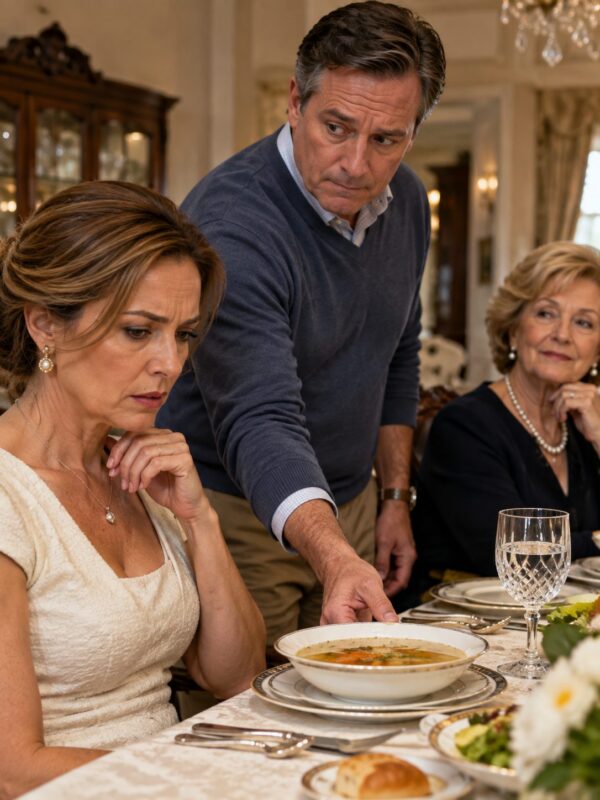
That one small movement told me everything. People don’t check to see if they’re being watched when they’re just adding a little extra seasoning. I stepped backward into the hallway before he could spot me and quietly slipped into the guest bathroom.
For a long time, I just stared at my reflection in the mirror. I looked pale. Tense. Older than I remembered.
My name is Diane Foster. I was fifty years old that Sunday evening, and up until that exact moment, I would have sworn to anyone that after twenty-six years of marriage, I knew my husband inside and out.
I was dead wrong.
Mark and I lived in Carmel, Indiana, in the same brick ranch house we’d bought when we were young. We never had children; life simply unfolded differently for us. Instead, we filled our years with our careers, church events, weekend getaways, dinners with friends, and the rigid family traditions that Mark’s mother, Judith, treated like the letter of the law.
The most unbreakable of those traditions was Sunday dinner. Every Sunday at 5:30 sharp, the Foster family gathered at Judith and Harold’s house near Geist Reservoir. Being late was frowned upon. Missing it entirely was practically unthinkable.
That particular Sunday, Mark and I walked in three minutes late.
“You’re late,” Judith announced the second she opened the front door.
“Traffic,” Mark muttered.
From his recliner in the living room, Harold glanced over. “There wasn’t any traffic.”
Judith shot him a withering look. He just shrugged and went back to watching his fishing show.
Normally, I would have chuckled. It was such a quintessential Foster-family exchange that it seems impossible, looking back, that something so much darker was already brewing beneath the surface. But Mark had been acting strangely the whole drive over. Usually, he’d fill the silence griping about Colts football, highway construction, gas prices, or annoying neighbors. That afternoon, he had barely said a word. His knuckles were white on the steering wheel, and he kept checking the dashboard clock.
“You okay?” I had asked.
“Just tired,” he replied, flashing a smile.
But after twenty-six years, I knew his real smile. This wasn’t it.
His brother Steve and Steve’s wife Karen arrived shortly after, carrying a blueberry pie. Karen slipped into the kitchen next to me.
“Judith still insists homemade is better,” she whispered.
“I know.”
“So I took it out of the store packaging in the car before we came in.”
I laughed. “I did the exact same thing last Thanksgiving.”
For a few minutes, we were just two daughters-in-law trying to survive another Foster dinner. Then Judith called everyone to the dining room.
Chicken soup was always the first course. Six steaming bowls sat waiting for us, soon to be followed by pot roast, potatoes, carrots, rolls, and pie.
“Oh, I forgot the crackers,” Judith said, already half-seated.
“I’ll get them,” Mark offered immediately. Too immediately.
Then, for reasons that would only make sense minutes later, he picked up my bowl.
“My bowl?” I asked.
“You like extra pepper.” He gave me that same fake smile again.
A knot tightened in my stomach. “I’m going to go wash my hands.”
Nobody paid any attention when I left the room. But instead of heading straight for the bathroom, I slowed my pace as I neared the kitchen entrance.
That was when I saw him. Mark was standing with his back half-turned to me. He pulled a small, folded packet from his pocket, tore it open, and tapped a fine white powder into my soup. He gave it two quick stirs.
My heart started hammering against my ribs. In a flash, the last six months of my life rearranged themselves in my mind, the puzzle pieces suddenly snapping into a terrifying picture.
The sudden dizzy spells. The crushing headaches. Walking into rooms and completely forgetting why I was there. Losing my train of thought mid-sentence. Falling asleep, exhausted, at odd hours. Feeling clumsy, living in a constant brain fog.
Mark had always been quick with an explanation. “You didn’t eat enough.” “You’re just stressed.” “You’re working too hard.” “You’re fifty, Diane. Bodies change.”
Once, after I got totally disoriented driving to a grocery store I’d shopped at for years, I pulled into a parking lot and just cried. When I told Mark about it later, he gave me a gentle, patronizing smile. “Welcome to getting older.”
Even my doctor had been stumped. But standing there in the shadows of Judith’s hallway, I realized the explanation might have been sleeping next to me this whole time.
Mark carried the bowl back into the dining room. “There you go.”
“Thanks.” I took my seat beside him. Beneath the table, his knee was bouncing a mile a minute.
Chatter filled the room. Judith went over her Thanksgiving itinerary, Harold recounted an old story, Steve corrected his details, and Karen laughed. Everything looked so painfully, deceptively normal.
I stared down at the soup in front of me. Steam curled into the air, carrying the scent of rosemary, thyme, and chicken stock. It smelled like home. Like family. And like something that absolutely did not belong.
For a split second, I tried to convince myself I was crazy. Maybe it was harmless. Maybe there was a perfectly logical explanation. Then, I caught Mark watching me. Just waiting.
That ended the debate in my head.
When a joke drew everyone’s attention to the other end of the table, I quietly reached over and swapped my bowl with Judith’s. They were identical. Nobody noticed a thing.
Judith sat back down. “So,” she said, picking up her spoon, “who is hosting Thanksgiving this year?”
My mouth went completely dry. She took a bite. Then another.
Mark leaned in. “You’re not eating.”
“It’s too hot.”
“Give it a minute,” he said, his tone strangely encouraging.
Several minutes ticked by. Then, Judith suddenly stopped mid-sentence. She blinked hard.
“My hands feel strange.”
Her spoon clattered onto the table, slipping right through her fingers. Harold frowned. “What’s wrong?”
Judith tried to push her chair back and stand, but her legs wobbled dangerously. Steve jumped up to catch her while Karen frantically dialed 911. The room erupted into total chaos.
And amidst all the panic, I locked eyes with Mark.
He didn’t look at his mother first. He looked straight at me. I was sitting perfectly upright, alert, and watching him closely. All the color drained from his face. That look of sheer panic told me more than a signed confession ever could.
The paramedics arrived quickly and rushed Judith to the ER. Steve and Harold followed the ambulance, while Karen promised to swing by later with some overnight clothes. Soon, Mark and I were left standing alone in the driveway.
“You should probably get checked out too,” he mumbled.
“For what?”
“You’ve been… tired lately.”
For six solid months, he had gaslit me about every single symptom. Now, suddenly, he was the concerned husband.
“I feel fine,” I said flatly.
His jaw clenched. The drive home was deafeningly silent.
Later that night, Mark went upstairs to take a shower. The second the bathroom door clicked shut, I grabbed some clean plastic bags, a pair of gloves, and my car keys, and drove straight back to Judith’s house.
The dining room looked exactly as we had left it—a pushed-back chair, half-empty water glasses, crumpled napkins on the rug. And the soup bowls, still sitting on the table.
Carefully, I bagged the bowl Judith had eaten from, along with her spoon. Then, glancing under the table, I spotted it: a tiny, crumpled white packet. Mark must have dropped it in the commotion. I sealed that in its own bag.
I had no idea if any of this would hold up legally, but I knew that if someone came in and cleaned the house, my only chance at getting real answers would be washed down the drain.
When I got back to our house, Mark was waiting in the kitchen.
“Where were you?”
“I went back. I thought I left something behind.”
His eyes narrowed. “You didn’t bring anything in with you.”
I held his gaze, unblinking. “It’s been a long night.”
We stood there in a standoff for what felt like hours. Finally, he looked away.
Neither of us slept. The next morning, Karen called.
“They don’t think Mom had a stroke,” she said.
I sat down heavily. “What do they think it is?”
“They’re running a toxicology screen and some more tests.”
Across the kitchen island, Mark was gripping a newspaper he definitely wasn’t reading.
That afternoon, I managed to get an emergency appointment with my longtime physician, Dr. Emily Lawson. After listening to my story, she quietly got up and shut the exam room door.
“Diane, I need to ask you a very unusual question,” she began. “Has anyone had regular access to your food or daily medication?”
My stomach dropped. “Why?”
She swiveled her computer monitor to face me. “One of your blood panels from a few months ago showed trace amounts of a heavy prescription sedative. The levels were incredibly low, and at the time, we couldn’t determine if it was an anomaly. I ordered a follow-up test, but you canceled it, saying you were feeling better.”
I barely remembered canceling.
“Have you knowingly taken any sedatives?” she asked gently.
“No.”
“Does Mark prepare food or drinks for you?”
I thought about the morning coffees. The afternoon smoothies. The dinners he had recently started insisting on cooking from scratch.
“Yes.”
Dr. Lawson immediately ordered a full workup. Leaving her office, I drove straight to a private, independent testing lab with my plastic bags.
“I need these analyzed,” I told the technician.
“Looking for anything specific?”
“I have no idea.”
The expedited testing cost a fortune, but I handed over my credit card without hesitating.
Over the next few days, Judith began to recover. The doctors confirmed there was no permanent neurological damage. Mark, however, was unraveling, growing more paranoid and jittery by the hour.
Then, the lab called.
The technician asked me to come in person and closed her office door before giving me the results.
“We identified a powerful, concentrated prescription sedative in the soup,” she said.
“What does it do?”
“Depending on the dosage, it causes severe confusion, dizziness, chronic fatigue, memory gaps, loss of coordination, and severely impaired judgment.”
My symptoms. Every single one.
“What if someone was given micro-doses of this over a long period?” I asked.
She hesitated, giving me a sympathetic look. “Over time? That person would appear to be suffering from severe, progressive cognitive decline.”
Progressive. That word changed everything. This wasn’t a one-time mistake. This had been happening for months.
Then she handed me a second page. The lab had pulled prints from the little white packet. More than one person had handled it.
Up until that moment, I thought Mark was acting alone. Now, another horrifying possibility crept into my mind. And the first person I thought of was Judith.
The very next morning, I reached out to Tom Reynolds, a retired Indianapolis detective that Harold had actually recommended to us years ago. We met at a quiet corner café. Tom listened in absolute silence as I laid everything out.
When I finished, he took a sip of his coffee and looked me dead in the eye. “Are you prepared for the possibility that your marriage—and your life—has been very different from what you believed?”
I stared down at my mug. “I think I’m already there.”
Tom started digging into the financials first. A few days later, he slid a document across the table: a life insurance policy on me. The payout number made me do a double-take. Two million dollars.
“When was this increased?” I asked, feeling sick.
“Eight months ago.”
I traced the signature at the bottom. It looked exactly like mine. But I had never signed it.
Tom had also unearthed the truth about Mark’s boutique insurance agency. It was drowning. Terrible investments and a mass exodus of clients had left him hundreds of thousands of dollars in debt.
He had a motive. A massive financial motive. But that still didn’t explain Judith’s involvement.
I went to see Judith at the hospital. Without her makeup and perfectly styled hair, she looked small and frail in the sterile bed.
“Diane. I’m so glad you came.”
“How are you feeling, Judith?”
“Embarrassed,” she sighed.
That threw me off. “What do you remember about that night?”
She frowned, rubbing her forehead. “Making the soup, mostly.”
My chest tightened so hard I could barely breathe. “You made it?”
“Of course. Mark helped me.”
The hospital room suddenly felt like a freezer. Before I could press her further, Harold walked in, putting a swift end to the conversation. But not to my questions.
A few days later, Harold called me out of the blue and asked to meet privately. When I pulled up, he was sitting alone on his back patio, staring out at the yard.
“I suppose you know,” he said quietly as I approached.
“Know what?”
“About Mark.”
I took the wrought-iron chair across from him. “Tell me.”
Harold looked exhausted. He explained that after fifty years of marriage, he had simply learned to live with Judith’s obsessive need for control. She hoarded documents. Kept meticulous notes. Stored copies of personal information that people had no idea she possessed.
“Why?” I asked.
Harold didn’t look away from the lawn. “Leverage.”
But it was Steve who had stumbled upon the real goldmine. Judith, always needing to be the all-seeing matriarch, had installed hidden nanny cams in various rooms of the house to keep tabs on the family when she wasn’t around.
Most of the footage was mundane. One clip even caught Judith sneaking three slices of the pie she had loudly complained was «too sweet.» For the first time in a week, Steve and I had shared a grim laugh over that one.
But then Steve opened a hidden folder on her computer. And all the laughter died.
The video showed Mark and Judith sitting at the kitchen island, having a hushed conversation. About me. About my inheritance—a sizable trust my late aunt had left me, completely separate from my marital assets with Mark.
Judith spoke about the money as if it were already sitting in her bank account. Then, Mark brought up my «memory issues.» Judith eagerly suggested documenting more «incidents.»
And then, she dropped the word. Guardianship.
My blood turned to ice. Suddenly, the entire sick master plan snapped into crystal-clear focus.
They weren’t just trying to make me sick or kill me off. They wanted the world to believe I was losing my mind, that I could no longer manage my own affairs. If enough doctors, friends, and family members went on the record saying I was slipping into early-onset dementia, my financial independence could be legally stripped away. Mark could seize control of my inheritance to bail out his failing business, and Judith would hold the puppet strings.
While Steve and I were staring at the paused video, my phone buzzed. A text from an unknown number.
Stop looking for answers.
That was the exact moment my fear finally burned away, leaving nothing but pure, white-hot anger.
Tom advised me not to reply. “Don’t confront them yet,” he warned. “Just keep gathering evidence.”
Living under the same roof as Mark while pretending I didn’t know he was methodically poisoning me was its own kind of torture.
Every morning, he played the doting husband. “How did you sleep, honey?” Every evening, he probed for weakness. “Are you feeling tired today?”
He started bringing me coffee in bed. I poured it down the drain. He offered to cook dinner. I found excuses to eat out or skip meals entirely.
Then, one night over takeout, he casually dropped a bomb. “Maybe we should think about selling the house.”
“Why?” I asked, keeping my voice level.
“Fresh start,” he smiled.
“For us?”
“Sure.” His answer came way too fast.
Our home was fully paid off. It had massive equity. It was just another asset they wanted to liquidate.
“Maybe,” I murmured.
Visible relief washed over his face. He actually thought I was giving up. He thought he was winning.
He had no idea.
Tom eventually uncovered Judith’s digital footprint. She had spent hours researching adult guardianship and power of attorney laws in Indiana. Meanwhile, Harold finally took a crowbar to one of Judith’s locked filing cabinets.
Inside was a master class in stalking. She had compiled a massive dossier on me: copies of my private medical records, bank statements, the inheritance trust documents, and pages upon pages of handwritten, detailed logs noting every time I left the house, when I was alone, and every manufactured instance where I “seemed forgetful.”
I stared at her neat, cursive handwriting until my hands shook. For years, this woman had sat across from me at Sunday dinner, passing the gravy while quietly calculating my destruction.
We brought in Melissa Grant, a powerhouse family and estate attorney. She reviewed the mountain of evidence and nodded grimly. “Legally, this is substantial. But realistically? Making them confess to this plot in front of witnesses is what will destroy their ability to deny it in court.”
The perfect opportunity fell right into my lap when Mark suggested we host a «welcome home» Sunday dinner for Judith once she was discharged.
“Just a nice, quiet family dinner,” he insisted.
I almost laughed in his face. “I think that’s a wonderful idea.”
That Sunday, the exact same cast of characters took their seats around our dining room table. Judith. Harold. Steve. Karen. Mark. Me.
For the first excruciating ten minutes, everyone engaged in polite, plastic small talk.
Then, I reached down and dropped a thick manila folder right in the center of the table.
Mark stopped mid-sentence. “What’s that?”
“Answers,” I said.
I pulled out the documents one by one, fanning them out like a deck of cards. The forged life insurance policy. The toxicology report. Judith’s printed search history on adult guardianship.
Judith’s hand started to visibly shake. “Diane—”
I held up a hand, silencing her. “Please.” And for the first time in twenty-six years, she actually shut up.
I flipped open my laptop and connected it to the living room TV. I pressed play.
Judith’s voice echoed through the house, crystal clear. She was talking about my memory. Then Mark’s voice chimed in, discussing how to manipulate my doctor into documenting my “cognitive decline.” Then they moved on to the house equity, the trust fund, and the guardianship timeline.
Karen slapped both hands over her mouth. Steve stared at his brother like he was looking at a monster.
Mark’s face turned scarlet. He leaped up. “Where the hell did you get this? This is ridiculous!”
I calmly clicked the mouse, playing the next clip. And then the next. With every video, another one of their possible alibis burned to the ground.
Finally, Mark slammed his fist on the dining table. “This is insane!”
Harold looked up at his son, his eyes hollow. “No, son.” Mark froze. Harold’s voice was barely a whisper, but it carried across the room. “But it is true.”
Judith was practically hyperventilating. “You don’t understand! We were just—”
“Then explain it,” I challenged her.
She opened her mouth, but nothing came out.
Right on cue, the doorbell rang, and Tom walked in. We had arranged for him to wait outside.
Mark spun around. “Who the hell are you?”
“I’m the guy who’s been helping Diane figure out exactly what you put in her soup,” Tom said coolly. He pulled out a voice recorder and hit play.
It was a phone call we’d intercepted. Judith complaining that the poisoning was taking too long. Mark warning her they couldn’t rush it. Them gloating over how lethargic I’d been, and re-confirming their plan to seize my inheritance to pay off Mark’s staggering business debts.
When the tape hissed to a stop, the room was dead silent.
Slowly, Harold pushed his chair back and stood up. He looked down at Judith with an expression of pure, unadulterated disgust—a look I had never seen on him before.
For nearly fifty years, he told her, his voice shaking, he had convinced himself that biting his tongue was the only way to keep their family intact.
“I told myself you were just a strong woman,” Harold said, tears welling in his eyes. “But this isn’t strength.” He leaned in close. “It’s cruelty.”
No one yelled after that. There was no need to. The truth was far too enormous, too heavy, to be shouted away.
The authorities took over the next day. Everything went through official channels. The hospital’s toxicology report confirmed Judith had ingested the exact same heavy sedative found in my soup. My own hair follicle and blood tests proved a consistent, long-term pattern of micro-dosing.
The detectives pieced together the rest of the puzzle: Mark’s impending bankruptcy, the forged signatures, the deleted text messages, and the undeniable intent to medically gaslight me into a conservatorship.
The plan had been chillingly simple: drug me just enough to make me appear incompetent, build a medical history of dementia, and then legally hijack my life. The only flaw in their plan was the double dose in the soup that forced my hand.
Before Mark left the house that final night, as he was packing a bag, he stopped in the doorway. For a fleeting second, his mask slipped, and I saw the young man I had married. The man who had slow-danced with me in our first tiny apartment. The man who had held me together at my father’s funeral. The man who once drove three hours through a blizzard just because I was scared to be alone.
“I’m sorry,” he whispered.
And the crazy part? I actually believed him. I think he really was sorry. Sorry he got caught. Sorry he’d destroyed his mother. Sorry his entire life was going up in flames. Maybe, somewhere deep down, he was even sorry for what he had done to me.
But regret doesn’t undo choices.
“I’m sorry, too,” I said.
A flicker of pathetic hope crossed his face. “For what?”
“For ever believing I knew who you were.”
I turned and walked away, and I didn’t look back.
The next year was a blur of depositions, forensic accounting, court dates, and endless meetings with lawyers. My marriage didn’t end with a dramatic movie moment; it ended with the dry rustle of paperwork and a judge’s gavel.
Harold filed for divorce from Judith shortly after. Mark ended up accepting a plea deal for multiple felonies related to the financial fraud and the poisoning. Judith’s high-priced attorneys played the “elderly and frail” card, dragging out her hearings, but the courts eventually stripped her of everything that mattered to her.
I learned very quickly that real justice doesn’t look like a TV show. There are no sweeping monologues or triumphant applause. Real justice is just evidence logged in plastic baggies, exhausted lawyers sipping stale coffee under fluorescent lights, and a judge reading a verdict in a pin-drop quiet room.
Physically, I bounced back faster than anyone expected. Once the daily poison stopped, the fog lifted. My dizziness vanished. My memory sharpened. The bone-deep exhaustion finally faded away.
I stopped feeling like a prisoner in my own failing body. But that realization brought its own kind of grief. For months, I had blamed myself. I blamed my age, my stress levels, my health. All while the people I loved most were actively trying to destroy my mind and steal my life.
I started going to therapy. I hated it at first. My therapist pushed buttons I didn’t want touched.
“Do you trust your own memories, Diane?”
“Do you trust your judgment?”
“Do you trust people?”
It took a long time to realize why she kept asking. The money, the house, the betrayal—none of that was the worst thing Mark and Judith had stolen from me. They had stolen my confidence in my own perception.
Every time I felt sick, they fed me a lie. Every time I forgot my keys, they weaponized it as proof. When I questioned them, they made me feel hysterical. True recovery wasn’t just getting the drugs out of my system; it was learning how to believe myself again.
Harold struggled with his own guilt. A few months after the dust settled, we took a walk along Geist Reservoir.
“I should have spoken up decades ago,” he muttered, watching the water.
“Harold, you couldn’t have possibly known they would do something like this.”
“I knew Judith controlled people.”
“Being controlling isn’t the same as knowing she would do this.”
He sighed heavily. “I thought silence kept the peace.”
I stopped walking and looked at him. “Sometimes, silence only protects the person causing the problem.”
He gave me a sad, tired smile. “Seems like we’re learning some hard lessons a little too late.”
“Better late than never.”
Steve and Karen became my lifelines. Karen brought over casseroles when the legal proceedings drained me. Steve called me so incessantly that I finally had to set boundaries.
“Steve, I promise you, I’m allowed to spend an evening alone without you calling to check if I’m okay,” I told him over the phone.
He chuckled. “Fine. Every other evening.”
It was annoying, sure. But it was also what real love looked like. Real love, I learned, is the exact opposite of control. It doesn’t thrive on confusion. It doesn’t make you doubt your sanity. And it certainly doesn’t need to break you down just to feel powerful.
About a year later, I sold the Carmel house. Packing up twenty years of my life was gut-wrenching. Every room held a ghost. Christmas mornings by the fireplace. Rainy Sunday breakfasts. Friends laughing on the patio. Mark stubbornly painting the guest room a hideous shade of blue, swearing it would look different when it dried.
Some of those memories were genuinely wonderful. And that was perhaps the hardest lesson of all. Someone can completely shatter your world, betray you in the worst imaginable way, and it doesn’t magically make every earlier moment false. Life is messier than that. I didn’t have to erase every good year to accept the nightmare it became.
But I also didn’t have to keep living in a house where every coffee cup and cabinet door made me suspicious.
I bought a cozy little cottage down in Brown County. It wasn’t nearly as grand. The kitchen desperately needed a remodel, the front porch had a slight lean, and the garden was a neglected mess.
I fell in love with it immediately.
My first night there, I sat out on the porch with a mug of hot tea. The night air was loud with crickets. No television blaring in the background. No heavy footsteps pacing behind me. No one asking, with fake concern, if I was feeling tired.
For the first time in years, the silence felt safe.
That spring, I planted flowers. Some bloomed beautifully; some of them died. I started volunteering at the local library. I joined a walking group. I taught myself how to cook meals for one without staring sadly at the empty chair across the table.
Eventually, it stopped being an empty chair. It was just a chair.
Almost two years to the day of that infamous Sunday dinner, Harold, Steve, and Karen drove down to visit me. Karen walked up the path carrying a blueberry pie.
“Homemade?” I teased.
She feigned outrage. “Obviously.”
Steve laughed. “She threw the store packaging away before we got here.”
We ate out on the porch. Nobody checked the clock. Dinner didn’t start at exactly 5:30. And absolutely nobody cared.
At one point, Harold raised his glass. “To new traditions.”
We raised ours, and for a fleeting moment, my mind drifted back to the old Foster dining room. For twenty-six years, I had believed that strict traditions were the glue that held a family together. Judith had believed it, too.
But we had both misunderstood something fundamental.
A table doesn’t make a family. A schedule doesn’t make a family. Even sharing a last name doesn’t make a family.
Trust does. Respect does. Safety does. Without those things, tradition is nothing but repetition.
People sometimes ask me if I regret swapping those bowls that Sunday. It’s not a simple answer. Judith ended up severely ill from the overdose, and for a long time, I carried a lot of guilt over that.
But I also know what I saw. I know exactly what was slipped into the bowl intended for me. I know the hell my health had been put through for months. And I know I only had seconds to decide what to do.
That split-second decision exposed a rot that would have eventually stolen far more from me than just my money.
For the vast majority of my marriage, I equated strength with patience. I thought being a good wife meant always giving someone another chance to explain. I thought maturity meant avoiding conflict whenever possible.
Those qualities aren’t wrong. But they become incredibly dangerous when someone learns how to use them against you.
There is a massive difference between being patient and ignoring warning signs. There is a difference between forgiveness and surrender. And there is a profound difference between peace and silence.
I know that now.
Sometimes, my mind still wanders back to that Sunday dinner. I see the steam rising off the soup. I see Mark watching me. The tiny packet crumpled beneath the table. And my own reflection in the guest bathroom mirror, moments before everything changed.
I looked frightened in that mirror. But buried underneath the terror was something else. A quiet, stubborn voice I had been ignoring for far too long.
It was telling me that what I saw was real. That my instincts mattered. That I mattered.
For months, other people had been actively teaching me not to trust my own mind. On that one Sunday evening, I finally did.
And that decision didn’t just give me my old life back. It gave me the chance to build an entirely new one.





