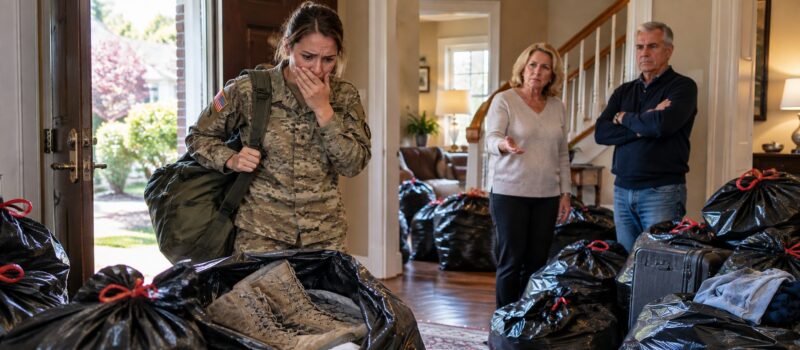
After returning from a nine-month deployment, I walked into my house to find my belongings stuffed into trash bags. Evelyn stood there in her usual pressed blouse, looking as though she had somewhere important to be. My dad, Richard, stood behind her with his arms crossed and posture straight, still carrying himself like his old colonel title hadn’t been retired.
Neither of them was smiling.
“You’re back earlier than we expected,” Evelyn said.
I blinked slowly.
“I told you my return date,” I said.
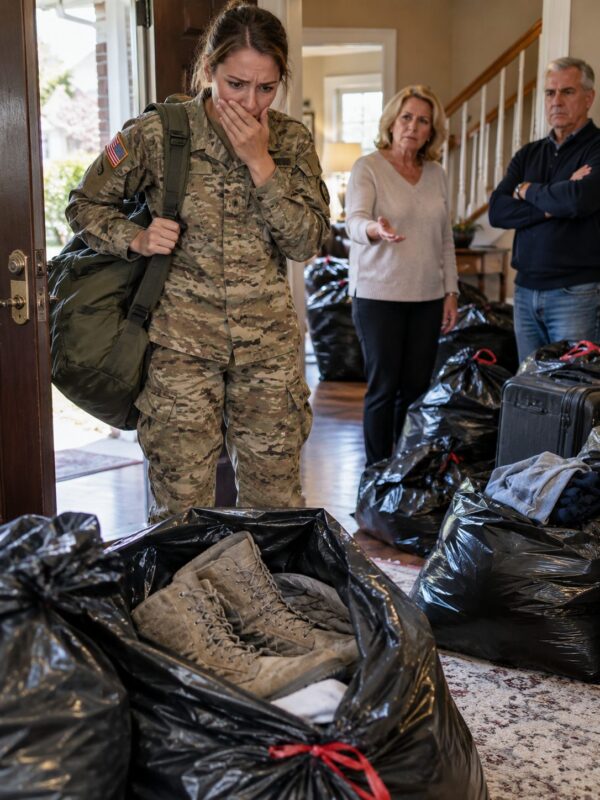
She waved that away as if deployment schedules and time zones were optional.
“Well, things changed.”
Of course they had. I lifted one of the garbage bags slightly.
“Yeah,” I said. “I can see that.”
Richard stepped forward—not aggressively, just enough to take up space.
“We needed to make some adjustments while you were gone.”
Adjustments.
That word carried a lot of weight in this house. I looked past them into the living room. The furniture had been rearranged. New throw pillows. A framed photo I didn’t recognize. None of it was mine.
“Where’s Chloe?” I asked.
Evelyn finally smiled.
“Oh, she’s upstairs resting.”
Resting. That told me enough.
“And Vance?”
“Moved in.”
My duffel bag still sat on the porch behind me like it hadn’t gotten the memo.
“And my room?”
Evelyn tilted her head as if explaining something obvious.
“Well, honey, Chloe needed the master suite.”
Of course she did.
“She’s been under a lot of stress,” Evelyn continued. “You know how sensitive she is.”
Yeah. Sensitive enough to need a king-size bed that wasn’t hers. I nodded once.
“So, where am I sleeping?”
Richard answered.
“You’ve got options,” he said.
Options.
“The basement is available,” he added.
They had moved in last month. Not visiting. Not temporarily. Moved in.
“Or you can head back to the barracks on base. Might be easier with your schedule anyway.”
I stared at him. An unfinished basement with a cold concrete floor and half-installed drywall, or returning to base as if my deployment had never ended. Those were my choices.
Evelyn stepped closer, using her soft public voice.
“We just thought it made more sense,” she said. “You’re single. You’re gone half the time. You don’t need all this space.”
There it was. No guilt or hesitation, just pure certainty, as though they had rehearsed this justification repeatedly before I ever walked through the door.
“Be a good sister for once,” Evelyn added.
And there was the role I had played my whole life: the reliable one, the one who adjusted, the one who made everything work.
They expected an argument. I gave them none.
Instead, I walked right between them. Richard shifted slightly, perhaps expecting me to storm upstairs and make a scene. I didn’t. I passed the living room and kitchen, heading straight for the basement.
The air grew colder as I descended. Same unfinished walls, same dust and old paint. Nothing had changed because no one cared enough to change it. Behind several storage bins, I knelt beside a floor panel that didn’t quite match the others.
Still there. Good.
I lifted it carefully. The safe sat exactly where I had left it. Digital keypad. No scratches. No sign anyone had touched it.
They hadn’t looked. They didn’t know.
I punched in the combination. Click.
Inside, protected by a waterproof sleeve, was a single folder. I opened it.
The original deed. Still crisp. Still untouched. Not in Richard’s name. Not in some shared family trust. Mine. Transferred years earlier, quietly and legally, protected through layers they had clearly never bothered to understand.
My grandfather had made sure of that. A general doesn’t leave loose ends.
My heartbeat steadied. Upstairs, I heard movement and laughter. They thought this house belonged to them; they thought I was the one who no longer belonged. I looked at the deed and smiled, barely.
They had no idea what they had done.
I kept the folder beside me and pulled my laptop from my duffel. If they wanted to play house, I was going to check the rest of my life.
The screen lit the concrete floor. I connected to the Wi-Fi. Same password, of course. Nothing in this house changed unless it benefited Chloe. I logged into my military banking portal.
Before the dashboard even finished loading, something felt wrong. Experience teaches you not to ignore that feeling. Then the balance appeared.
Wrong. Not slightly off. Wrong.
Hazardous-duty pay gone. Deployment bonuses gone. Not pending. Not delayed. Gone.
“Okay,” I muttered. No panic. Assessment.
I opened the transaction history. Multiple transfers. Clean. Structured. Whoever had done this knew precisely when I was deployed, when communication was unreliable, and when I had almost no oversight.
I opened the first large withdrawal. A domestic wire. Then another, and another. Different amounts, same pattern. I pulled out a notebook and recorded the dates, transaction numbers, and totals. This wasn’t emotional anymore; it was a problem, and problems could be documented.
I traced the destination accounts until one connected directly to Evelyn. I checked twice. Same routing number, same bank, same name.
“Of course,” I whispered. “Of course it was her.”
Then I checked login records. Every login leaves a footprint, and there were account accesses originating right from my home while I was halfway across the world. Same device signature. Same location. No attempt to hide it because they simply assumed I would never check.
Then I found a document uploaded three months earlier: a power of attorney. My name at the top, Evelyn listed as the authorized agent, and my signature at the bottom.
Except it wasn’t mine. It resembled my handwriting enough to fool a casual observer, but the pressure and flow were all wrong. Copied, not written. There was a witness signature and a notary stamp, too—official-looking, which made it all the worse. This wasn’t simple theft; it had been planned, documented, and filed.
I returned to the transactions and totaled them twice. $45,000.
The money mattered, but the access, intent, and forged paperwork mattered more. I followed the trail beyond Evelyn’s account to find irregular payments and large credits, and then I saw the name attached to the underlying debts: Vance.
I stared at the screen and let out a single, sharp laugh. Of course. Lieutenant Vance—all perfect uniform and crisp posture, constantly talking about integrity and career progression. Meanwhile, he was buried in gambling debt severe enough to require $45,000 to disappear quietly. Debt that could instantly torch his security clearance and his career.
Everything clicked. Evelyn hadn’t stolen from me for herself; she had done it to protect Vance and preserve Chloe’s perfect life at my expense.
I closed my eyes briefly and locked the facts into place: federal wire fraud, identity theft, forgery, and an active-duty officer involved. Vance wasn’t just a man with bad habits anymore; he was a liability in uniform.
I documented everything—screenshots, transaction logs, IP records, and copies of the forged power of attorney—then duplicated and organized the files. I connected my portable printer, and the pages slid out one by one. I aligned them and slipped everything into the tactical folder I normally used for deployment briefings.
Appropriate.
Upstairs, they still thought this was about a bedroom, or about me being difficult. It wasn’t. This was evidence, and I knew exactly where evidence belonged.
I packed my laptop and headed upstairs. Before I even reached the top, I caught the smell of barbecue, followed by laughter and the clinking of glasses. I opened the door.
They were hosting a party in my backyard. String lights, folding tables, a full barbecue spread. Officers everywhere—captains, a major I recognized, and even a lieutenant colonel standing near the cooler. I hadn’t been home twelve hours, and somehow I was the guest at my own welcome party.
Evelyn moved through the crowd effortlessly, touching shoulders, smiling warmly, and laughing at the exact right moments. Perfect. Always perfect.
“Harper!” she called out loudly enough to turn heads. Performance time.
I walked forward calmly. Every person who looked at me seemed to perform the same quick assessment—posture, expression, condition—trying to match me to whatever version of myself they had already been told to expect.
Evelyn gave me a quick hug, far too brief to mean anything.
“We’re so proud of you,” she said, just loud enough for the nearby group to hear.
I didn’t hug her back.
“Didn’t know I was getting a welcome party,” I said.
Her smile tightened. “Oh, it’s just a small thing. You know how your father likes to keep connections strong.”
Translation: This wasn’t for me.
Across the yard, Vance stood near the grill, laughing too loudly and networking like his career depended on it. Beside him stood Chloe in a new dress, with perfect hair, flawless makeup, and an expensive designer watch wrapped around her wrist.
I looked at it half a second longer than necessary. She noticed, her smile widening as she lifted her wrist and adjusted her hair to make damn sure I saw it.
Message received. I walked right past her.
“Captain Harper.”
I turned. Major Collins. I had met him once during a logistics briefing.
“Sir,” I said with a nod.
“Welcome back,” he said. “Heard you had a rough deployment.”
“Nothing I couldn’t handle.”
Before he could continue, Evelyn appeared at our side.
“Oh, she’s just being modest,” she said with a soft laugh. “It’s been difficult.”
I didn’t look at her.
“She’s had a lot of stress,” Evelyn continued smoothly. “We’re just trying to give her space to adjust.”
Major Collins shifted slightly. It was a tiny movement, but I caught it. This was how Evelyn operated—not with direct accusations, but with subtle suggestions designed to frame everything I did afterward through a specific lens.
“I’m fine,” I said. Simple. Direct.
Evelyn smiled as though my answer conveniently proved her point. “Of course you are, honey. We all just want what’s best for you.”
Concern weaponized as control. I picked up a sparkling water from the table—no alcohol for me, I wanted a clear head. As I moved around the yard, I listened. Richard mentioned to a group that I might need time, noting how combat zones change people, and how lucky I was to have family. Every comment was carefully framed so that by the time I told anyone the truth, everyone would already be primed to question it.
Smart. Almost impressive.
I stopped near the grill. Vance looked up.
“Hey, Harper,” he said, flashing a grin like we were old college buddies. “Good to see you back.”
“Lieutenant.”
His smile twitched. Rank mattered to men like him.
“How was overseas?” he asked.
“Hot,” I said.
He laughed too loudly. “Yeah, I bet. Nothing like being back home, though, right?”
I looked him straight in the eye. “Depends on the home.”
His smile remained, but his eyes hardened. Chloe sidled up beside him and slipped her arm through his.
“We made your room really nice,” she chirped. “I think you’ll like the basement once it’s finished.”
Once it was finished. They already had long-term plans for my house. I took a sip of my drink without answering.
Across the yard, Richard caught my eye and gave a subtle nod toward the side of the house. Private conversation. Of course.
I followed him out of earshot.
“You need to handle something tomorrow,” he said immediately. No greeting, just an order.
“What kind of something?”
“A transfer,” he said. “Paperwork. Simple.”
I already knew where this was headed. “Transfer of what?”
“The house.” There it was.
“Chloe needs stability,” he continued, doubling down. “You’re not here enough to justify holding onto a property like this.”
Holding onto. Interesting phrasing.
“I’m here now,” I said.
He ignored that completely. “You’ll go down to the office tomorrow, sign the documents, and make it official.”
Not a request.
“And if I don’t?”
His tone dropped, hardening into something colder. “I still have connections. People who remember what I’ve done, who I’ve helped.” The old colonel emerged from beneath the surface. “You’re up for major soon. It would be a shame if something complicated that process.”
I looked at him carefully. This wasn’t family; this was leverage, pressure, and control deployed through familiar tactics on a different battlefield. He still thought he was in command.
I let the silence sit for a beat, then smiled.
“I’ll make sure the paperwork is handled exactly as it should be, Dad.”
He searched my face for resistance and found none.
“Good,” he said, before turning and walking away.
I stayed right where I was, listening to the muffled sounds of the party: Chloe still showing off her watch, Vance networking, and Evelyn smiling as though everything in the world was under control.
My smile stayed, too—through the sunset, through the guests leaving, through the quiet of the night, and straight into the fluorescent-lit JAG office early Monday morning.
I carried my folder tucked under one arm through the clean floors and quiet halls. No emotion. Absolute precision.
A specialist checked me in, and two minutes later I was sitting across from Captain Morales. She had sharp eyes and zero interest in small talk.
“You said this was urgent,” she noted.
I slid the folder across the desk toward her. “It is.”
She started with the bank records, moved to the IP logs, and finally examined the power of attorney. I let her read in silence. Her expression barely shifted until she reached the forged signature.
“That’s not yours,” she stated.
“No, ma’am.”
She flipped to the next page. “$45,000 transferred while you were deployed.”
“Yes.”
“And this individual, Vance—he’s an active-duty lieutenant.” She leaned back in her chair and let out a slow breath. “All right. This is already bad.”
“It gets worse,” I said.
“I need to bring someone else in,” she decided, sliding the folder back slightly. “This overlaps with civilian property law if there’s more tied to it.”
“Call him,” I said.
Ten minutes later, a civilian real-estate attorney in his mid-fifties named Mr. Dalton joined us. He was direct and wasted no words.
“Captain,” he said, adjusting his glasses. “Let’s see what we’re dealing with.”
Morales handed him the folder. Dalton moved through the documents quickly, focusing less on the financial fraud and more on where the paper trail led. Then, he stopped.
“Hold on,” he muttered, pulling out a loose sheet I hadn’t seen yet. “Is this yours?”
It was a purchase agreement for my address. Buyer: a private development firm. Sale price: $650,000.
“Where did you get this?” I asked, leaning forward.
“Pulled from preliminary county filings,” he said. “This was submitted for processing last week.”
Last week. While I was still overseas. Seller: Richard. Signature: Richard. Co-signed by Evelyn. Attached to it was a deed bearing my name and another forged signature—cleaner than the power of attorney, but still fundamentally wrong.
“They don’t own this property,” Dalton said, looking up.
“I do,” I replied.
“Through what structure?”
“A revocable trust,” I explained. “Transferred directly by my grandfather.”
His attention sharpened instantly. “Is it recorded?”
“Not at the county level. It’s protected and private.”
Dalton nodded slowly. “Then they assumed it was still part of the estate. They thought they could execute a clean transfer.”
“They didn’t check.”
“They didn’t even know what to check,” he corrected.
Fair enough. Morales leaned forward, her eyes narrowing.
“So they forged a deed, attempted to sell a property they don’t legally own, and committed financial fraud using a forged power of attorney.”
Dalton let out a quiet whistle. “That’s not a mistake. That’s a coordinated pattern.”
Exactly.
“Were they planning to pocket the money?” he asked.
I pictured Chloe’s designer watch and the smug way she had talked about my room. “Yes.”
“All of it?”
I nodded.
“All right,” Dalton said firmly. “Then we don’t warn them.”
Morales agreed without hesitation. I looked between them.
“What’s the fastest way to stop this?”
Dalton didn’t miss a beat. “A lis pendens—a formal notice of legal dispute tied directly to the property.” Once filed, the transaction would freeze instantly. No sale, no clean title, and zero access to the property until the legal dispute was fully resolved.
“And the trust?” Morales asked.
“We record it immediately,” Dalton said. “Put it on public record. That kills their claim completely.”
“Do it.”
If we moved fast, everything could be filed the moment the county clerk opened at eight o’clock the next morning.
“I’ll be there,” I said, closing the folder.
Sitting there in the quiet office, I realized how much my perspective had shifted over the past forty-eight hours.
The first shift was internal: I stopped treating the situation purely as a messy family dispute and started treating it as a logistical problem that needed to be handled correctly.
The second shift was in communication. I stopped trying to argue or explain myself. Explaining what you know to people who are actively manipulating you only gives them more information to weaponize against you. While they talked, I collected facts—bank records, IP logs, legal documents, and signed filings. Opinions can be easily dismissed, but a paper trail is much harder to argue away. Once I had documentation, I didn’t need to convince anyone emotionally.
The third shift was letting go of the need for a confession or closure. Most people confronting someone who wronged them want acknowledgment—they want the other person to admit they did it, that you were right, that they caused pain. I realized I didn’t need that. Their admission wouldn’t change the underlying facts. I just needed the truth documented. After that, everything became procedural: file the report, record the trust, submit the evidence, protect the property. Each action was simple on its own, requiring no shouting or drama.
That taught me something vital: formal systems exist precisely for situations where human emotions distort reality. Legal systems, military systems, financial systems—when they function correctly, they care about documentation, accuracy, timelines, and proof. They don’t care that someone says, «But we’re family,» and they don’t care that someone calls you selfish for refusing to bankroll their poor choices. It can feel cold, but structure is an invaluable shield when guilt and obligation are being weaponized against you.
My family’s entire argument depended on emotion—Be a good sister, we’re family, you owe us—but none of those phrases changed who legally owned the house, none erased the forged signature, and none wiped away the stolen $45,000. Facts stripped away all their emotional camouflage.
The fourth shift was timing. I hadn’t revealed everything the moment I discovered it. I waited, letting them continue moving forward with their scheme because the further they went, the more exposed they became. People naturally want to react immediately out of anger, but patience matters. They continued the property transfer because they genuinely believed no one would challenge them, thereby generating crucial documentation. They pressured me directly, creating a recording. Vance continued operating with impunity until the investigation finally hit his chain of command.
And the final shift was the hardest: I stopped saving them.
For years, that was all I had done—covering bills, removing obstacles, fixing messes, and softening the blow of consequences. I used to call it support. But constant rescue only prevented the people around me from ever facing the actual cost of their choices. When I finally stepped away, everything collapsed quickly, not because I created their problems, but because I stopped preventing those problems from reaching them.
Someone else’s consequences are not automatically yours to carry just because you love them. You are not responsible for cleaning up every mess you didn’t create, and you certainly don’t have to sacrifice your own stability to keep other adults comfortable. That isn’t loyalty; it’s self-neglect.
When it was all over, I didn’t feel some grand rush of victory. That actually surprised me. After the house dispute, the formal investigations, the public confrontations, and the fallout, I half-expected an emotional high. Instead, I just sat in the quiet living room on another calm morning, feeling a deep, profound sense of clarity.
Clarity isn’t loud. It’s still. For the first time in years, I wasn’t waiting for a crisis, I wasn’t anticipating another panicked phone call asking me to fix a disaster, and I wasn’t bracing for someone else’s emergency to land on my doorstep. There was simply space.
And in that quiet space, I realized something fundamental: I hadn’t lost my family in seven days; I had simply stopped pretending I had the kind of family I always wanted to believe I had.
Accepting that truth was harder than losing the money. Most of us grow up being told that family is permanent—that you stick together, forgive everything, work through every crisis, and maintain the connection no matter what. Those ideals sound noble until you realize that one person has been carrying the entire weight, until connection turns into perpetual obligation, and until love starts requiring your complete self-erasure.
For a long time, I feared that walking away would prove I was the difficult one—cold, selfish, and disloyal. But a relationship that only functions while one person continuously sacrifices themselves is already broken. Staying longer doesn’t magically repair the fracture; it only prolongs the damage.
I didn’t leave because I hated them. I left because trust and respect were entirely gone, and without those foundations, all that remained was toxic habit. And habit was never going to be enough.
Setting boundaries would have been much easier if I had drawn the line years earlier. Instead, I had made exception after exception, telling myself each compromise was temporary, minor, and not worth a fight. But people adapt remarkably fast to what you repeatedly allow. First they appreciate it, then they expect it, then they depend on it, and eventually, they demand it as a right. And when you finally draw the line and say no, your refusal feels like an aggressive disruption to them.
But setting a boundary isn’t creating a problem; it’s simply interrupting a dysfunctional pattern that should have been stopped long ago. Healthy people don’t run away from boundaries; those boundaries merely reveal which relationships only survived because you had none of your own.
That truth stings, but it is ultimately liberating. Once I understood it, I stopped negotiating my own value, stopped wasting breath explaining why basic respect should matter, and stopped trying to prove myself to people who profited from my compliance. Most importantly, I stopped staying in situations that cost me far more than they ever gave back.
Walking away didn’t mean I stopped caring. It just meant I finally included myself on the short list of people I was willing to protect. And once I crossed that line, I could never go back to being the old version of myself. I saw things differently, moved differently, and made very different choices.
The world got a lot quieter. Some relationships simply don’t survive when the person who always gives suddenly starts requiring balance. They fall away, not always because you pushed them out, but because they simply couldn’t operate without the version of you that never said no.
That silence isn’t a loss. It’s the room where peace, clarity, self-respect, and true control over your own life finally get to live. And those things became infinitely more valuable to me than cheap approval or keeping broken dynamics alive at any cost.
So when I think back to standing in that hallway with the garbage bags, I don’t see it as the beginning of a tragedy anymore. I see it as the final, unmistakable warning. The pattern had been there all along; I just finally opened my eyes enough to see it.





