After forty years of marriage, I believed there was very little left for me to discover about my husband.
I knew Frank’s habits, his moods, his favorite songs, and the little things that made him laugh. I knew he hated being late, checked the front door twice before going to bed, and deliberately sang the wrong lyrics whenever one of his favorite tunes came on the radio.
I knew the stories from his childhood.
I knew the names of people he had lost.
I knew about the mistakes he regretted and the things he was proud of.
Most importantly, I believed I knew the man himself.
After four decades together, I thought there were no secrets left between us.
I was wrong.
The hardest goodbye I had ever imagined was supposed to happen with Frank’s hand in mine.
Instead, it came through a phone call from thousands of miles away.
Frank had traveled overseas to visit Claire, his daughter from his first marriage. Their relationship had been complicated for years. There had been long stretches when they barely spoke, followed by brief, hesitant attempts to reconnect.
But recently, something had shifted.
They were calling each other almost every week, and Frank was happier about it than he wanted to admit. Whenever Claire called, I could see the change in his face. He would disappear into another room with the phone and return twenty minutes later pretending the conversation had been totally ordinary.
It never was. He had spent years wishing they could become close again.
So when he told me he wanted to spend three weeks with her, I didn’t try to stop him. I encouraged him.
“You should go,” I told him. “You’ve spent enough years missing each other.”
Frank kissed my forehead. “Forty years together and you’re still trying to get rid of me.”
I laughed. “Three weeks, Frank.”
“Three weeks,” he repeated.
He smiled, picked up his suitcase, and walked toward the front door. I watched him leave, remembering thinking that three weeks was nothing. After forty years together, three weeks seemed like the blink of an eye.
I had no idea I had just watched my husband walk out our door for the last time.
Six days later, Claire called me crying.
The moment I heard her voice, something inside me tightened.
“Diane, Dad collapsed.”
I sat down immediately. I didn’t know why, but something in her tone had already told me there was more.
“Is he in the hospital?”
There was a long pause. I could hear her breathing. Then came the words that stopped my world.
“No. He’s gone.”
I don’t remember much after that. Claire said the ambulance had arrived quickly, that the doctors had tried everything, and that there was simply nothing anyone could do. None of those sentences made any sense to me.
Frank had left six days earlier. He was supposed to come home in another two weeks. He was supposed to complain about the airline food, tell me Claire had finally learned how to make coffee the way he liked it, and walk through our front door to say he was glad to be back.
Instead, I was standing in my kitchen listening to his daughter tell me he was dead.
I immediately started looking for flights. “I’ll come,” I told her.
“No,” she said. The answer came so fast I froze. “Please don’t.”
“What do you mean, don’t?”
“There’s nothing you can do here. The hospital paperwork is a nightmare, and you’ll just be alone while I deal with it. Let me take care of Dad.”
“I should be there.”
“I know.” Her voice broke. “Please let me do this for him.”
Every part of me wanted to fight her, to get on the first plane I could find. Frank was my husband. For forty years, we had faced everything together. And now he was dead in another country, and I wasn’t even there to say goodbye.
But Claire kept insisting. She promised she would handle everything, make sure he came home, and take care of her father.
Eventually, I agreed. Maybe grief makes you easier to direct. Maybe I was simply too devastated to think clearly. Or maybe I trusted Claire because Frank had spent so many years trying to repair his relationship with her.
Either way, I stayed home. Claire arranged the cremation, promising Frank would come back to me.
Two weeks later, a package arrived.
I knew what it was before I even opened it. My hands shook as I lifted the lid. Inside was a soft-blue ceramic urn.
Blue had always been Frank’s favorite color. He used to say that everything looked better in blue, and even joked that if he ever had to choose his own coffin, I wasn’t allowed to pick anything else. Now, I was holding an urn. His urn.
I sat on the living room floor, pulled it against my chest, and cried until my throat burned.
There is something strange about grief. When someone dies, you expect the pain to hit you in one enormous wave, but it doesn’t. It arrives in tiny, agonizing moments.
You see their favorite chair. You hear a stray noise outside. You reach for a second cup of coffee without thinking, or you turn toward the front door at six o’clock because that was always when they came home.
Then you remember. They aren’t coming home.
Years earlier, Frank and I had made a promise: whoever died first would be scattered beneath the old willow tree beside the lake where we’d met.
It had been our place. We had spent countless afternoons there when we were young, talking about our future, arguing, laughing, and sharing our very first kiss beneath its sweeping branches. That was where I needed to say goodbye.
It took me another full month to find the courage.
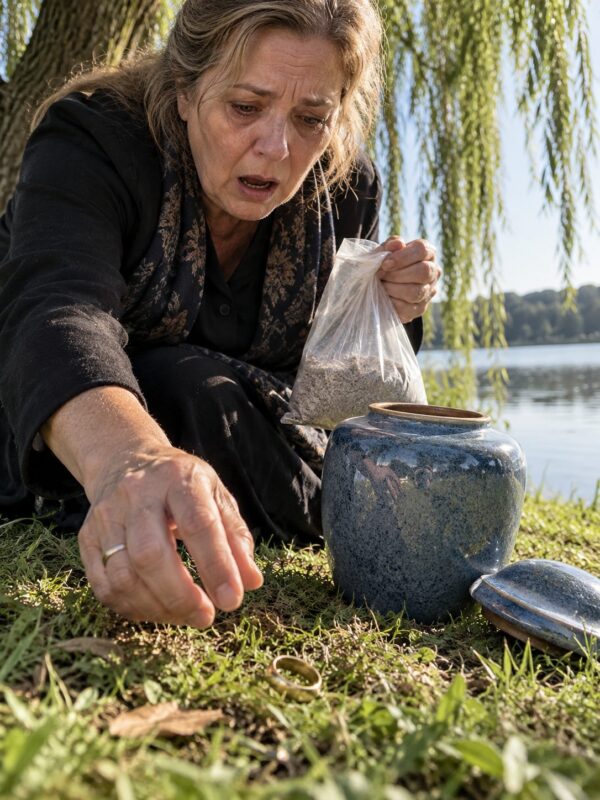
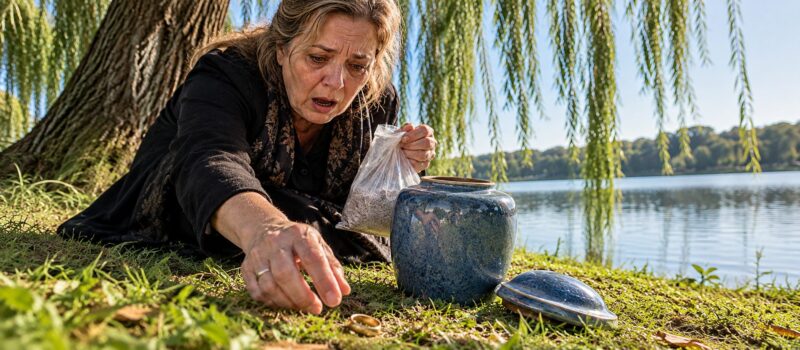
I chose an early morning when the lake was quiet, the air was cool, and the willow branches moved gently in the breeze. I sat beneath them with Frank’s urn in my lap, unable to bring myself to open it for several minutes.
Then I looked out at the water.
“I hate you for doing this first,” I whispered.
The words sounded ridiculous, and suddenly, I laughed—the first genuine laugh I’d had since he died.
I began talking to him about everything he’d missed: the leaking kitchen faucet, the neighbor’s new dog, the mail that kept piling up with his name on it, and the fact that I still expected to hear his key turn in the lock every evening.
“You always were selfish,” I murmured, smiling through my tears.
Talking to an urn felt absurd until it didn’t. For a brief moment, I could almost imagine Frank sitting right beside me, ready to interrupt if I got too sentimental, telling me I was making things far more dramatic than they needed to be.
Eventually, I took a deep breath and removed the lid.
I expected nothing except ashes. Instead, something hard rattled against the ceramic bottom, and an object fell out onto the grass.
I froze. I reached down and picked it up.
It was Frank’s wedding ring.
I stared at it in disbelief. I knew every scratch and nick on that band. He had worn it faithfully for forty years. I had watched him put it on every morning, taken it off before he showered, and held his hand while wearing it.
Claire had specifically told me Frank had been cremated wearing it. She had even said she saw it on his finger before the process.
Frank used to joke about it: “Only you get to take this off me.”
Now, it was sitting in my palm.
I turned it over, looking for anything unusual. Then, the morning sunlight caught the inside edge of the band.
My breath caught.
Frank’s ring had never been engraved. Not once in forty years.
I squinted, turning it toward the light. Three stark words were carved into the metal:
DON’T BELIEVE HER.
I read them once. Then again. Then a third time.
My hands began to tremble violently. Her. Who was “her”?
I already knew. Only one woman had been with Frank during those final six days.
Claire.
I stared at the ring until the letters blurred together. Why would Frank leave me a message like that? What had happened during those six days? What had Claire lied about?
I didn’t call her. I didn’t confront her over the phone. I didn’t even tell anyone what I had found.
Two days later, I was on a plane.
Claire thought I was still home grieving. When the taxi stopped outside her house, I almost told the driver to keep going, sitting frozen in the back seat for a few long seconds.
Then I looked through the window.
A boy, maybe twelve years old, was moving inside the house. He was wearing Frank’s old baseball cap—an ugly thing Frank had owned for thirty years. I recognized it instantly.
The boy was kneeling beside Frank’s open suitcase, carefully taking things out.
My stomach dropped. Why was a child going through Frank’s belongings? Why was Frank’s suitcase even here? Why had Claire never told me?
I stepped out of the taxi. The front door was wide open. Boxes were stacked throughout the hallway, and two men were carrying furniture out toward a van. Several cardboard boxes had FRANK written across the side in black marker. His shoes sat neatly beside the stairs; his travel bag rested on a chair; his cane leaned against the wall.
Claire had sent me almost none of this. She had told me the hospital had misplaced many of his belongings, that there wasn’t much left to send.
Yet here I was, standing inside a house completely filled with my husband’s things. For one wild, terrified second, I wondered if the ring had been warning me about something much worse than a simple lie.
I stepped inside. “Claire?”
She came hurrying from the kitchen carrying a box, nearly dropping it when she saw me. Her very first words weren’t hello.
“You weren’t supposed to come here.”
I stared at her. “That’s an interesting thing to say.”
Her face paled. “I meant I would’ve picked you up from the airport.”
“No, you didn’t.”
“Diane—”
“Why is Frank’s stuff still here?”
“I was going to ship everything—”
“You told me the hospital misplaced most of it!”
She opened her mouth, but no answer came out. That was when I noticed Frank’s phone sitting right on the kitchen counter. My heart hammered against my ribs. I walked over and picked it up.
Claire moved immediately. “Give me that.”
I pulled it against my chest. “You told me this was missing, too.”
She stopped dead in her tracks. Neither of us spoke.
Then, a voice echoed from the top of the stairs. “Mom?”
It was the boy. He was still wearing Frank’s cap. He looked at me curiously, then looked at Claire.
Claire closed her eyes tightly. “Go upstairs, Eli.”
The boy didn’t move. He looked at me again.
I turned back to Claire. “Who is that?”
“Upstairs, Eli. Please.”
He disappeared down the hallway. I turned back to her, my voice dropping to a whisper. “Who is that?”
She wouldn’t answer. For a few seconds, I honestly thought I had misunderstood everything.
“Who is Eli?”
“My son.”
I stared at her. “Your what?”
“My son.”
“You’re telling me Frank had a grandson?”
Claire finally burst into tears. I didn’t. Not yet.
“How old?”
“Twelve.”
My legs gave out and I sat down at the table. Twelve years. Twelve Christmases. Twelve birthdays. For years, I had mailed Claire cards, sent holiday gifts, and invited her to visit. Every December, I had asked Frank if we should send something extra, and every time, he told me Claire preferred keeping things simple.
Apparently, “simple” had meant leaving an entire human being out of the story.
I looked up at her. “Did Frank know?”
Her silence answered me louder than words. Something inside me cracked wide open. I stood up so fast my chair scraped hard against the floor.
“How long?”
“Since Eli was little.”
“How little?”
“Three.”
“Nine years?” My anger surged so suddenly that I felt dizzy.
“Diane, please—”
“Frank knew for nine years?”
She covered her face with her hands. “Yes.”
I stared down at the floor. Nine years. Nine years of Christmases, birthdays, and everyday conversations where Frank had known a massive truth I was completely shut out of.
The engraving in my purse felt heavier than lead: DON’T BELIEVE HER.
But then another brutal realization hit me: Frank had been lying, too. He had known. He had kept the secret. He had allowed me to live beside him without ever telling me I had a grandson.
I looked straight at Claire. “Tell me everything.”
She shook her head. “I can’t do this right now.”
“Your father is currently sitting in a ceramic urn, Claire. He left me a warning inside his wedding ring. We are doing this now.”
Her head snapped up. “What?”
I pulled the ring out of my pocket and set it on the table. She stared at the engraving.
“Oh, Dad,” she whispered.
“Explain,” I demanded.
Claire sat down across from me, her hands trembling. “Eli’s father left before he was born. Dad and I weren’t speaking back then. When Dad and I finally started talking again, Eli was three.”
She wiped her eyes. “Dad came to visit. I asked him not to tell anyone yet.”
“Why didn’t you tell me?”
“I was ashamed.”
“Of having a child?”
“Of everything.” She looked down at her hands. “You’d spent years trying to make me part of your family, and I kept pushing you away. Suddenly, I had a whole child I’d hidden from you, and I didn’t know how to face you.”
“So you just kept hiding him.”
“At first, I thought I’d tell you soon. But then years passed.”
“And then?”
“Dad started saying the same thing. Every year made the lie worse.”
I let out a bitter, humorless laugh. “That’s usually how lying works.”
She nodded miserably. “Yes.”
I picked up the ring again. “Is that why he came here?”
Claire hesitated, then whispered, “Partly.”
She explained that she and Eli were finally planning to move back to our town, and Frank had flown out to force her hand—to convince her to stop hiding Eli before they arrived.
“He said we couldn’t just walk into your life and pretend the last twelve years hadn’t happened,” Claire said.
“So he finally grew a conscience?”
She flinched. “He’d been telling me for years that we needed to tell you.”
“But he still kept your secret.”
“Yes.”
That single word mattered. She didn’t defend him. Frank had kept the secret. Claire had kept the secret. Both of them had convinced themselves they were protecting something, but all they had done was build a wall between us.
“He loved you,” Claire said softly. “And he failed you.”
I looked away. “When did he change the ring?”
Claire looked confused. “What do you mean?”
I told her about the new engraving. She stared at me blankly, and then said something that completely knocked the wind out of me.
“The ring was supposed to say something else.”
I froze. “What?”
“Two days before he died, Dad went to a jeweler. He told me he was having it engraved for your upcoming anniversary.”
“What was it supposed to say?”
Claire swallowed hard. “FORTY YEARS. STILL YOU.”
I couldn’t speak.
“The next morning, we fought,” she continued.
“About Eli?”
“Yes. I told him he had no right to force me after helping me hide it for so long. He got furious and said that if I didn’t tell you the truth myself, he would. He stormed out and went to the jeweler.”
“To change the engraving.”
Claire nodded. “When Dad collapsed the following morning, the ring wasn’t on his finger yet. I found the jeweler’s receipt in his pocket and collected it later.”
For the first time all day, that felt like a truth I could believe.
“You saw the message he left?” I asked.
“Yes.”
“And you still sent it to me?”
Claire looked down at the table. “I almost didn’t.”
“You also told me he’d been cremated wearing it.”
“I panicked,” she confessed, her voice cracking. “When you called me, asking about his personal effects, I hadn’t even picked up the ring from the jeweler yet. I knew if I told you it was sitting at a shop abroad, you’d ask questions I wasn’t ready to answer.”
“So you lied.”
“Yes.”
“Again.”
“Yes.” She twisted her hands together tightly. “The words just tumbled out before I could think of anything better.”
“You could’ve corrected it later.”
“I know.”
“But you didn’t.”
“No.”
Her explanation didn’t shrink the lie; it only made it painfully human—transparent enough to understand how she had dug herself into such a deep hole.
Then, a small voice broke through the quiet from the hallway.
“Is Grandpa mad at Mom?”
Eli was standing by the door. Claire quickly wiped her face. “No, sweetheart.”
He looked at the ring in my hand, then at me. He pushed his glasses up his nose with one finger—the exact, identical mannerism Frank had used his entire life.
My chest tightened. I looked at him properly for the first time. Same eyebrows. Same little gesture. For the first time, I wasn’t just looking at a secret Claire had kept; I was looking at Frank’s flesh and blood.
“Did you really know Grandpa for forty years?” Eli asked softly.
“Yes,” I answered.
“What was he like when he was young?”
Claire started to interrupt. “Eli, maybe later—”
“No,” I said, cutting her off. I pulled out the chair right beside mine. “Come here.”
He walked over and sat down. So I told him. Not about deaths, or secrets, or the painful fractures of a forty-year marriage. I told him about Frank when we were young.
I told him how Frank deliberately sang the wrong lyrics to annoy me, how he couldn’t make a batch of pancakes without burning the first one, and how stubborn he could be.
Eli laughed. “He did that here, too.”
I smiled through the lump in my throat. “I’m sure he did.”
For the first time since Frank died, I laughed without feeling an immediate wave of guilt.
“And he checked the doors twice every night,” Eli added.
“Every single night.”
Claire sat across from us, watching quietly while tears slipped down her cheeks.
Eventually, Eli excused himself and went back upstairs. Claire watched him go, then turned her heavy eyes back to me.
“Can we still come home?” she asked, her voice barely a whisper.
I thought about Frank. About the beautiful anniversary engraving he had ripped away to leave a warning. About nine years of silence. About Claire’s fear, my husband’s cowardice, and a twelve-year-old boy who hadn’t asked for any of this mess.
Claire started crying harder.
“Yes,” I said softly.
She looked up, stunned.
“But no more secrets.”
She nodded immediately. “No more secrets. I promise.”
Three weeks later, Claire and Eli stood beside me beneath the willow tree.
The same tree. The same lake. The same place where Frank and I had once been young enough to believe we had our entire lives mapped out ahead of us.
This time, I wasn’t alone.
Eli helped me lift Frank’s urn. Claire stood on one side of me, and Eli stood on the other. For a moment, I thought about everything that had happened since Frank left for that trip: the phone call, the cremation, the ring, the warning, the hidden grandson, the lies, and the love.
Standing beneath those sweeping branches, I realized grief wasn’t going to give me a neat, tidy answer. There was no simple way to categorize what Frank had been.
He had loved me fiercely for forty years.
He had also kept something enormous from me for nine of those years.
Both things were entirely true.
We scattered his ashes beneath the willow where Frank had kissed me for the first time forty-two years earlier. There wasn’t a formal speech—there didn’t need to be. The wind caught the ashes and carried them gently through the branches.
Before we left, I reached into my pocket and handed Eli Frank’s old baseball cap.
His face lit up with a grin that looked so much like his grandfather’s it took my breath away. “Really?”
“Really.”
He put it on immediately, adjusting the brim. I watched him, and for one brief, comforting second, I could almost picture Frank standing right beside us.
I kept Frank’s ring in my hand.
The warning was still engraved inside: DON’T BELIEVE HER.
Frank had loved me for forty years. Maybe someday I’ll have the original words restored, and maybe I won’t. The original message—FORTY YEARS. STILL YOU—was what he had intended to leave me. But the warning was what he ultimately believed I needed to find.
Both truths belonged to him. Both truths belonged to me.
I didn’t need to decide that morning which truth mattered more. Maybe I never would.
I slipped Frank’s ring safely into my pocket. As we walked back toward the car, Eli reached out and took Claire’s hand, then turned around to look back at me.
“Are you coming, Diane?”
I looked at him. For the first time, the question didn’t feel like an invitation from a stranger. It felt like a family member asking if I was coming home.
“Yeah,” I said, quickening my pace to catch up with them. “I’m coming.”





