The woman once got locked out of her own Mercedes because she didn’t know how the key fob worked.
Nobody noticed me come in.
Being invisible in the right family was a lot less painful once I finally stopped trying to earn visibility. I stepped into the hallway beside the dining room just as Diane’s voice drifted across the house.
«Oh, my God, Chloe, honey, sit on this side. The lighting is so much better for photos.»
Then I heard a man ask, «So where’s your other daughter tonight?»
Marcus’s parents. I recognized the voice from an engagement party two years earlier—Richard Sterling, a commercial real estate investor with the permanent facial expression of a man who had just smelled expired milk.
Diane laughed softly. Not nervous, not uncomfortable—just dismissive.
«Oh, Elena? She’s just Arthur’s little charity project.»
A few people chuckled politely. My fingers froze on my duffel strap.
«She’s not really family, so we don’t involve her in estate planning.»
It was delivered like I was an awkward tax situation. Nobody defended me. Not Chloe, not Marcus, not the Sterings. I heard silverware clink against fine china. Someone asked for more Pinot Noir.
Then Marcus laughed. «Elena’s probably a lot more comfortable blowing things up than managing assets.»
That earned a bigger laugh. Which was funny, considering that just two months earlier, I had successfully supervised a $12.8 million military infrastructure operation without losing a single soldier or contractor. Meanwhile, Marcus had once accidentally overdrafted his own business account to buy a boat he named Financial Freedom.
I stared at the hardwood floor for maybe three seconds. Not devastated, not shocked—just tired in a very specific, bone-deep way.
Arthur had adopted me when I was four years old. He had never once called me adopted. Not a single time.
Diane, however, had always found subtle ways to remind me. Different Christmas gifts. Different rules. Different expectations. When Chloe crashed her BMW at nineteen, Diane called it a «learning experience.» When I pulled a B-plus in chemistry at sixteen, Diane wondered aloud if community college might be «more realistic for someone like me.»
Arthur noticed all of it. He just rarely fought her. That used to make me angry when I was younger.
Inside the dining room, Diane spoke again. «I mean, Arthur had a good heart—sometimes too good.»
Another small laugh. That was when I moved.
Not with the quiet suspense of a dramatic movie, but with a real, heavy silence. Forks stopped halfway to mouths. Eyes shifted. People recalculated themselves in real time.
Chloe looked annoyed first, then nervous. Marcus suddenly resembled a man realizing his joke had survived fourteen seconds too long.
I walked to the end of the table and gently placed my duffel bag on the hardwood floor.
Then I smiled. Not a fake smile. Not an angry one either.
Nobody spoke. Even the servers froze. Diane cleared her throat and stood up a little too fast from her chair.
«Elena,» she said, her voice tight. «We didn’t know you were already here.»
«I know.»
That was it. Two words.
Chloe reached for her wine glass like she needed emotional support from fermented grapes. I didn’t sit near Diane or Chloe. I took a seat by the windows facing the lake—the exact same lake Arthur used to take me fishing on at 5:30 in the morning before the rest of the house woke up.
A server approached me. «Would you like red wine or white?»
«I’ll take coffee,» I said.
Marcus blinked. «At dinner?»
I looked at him briefly. «I’ve been awake since yesterday morning, Marcus. Some of us actually work for a living.»
A few people coughed into their napkins, trying and failing to suppress a laugh.
I finished my second cup of coffee while standing barefoot in Arthur’s old kitchen at 6:18 the next morning. The lake outside looked completely still. The house always sounded different before Diane woke up—quieter, more honest.
I had slept maybe four hours in one of the guest rooms upstairs. Opening the refrigerator for creamer, I found six bottles of champagne, imported artisanal cheese, and one expired carton of almond milk. Classic Diane priorities.
I was pouring my coffee when Chloe walked into the kitchen wearing silk pajamas that probably cost more than my monthly truck payment.
«You’re up early,» she noted.
«I spent fourteen months in a desert. My body still thinks sleep is optional.»
She ignored that and checked her phone. About thirty seconds later, Diane entered wearing an ivory cashmere robe, her hair already professionally styled at 6:30 in the morning as if Fox News might interview her unexpectedly beside the toaster.
«Good,» Diane said. «You’re both here.»
It was that tone—the exact tone bank managers use right before denying a loan. I took another sip of coffee.
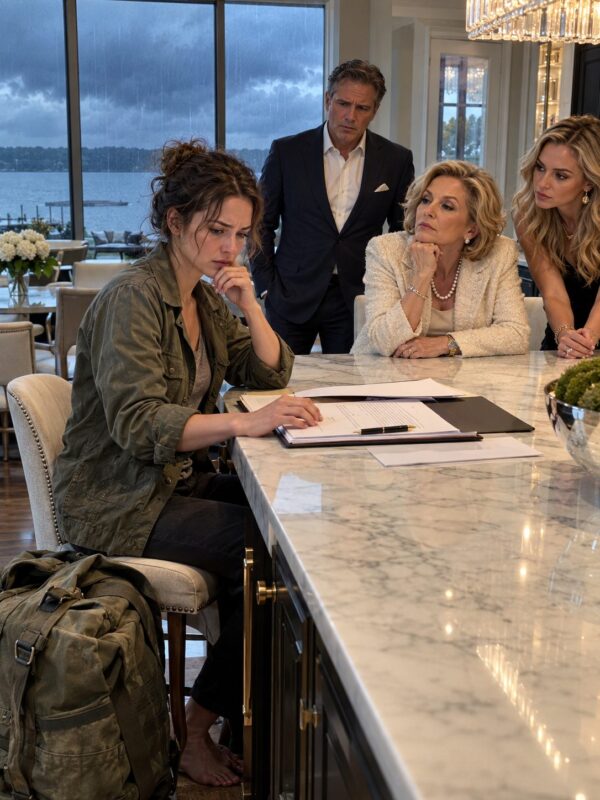
Diane nodded toward the kitchen island. «Sit down, Elena. We need to discuss something important regarding the family.»
An interesting choice of phrasing, considering she’d declared I wasn’t family twelve hours earlier.
Chloe slid a thick folder across the marble countertop toward me. Heavy paper, professional binding, gold tab dividers—expensive. Now that I was paying attention, the warning signs were obvious. The Rolex was gone. So was the Aston Aston Martin from last Christmas.
Diane folded her hands together. «Marcus has an extraordinary opportunity. He’s expanding Sterling Urban Development into mixed-use commercial properties.»
I nearly smiled into my coffee.
Chloe jumped in. «The lender just needs stronger collateral partners temporarily. It’s procedural.»
I opened the folder. Inside sat a commercial loan guarantee agreement totaling $4 million through Ridgemont Capital Bank. There was also an ownership transfer clause tied to Wright Industrial Holdings—my supposed 15% passive share in a regional construction company with an estimated annual revenue of $2.3 million.
I kept reading. Page seventeen: debt restructuring disclosures, outstanding private liabilities, personal guarantees. My eyes stopped briefly on one number: $3,819.76.
Jesus. Not expansion debt. Survival debt. Marcus wasn’t building anything; he was drowning while wearing Italian loafers. I flipped another page: missed interest payments, default warnings, asset overvaluation concerns.
This wasn’t an investment paperwork. This was a financial trap. And they wanted me absorbing the impact.
Diane mistook my silence for hesitation. «Elena, family supports each other during strategic moments.»
I looked up. «Strategic moments?»
Marcus cleared his throat. «The market slowed unexpectedly.»
«The market?» I asked. «Or the fact that you bought twelve condo lots outside Richmond at peak pricing using adjustable-rate commercial leverage?»
Nobody spoke. That definitely got their attention. Marcus blinked hard. «How do you know that?»
«I can read.»
Chloe crossed her arms. «You always do this.»
«Do what?»
«Act superior because you were in the military.»
I stared at her for a second. «No, Chloe, I act concerned when someone with the financial instincts of a raccoon near a casino asks me to cosign a $4 million loan.»
Marcus’s face tightened. Diane stepped in quickly. «This attitude is why Arthur always worried about you fitting into this family socially.»
That almost made me laugh. Arthur had spent most family dinners silently drinking bourbon and watching Marcus explain basic economics incorrectly.
I looked back down at the contract and found the final clause. If the loan defaulted, my ownership share absorbed primary recovery exposure before Sterling Urban Development’s own assets. There it was—the core of it. Not support. Sacrifice. They wanted me acting as a human shield while Marcus escaped the wreckage.
I leaned back slightly in the chair.
Then Diane delivered the line she had clearly rehearsed beforehand: «You owe this family, Elena.»
I looked at her calmly. «For what?»
Her answer came instantly. «For taking a stray in.»
Even Chloe went silent at that.
Diane kept going, listing off every meal, every year of schooling, and every «opportunity» they had supposedly blessed me with.
I gave a slow nod. «Arthur did.»
That sharpened the room instantly. Marcus looked down at the counter. Chloe looked furious. Diane looked personally insulted by reality.
I reached for the pen sitting beside the paperwork. All three of them visibly relaxed—they always mistook patience for surrender.
I uncapped the pen, scanned the signature line one last time, and slid the entire contract back across the marble island.
«No.»
Marcus muttered under his breath, «Jesus Christ.»
Chloe exploded first. «Are you serious right now?»
Diane’s expression turned glacial. «If you refuse to help this family, then maybe it’s time we formally reconsider your place in it.»
There it was. The real conversation. Not money, not business—punishment.
I stood from the chair and picked up my coffee mug.
Diane continued, «You will not attend the Wright Heritage Gala next week, and if necessary, I’ll make your separation from this family official.»
I set my mug gently into the sink.
«If you want to disown me,» I said, «do it in writing.»
I sat in my truck, watching the rain collect on the windshield for nearly ten minutes after leaving the lake house. My phone buzzed like a slot machine from hell—three voicemails, two texts: Let’s solve this like adults.
I deleted everything without opening them. Then I reached into the side pocket of my duffel bag and pulled out the envelope Arthur had given me six days before he died.
“Open this if Diane ever asks you for money,” he had told me at his hospital bedside.
I tore it open. Inside was a single handwritten note:
Go see Victor.
Don’t tell Diane first.
And don’t sign anything.
The address was handwritten underneath. No explanation, no emotional speech. Classic Arthur.
The drive took about forty minutes west through two-lane roads lined with soaked pine trees and old farmland. Northern Virginia gets weirdly beautiful once you leave the wealthy zip codes behind.
Victor opened his office door before I even knocked.
«About time,» he said.
He was sixty-five, lean, silver-haired, and looked permanently irritated by modern technology. Arthur used to call him the last honest lawyer in Virginia. Victor glanced at my bag. «You look tired.»
«I just got back from the Middle East.»
Victor nodded once. «And somehow, this is still probably more stressful.»
Fair point.
His office looked frozen in 1997: metal filing cabinets, framed Navy certificates, and a massive wooden desk covered in organized stacks of paper. No trendy minimalist nonsense. A real office for real problems.
Victor handed me black coffee in a chipped mug that said World’s Okayest Boss. Then he walked over to a tall gray safe bolted into the wall behind a bookshelf.
«You know why Arthur hired me instead of Diane’s corporate attorneys?» he asked, turning the dial.
«Because you’re cheaper.»
Victor snorted. «Because I don’t care about rich people’s feelings.»
The safe clicked open. Inside sat several thick folders, a locked cedar box, and a stack of certified legal binders. Victor carried everything back to the desk and looked at me.
«Your father knew what Diane was.»
That landed harder than I expected—not because it surprised me, but because someone finally said it plainly.
Victor slid a folder across the desk. «Arthur started documenting financial concerns three years ago after Diane attempted to restructure several property assets without disclosure.»
I opened the file. Inside were copies of bank statements, rental agreements, internal emails, and notarized legal notes with amounts and signatures. Arthur had tracked everything. Diane had assumed his cancer treatments made him less attentive—a massive mistake.
Victor flipped to another document. «Marcus Sterling entered private debt restructuring eighteen months ago.»

That matched what I saw in the kitchen. Arthur had found out shortly before his second surgery.
Victor opened one of the certified binders and removed a sealed document with gold notarization stamps along the bottom. He stopped talking. The room suddenly felt smaller, and even the rain outside seemed quieter.
Victor placed the document in front of me. «Arthur amended the trust before he died.»
I looked down at the title page: Irrevocable Property Trust Transfer.
My eyes moved lower: Property Designation, Wright Lake Estate.
I blinked, then read it again, slower. Victor leaned back in his chair. «The lake house is yours, Elena.»
Everything shifted into place. Victor pointed toward the final transfer page. «Arthur moved the property entirely into the trust eighteen months ago. Diane was never informed.»
I looked at the valuation paperwork attached behind it: Current Assessed Market Value: $17,240,000. The estate, the main house, the boat dock, the guest houses, the lake access properties—all of it. Mine.
Victor slid another folder toward me. «And this part? Six separate short-term luxury rental agreements for the guest houses on the property. Monthly deposits, wire transfers, occupancy schedules.»
I quickly added the numbers in my head. «At least $140,000.»
«Probably more,» Victor answered before I finished. «Diane and Chloe have been illegally renting portions of the property for nearly two years.»
He handed me a typed audit summary. The exact figure sat highlighted near the bottom: $142,850, plus a 7% annual recovery interest under clause 7 of the trust enforcement terms. Arthur really had thought of everything.
I leaned back in the chair and stared at the paperwork spread across the desk. Not excited, not triumphant—just recognizing reality. For the first time, someone had built protection around me before the damage happened.
Victor watched me closely. «You know what the strange part is?»
«What?»
«Arthur never sounded angry when he discussed Diane.» Victor adjusted his glasses. «He sounded disappointed in himself. One winter when you were seventeen, he watched you changing the brake pads on your truck and told me, ‘You learn a lot about people when money gets near them.'»
Victor pushed the cedar box across the desk. «Arthur wanted you to have this after the trust activated.»
I recognized it instantly. Arthur had built it by hand years ago in the workshop behind the lake house: walnut corners, cedar panels, and a slight scratch near the hinge where I had dropped it while helping him carry tools. I rested my hand lightly on the lid.
Then Victor dropped the final piece. «Diane is currently trying to leverage the lake house as collateral for Marcus’s recovery financing.»
I looked up sharply.
Victor nodded once. «She doesn’t know she doesn’t own it.»
I spread every document across my motel bed in Fredericksburg at 11:43 that night. Trust papers, audit summaries, property transfers, Marcus’s debt disclosures.
Victor emailed me additional records around midnight with the subject line: You’re going to love this. Inside were copies of the preliminary financing proposals Marcus had pitched to investors, listing the Wright Lake estate as secured collateral.
That idiot. Marcus wasn’t just lying socially anymore; he was actively attempting to secure emergency capital against property he did not legally own. That crossed from embarrassing straight into federal territory.
I called Victor. «You saw it?»
«I saw it,» Victor replied. «Marcus listed the estate as secured collateral.»
«Does Diane know?»
Victor laughed softly. «Oh, she knows.»
«You think they’re desperate enough to sign before verifying ownership?»
«Elena,» Victor said dryly, «wealthy people skip due diligence every day if somebody serves enough wine first.»
«Fair point. So, what do we do?»
Victor stayed calm. «You do nothing emotional. Paperwork doesn’t yell, but it wins.»
By 2:15 a.m., I had a full sequence mapped out:
File notice of ownership enforcement with the county clerk.
Trigger trust audit activation under clause 7.
Prepare financial recovery demand for unauthorized rental income.
Wait.
No threats, no dramatic confrontations, no warning shots.
There’s something wonderful about county offices. A billionaire and a guy arguing about fishing permits both have to take a number and wait under fluorescent lighting together. Wealth doesn’t matter there.
I filed the notice of default enforcement at 9:26 a.m. Three certified copies, one trust verification packet, one preliminary audit request. Thunk, thunk, thunk. Years of Diane’s social posturing reduced to office stamps and carbon paper. Honestly, it was therapeutic.
Nobody stopped me when I entered the property later that week, which made sense. Technically, they worked for me now. That thought still felt surreal.
Diane noticed me immediately. Her smile looked professionally manufactured. «Elena,» she said. «I wasn’t expecting you back today.»
«I live here.»
The smile twitched slightly.
Marcus stood near the bar, speaking into an earpiece while pretending not to sweat through a $4,000 jacket. Meanwhile, Chloe was arguing with an event planner about candle heights.
I walked past all of them toward Arthur’s old workshop behind the garage. Nobody followed me.
The workshop smelled exactly the same: cedar wood, motor oil, dust. I opened the cedar box Victor had given me and placed the trust documents inside. The wood felt smooth beneath my hands. Arthur had built this box the summer I turned fifteen, right after teaching me how to measure lumber properly.
Slow is smooth, he used to say. Smooth becomes fast.
Military instructors later repeated almost the exact same thing.
My phone buzzed at 4:07 p.m. from an unknown number. I answered.
«Lieutenant Wright?»
«Yes.»
«This is Eastern Courier Services. I have a certified legal delivery for Elena Wright.»
The courier arrived twenty minutes later wearing a navy polo and carrying a flat legal envelope. Diane watched from the front porch while he approached me by the driveway. That alone told me what this was.
The courier checked my ID, then handed over the signature tablet. «Restricted legal correspondence.»
I signed calmly. The guy glanced awkwardly between me and Diane, who was standing near the front entrance, pretending not to stare.
I opened the envelope beside my truck. Inside sat notarized legal stationery from Diane’s attorney—a formal family separation notice. Even her cruelty sounded country club expensive. There was even a pompous line about protecting family reputation and legacy.
I laughed, just enough for the courier to glance back nervously before driving away.
Diane crossed her arms from the porch. «Well,» she called out coldly. «You asked for it in writing.»
I looked at the letter again, folded it up, and walked back toward the workshop without answering her.
Diane had just formally banned the legal owner of the estate from attending her own gala.
The federal investigators arrived eleven days later.
There was no dramatic scene with armored trucks or agents crashing through windows—just two dark sedans pulling into the circular driveway at 8:13 on a Tuesday morning while landscapers trimmed the hedges by the lake. That was probably the funniest part: the hydrangeas still looked incredible.
Marcus tried acting confident at first. Unfortunately for him, wire fraud investigators tend to vastly prefer paper trails over confidence. And there were plenty of documents—the Ridgemont proposals, the property representations, the forged collateral, the email chains. Turns out sending fraudulent financial statements electronically creates a remarkably traceable paper trail. Who knew?
By week three, Sterling Urban Development had completely collapsed. Employees stopped showing up, projects froze, and subcontractors filed liens.
Marcus eventually accepted a federal plea deal after his defense attorneys realized the evidence was essentially gift-wrapped.
The fallout around Diane moved slower. First came distancing, then radio silence, followed by sudden scheduling conflicts from friends who previously called three times a day. Country club memberships quietly lapsed. Charity boards replaced her. Dinner invitations vanished entirely.
Nobody announced it publicly. That’s not how old-money circles work—they just erase you politely.
One afternoon, about two weeks after the gala, I found Diane sitting alone in the breakfast room, staring out at the lake without makeup for perhaps the first time in her life. She looked older—not physically, but structurally, like the scaffolding holding her together had finally been removed.
«I never thought Arthur would do this,» she murmured.
I stood near the coffee machine, filling my mug. «He didn’t do this to you.»
That probably hurt worse than yelling would have, because deep down, Diane knew the terrible truth: Arthur hadn’t destroyed her life. He had simply stopped protecting her from the consequences of it.
The court-approved property enforcement order gave Diane and Chloe thirty days to vacate the estate. Victor handled everything professionally. No cruelty, no petty revenge games—just paperwork. Always paperwork.
By the fourth week, moving trucks lined the driveway almost daily, hauling away the imported furniture Diane used to brag about endlessly: Italian dining sets, French mirrors, custom velvet chairs that nobody was ever actually comfortable sitting in.
At one point, two movers spent forty straight minutes trying to haul away a marble sculpture Diane had bought simply because a lifestyle influencer called it «quiet luxury.» The thing weighed six hundred pounds and looked like a depressed egg. Arthur would have hated it.
On the final day, low rainclouds hung heavy over the water while movers loaded the last truck around noon.
Diane walked down the front steps wearing a simple raincoat. No designer sunglasses, no audience. Just her and Chloe.
She looked at the chandeliers through the entryway, the grand staircase, and the lake beyond the glass. Then she looked at me.
«Where are we supposed to go?» she asked.
She didn’t sound manipulative. She just sounded old. The bitterness wasn’t there anymore—that was what surprised me the most. People often think revenge creates peace, but usually, it just bounces pain around the room.
This felt different. Not a victory lap—a correction.
I took a slow sip of my coffee while rain tapped softly against the windows. Then I answered her in a soft voice, completely devoid of anger.
«That’s a family matter, Diane.»
She closed her eyes, and I finished the sentence: «As you pointed out… I’m not family.»
Diane looked down at the floor. No dramatic crying this time, no theatrical collapse—just silence. She gave one small nod, turned around, and walked toward the driveway where Chloe was waiting by the passenger side of the last remaining SUV.
Neither of them looked back.
I closed the heavy front door behind them, and the lock clicked cleanly and securely into place.
A month later, contractors began renovating the east guest wing.
I used a portion of the estate trust to establish the Arthur Wright Foundation for transitioning veterans. Victor handled the legal structuring; apparently, sharp lawyers become extremely efficient nonprofit advisers once they’re personally invested.
The first group arrived in early spring: six veterans—three women, three men.
One former combat medic stood on the back porch one morning, staring out across the lake while holding a mug of coffee in both hands.
«Feels weird here,» he admitted quietly. «So quiet.»
I understood exactly what he meant. But eventually, your nervous system learns the difference between silence and safety.
The lake stretched still beneath the sunset. No gala lights, no fake speeches, no performance—just calm water moving softly beneath the fading sky.
Arthur used to tell me something while we fished here early in the mornings: «Strong foundations don’t make noise.»
For the first time, I truly understood what he meant. Peace isn’t something people hand to you. Sometimes, you have to build it yourself.





