When I was thirteen, my mother dropped me off at Aunt June’s cattle ranch with my belongings crammed into a black trash bag. Before pulling away, she looked at me and said, “Your sister deserves real summers. You only ruin them.”
I stood in the gravel driveway, watching until their taillights vanished into the dark.
Twenty minutes later, Aunt June found me still clutching that bag.

“She said they’d be back in August,” I whispered.
June gazed down the empty road and sighed. “They didn’t tell me that.”
August came and went. Then September. Nobody ever showed up.
June didn’t give me any pity speeches about being unwanted. Instead, she put fresh sheets on the spare bed, made me a grilled cheese, and sat quietly beside me until I stopped trying to hide my tears. The next morning, she handed me a pair of work gloves and said, “You can stay as long as you need.” Nobody had ever made a sense of home sound so simple.
My parents ignored June’s calls entirely. They mailed over my school records, a notarized guardianship form, and nothing else. On social media, my younger sister, Claire, posted photos from beaches, theme parks, ski resorts, and Christmas cruises.
I wasn’t in a single picture.
For years, I convinced myself they’d made a mistake. By sixteen, I finally understood—it had been a deliberate choice.
June never treated me like an afterthought. She taught me cattle breeding, accounting, fence repair, irrigation, and how to read land contracts. And she made sure I finished my education.
“Land remembers who takes care of it,” she used to say.
At twenty-two, freshly graduated from agricultural college, I returned to modernize the ranch. I introduced rotational grazing, leased unused acreage for solar infrastructure, and launched a direct-to-consumer beef operation that turned June’s struggling property into a thriving business.
When June passed away nine years later, she left the entire ranch to me. Not out of pity for the girl who was abandoned there, but because I’d earned my place.
I never reached out to my parents.
Then, eighteen years after the day they dumped me, a real estate broker named Tom Alvarez called.
“Ms. Harper, I have a buyer who’s very interested in Cedar Ridge Ranch.”
“It’s not for sale.”
“I told him that.”
“Then why are you calling?”
Tom hesitated on the line. “Because the buyer is Robert Harper.”
My father.
I gripped the edge of my desk.
“He says he wants the property as a gift for his younger daughter.”
Claire. Of course.
Tom added cautiously, “He claims there might be a family ownership issue.”
I almost laughed. “There isn’t.”
That evening, Tom met with my father and showed him the county property records. Only my name appeared on the deed. Tom told me my dad stared at it for nearly a minute before murmuring, “That can’t be right.”
By sunrise, I had eighty-eight missed calls on my phone.
I finally picked up on the eighty-ninth.
My dad skipped the greeting entirely. “You need to explain why your name is on June’s property.”
I looked out my office window, watching the cattle cross a pasture bathed in golden morning light. “It’s my property.”
“That ranch belongs to the family.”
“Which family?”
Silence stretched over the line.
Then my mother chimed in on speakerphone. “Don’t start this old drama again, Hannah.”
Old drama. Apparently, abandoning a thirteen-year-old was now considered a minor family disagreement.
My dad took the phone back. “Claire needs stability. She and Mark want to raise their kids somewhere wholesome. You’re single. You don’t need twelve hundred acres.”
I let out a cold laugh. “You called eighty-eight times just to tell me I own too much land?”
His tone turned harsh. “We can settle this privately. I’ll give you two hundred thousand.”
Cedar Ridge was valued at nearly six million dollars.
“That’s generous,” I replied.
He missed the sarcasm completely. “I knew you’d see reason.”
“I didn’t say yes.”
He started yelling, so I hung up.
An hour later, Tom forwarded me my father’s purchase offer. In it, my dad claimed an “equitable family interest” in the ranch, asserting that June had only held the title temporarily.
That lie mattered. So did the attached financing letter.
My father was planning to use a commercial property he co-owned with my mother as collateral to buy Cedar Ridge. The lender’s approval hinged on his declaration that there were no ownership disputes or undisclosed claims against his assets.
I forwarded the whole file to my attorney, Melissa Grant.
“Do nothing for now,” she advised. “Let him keep talking.”
And he did. My father wrote to county officials alleging June had manipulated me into taking family property. My mother told neighbors I was refusing to honor a “deathbed promise.” Claire posted a photo of Cedar Ridge with a caption about bringing the ranch “back where it belongs.”
They expected their pressure to break me. But their arrogant certainty didn’t scare me—it made them reckless, and reckless people leave paper trails.
Then Melissa uncovered something even better.
Fifteen years earlier, June had refinanced the ranch during a severe drought. To secure that loan, my dad had signed a notarized disclaimer explicitly waiving any legal, equitable, or inheritance rights to Cedar Ridge. The bank had required all potential family claimants to surrender their rights.
His signature directly contradicted his new claims to the lender.
And it got worse for him. The commercial property he was pledging as collateral was actually held in part by a family trust set up by my grandfather—and my dad had claimed sole ownership on his loan application.
I happened to be one of that trust’s beneficiaries.
Melissa leaned back in her chair. “Your father made representations to a lender that appear materially false.”
I looked down at the old disclaimer. For eighteen years, my family acted as if throwing me away had erased my existence. Instead, they had left me in the one place where every important record was safely kept.
“Send the public records to his lender,” I said.
Melissa nodded. “And Hannah?”
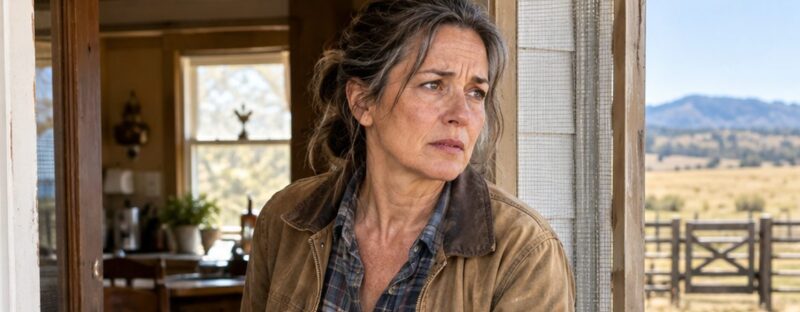
“Yes?”
“Don’t sell them a single acre.”
I smiled. “I wasn’t planning on it.”
Three days later, my father drove up to Cedar Ridge with my mother, Claire, and their lawyer in tow.
I met them in the yard outside the original ranch house. Claire stepped out of a brand-new SUV, her white boots sinking straight into the mud.
“This is ridiculous,” she snapped. “Dad already offered you money.”
My mother surveyed the land like she was inspecting a future vacation home. “Hannah, enough with the punishment. We’re still your parents.”
I looked her dead in the eye. “You left me here with my clothes in a trash bag.”
“You were a difficult child.”
“I was thirteen.”
My dad thrust a folder toward me. “Sign the sales agreement.”
Melissa stepped out from the ranch office behind me, and my dad froze. She handed his lawyer three documents: the notarized disclaimer, the current property deed, and a copy of the formal notice sent to his lender regarding the discrepancies in his application.
His lawyer scanned the papers, his face draining of color. “Robert,” he said quietly, “we need to leave. Now.”
My dad ignored him, glaring at me. “What did you send to the bank?”
“The truth,” I said.
His financing collapsed that afternoon. Without the loan, Cedar Ridge was completely out of reach. Worse, the lender opened an investigation into his fraudulent claims regarding the commercial property, bringing the family trust’s attorneys down on him. Ultimately, my dad was forced to refinance properly, pay heavy penalties, and give up management of the trust assets after the trustees removed him.
Claire’s dream of taking my ranch vanished with the loan. She called to accuse me of being heartless, then called back a week later begging for just five acres near the creek.
“No.”
“Do it for my kids!”
“No.”
“You don’t even have children!”
There it was again—my parents’ lifelong logic: the more Claire wanted something, the less I deserved to keep what was mine.
“I don’t need children to own what belongs to me,” I said, and ended the call.
My parents cycled through guilt trips, rage, and desperate apologies disguised as negotiations. I ignored all of it.
Six months later, Cedar Ridge expanded by another two hundred acres when I bought out the neighboring parcel. I renovated June’s old farmhouse into living quarters for agricultural interns and established a scholarship in her name for kids raised by guardians or extended family.
On the day of the dedication, I found my old trash bag inside a storage trunk. June had kept it all those years.
For a split second, I felt thirteen again, standing in the driveway gravel and wondering what was wrong with me.
Then I walked outside.
Dozens of people had gathered in the yard—ranch hands, students, neighbors, and friends who had chosen to stay.
I hadn’t burned anything down or taken anything that belonged to my parents. I had simply kept what they threw away. The ranch was no longer the place I’d been dumped; it was proof that surviving can turn into building an empire.
That evening, I leaned against the fence and watched the sun dip below the horizon.
My phone buzzed in my pocket.
Mom: We miss our daughter.
I looked out over the land June had protected and finally saw the difference.
They missed having access to me. June had actually loved me.
I deleted the message and walked back to the house.





