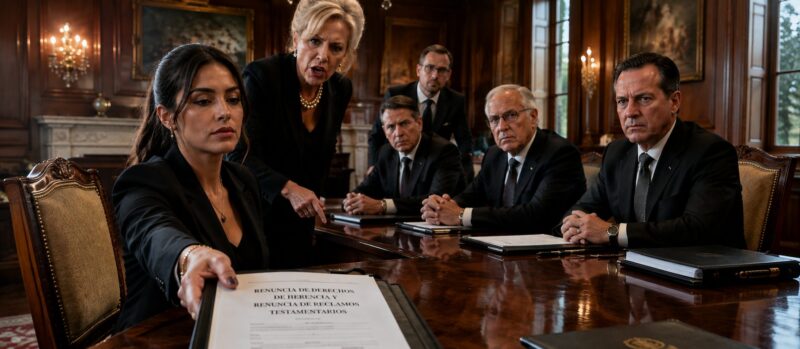
I pulled the waiver toward me and turned the first page slowly, resisting the urge to look at my mother. Five attorneys had been brought into this room for a reason. Whatever Victoria had envisioned, she wanted the full weight of professional authority pressing down on my side of the table.
So, I gave the professionals my undivided attention.
“Who drafted this?”
The lawyer who had addressed me as Colonel Sterling raised a hand slightly. “I coordinated it. Daniel Mercer.” He was in his late fifties with silver hair—calm, though noticeably less comfortable than the other four suits.
“On whose instructions?”
“Mrs. Sterling’s counsel contacted my firm.”
“That wasn’t my question.”
A brief silence hung in the room.
“My mother instructed you to draft a surrender of my rights under my father’s will?”

“Yes.”
“And you represent her?”
“I represent Mrs. Sterling regarding a potential family settlement. Two of my colleagues represent entities connected to the Sterling holdings. Mr. Bell represents your brother, and Ms. Chen is here to handle tax implications.”
I turned to the fifth attorney, a woman with tortoiseshell glasses who was closing her notebook. “And you?”
“Eleanor Graves. I represent Richard Sterling personally.”
Richard shifted uncomfortably near the door. The dynamic was far more complicated than I’d anticipated—and far more interesting.
I flipped to the next page. The document transferred virtually everything my father had left me into a newly formed family holding company. Julian would receive controlling voting rights, my mother would chair the board, and Richard would serve as financial manager.
I would be left with a small, non-voting interest. Generous, apparently, by their standard.
“Did anyone send this to my counsel before today?”
Mother exhaled sharply. “This is a family conversation, Sienna.”
I kept reading. “Did anyone send this to my counsel?”
“We were told you didn’t intend to retain separate counsel,” Mercer offered.
I looked up. “Who told you that?”
My mother’s face tightened. “You never said you had a lawyer.”
“I never said I didn’t.”
Julian finally put his phone away. “Sienna, can we not turn this into one of your interrogations?”
“One of my what?”
“You know what I mean.”
“No, I really don’t.”
He looked irritated, but a layer of uncertainty was creeping in. The morning was rapidly veering off the script he’d rehearsed.
Mother stepped in. “We’re trying to keep your father’s assets intact. That’s all. Julian has experience running businesses. You live all over the country, disappear for months at a time, and won’t even use half of what your father left you.”
There it was. The exact narrative she’d been spinning since the funeral. Not that the will was invalid, or that Arthur had made a mistake—just that his final wishes inconvenienced everyone else.
I closed the folder. “Mr. Mercer, before we move forward, I’d like to clarify something. Was I invited here for a negotiation?”
“Yes,” Mother answered before he could speak.
I kept my eyes fixed on Mercer. He caught the shift.
“A proposed negotiation,” Mercer corrected carefully. “Nothing presented today is binding or compulsory.”
“Thank you.”
Richard finally stepped away from the doorway, perhaps realizing how predatory his position looked. I noted the move. My mother, however, did not appreciate it.
“Oh, for heaven’s sake. Nobody is holding you hostage.”
“I didn’t say you were.”
“You kept looking at the door.”
“I note exits. It’s a habit.”
Julian let out an impatient laugh. “Of course you do.”
I let it slide. People had poked fun at my occupational habits for years. I never corrected them because I never needed their validation. For most of my adult life, my family only knew three things about my career: I worked for the government, I moved constantly, and I couldn’t discuss where I’d been.
They filled in the blanks with their own assumptions. My mother called me an analyst. Julian called me a bureaucrat. Richard once introduced me at a charity gala as “the family’s mysterious little civil servant.”
It had always been easier just to smile.
My father was the only exception. He never asked questions I couldn’t answer, but he listened intently to the things I could say. That distinction meant more than anyone in this room realized.
Mother crossed her arms. “Are you going to sign it or not?”
“No.”
The word didn’t carry drama. It just landed quietly, which is probably why it hit so hard.
Julian stared. Mother froze. Richard immediately looked toward Mercer.
I reached into my handbag and pulled out a separate folder.
“This is a formal notice from my attorney. It informs all parties that no transfer, encumbrance, restructuring, or settlement involving the property devised to me under Arthur Sterling’s will may proceed without written authorization from my counsel.”
Mercer took the document, his eyebrows lifting the moment he saw the letterhead. “Harrison Pike?”
“Yes.”
Even Julian seemed to recognize the name. Mother, predictably, did not.
“Who is Harrison Pike?”
“A probate attorney,” I said.
Mercer looked up at me. “One of the premier estate litigators in New England.”
“I’m not looking for a fight,” I said.
“That makes two of us,” Mercer replied.
The tone in the room fundamentally shifted. For the first time, Mercer stopped acting like an opposing advocate and started acting like a professional realizing he hadn’t been given the whole story.
I laid another sheet on the table. “That’s an acknowledgment of service. Harrison emailed it directly to your office yesterday afternoon, Mr. Mercer.”
Mercer checked his phone. One of the junior attorneys leaned over and whispered in his ear. Mercer’s jaw tightened—someone at his firm had clearly received it and dropped the ball.
Mother turned on me, furious. “You hired a lawyer behind my back?”
“You hired five.”
“That’s completely different!”
“It’s exact same thing.”
Richard rubbed his temples. “Victoria, stop.”
She ignored him. “You came here planning this whole scene.”
“I did.”
The blunt answer cut off her momentum entirely.
I’d spent three weeks preparing—not for war, but for clarity. My father taught me early on that confusion only benefits the person generating it. He built his fortune in construction, hated unnecessary drama, and believed every dispute could be resolved by laying out the facts.
He taught me to keep receipts, read contracts, trace who benefits, and never sign anything under pressure. My military career sharpened those instincts, but my father planted them.
I folded my hands. “Before we discuss touching Dad’s estate, I want a complete accounting.”
Julian frowned. “An accounting of what?”
“Everything.”
“You have the will.”
“A will isn’t a financial ledger.”
Mother pushed back from the table. “This is ridiculous and insulting.”
Mercer turned to her calmly. “Mrs. Sterling, a formal accounting is a completely reasonable request.”
She glared at him. “I didn’t hire you to side with her.”
“You hired me for legal counsel,” he said smoothly. “Which is precisely what I’m providing.”
It was the first visible crack in their front—small, but undeniable. Richard caught it too. He finally took a seat.
“What exactly do you need to see, Sienna?” Richard asked.
“Statements for Dad’s investment portfolios, property valuations, corporate records, outstanding debts, and any personal loans made to family members or affiliated businesses. I also want to see any guarantees he signed, trusts, codicils, or side agreements.”
Julian’s posture shifted slightly. It was subtle, but enough to catch my attention.
“Problem, Julian?”
“No. Nothing.”
“What is it?”
He looked past me to our mother, which only heightened my suspicion.
Mother cut in. “There are routine business affairs that have nothing to do with Arthur’s personal will.”
“Then a full audit will confirm that.”
Mercer cleared his throat. “There is one more matter.”
Mother snapped her head toward him. “Daniel, don’t.”
He opened his briefcase anyway. “I was instructed to hold this unless Colonel Sterling rejected the proposed settlement terms.”
A heavy silence settled over the room. The shift wasn’t aggressive—it was pure information. And information changes a dynamic faster than emotion ever could.
Mercer pulled out a sealed envelope. My father’s distinct handwriting was across the front: SIENNA.
I knew those strokes anywhere—slanted slightly to the right, tightening whenever he was focused. I didn’t reach for it right away.
“Where did you get that?”
“From Albert Wexler.”
My chest tightened. Albert had been my father’s personal attorney for nearly thirty years. He’d attended the funeral but skipped the reception. I’d assumed he was just overwhelmed by grief.
“Why does my mother’s attorney have a private letter from my father’s lawyer?”
Mercer glanced at Victoria. “Mrs. Sterling asked Mr. Wexler if any additional testamentary directives existed. He confirmed Mr. Sterling had left specific letters to be released under precise conditions. He handed this over once he learned a forced settlement was on the table.”
My mother went pale. “I had no idea what was in it.”
“I believe you,” Mercer said quietly.
I picked up the envelope. It was sealed with basic Scotch tape—no elaborate wax, no theatrical flair. Just Dad.
My thumb hovered under the flap. For the first time all morning, my composure cracked. Three weeks is nowhere near enough time to process a world without your father. I’d spent those days filling out forms, selecting floral arrangements, nodding through condolences, and waking up at 3:00 a.m. forgetting he was gone.
Now, his voice was waiting in my hands.
“Sienna?” Richard said softly. His sharp edge had softened. “We can take a break if you need to.”
Mother said nothing. Neither did Julian.
I broke the tape and pulled out three pages. The opening line hit me like a physical force:
Kiddo, if you’re reading this, somebody is already fighting over things I no longer need.
A small smile slipped out. That was him.
I read on in silence. He explained that his estate plan wasn’t a sudden decision—he had reviewed and updated it annually for nine years. He reiterated his love for Victoria, and for Julian.
Then came the line that made me pause:
I am leaving the physical estate directly to you because I have already given directly to them.
I stopped and re-read it. Mother stared blankly at the table; Julian looked lost.
I continued reading. Over the past twelve years, Dad had personally funded Julian’s restaurant ventures, absorbed massive operating losses, bought out a commercial property for one of Julian’s companies, and paid off a massive line of credit when an expansion failed.
None of it completely shocked me, but the cumulative total did: nearly six million dollars.
Julian bolted upright. “That’s insane. That’s impossible!”
Mercer raised a hand. “Let her read, Julian.”
“No! Six million? He never handed me six million dollars!”
“Not in liquid cash,” I said, looking up from the page. “In property, debt relief, capital injections, and that failed catering venture.”
Dad had documented every single transaction, choosing to classify most of them as gifts rather than formal loans.
Julian sank slowly back into his chair, deflated. Mother closed her eyes.
The letter went on to clarify that Dad had established an independent trust for Victoria years ago. The Greenwich estate was hers for life, backed by a portfolio designed to generate substantial annual income. She wasn’t being cast out or left destitute—far from it. She had more than enough to live comfortably without touching a single asset left to me.
Then, I hit the paragraph that changed everything:
There is one critical matter I haven’t disclosed to any of you, because I kept hoping I could resolve it quietly on my own.
I looked at my mother. The color had completely drained from her face. She knew.
“What was he referring to?” I asked.
Her lips parted, but no sound came out.
Richard spoke up instead. “The construction firm.”
Julian turned to him. “What about Sterling & Rowe?”
Richard’s posture completely collapsed. “Arthur was quietly absorbing its losses.”
The room went dead silent. Sterling & Rowe was my father’s legacy—built from two rusted pickup trucks, a sub-leased office, and a borrowed drafting table. By the time I started college, it was an empire employing over two hundred people across New England.
Dad had stepped back from daily management years ago, installing Richard as COO while Julian recently took a seat on the board.
I looked straight at Richard. “How bad is it?”
“We don’t have the full picture yet.”
“You always have the full picture, Richard.”
He flinched. It wasn’t an accusation; it was just a fact. Richard was obsessively thorough—the kind of man who cataloged his life down to the penny. The fact that he was admitting to blind spots frightened me more than a concrete number would have.
“We uncovered severe accounting anomalies after he passed,” Richard admitted. “Not embezzlement—at least, we don’t think so. But projects were severely underbid, material costs skyrocketed, and two major commercial developments stalled out. There are massive personal guarantees attached.”
“Dad’s guarantees?”
“Yes.”
Mother finally found her voice. “If the company goes under, dozens of families lose their livelihoods!”
The puzzle pieces snapped into place. It wasn’t just about control or preference. She was desperate to bundle my inheritance into a holding company so she could liquidate those assets to bail out Sterling & Rowe.
“You wanted my inheritance locked up to subsidize the firm,” I said. “And you were going to put Julian in charge of it?”
“He understands business!” she insisted, her eyes flashing. “I am trying to save what your father built!”
“By handing him the wheel?” I turned to Julian. “Do you actually understand the firm’s financial reality?”
“Of course he does!” Mother interjected.
Julian didn’t back her up. He stared down at his hands, looking smaller than I’d ever seen him.
“Julian?” I pressed gently.
He swallowed hard. “I know how to run a kitchen, Sienna. I don’t know the first thing about commercial construction finance. Dad put me on the board because Mom pushed for it.”
Mother turned on him. “You told me you were ready for this!”
“I said I’d try!” he snapped back, his voice cracking. “I told you I’d try!”
For the first time in memory, Julian wasn’t acting like the favored, arrogant younger brother. He just looked exhausted.
“I don’t even want her properties,” Julian admitted quietly.
Mother stared at him in disbelief. “Then why are you sitting at this table?”
“Because you told me that if we didn’t pool everything together, Dad’s legacy would go bankrupt!”
Richard closed his eyes, unable to meet anyone’s gaze.
There it was—the ugly truth buried beneath layers of legal jargon. It wasn’t just greed; it was raw panic, entitlement, and toxic family conditioning fused together until no one could tell where the love ended and the manipulation began.
I turned to the final page of Dad’s letter.
He hadn’t wanted me to blindly bail out the firm, nor did he want Victoria liquidating my future to cover the bleeding. He wanted an uncompromising, objective review—and he had explicitly appointed the one person he trusted to execute it.
Me.
Not because of my rank or my security clearances, but because, as he put it: Sienna asks the hard questions nobody wants to face, and she doesn’t leave until she gets real answers.
My eyes stung, but I forced the tears back.
Julian let out a faint, breathless laugh. “That’s Dad, alright.”
“It really is,” I agreed.
Even Mother offered a fleeting, fragile smile before reality settled back over the room.
Mercer reached into his briefcase one last time and pulled out a final document. “There is one more piece to this.”
“Is that for me?”
“No.” He set it in the center of the table.
ARTHUR STERLING — FAMILY CONTINUITY MEMORANDUM.
Mother looked genuinely bewildered. “I’ve never seen that before.”
“Neither have I,” Richard added.
Mercer nodded. “Mr. Wexler was under strict instructions to execute this only if the family attempted to alter the estate distribution within ninety days of Arthur’s passing.”
I almost laughed. Dad really had mapped out every single contingency. He didn’t do it out of malice—he just knew his family inside and out.
Mercer broke the seal. The memorandum, notarized six months before Dad’s death, laid out a strict protocol: for ninety days following his passing, no estate assets could be pledged, transferred, or leveraged for Sterling & Rowe without a mandatory independent audit.
Arthur had appointed three trustees to oversee the process: myself, Richard, and a woman named Naomi Brooks.
I paused. “Who is Naomi Brooks?”
Silence descended on the room.
Eleanor Graves, Richard’s personal lawyer, slowly turned her head to look at her client. Richard had turned pale, staring fixatedly at the paper.
“Richard?” Mother asked, picking up on the sudden tension.
“I haven’t heard that name in twenty-three years,” Richard said softly.
Julian leaned in. “Who is she?”
Richard looked up, first at me, then at Victoria. The defensiveness had completely drained from him, replaced by the heavy resignation of a man watching a long-buried secret finally surface.
“She used to work for Arthur,” Richard said.
“In what role?” I asked.
“Chief Financial Officer.”
Mother looked increasingly lost. “I don’t remember any CFO by that name.”
“You wouldn’t. She resigned right before you and Arthur bought the Greenwich property.”
I looked back down at the document. “Why would Dad appoint a former CFO he hadn’t spoken to in over two decades?”
Richard took a slow breath. “Because Naomi Brooks is the only reason Sterling & Rowe didn’t go under twenty-three years ago.”
No one moved. Outside, the cold winter sun reflected off the frozen lawn. The lawyers had stopped typing. Even my mother seemed to forget about the surrender document sitting unsigned on the table.
“What happened back then, Richard?” I asked.
He hesitated. “Arthur made a critical mistake.”
“What kind of mistake?”
“A massive financial miscalculation. Naomi caught it, stood up to him, and pulled the company back from the brink.”
“Then why did she leave?”
Richard looked past us, staring at the empty chair at the head of the dining table. “That… is something Arthur took to his grave.”
Mercer handed me a slip of paper with a phone number handwritten across the bottom, accompanied by a final note from my father:
Call Naomi before anyone spends another dime trying to save my legacy.
The five attorneys, the legal threats, my mother’s outrage—it all faded into background noise. There was only my father’s handwriting and the mystery of a woman none of us really knew.
I pulled out my phone.
“Sienna,” Mother said softly. The sharp, commanding edge in her voice was entirely gone.
I looked over. She looked smaller, exhausted.
“Are you calling her right now?”
I considered it for a moment, then set the phone screen-down on the table. “No.”
Julian blinked. “Why not?”
“Because Dad said to call her before anyone spends another dollar trying to save the firm.” I swept my eyes across the table. “So step one is: we stop spending money.”
Mercer’s lips twitched into a subtle smile. “What are you proposing?”
“I’m proposing this meeting is over.”
Mother started to protest, but I raised a hand. “Not forever. Just for today.”
The distinction sank in.
I turned to the gallery of lawyers. “No family needs five attorneys in the room to have the conversation we actually need to be having.”
Daniel Mercer nodded approvingly. “I agree.”
Mother shot him a betrayed look, but he was already packing his files into his leather briefcase. One by one, the other four lawyers followed suit. There was no dramatic showdown—just the quiet release of pressure from a room that had been stretched to its limit.
Once the front door clicked shut behind the last attorney, only the four of us remained at the long mahogany table. No legal pads, no briefcases, no scripted intimidation. Just family.
Mother stared down at the unsigned waiver. “You humiliated me today.”
“That wasn’t my goal.”
“You could have warned me you had counsel.”
“You could have warned me you were bringing an army.”
She had no comeback for that.
Julian stared blankly at the tabletop. “Six million dollars…” He looked up at me, his eyes wide and raw. “I genuinely had no idea, Sienna. I knew Dad covered for me, but I never knew the real number.”
Mother instinctively reached out to comfort him. “Your father wanted to support your dreams.”
“I get that, Mom,” Julian said, pulling his hand back slightly. “But it doesn’t change what it was.”
For years, Julian had carried himself as the sharp, self-made entrepreneur of the family, looking down on my steady military paycheck. Now he was forced to confront the fact that his entire empire was built on a safety net supplied by our father.
It was a bitter pill to swallow, and I actually felt for him. We were both realizing just how many invisible battles Arthur Sterling had fought to protect us.
Mother looked across at me. “Where does this leave us?”
“Tomorrow morning, I meet with Naomi Brooks.”
“And what about the company?”
“We get an honest diagnosis before anyone decides if it’s worth saving.”
She looked at me for a long moment, her eyes tracing my face. “You sound just like your father.”
“No,” Richard interjected quietly. We all looked at him. He offered me a tired, genuine smile. “She sounds like herself.”
The words hit deeper than I expected.
I gathered my things and headed toward the foyer. As I reached the front door, Mother’s voice called out behind me.
“Sienna.”
I paused and turned around.
She was looking past me, out toward the driveway. “The uniform in your car…”
I’d forgotten it was hanging in the back seat. “What about it?”
“Why did you bring it?”
I thought about giving a diplomatic answer, but we were past the point of rehearsed lies.
“Because I needed to remind myself of who I am before I stepped foot inside this house.”
A shadow of genuine pain crossed her face. “I know who you are, Sienna.”
“No, Mom,” I said softly. “You know the character you made up because you never bothered to ask about the real person.”
She absorbed the hit in silence. No counter-argument, no deflection. That was a first.
I stepped out into the crisp, biting winter air. My phone began to vibrate in my coat pocket before I even reached the SUV.
Unknown number. Connecticut area code.
I answered. “Sterling.”
A voice came through the line—measured, mature, and entirely calm.
“You answer the phone exactly like your father used to.”
I stopped in my tracks beside the driver’s side door. “Naomi Brooks?”
“Yes.”
“How did you get this number?”
“Arthur gave it to me.”
“When?”
A brief pause. “About six months ago.”
My grip tightened on the phone. “You were in contact with him recently?”
“I was.”
“Why?”
Another quiet pause over the line before Naomi spoke again, her words instantly rewriting everything I thought I understood about the last few weeks.
“Because your father knew Sterling & Rowe was falling apart long before anyone else realized it.”
I glanced back toward the main house. Through the floor-to-ceiling dining room windows, I could see my mother sitting motionless at the table.
“And he knew why,” Naomi added.
“What do you mean?”
“That isn’t a conversation for a cell phone, Colonel.”
“When do we talk?”
“Tomorrow morning. I’ll text you the address.” She hesitated for a fraction of a second. “And Sienna?”
“Yes?”
“Bring Richard with you.”
I looked back through the glass. Richard had walked back into the room and was standing quietly behind my mother’s chair, his hands resting on her shoulders.
“Why Richard?”
Naomi’s voice dropped, heavy with decades of history.
“Because twenty-three years ago, Richard Sterling took the fall for a disaster your father created… and if Arthur’s final records are any indication, he’s doing it all over again.”
Naomi Brooks sent the address at 6:12 the next morning. It wasn’t an office—it was a small bakery in Stamford.
I stared at the screen for a moment before forwarding the text to Richard. His reply was almost immediate: I’ll drive.
At 7:45, his sedan pulled into the hotel parking lot. I’d stayed in Greenwich instead of heading back to D.C. because this estate review was rapidly turning into something far larger than a one-day affair.
I climbed in, and Richard handed me a coffee without a word. Black. Exactly how I drink it.
“You remembered.”
“Arthur reminded me for twenty years,” he said quietly.
It was a small detail, but it stung. We pulled out into traffic, driving several miles in complete silence.
Richard and I had never disliked each other—that would have been simpler. Instead, we’d spent twenty-five years being politely adjacent. He married my mother when I was thirteen, four years after my parents’ divorce. He never tried to replace my father, and I respected him for that. But he also stood by silently while my mother dismissed my choices, while Julian mocked my career, and while family dinners degraded into subtle competitions over whose achievements mattered most.
I used to think his silence was approval. Now, I wondered if keeping quiet was just Richard’s oldest survival mechanism.
“You knew Naomi,” I said.
“Yes.”
“How well?”
“Well enough to respect her.”
“Dad’s letter implies she saved the firm.”
“She did.”
“How?”
Richard kept his eyes fixed on the road. “Back in 2003, Arthur wanted to buy a regional concrete supplier. It would have doubled Sterling & Rowe’s size overnight, and everyone thought it was a masterstroke.”
“Except Naomi.”
“Except Naomi.”
“What did she uncover?”
“The supplier’s books were accurate—that was the problem. Arthur thought he was buying growth, but Naomi realized he was buying massive exposure. They relied on three key clients: one was already pulling their business, another was on the brink of bankruptcy, and the third accounted for half their revenue.”
“So the deal was a house of cards.”
“Completely.”
“And Dad missed it?”
“He saw what he wanted to see.”
It was a painfully grounded assessment. People love to turn the deceased into static caricatures—saints, villains, legends. But my father was neither flawless nor simple. He could be extraordinarily patient for months, then act on pure impulse in an afternoon. He hated flashy spending, but once bought a sailboat on a whim from a restaurant window. He lived by spreadsheets, yet occasionally chose to ignore them entirely.
“What happened next?”
“Naomi called him out in front of the board.”
I let out a faint smile. “He must have hated that.”
“For about forty-eight hours.”
“And then?”
“He actually checked her math.”
My smile widened. That was Dad.
“He scrapped the acquisition,” Richard continued. “Lost the earnest deposit and took a hit to his pride. But the supplier went under eleven months later.”
“So Naomi saved him millions.”
“She saved the entire business.”
“Then why did she leave?”
Richard’s knuckles turned white on the steering wheel. “Because the board demanded a fall guy.”
“For what?”
“For how close Arthur had come to driving the company off a cliff.”
I turned to face him. “And?”
“I took the blame. I told them I was the one who recommended the purchase.”
“You didn’t.”
“No.”
“Why would you do that?”
“Arthur built that company. People trusted him implicitly. We were negotiating a massive credit line at the time—if the lenders thought Arthur was making reckless, emotional decisions and ignoring internal red flags, it would have ruined everything.”
“So you fell on your sword.”
“Yes.”
“And Naomi?”
“She refused to play along with the cover-up.”
“Good for her.”
Richard glanced at me sideways. “I figured you’d say that.”
“What happened to her?”
“She resigned.”
“And Dad let her walk?”
His jaw tightened. “Yes.”
The single word carried twenty-three years of lingering regret. The traffic light turned green, and we moved forward.
“Why would she agree to meet now?” I asked.
“I don’t know.”
“Why did Dad reach out to her?”
“I don’t know that either.”
“You know more than you’re letting on, Richard.”
He sighed deeply. “So do you, Sienna.”
I looked over at him, and he gave me a subtle nod. “Colonel.”
I almost laughed. “So this is about my background?”
“Not quite. It’s about the fact that Arthur understood your work a lot better than Victoria ever did.”
That caught me off guard. “How much did he know?”
“No operational details—he just understood the nature of it.”
I studied his profile. “And you do too?”
Richard offered a small smile. “Sienna, I spent forty years in construction. I know the difference between ignorance and professional discretion. Arthur told me you managed high-stakes situations, and that when you said a topic was off-limits, the only correct response was to drop it.”
I looked out at the passing buildings. “Mom never grasped that.”
“No.”
“You could have stepped in and explained it to her.”
“I could have.” His answer was completely undefensive, making it surprisingly hard to stay angry with him. “I told myself it wasn’t my place—though I’m realizing I used that excuse far too often.”
The bakery occupied the corner of a classic brick building, radiating warm light against the cold morning. Naomi Brooks sat alone at a table near the back. In her early seventies, with short gray hair and a navy sweater, she held the natural posture of someone who never needed to raise her voice to command a room.
She stood as we approached. “Richard.”
“Naomi.”
They looked at each other for a long moment before she pulled him into a warm hug. Richard froze in surprise, as did I.
Naomi stepped back, eyeing him up and down. “You got old.”
“So did you.”
“I aged better.”
Richard laughed, breaking the tension instantly.
Then she turned to me. “Sienna.”
“Mrs. Brooks.”
“Call me Naomi.”
We took our seats. She had already bought a tray of pastries. “Your father used to say that serious financial discussions require real carbohydrates.”
“That sounds like him.”
“He said you’d say that, too.”
A sudden tightness hit my throat. “How often were you two in touch?”
“Every few months over the last two years.”
Richard stared at her. “Two years?”
Naomi nodded calmly. “He reached out out of the blue to apologize. He should have done it twenty years ago, but he finally did.” She folded her hands on the table. “Arthur told me Sterling & Rowe was becoming fragile. Not insolvent, not corrupt—just fragile.”
I leaned in. “What was causing it?”
“A buildup of small, seemingly harmless issues,” she explained, pulling a slim laptop from her bag. “Construction firms rarely die from one catastrophic blow. Usually, cash gets tied up, projects get delayed, receivables age out, and personal guarantees stack up. Everyone assumes the next big contract will fix the ledger.”
She opened a spreadsheet—Dad would have appreciated the irony—and walked us through four specific projects. Each was technically profitable on paper, but together they created a massive liquidity crunch. One developer was dragging out billing disputes; another was suffering from surging material costs; a third had unpaid change orders; and a fourth was a public-private deal with horribly negotiated payment milestones.
Richard leaned over the screen. “I’ve reviewed these numbers. There’s nothing here I didn’t already see.”
“I know,” Naomi replied. “Which is why you’re looking at the wrong ledger.”
She brought up another document: a master list of personal guarantees. Arthur had signed several, but so had Richard.
Richard frowned, pointing at a signature. “That one isn’t mine.”
“I know,” Naomi said.
I leaned in closer. The handwriting looked like Richard’s, but something was off. “Is it a forgery?”
“No,” Naomi said, zooming in. “It’s Arthur’s signature.”
Richard stared in disbelief. “That’s impossible.”
“Not impossible—just inconvenient.” She highlighted the text below it. Arthur had signed his own name, but beneath it was a typed block stating he was acting under delegated authority from Richard.
Richard leaned back, stunned. “I never authorized that.”
“I know.”
“Then why—”
“Because Arthur was trying to shield your personal credit line.”
Richard closed his eyes tightly. “He used my authority.”
“He used a gray-area board resolution from years ago,” Naomi corrected. “Though I certainly wouldn’t want to defend that logic in court.”
I looked between them. “Was it illegal?”
“Strictly speaking? No,” Naomi said. “Based on what I’ve audited, it was legal—but it was aggressive, poorly documented, and completely out of character for him.”
“Why take that risk?”
Naomi opened another directory showing a web of capital transfers totaling millions of dollars moved across company accounts over eighteen months. Not stolen—just shifted. Every single dollar was funneled into a project called Harbor Point East.
Richard’s brow furrowed. “We backed out of Harbor Point two years ago.”
“Publicly, you did,” Naomi noted. “But Arthur kept funding the predevelopment work through an off-books entity: Sterling Community Partners LLC.”
Neither Richard nor I had ever heard of it.
“Who held ownership?” I asked.
“Arthur did exclusively. It was a non-profit development arm created to hold title and manage site assembly.”
Naomi pulled up the architectural master plan: residential buildings, retail, a community daycare, a health clinic, and public park space. It looked less like a commercial job and more like an entire integrated neighborhood.
Richard stared at the layout. “Affordable housing?”
“Mixed-income,” Naomi corrected.
He shook his head. “Arthur always avoided residential work.”
“He avoided badly planned residential work.”
I could practically hear my father’s voice saying those exact words.
Naomi continued. “Harbor Point East was meant to be the capstone of his career. But when the board voted it down due to low projected margins, he built an alternative structure to fund it anyway.”
Richard’s face was a storm of conflicting emotions—frustration, awe, and grief. “That stubborn old fool…”
“Precisely,” Naomi agreed.
I looked down at the financial summary. “Is this what put the firm at risk?”
“Partially. He put nearly eight million dollars into it—much of it secured by real estate assets.”
“Whose real estate?”
Naomi looked directly at me. “Arthur’s.”
The realization hit me hard. The commercial properties my father left to me weren’t just valuable real estate—two of them were acting as collateral for credit lines backing Harbor Point East.
My mother’s strategy was suddenly far more dangerous than she realized. If my inheritance had been rolled into a family holding company with Julian holding voting control, he would have taken charge of assets tied to complex obligations he didn’t even know existed.
“It would have triggered a total collapse,” I said.
“Yes,” Naomi confirmed. “That’s why Arthur put the ninety-day hold in his will—to keep everyone from making uneducated moves before understanding the structure.”
I leaned back, feeling a wave of frustration toward my father for the first time since his passing. “He should have told us instead of leaving a riddle.”
“He didn’t know he was sick, Sienna,” Naomi said gently. “He was trying to fix his worst habit: keeping secrets and carrying every burden alone.”

She looked over at Richard. “Sound familiar?”
Richard offered a quiet, bitter smile. “Painfully.”
Naomi turned back to me. “He wanted an objective review. He knew you’d inherit encumbered assets, and he trusted you to separate personal feelings from what actually needs to be done.”
“What happens if Harbor Point fails?” I asked.
“Sterling & Rowe survives, but it will have to scale back significantly. Some assets will be liquidated, reducing your inheritance, though Victoria’s trust remains completely untouched.”
“And if it succeeds?”
“The company gets reimbursed for its capital advances, the housing moves forward, and your inherited properties are released from the guarantees over time.”
Richard rubbed his forehead. “So Sienna doesn’t need to sign anything over.”
“Not a single thing.”
“Victoria has no idea.”
“No.”
“Why didn’t Arthur tell her?”
Naomi hesitated. “He planned to—right after resolving one final issue.”
“What issue?”
Naomi closed her laptop and looked at Richard. “You should tell her.”
Richard looked bewildered. “Tell her what?”
Naomi’s expression turned solemn as she reached into her bag and pulled out a faded, vintage photo: young Arthur, young Richard, Naomi, and a striking woman I didn’t recognize, all standing outside Sterling & Rowe’s very first office building.
Written on the back: The four fools who thought we could build the world.
“Who is she?” I asked.
Richard took the photo, the color draining from his face. “Claire.”
“Claire who?”
“Claire Rowe.”
The name landed like a thud. Sterling & Rowe.
“Dad’s co-founder?”
“Yes.”
“What happened to her?”
Richard looked at Naomi. “She passed away years ago.”
Naomi shook her head. “No, Richard. She didn’t.”
“What?”
“Arthur let people assume she was gone,” Naomi said softly. “She resigned in 1989 and moved to Vermont. She’s still alive.”
I picked up the photo. Claire looked to be around thirty, with dark hair and a brilliant smile, her hand resting naturally on my father’s shoulder.
“Why did she leave?” I asked.
Neither answered immediately. A cold feeling settled in my stomach—the distinct realization that families build massive facades around the truths they refuse to speak aloud.
“What does Claire Rowe have to do with Harbor Point?” I asked.
“Everything,” Naomi replied, pulling up a land record. “The property for Harbor Point East originally belonged to Claire’s family. In October 1989, Arthur and Claire signed an agreement: if that land were ever developed, a portion had to be reserved for affordable housing and community space. Arthur spent thirty-five years trying to fulfill that promise because he always felt he bought her out for far less than her shares were worth after she left.”
My father’s secret project wasn’t just a business venture; it was a debt of honor to a woman hidden from his past.
By the time Richard and I drove back to Greenwich, my mother and Julian were waiting in the kitchen—no attorneys present this time. Mother had brewed coffee herself, a quiet gesture that meant more than a formal speech.
I laid out the entire reality: Harbor Point, the financial guarantees, the pending investors, and Dad’s hidden company. Julian listened in stunned silence, while Mother stared quietly into her mug.
“He never told me,” she whispered.
“No.”
“I was his wife.”
“I know.”
A flash of raw pain crossed her face. “You say that like it doesn’t matter.”
“It matters a lot, Mom. But maybe he just didn’t know how to share things he thought you’d disapprove of.”
Mother’s shoulders dropped. Richard stepped up beside her. “He hid it from all of us, Victoria.”
“Not from Naomi,” she said, her voice laced with immediate, human vulnerability. “Who is Naomi, really?”
I showed her the old photograph. Mother’s hand froze over the print. She did recognize Claire.
“I met her once,” Mother said quietly. “Right after your father and I got married. She came to his apartment in ninety-one or ninety-two.”
I stopped. Claire had supposedly left the firm in 1989, and my parents divorced in 1990.
“Why was she there?”
“They were arguing,” Mother recalled, her eyes fixed on the photo. “Arthur asked me to take you to the park. As we were leaving, I heard Claire say: ‘You don’t get to decide when she learns the truth.’”
Silence filled the room. Julian looked between us, while Richard stood frozen.
My phone buzzed on the table. A text from Naomi:
There is one final envelope Arthur left in my care. It is for you alone. Read it before you try to contact Claire. And Sienna—don’t jump to the obvious conclusion.
I stared at the screen, then back down at the photo of Claire Rowe—at her hand resting on my father’s shoulder, at the date, and at the name that had been on our family’s company my entire life.
For the first time, I realized that the greatest inheritance my father had left me wasn’t real estate, money, or a company to salvage.
It was a thirty-five-year-old secret he was finally trusting me to resolve.
Naomi brought the envelope to Greenwich that afternoon.
She refused my mother’s invitation to stay for dinner.
“This belongs to Sienna,” she said. “What happens afterward belongs to all of you.”
Then she left.
The envelope was thinner than the first, with my name written across the front in Dad’s familiar handwriting. I carried it upstairs to the room that had once been mine. Mother had redecorated years ago, but the room’s proportions remained unchanged: the same windows, the same oak floor, and the same radiator that clicked unpredictably on cold evenings.
For a long while, I sat on the edge of the bed without opening the letter. I had spent much of my professional life learning to distrust assumptions, yet Claire’s photograph had awakened one immediately. A woman connected to my father. An argument about when “she” would learn the truth. A secret carried for decades.
There was an obvious conclusion, but Naomi had explicitly warned me against making it. That was reason enough to wait until my breathing slowed before breaking the seal.
Dad’s letter began without humor this time:
Dear Sienna,
There are truths you delay because you are afraid they will hurt someone. Eventually, the delay becomes the thing that hurts them.
I read on.
Claire Rowe was not my mother. Dad answered that question directly in the second paragraph. I actually laughed—not because it was funny, but because the human mind can only carry so much tension before relief finds some strange outlet.
Dad explained that Claire had been his closest friend in college and later his business partner, but they had never been romantically involved. Victoria had known Claire briefly during the final years of my parents’ marriage, though Claire had already left the company by then.
The secret was not about my parentage. It was about Dad’s.
I read that sentence twice.
Arthur Sterling had been adopted—informally and quietly, in the way families sometimes handled difficult circumstances in the 1950s by rewriting the narrative until it became official family history. The woman I knew as my grandmother—Margaret Sterling, whose Boston house Dad had left to me—was actually his aunt. His biological mother was Margaret’s younger sister, Evelyn.
Evelyn had been nineteen and unmarried when Arthur was born. The family decided Margaret and her husband would raise the baby as their own. Arthur didn’t learn the truth until he was seventeen, and my grandfather—technically my great-uncle—died two years later. Margaret never spoke about Evelyn, and Arthur rarely did either.
But Claire knew. She knew because her mother had been Evelyn’s closest friend.
I lowered the letter. Suddenly, the Boston house meant something completely different. The historic property I had inherited was deeply tied to a family story I had never been told.
I kept reading.
Evelyn Sterling hadn’t vanished. She had moved to Vermont, eventually married, and had another child—a daughter named Claire Rowe.
I stopped, went back, and read the line again.
Claire was Dad’s half-sister. My aunt.
Sterling & Rowe wasn’t named for two business partners; it was named for a brother and sister who couldn’t publicly explain they were related.
Dad had discovered Claire’s existence when he was twenty-four, shortly before their mother passed away. For years, Arthur and Claire tried to build a company and a sibling relationship simultaneously. It worked until 1989, when the inevitable rupture occurred.
Claire wanted Arthur to tell Margaret Sterling the truth—that he had reconnected with Evelyn before her death, that he knew Claire, and that he intended to publicly acknowledge her as family. Arthur refused. Margaret was elderly and ill, and he feared it would reopen wounds she had spent her life trying to bury. Claire believed he was protecting his own comfort rather than the truth.
Their disagreement escalated until Claire sold her shares and walked away.
The land at Harbor Point had originally belonged to Evelyn’s second husband’s family. Claire had inherited an interest in it and later sold it under strict conditions reflecting the values her mother cared about: affordable housing, health services, and public green space. Arthur had spent years trying to fulfill those terms—not out of legal obligation, but out of lingering guilt.
Then came the part involving me.
When Claire visited my father in 1991, the argument my mother overheard about «when she learns the truth» was about me. Claire believed I should grow up knowing our full family history. Dad disagreed, thinking I was too young.
One year became five. Five became ten. By the time he considered telling me, Claire was no longer speaking to him. By the time they reconciled, I was deployed overseas, and Dad convinced himself there would eventually be a better moment.
There was always going to be a better moment—until there wasn’t.
His final paragraph blurred before my eyes:
You have spent your life working in places where incomplete information matters. I’m sorry I gave you incomplete information about your own family.
The Boston house belongs to you because Margaret left it to me, and because I believe you will understand that inheritance is not the same as ownership. We borrow things from the people who came before us: money, buildings, names, and sometimes mistakes. What you do with them is your part of the story.
Love, Dad.
I sat alone for a long time and cried. It wasn’t dramatic—no collapse, no broken furniture, no sudden release. Just quiet tears tracing down my face as the afternoon light faded across the room. Grief is strange that way. It can wait patiently behind paperwork for weeks, until a familiar phrase in familiar handwriting finally unlocks the door.
I missed him. I was angry with him. I understood him. I wanted five more minutes with him to demand why he had kept the secret, and five more minutes to tell him it was all right. Both feelings were entirely true.
Eventually, I went downstairs. Everyone was still sitting in the kitchen. No one asked what the letter said—perhaps the first real sign that something in our family dynamic had shifted.
Mother simply looked up at me and asked, “Tea?”
“Yes.”
She poured a cup, I sat down, and I told them everything.
When I finished, Richard leaned back, visibly stunned.
Julian broke the silence. “So Claire is our aunt?”
“My aunt,” I corrected.
He nodded. “Right. Your aunt.” He frowned slightly. “Technically, what does that make her to me?”
Mother gave him an exhausted look. “Julian.”
“I’m just asking.”
Against all expectation, I laughed. Julian joined in, then Richard, and finally even Mother surrendered. The sound felt almost inappropriate in the middle of so much heavy history, which was probably why we needed it so badly.
The next morning, I called Claire Rowe. She answered on the fourth ring.
“Yes?”
“My name is Sienna Sterling.”
A long pause filled the line. “I know who you are,” she said, her voice stronger than I had anticipated.
I looked out the hotel window at the bare trees. “I read my father’s letter.”
Another silence followed. “I’m sorry he passed.”
“Thank you.”
“He was very proud of you.”
I closed my eyes. “He talked to you about me?”
“Constantly.”
That pulled a genuine laugh out of me. “He told us almost nothing.”
“He told me almost everything.”
“Apparently, keeping secrets was a family tradition.”
Claire laughed softly. “Yes. It was.”
We spoke for nearly an hour. We didn’t talk about money—not at first. She told me about Dad in his twenties: his terrible shirts, the time he tried to repair a motorcycle and somehow made it completely inoperable, and how he couldn’t cook anything besides eggs. She told me how terrified he had been before his first date with my mother.
“He was?”
“Terrified.”
“I wish I’d known that.”
“There are probably many things you wish you’d known,” she said gently, without a hint of accusation.
I asked why she had stayed away for so long.
“Pride,” Claire replied simply. “At first, and for years afterward.”
“Was it really that simple?”
“No. But simplicity and truth sometimes overlap.”
She explained that after decades of silence, she and Dad had resumed occasional contact—first through Christmas cards, then emails, and eventually phone calls. Two years ago, they finally met in person. Both apologized. Neither apology could erase the missing decades, but it gave them a foundation to rebuild on.
Harbor Point had become their shared project. Claire hadn’t wanted an ownership stake; she only wanted Arthur to honor their mother’s original vision for the land.
“Do you still want that?” I asked.
“Yes.”
“Even if it strains the company?”
“No.”
That answer surprised me. “Arthur thought you did.”
“Arthur always believed suffering proved sincerity,” Claire said.
I smiled. “That sounds just like him.”
“I told him the promise was meant to help people, not destroy Sterling & Rowe.”
“So what would you do?”
“Build less,” she said plainly. “Arthur wanted the entire forty-acre master plan. I only care about twenty-six acres: finish the housing, the clinic, the park, and the neighborhood retail. Sell the remaining parcels at market value and use the proceeds to repay the company.”
The solution was so straightforward I felt almost foolish. “Did you suggest that to Dad?”
“Many times.”
“And?”
“He called it a compromise—as though that were a bad word.”
“Your father could be exhausting,” she added.
I laughed again. Then we both grew quiet.
“Claire?”
“Yes?”
“Would you be willing to meet me?”
A long pause stretched over the phone. “I think I’d like that very much.”
Three days later, Claire arrived in Greenwich.
Mother was noticeably nervous—more than I had ever seen her. Victoria Sterling rarely let her composure slip, yet she changed the fresh flowers twice, rejected Richard’s suggestion of a formal lunch, dismissed Julian’s idea of ordering pizza, and finally settled on making soup.
“Soup?” Julian whispered to me in the hallway.
“Don’t interfere.”
“I wasn’t going to.”
“You were definitely going to.”
Claire arrived shortly after noon. She looked older than she had in the photograph, but I recognized her immediately: she had my father’s eyes.
My eyes.
I froze for a second, and she noticed.
“Yes,” Claire said softly. “I see it too.”
“So did Arthur.”
We hugged—not like long-lost family, but like strangers who knew they didn’t have to remain strangers. That felt far more honest.
Mother greeted her next. “Claire.”
“Victoria.”
For a moment, I wondered how two women navigate thirty-five years of unresolved tension. Apparently, they shake hands.
“I owe you an apology,” Mother said directly.
Claire raised an eyebrow. “That’s an ambitious opening.”
Mother almost smiled. “I completely misunderstood your place in Arthur’s life.”
“For thirty-five years?”
“Approximately.”
“I see.”
“I assumed you were—”
“I know what you assumed.”
Mother flushed, but Claire quickly rescued her. “For what it’s worth, Arthur would have made an unbearable romantic partner.”
Richard coughed to hide a sudden laugh. Mother stared in disbelief for a second before unexpectedly breaking into a laugh of her own.
Lunch stretched into a three-hour affair. Claire and Richard swapped old stories, Mother filled in the missing details, and Julian listened with the focused intensity of someone realizing his parents had once been young, uncertain people navigating life without a manual.
At one point, Claire turned to him. “Your restaurants.”
Julian blinked. “What about them?”
“Arthur talked about them often. He said you had brilliant instincts for people, but terrible instincts for expansion.”
Mother looked ready to defend him, but Julian just laughed. “That sounds like Dad.”
Claire studied his expression. “He worried you believed accepting help meant you had failed.”
Julian’s smile faded. The room quieted as he stared down at his napkin.
“I didn’t realize how much financial backing he had given me,” he admitted quietly.
“I know.”
“How?”
“Because he told me.”
Julian looked down, embarrassed. “I thought I built everything entirely on my own.”
“You did build it yourself,” Claire said gently. “You simply didn’t finance every single piece of it yourself.”
The distinction was crucial, and I watched the weight of it settle on him. For years, Julian and I had been locked in a silent competition: he viewed my stable career as overly cautious, while I viewed Dad’s financial support of his business as favoritism. Both of our narratives had been incomplete.
After lunch, we gathered in Dad’s study to address the practical details. Naomi joined via video call alongside Harrison Pike—just one attorney this time, not a legal team.
Harrison reviewed the estate structure, Naomi presented the revised Harbor Point plan, Richard outlined Sterling & Rowe’s cash-flow requirements, Julian kept everyone supplied with coffee, and Mother simply sat with us. Her presence alone was perhaps the most important contribution of the afternoon.
For four hours, we worked through our options. No one surrendered their inheritance, no one seized control, and no one played the hero. We simply negotiated what each of us was willing to risk.
I agreed to maintain the existing financial guarantees temporarily without expanding them. Richard committed to commissioning an independent operational audit of Sterling & Rowe. Naomi agreed to lead the financial review, and Claire officially approved the scaled-back Harbor Point proposal.
Julian stepped up and volunteered to sell one underperforming restaurant location to repay part of the capital Dad had advanced him.
Mother immediately objected. “Your father considered that money a gift.”
Julian nodded. “I know, Mom. But I owe it to myself to run a business I can actually afford.”
I looked over at him, and he offered a subtle smile. It felt like we were both finally ready to stop playing our assigned family roles.
Six weeks later, the restructured financing for Harbor Point closed.
It wasn’t a fairy-tale ending—real life rarely resolves that neatly. Sterling & Rowe had to sell two undeveloped parcels of land, cancel a planned office expansion, cut annual bonuses, and freeze senior executive salaries temporarily. But we avoided mass layoffs, and the company stabilized.
A regional pension fund backed the affordable housing component, a health network agreed to operate the clinic, the city approved the revised park layout, and the guarantees on my inherited properties were put on an eighteen-month release schedule.
The estate remained mine, but my perspective on it had fundamentally shifted. I no longer viewed Dad’s properties as trophies to protect or as assets others were entitled to claim; I saw them as real responsibilities. Some I chose to keep, and others I decided to change.
The Boston house became the most meaningful piece. I visited in April, and Claire joined me.
The house sat on a quiet street framed by trees coming into spring bloom. Margaret Sterling had lived there for fifty-three years. Walking through the front door brought back a rush of holiday memories: polished silver, the smell of aged paper, and the strict rule that no one played the piano without washing their hands first.
Claire stood in the grand entrance hall for a long time. “She never invited my mother here after Arthur was born.”
“I’m sorry,” I said quietly.
Claire nodded. “So am I.”
We explored the rooms upstairs. In the back of Margaret’s bedroom closet, we found an old cedar box containing vintage photographs: Arthur as a baby, Evelyn holding him, and Margaret standing beside them, all three smiling.
On the back of one photo, Margaret had written three simple words: Our boy.
Claire sat on the floor, and I sat beside her in silence. The story we had inherited—that Margaret had erased Evelyn, that Arthur was a shameful secret, and that the sisters never reconciled—wasn’t entirely true. We also found dozens of letters between them: some angry, some loving, some left unfinished.
They were deeply human.
Our family history wasn’t built on one massive deception. It was a chain of frightened people making imperfect choices and living with the consequences.
Instead of selling the house, Claire and I established a small, practical foundation. The ground floor became office space for a nonprofit supporting first-generation college students and military families transitioning between assignments, while the upstairs rooms were converted into affordable rentals for graduate students.
Mother initially hated the plan. “Strangers living in Margaret’s house?”
“Yes.”
“She would be horrified.”
That objection vanished when we uncovered a letter in which Margaret complained that “large houses with empty bedrooms are a ridiculous waste of space.”
Julian eventually sold his struggling restaurant, and something remarkable happened: his remaining two locations became significantly more profitable. Without the pressure of constant expansion, he was happier. He stopped talking about building a restaurant empire and focused on mentoring one of his longtime managers into a business partner.
A year later, Richard retired as Sterling & Rowe’s chief operating officer. He bought a small sailboat—despite Mother reminding him that Arthur had already proven Sterling men shouldn’t own boats—and sailed anyway.
His marriage with my mother evolved after Dad’s passing. They began communicating with real honesty: Mother learned, with visible effort, to ask instead of dictate, while Richard learned to speak up rather than retreat into silence. Neither became a different person; they just became better versions of themselves.
Forgiveness between my mother and me took longer. There was no single dramatic conversation, just a series of small ones—some awkward, some frustrating, and some unexpectedly tender.
Months after the estate meeting, we sat together on the back terrace in Greenwich.
“I owe you an apology,” she said.
“You’ve said that before.”
“I know. I’m practicing.”
I smiled as she looked out over the garden.
“I thought your military career was just something you did because you didn’t know what else to do with yourself,” she admitted.
“How flattering.”
She sighed. “I think I needed to believe Julian needed me and you didn’t.”
It was the most honest statement she had ever made about our relationship.
“Why?” I asked.
“Because you left.”
“I grew up, Mom.”
“I realize that now.” She paused before continuing. “You went places I couldn’t understand and did work you couldn’t explain. Your father understood it, but I didn’t.”
“So you dismissed it.”
“Yes.”
“Why?”
She looked down, embarrassed. “Because dismissing it was easier than admitting I didn’t understand.”
I thought of Dad, Claire, Margaret, and Evelyn—and how often pride had masked fear in our family.
“I’m not angry that you didn’t understand my work, Mom.”
“I know.”
“I was angry that you never asked about it.”
She nodded slowly. “I know that too.” Then she looked up at me. “So I’m asking now. What does Colonel Sienna Sterling actually do?”
I laughed. “Most of it I still can’t tell you.”
Mother looked deeply offended. “That is incredibly annoying.”
“I know.”
“But you command people?”
“Yes.”
“How many?”
“Mom.”
“I’m asking!”
I shook my head, and she smiled. It was a start.
A year after Dad’s death, we gathered at Harbor Point for the opening of the community clinic. There was no massive Sterling logo on the facade—Claire had insisted on that, and while Dad would have argued initially, he would have secretly approved.
A bronze plaque near the entrance read:
HARBOR POINT COMMUNITY HEALTH CENTER
Built through the cooperation of neighbors, workers, planners, and families who believed a community is strongest when people leave room for one another.
Below it, in smaller lettering:
In memory of Evelyn Sterling Rowe and Arthur Sterling.
Claire touched the inscription. “Do you think he’d like it?”
“No,” I said.
She looked at me, surprised, until I smiled. “He’d want his name in larger letters.”
She laughed. “So would Evelyn.”
Mother joined us, Julian arrived carrying catering from his restaurant, Richard complained about the parking lot layout, and Naomi immediately criticized Richard for complaining. For a few minutes, everyone was talking over one another.
I stepped back slightly to watch them: my family—complicated, competitive, loving poorly at times and brilliantly at others, but still trying.
Dad had tried to protect us with legal documents, Mother with control, Richard with silence, Julian by pretending he was entirely self-sufficient, and I by keeping my distance. None of those defenses had worked. What finally worked was far simpler: questions, honest answers, clear boundaries, apologies, time, and the willingness to sit at the same table again.
Mother walked over to join me. “You’re doing that thing again.”
“What thing?”
“Standing by yourself and analyzing everyone.”
“Force of habit.”
She gestured toward the group. “Come eat.”
“In a minute.”
She studied my face, then simply said, “All right.” That small moment of restraint meant more to me than she knew.
As she turned to walk away, I touched her arm. “Mom?”
“Yes?”
“Thank you.”
“For what?”
“For asking.”
She understood, her eyes softening.
Then Julian shouted across the courtyard, “Sienna! If you don’t grab food now, Richard is going to clear out the entire tray!”
“That is absolute slander!” Richard called back.
“It’s an accurate observation,” Julian retorted.
Claire laughed, Naomi shook her head in amusement, and Mother turned back to me. “Well?”
I walked over to join them.
I still owned the properties my father left me, Julian still ran his restaurants, Mother still had her trust, Richard still over-organized everything, Claire still lived in Vermont, and Naomi still audited everyone’s spreadsheets. No one surrendered everything, and no one won everything. That wasn’t how our story ended.
Arthur had left us money, real estate, company shares, debts, and secrets. But those were just the visible inheritances; the real inheritance was far more challenging. He left us the fallout of conversations he had spent a lifetime avoiding, along with the unexpected opportunity to finally have them.
I used to believe strength meant walking into a difficult room without needing anyone. My father’s final gift taught me something different: sometimes real strength is choosing to stay in the room, asking the hard questions, holding your ground, and accepting a plate of food from your frustrating younger brother while your mother argues with your stepfather and an aunt you recently discovered laughs alongside you.
There are far worse things to inherit than an unfinished family—especially when everyone is finally willing to keep building it together.





