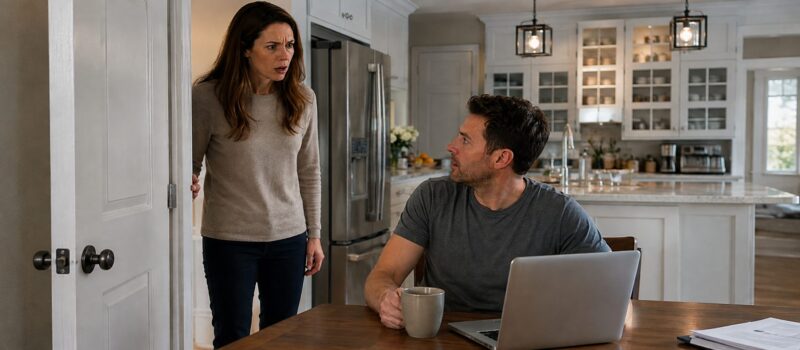
Three days after my father passed away, I walked into the kitchen at 10:30 on a Wednesday morning to find my husband drinking coffee in his gray sweatpants.
I stopped short in the doorway.
For most of our twenty-two-year marriage, Mark had left the house before eight with a travel mug in one hand and his company phone in the other, usually grumbling about some distributor whose emergency couldn’t wait until Monday. Seeing him sitting at the kitchen table in the middle of a weekday felt entirely wrong.
“Why are you home?”
Mark glanced up from his laptop.
“Morning to you, too.”
“It’s Wednesday.”
“I know what day it is.”

For a split second, I assumed he had taken time off because of Dad. Walter Hail had been gone barely seventy-two hours, and I had spent the morning arguing with a florist over whether a man who considered decorative pillows a personal insult would have wanted something called Heavenly Garden at his service.
Then I noticed Mark’s company phone was missing from the counter.
“Did something happen at work?”
He closed his laptop.
“I quit.”
I stared at him.
“You what?”
“I resigned.”
“When?”
“Yesterday.”
He took another sip of his coffee.
“Clare, don’t make it sound like I joined a cult.”
Normally, I might have laughed. Mark was always great at using humor to soften an awkward conversation.
That morning, I didn’t.
“Why would you quit your job yesterday?”
He leaned back in his chair.
“Because I just don’t see the point anymore.”
“A paycheck is usually the point.”
“You know what I mean.”
“No, Mark. I really don’t.”
He studied me for a second, then said casually, “Why keep working? Your inheritance is enough for both of us.”
The kitchen went dead silent.
Sympathy cards were stacked right beside the toaster. Dad’s obituary was open on my tablet. His final voicemail was still saved on my phone because I couldn’t bring myself to delete it.
My husband had apparently looked at all of that and seen a retirement plan.
“What inheritance?”
Mark frowned.
“Come on, Clare.”
“No. Tell me.”
“Your dad sold Hail Mechanical for millions. His house is paid off. He had investments. He barely spent a dime.”
“How much do you think I’m getting?”
“I don’t know the exact amount.”
“Then how do you know it’s enough for you to stop working?”
He hesitated.
That bothered me far more than the answer itself.
“Well, conservatively speaking, it has to be a few million.”
Conservatively.
He had actually done the math.
I hadn’t.
I knew Dad had done well when he sold his commercial heating and cooling company six years earlier. I knew he had investments because he occasionally complained about his financial adviser using fancy terms like “wealth preservation.”
Beyond that, Dad and I never discussed what I might inherit.
Mark reached across the table.
“Look, I’ve worked since I was twenty-two. I’m fifty-five now. That’s thirty-three years of quotas, airports, regional meetings, and clients calling on Sundays because apparently an air filter is a national emergency. Maybe we finally get to actually enjoy our lives.”
I understood that part.
Mark had been exhausted for years. I had watched him come home from business trips looking ten years older than when he left.
Even so, understanding why someone wanted something didn’t make the way they took it reasonable.
“You quit without even talking to me.”
“I knew you’d worry.”
“That isn’t a defense.”
“I was going to tell you.”
“You are telling me. After you quit.”
He rubbed his forehead.
“Can we not do this right now?”
For one absurd second, I almost laughed. Apparently, three days after my father’s death was an inappropriate time to question a massive financial decision Mark had made because my father had died.
That evening, Mark’s mother and sister came over.
Diane brought lasagna, and Melissa brought wine. For the first twenty minutes, everything felt almost normal. We chatted about the funeral, the weather, and Dad’s old friend flying in from Florida. Diane even told a story about Dad refusing to replace a toaster because “new ones have too many settings.”
Then Mark started spending my father’s money.
Diane mentioned that her rent had gone up again.
Mark leaned back and said, “Don’t worry about it, Mom. Once everything clears, I’ll buy you a house.”
My fork stopped halfway to my mouth.
Diane blinked.
“Mark.”
“I’m serious.”
“Oh, honey, I couldn’t let you do that.”
Then, almost immediately, she added, “There are some nice little ranches near Westerville, though.”
Melissa laughed.
“Mom’s already got an entire zip code picked out.”
Diane waved her off with a smile.
“I’ve just looked, that’s all. It doesn’t mean anything.”
Mark chuckled, then turned toward his sister.
“And we’ll get you straightened out, too.”
Her smile vanished.
“What’s that supposed to mean?”
“Your business debt. I’ll give you two hundred thousand. Clean slate.”
Melissa slowly put her fork down.
“Are you serious?”
“Absolutely.”
She jumped up and ran over to hug him.
I sat there with both hands wrapped tightly around my water glass.
Nobody had asked me anything.
Not how I was doing.
Not what Dad’s estate actually contained.
Not what I planned to do with it.
They had skipped straight to distribution.
“Mark.”
He looked over at me.
“What?”
“Dad hasn’t even been buried.”
The table went dead quiet. His smile vanished.
“Clare, that’s not what this is.”
“Then what is it?”
“I’m just talking about taking care of family.”
I looked from Diane to Melissa.
“Whose family?”
Diane looked down at her plate. Melissa leaned back. Mark’s jaw tightened.
“That’s completely unnecessary.”
“So was promising two hundred thousand dollars nobody consulted me about.”
Melissa raised both hands.
“I don’t want to be in the middle of this.”
An interesting statement from someone who had accepted two hundred thousand dollars less than a minute earlier.
I didn’t say it. Back then, I was far too good at swallowing whatever might make an uncomfortable moment worse.
After they left, Mark followed me into the kitchen.
“You really embarrassed my mother.”
I turned around.
“I embarrassed your mother?”
“She already feels uncomfortable accepting help.”
“She recovered remarkably fast.”
“Clare.”
I set down the foil I was using to cover the leftovers.
“You had no right to promise either of them anything.”
“We’re married.”
“What does that have to do with promising Melissa two hundred thousand dollars?”
“If your dad left you what I think he did, we’re talking about way more money than we’ll ever need.”
“That still doesn’t answer my question.”
He sighed heavily.
“You’re turning this into something it isn’t.”
“What is it, then?”
He gave a tired laugh.
“Clare, there isn’t going to be ‘your money’ and ‘my money.’ We’re completely set.”
I didn’t answer. Partly because I was exhausted, and partly because I had spent years deciding which disagreements were actually worth the fight.
Mark had always been generous—sometimes with things that weren’t entirely his. Years earlier, he loaned my SUV to Melissa for four days and only told me afterward. When Diane’s water heater broke, he promised we would pay for the replacement before ever mentioning it to me. He volunteered our house for Thanksgiving so often that one year I found out we were hosting because Diane called to ask what time she should bring the rolls.
None of those things had seemed enormous on their own. Marriage is full of small irritations, and I had always told myself not every hill needed a battle.
The next morning, my phone rang while I stood in Dad’s bedroom trying to decide which suit he should wear for the service.
“Clare? It’s Samuel Green.”
Dad’s attorney.
After the expected condolences, Samuel said, “There are several estate documents Walter wanted me to review with you personally. Could you come into my office tomorrow?”
“Of course. Mark can come with me.”
There was a brief pause on the line.
“Actually, your father specifically requested that our first meeting be with you alone.”
I turned toward the doorway. Through the hallway, I could see Mark sitting on the couch with his laptop. On the screen was a listing for a used boat.
For the first time since Dad died, I wondered what my father had known that I didn’t.
“Yes?”
“There’s nothing in here about what I wanted.”
He kept quiet.
“No mention of whether I even wanted to retire. Nothing about Emily. Nothing about Dad’s scholarship fund. Nothing about keeping the investments intact.”
I looked down at the pages.
“I’m plastered all over this document.”
Samuel waited.
“And somehow, I’m not in it at all.”
“Are you okay?”
“No.”
It was the honest truth, and the easiest answer I’d given all week.
Before I left, I gave Samuel one final instruction.
“I don’t want a single penny of that inheritance transferred into our joint accounts. No checking, no savings, no investments, no property. Nothing.”
“We can certainly make sure everything is handled securely.”
“And I’m not authorizing any large distributions for what Mark promised.”
That evening, Mark was waiting for me at the kitchen table.
“Did you talk to the trustee?”
“Yes.”
“And?”
“I’m not requesting the funds.”
His expression shifted shifted instantly.
“Any of it?”
“Not for your mother’s house. Not for Melissa. Not for the lake cabin.”
For the first time since Dad died, Mark didn’t look annoyed or defensive.
He looked genuinely scared.
That was when it finally clicked.
Until that exact moment, it had never crossed his mind that I might actually say no.
The next morning, Mark called his old boss.
“I’m not asking you to pretend I never resigned. I just want to know if there’s any possible way to reverse it.”
After several long pauses, he hung up.
“What did he say?” I asked.
“My old position has already been offered to Greg.”
Mark had complained about Greg for the last six years.
“Well, that was fast.”
“Turns out Greg doesn’t need three weeks to make up his mind.”
I let it slide.
“They might have another opening down the road,” Mark muttered. “Probably pay less, though.”
“Okay.”
He let out a dry, humorless laugh.
“You don’t have to sound so thrilled.”
“What do you want me to say?”
“Maybe that we’ll figure this out together.”
“We can figure out our next steps together. What we can’t do is pretend that quitting your job was a joint decision.”
That became the underlying argument behind every single fight for the next week. Mark wanted me to pull enough cash from the trust to replace two years of his salary while he figured out his next move.
I said no.
I wasn’t jeopardizing our mortgage or our grocery money; I still brought in a steady income from my physical therapy practice, had my own savings, and shared our standard household funds. I simply refused to treat my dad’s estate like a severance package for a resignation I never agreed to in the first place.
Then Diane and Melissa came over to “have a talk.”
Melissa took the lead.
“Mark told us you’re not requesting any distributions from the estate.”
I looked right at Mark.
“That’s correct.”
“I just really wish I’d known that sooner.”
“Before what?”
“Before I rearranged things with my creditors.”
“I never told you to change a thing.”
“No. Mark did.”
“Then Mark owes you an apology.”
She frowned.
“He’s your husband, Clare.”
“Exactly. My husband. Not the executor of my father’s estate.”
Diane jumped in.
“Let’s not make this any uglier than it has to be.”
Apparently, expecting people not to spend my inheritance was what kept ruining the mood.
Diane’s situation was harder on me. She was seventy-six years old, her rent had gone up twice in three years, and she lived in constant anxiety over what she’d be able to afford by the time she hit eighty.
And, despite everything, I loved her.
She was the one who drove me to the hospital when Emily was born because Mark was out of town on a sales trip. She sat right beside me when my mother was sick in the hospital. She had been a fixture in my life for decades.
People are messy and inconvenient that way. They can hurt you deeply without erasing every good thing they’ve ever done for you.
After everyone cleared out, I found myself wondering if I should just buy Diane something modest. Not the house Mark had grandly promised her—maybe just a nice, manageable condo.
A few days later, I brought it up with Samuel.
“What if I wanted to buy Diane a place?”
“Do you?”
“I might.”
“That’s a separate question from whether you can.”
We crunched some numbers. A modest condo in the $225,000 to $250,000 range would likely qualify for trustee approval.
Then Samuel asked, “Is this actually what you want, Clare?”
“I just don’t want her stressing out about housing.”
“That wasn’t my question.”
I sighed heavily.
“I honestly don’t know.”
“Then don’t submit anything today.”
I didn’t. And I was deeply grateful for that restraint when Diane showed up at my front door the very next afternoon, still wearing her winter coat.
“Mark said you spoke with Samuel.”
“He told you that?”
“He mentioned you might be rethinking things.”
“I was just looking at a few options.”
Her face instantly lit up.
“A condo would actually be so much better than a house anyway. Way less maintenance.”
I had never mentioned a condo to her.
Mark had. Again.
“Diane, I haven’t decided a single thing.”
Her expression hardened.
“Clare, I honestly don’t understand what there is to deliberate over.”
“A lot.”
“Your father left you nearly four million dollars.”
There it was. The exact number. Mark had shared that, too.
“That’s between me and Dad’s estate.”
“I’m not trying to pry. I just think you’re making rash decisions while you’re still deep in grief. Walter made sure you’d never have to stress about money again.”
Then she dropped it.
“Walter can’t use it anymore anyway. What on earth are you saving it for?”
I stared at her. Her voice softened immediately.
“Oh, honey, I didn’t mean it like that.”
But there was no other way to interpret it. Up until that second, I thought I could somehow separate my own independent generosity from Mark’s overwhelming sense of entitlement. Sitting across from Diane, I finally realized I couldn’t—not yet, anyway. She wasn’t waiting to see if I felt generous; she was just waiting for me to finally cave.
“I think you should just renew your lease,” I said quietly.
Her face fell.
“Clare—”
“I haven’t submitted anything to the trustee.”
She stared at me for a long beat, grabbed her purse off the counter, and walked out.
Emily called that evening.
“Mom, what is going on?”
“What did your dad tell you?”
“That he made a really stupid mistake.”
“Well, that narrows it down.”
She didn’t laugh.
“He said he retired too early because Grandpa left enough money that we’d be fine. He also mentioned something about separate bank accounts and lawyers.”
“I already have a lawyer. He handles Grandpa’s estate.”
“Mom.”
Then came the inevitable question I knew was coming.
“Dad messed up, I know that. But are you really going to throw away twenty-two years of marriage over money?”
“No.”
“Then what are you doing?”
I could have texted her Mark’s six-page investment blueprint. Instead, I just said, “I’m not asking you to choose a side.”
“I’m not choosing.”
“Good.”
“But I just don’t understand.”
I sat down on the edge of my bed.
“I’m just trying to figure out the exact moment your father decided that being married to me meant he didn’t need to consult me anymore.”
Emily went totally quiet.
Later that night, Mark walked into the bedroom.
“We can’t keep living like this.”
“No, we really can’t.”
“If we’re a married couple, we’re supposed to build a future together.”
“I agree.”
“Then you can’t just wall off nearly four million dollars like it has nothing to do with me.”
I stared right at him.
“You quit your job without saying a word to me. You promised your mother a house without asking me. You promised your sister $200,000 without my input. You mapped out your entire retirement before Dad even passed away, and you still didn’t ask me.”
“Clare—”
“And now I’m the one who has to prove my commitment to this marriage?”
He didn’t have an answer for that.
I reached down and picked up my pillow.
“What are you doing?”
“Sleeping in the guest room.”
“For how long?”
I paused at the door.
“I don’t know.”
For once in my life, I didn’t rush to give Mark an answer just to make him comfortable.
He ended up moving into the guest room instead. For the next several weeks, our marriage turned into an exercise in icy politeness.
“Need anything from the grocery store?”
“No, thanks.”
“I’m taking the dog out.”
“Okay.”
“I’ll be home late. Got an interview.”
“Good luck.”
You can spend twenty-two years with someone and turn into courteous strangers startlingly fast.
Slowly, though, Mark started walking things back. He canceled the lake property contract and got our deposit refunded. He updated his resume and started reaching out to former clients and colleagues. Most importantly, he stopped badgering me about the trust.
At first, I figured it was just another strategy. But then, one Saturday morning while I was folding towels in the hallway, I overheard him talking to Melissa on the phone.
“No,” Mark said firmly. “You need to work out a payment plan with them.”

A pause.
“I know what I told you before.”
Another pause.
“No, Clare didn’t change her mind. This has nothing to do with Clare.”
I stopped folding.
“I shouldn’t have promised you that money.”
I couldn’t hear Melissa’s side of the conversation.
Then Mark said, “Because it was never mine to promise.”
My hands went completely still. That sentence mattered more than anything else he could have said. It wasn’t the trustee won’t approve it. It wasn’t Clare won’t release the funds. It wasn’t Walter tied everything up.
It was: It wasn’t mine.
A few days later, he called Diane.
“Mom, listen to me. Do not give notice on your apartment.”
Even from across the kitchen, I could hear her voice rising through the phone.
“I know what I said earlier.”
She kept pushing.
“No, Clare didn’t stop me.”
He looked up and caught my eye, then turned back toward the window.
“I promised you something that wasn’t mine to give.”
There it was again.
“I know you’re disappointed, and I’m sorry. But that’s on me.”
After he hung up, I looked at him. “Thank you.”
He looked genuinely surprised.
“For what?”
“For not making me out to be the bad guy.”
He gave a slow nod.
“I played that role enough already.”
It was the closest thing to tenderness we had shared in months. Which made what I had to do next that much harder.
The following Sunday, I asked him to sit down with me at the kitchen table. The exact same table where he had casually auctioned off my inheritance while my father’s funeral flowers were still sitting in our living room.
I laid Samuel’s thick folder right between us.
Mark looked down at it.
“What’s that?”
“You tell me.”
I slid the top page across the wood: HAIL-BENNETT FAMILY INVESTMENT PLAN.
His face dropped. He didn’t bother asking where I got it, which told me everything I needed to know.
“You actually presented this to Dad.”
“It was just a hypothetical.”
“Eleven months before he died.”
“Yes.”
I flipped open the folder.
“Here’s your retirement projection. Here’s the lake cabin. Housing funds for your mother. And two hundred to two hundred fifty thousand dollars earmarked for Melissa.”
“I was just mapping out possibilities.”
“Using whose money?”
He rubbed his temples.
“We’ve been over this.”
“No, we really haven’t.”
I slid the pages closer to him.
“Show me.”
“Show you what?”
“Show me the part where you asked what I wanted.”
He stared at me blankly.
“Clare, it’s a six-page document.”
“Then it shouldn’t take you long to find it.”
He didn’t touch the pages, so I pointed them out myself.
“My name is right here fourteen times. Clare’s expected inheritance. Clare’s projected assets. Clare’s investment income.”
I looked up, meeting his eyes.
“Where am I in any of this?”
He frowned.
“Your name is all over it.”
“Exactly.”
That shut him up.
“My money is everywhere. I am nowhere.”
For a long time, the only sound in the house was the low hum of the refrigerator.
Finally, Mark spoke. “I was just so tired.”
I waited.
“I know that doesn’t make it an excuse.”
“No, it doesn’t.”
“I’d been grinding at the exact same job forever. Your dad sold his company before he turned sixty. His house was completely paid off. He could help Emily through college without ever logging into his bank account to check balances.”
“Dad never threw that in your face.”
“I know he didn’t.”
The answer came too fast, making it all the more heartbreaking.
“Walter never had to tell me he was more successful than I was. I already knew it.”
“Mark—”
“No, let me finish.”
So I let him.
“I wanted to stop stressing about money. I wanted to be the guy who could tell his mother she’d never have to worry about a rent hike. I wanted to bail out Melissa. I wanted to be the hero everyone called because I could fix all their problems with a wave of my hand.”
I watched him quietly.
“You wanted to feel like my father.”
He looked away, his jaw working. After a moment, he whispered, “Maybe.”
I lightly tapped the cover of the investment plan.
“And you were planning to use my father’s money to buy that feeling.”
Mark closed his eyes and let out a long breath. He didn’t even try to argue.
And that was the moment something inside me finally settled. Not because I felt like I’d won—there was no victory here—but because I finally understood.
Mark hadn’t spent eleven months plotting some malicious scheme against me. He had done something much more common: he had built a comforting daydream in his own mind where my future inheritance solved every single disappointment he had accumulated about his life. No more business travel. No more corporate quotas. He got to be financially secure. He got to be the dutiful son who rescued his mother and the savior brother who rescued his sister. He got to be the husband who finally held all the cards.
And somewhere inside that neat little narrative, he had completely forgotten I was an actual person. I had stopped being his wife and simply become an asset with a first name.
Emily dropped by that afternoon. The folder was still sitting out on the table.
“What’s that?”
I glanced at Mark. He gave a small, defeated nod. So I handed it to her.
Emily read through the pages in absolute silence. When she finished, she looked up at her father.
“You wrote this up before Grandpa died?”
“Yes.”
“How long before?”
“Eleven months.”
She stared at him, appalled.
“Dad.”
There was more pure disappointment in that single syllable than an hour of screaming ever could have achieved.
Mark stared down at his shoes.
“I know.”
Emily didn’t suddenly jump in to take my side or comfort me; she just finally understood what she had spent weeks asking me to overlook and forgive.
After she left, Mark and I stayed sitting at the table.
“I’m truly sorry,” he murmured.
I believed him. And that, honestly, was the hardest part of all. If he had stayed arrogant and defensive, anger would have made this whole process so much cleaner. Instead, he was genuinely trying to do the work.
Except my dad hadn’t set up that trust to test whether Mark was eventually worthy of forgiveness. He had set it up to buy me time. And I finally realized what I needed to do with that time.
“Dad didn’t need to protect me from you by hiring a lawyer,” I said quietly. “He just gave me enough breathing room to see what I otherwise would have talked myself out of seeing.”
Mark looked up, alarmed.
“What are you saying?”
“I need you to move out.”
His face froze.
“For how long?”
“I don’t know.”
“Are you filing for divorce?”
I shook my head slowly.
“I haven’t decided that yet.”
He looked utterly devastated, and I hated that I still cared enough to feel a pang of guilt.
Then I looked him in the eye and said, “And that is the very first big decision in this house that nobody else gets to make for me.”
This time, Mark didn’t argue. He packed up and moved out the following Saturday.
There was no dramatic screaming match. He rented a modest one-bedroom apartment fifteen minutes away and hauled his things over in three trips with his SUV. On his final trip, he stood by the kitchen island holding his keys out to me.
“I’ll leave the garage door remote here.”
“Okay.”
“You can keep it on your keyring for now.”
He gave a stiff nod. After twenty-two years together, neither of us had any idea how to actually say goodbye.
“Call me if anything comes up with the house maintenance,” he said.
“I will.”
And then he walked out.
I locked the heavy deadbolt behind him, and immediately felt a wave of residual guilt for doing it. That’s the bizarre thing about finally setting boundaries after decades of avoiding conflict: even when you know deep down it’s the right call, a part of you still feels like you’re being rude.
The following months weren’t nearly as neat or satisfying as stories like this usually make them out to be. I missed Mark. Not every second of every day—some evenings, I genuinely relished eating exactly what I wanted for dinner and watching whatever television show I liked without him making snarky running commentary. But I missed hearing his familiar key turn in the front door. I missed his habit of leaving cabinet doors wide open. I even missed the way he sneezed loudly enough to startle the dog.
Missing someone, as I had to keep reminding myself, does not automatically mean you belong back with them.
Mark ended up landing another sales job after about seven weeks. It paid considerably less and required a lot more driving. When he finally told me about it, I smiled and said, “I’m glad for you.”
He gave me a crooked, self-deprecating grin.
“Not quite the glamorous early-retirement package I had mapped out.”
A few months prior, that comment would have instantly triggered a fight. This time, he just shook his head and added, “I know. And I have nobody to blame for that but myself.”
Diane ended up staying in her rental, successfully negotiating a much smaller rent increase before renewing her lease for another year. Melissa landed a full-time gig with an established local design firm and started chipping away at her debts through a realistic payment schedule.
Nobody lost their home. Nobody’s life collapsed into ruin. The catastrophic disaster everyone expected me to swoop in and prevent turned out to be nothing more than ordinary life—jobs, rent, bills, budgeting. The exact same baseline realities everyone else had been dealing with long before Walter Hail’s estate ever entered the picture.
Mark and I started going to counseling separately, and eventually, together. I won’t pretend therapy unlocked some magical, perfect conversation where every single wound was instantly healed. Mostly, it was just deeply uncomfortable.
One afternoon, our counselor asked Mark why he had been so dead-set on the assumption that I would eventually cave and greenlight his master plan.
Mark sat quietly for a long, heavy stretch.
Then he finally muttered, “Because she always just ended up going along with it.”
I turned and looked right at him.
“No. I usually just gave in.”
Mark started to object, then shut his mouth. There really wasn’t much left to say. I had spent over two decades calling it a “compromise.” Sometimes it genuinely was; plenty of times, it wasn’t.
Over time, Mark actually learned how to issue a real, unvarnished apology—one that didn’t come attached with a wall of excuses or self-pity. That mattered. He apologized for turning my father’s death into a financial windfall before I even had the space to process my grief. He apologized for making binding promises on my behalf. He apologized for operating on the arrogant assumption that my compliance was a given.
I believed him. I also believed that he was genuinely trying to grow.
But there’s a vital truth I really wish I had understood when I was younger: watching someone become a better person does not obligate you to return to the exact version of yourself who had to be broken down before they finally decided to change.
After several more months of work, I filed for a legal separation. Later down the line, we quietly moved forward with divorce proceedings. It wasn’t vicious, but it certainly wasn’t painless, either.
Around that same time, Emily and I finally tackled the daunting task of clearing out Dad’s house.
One Saturday morning, we stood shoulder-to-shoulder in his kitchen, surrounded by towers of cardboard boxes and all those mundane, lived-in possessions that suddenly take on a sacred weight once their owner is gone.
Emily held up four different tape measures from a drawer.
“Four?” she asked, baffled.
I smiled softly. “He never trusted the one out in the garage.”
“Why?”
“He swore it lied to him about a measurement once.”
She stared at me for a second, then burst out laughing. It was the very first time I had genuinely laughed inside Dad’s house since he passed away.
There were no shocking final secrets hidden away in a false-bottom drawer. No dramatic, cinematic letters left behind. Just Dad: hardware-store receipts tucked under lamps, reading glasses left on dressers, an ancient drip coffee maker I had tried to replace twice, and measurements hastily scribbled in pencil on old envelopes for shelves he clearly intended to build one day but never quite got around to.
While Emily was busy wrapping up his coffee mugs in packing paper, she paused and asked, “Mom… do you honestly think Grandpa knew Dad was going to pull all this?”
I considered it for a moment.
“No, I don’t think he knew.”
She looked surprised. “Really?”
“I think he was just deeply worried about it. There’s a big difference.”
I folded the flaps of another box closed.
“Dad didn’t magically understand my marriage better than I did. He wasn’t trying to rig some elaborate trap for your father. He just noticed a toxic dynamic that deeply concerned him, and he structured his estate so that I’d never be cornered into making permanent, life-altering decisions under pressure.”
Emily nodded slowly. “That was all?”
“That was all.”
In the end, I didn’t do anything wildly flashy with the inheritance. I didn’t buy a cherry-red convertible. I didn’t pack up and vanish to Italy. I didn’t magically morph into a totally different person just because the balance on a statement had more zeros attached to it.
I bolstered my own retirement accounts. Samuel and a smart financial adviser helped me secure a comfortable home for myself post-divorce. The vast majority of the funds remained safely invested. I set up an education fund for future grandchildren, and I made a substantial, quiet donation to the community college scholarship program Dad had always supported behind the scenes.
Later on, I did give Emily a generous sum toward her own first home down payment. But before I handed over a single dime, we sat down together at my kitchen table. We talked openly about the exact amount, why I wanted to provide it, and whether there were any hidden expectations attached to it. (There weren’t.) The whole conversation lasted maybe twenty minutes. It was easily the healthiest financial transaction anyone in my family had executed in years.
The legal paperwork for the divorce took quite a bit longer than either Mark or I anticipated. When we finally met up to sign the last set of settlement papers, we walked across the street and grabbed coffee afterward.
That might sound bizarre to some people, but twenty-two years of shared history don’t just magically evaporate because attorneys slapped some colored sticky tabs onto a stack of legal briefs.
Mark stirred his coffee, staring down into the mug.
“Do you ever wonder what would have happened if I had just kept my mouth shut and stayed at my job?”
“Sometimes.”
“We probably still would be married.”
I weighed the thought.
“Maybe.”
He looked up, meeting my eyes.
“Even so… that underlying problem still would have been there.”
“What problem?” I asked gently.
“I honestly believed that being your husband gave me automatic ownership over things that belonged to you.”
Mark looked away, swallowing hard.
“The money just finally made the price tag high enough for me to wake up and notice it.”
He gave a quiet nod. “I just really wish I had noticed it sooner.”
“So do I.”
We finished our coffee in companionable silence. Out in the parking lot, we shared a brief, quiet hug before walking away toward our separate cars.
For a long time in my life, I truly believed that my father’s final gift to me was a multi-million-dollar trust fund.
I was wrong. The single most valuable thing Walter Hail left me was time.
Without that protective barrier of time and structure, I know exactly how this story would have played out. Mark would have offered a tearful apology. Diane would have cried about her rent. Melissa would have laid out just how desperately she needed a lifeline. And I would have looked at those massive numbers and convinced myself that there was more than enough to go around.
Two hundred thousand to clear Melissa’s slate. A nice condo for Diane. A lake cabin getaway. A couple of years of salary cushion for Mark.
One little concession at a time. I would have labeled it all as generosity. I would have called it compromise. I would have chalked it up to the normal give-and-take of marriage.
And eventually, bit by bit, I would have caved. Not because I actually wanted to, but because somewhere along the way during two decades of smoothing over rough edges, I had fundamentally confused keeping everyone else happy with being a good wife.
Three days after my father passed away, my husband quit his job because he genuinely believed my inheritance meant neither of us would ever have to stress about real life again.
He was dead wrong.
Mark eventually went back to work. And, as it turns out, so did I.
Except the full-time job I finally walked away from was one I had been exhausting myself performing for twenty-two years without even realizing it: playing peacemaker. Smoothing out every uncomfortable silence. Making sure everyone else was comfortable at my own expense. Softening my hard no into a hesitant maybe until someone else could bend it into a yes. Pretending that keeping the peace and earning basic respect were the exact same thing.
They never were.
Dad never tried to dictate what decision I should make about my marriage. He never attempted to script my future. He simply made sure that, for once in my life, I was given enough protected time and space to choose it entirely for myself.
And in the end, that was worth infinitely more than everything else he left behind.





