“We took the treatment money for the cruise. You can handle Victor when you get back. We’re sick of taking care of him.”
That was the note my mother had left on the kitchen counter.
I had just returned home to Norfolk after nine months away. As a Navy flight surgeon, I’d spent almost that entire stretch rotating through grueling shifts, emergency medical transfers, and a long support mission at sea. For months, all I could think about was coming home, hugging my family, and above all, seeing Victor—my stepfather, the man who had raised me as his own daughter since I was eight years old.
Instead, I unlocked the front door to a freezing, pitch-silent house.
“Victor?”
No answer.
I dropped my duffel bag in the hallway and hurried down to his bedroom.
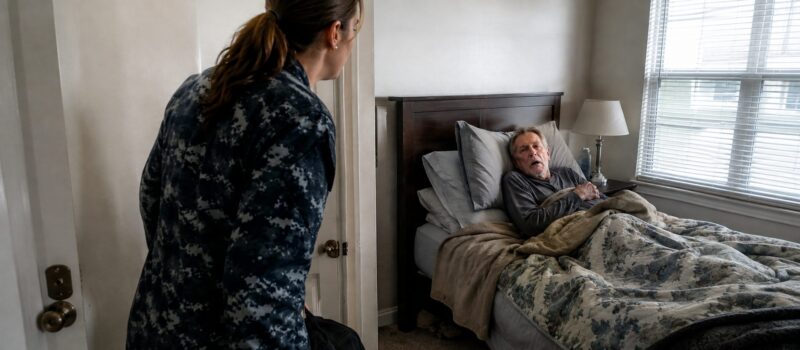
I found him curled on his side, shivering violently under a thin, threadbare blanket. He was severely dehydrated, his clothes were soiled, and his voice was barely a whisper. Victor had late-stage pancreatic cancer; he had reached the point where he needed help just to sit up.
“Maya… you’re home,” he rasped.
Something inside me shattered.
I cranked up the thermostat, gave him small sips of water, cleaned him up, changed his bedding, and immediately called his home-hospice team for guidance. While waiting for a callback, I warmed a cup of broth.
“Where’s Mom?” I asked softly.
Victor closed his eyes. “A trip.”
That was when I noticed the note on the counter.
My mother, Evelyn, along with my brother, Mason, and my sister, Chloe, had taken the family emergency money to finance a luxury Caribbean cruise.
The exact same account where I deposited a substantial chunk of my Navy paycheck every single month.
I picked up the tablet sitting on the coffee table. An Instagram notification popped up on the screen. Mason was grinning on the top deck of a cruise ship, wearing expensive new sunglasses and wrapping his arm around his girlfriend.
The caption read: “Working hard to play harder. Living the life we deserve.”
My stomach turned.
I opened the joint banking app on my phone.
Available balance: $14.12.
For a few seconds, I convinced myself it was a glitch. Then I pulled up the transaction history:
Cruise tickets
Designer boutique purchases
Premium drink packages
Onboard spa services
ATM cash withdrawals
Shipboard casino chips
In less than six days, they had burned through nearly $10,000—money I had transferred specifically to pay for Victor’s specialized prescriptions, home care visits, groceries, and utility bills.
I walked back into his bedroom, my hands trembling.
That’s when I noticed something else. The display cabinet that had always held Victor’s prized mementos from twenty-two years of active service in the U.S. Marine Corps was completely bare.
“Where are your military decorations, Victor?”
He let out a hollow, bitter laugh. “Your mother listed them online. Sold the whole shadow box.”
I stared at him. “What?”
“Said they were just old pieces of metal, and she needed extra spending money for port excursions.”
I couldn’t even find the words. But the nightmare was far from over.
Victor suddenly doubled over, groaning in agony. I rushed to the nightstand and reached for the bottle of liquid morphine prescribed for his breakthrough pain.
His weak hand caught my wrist with surprising strength. “Don’t give me that.”
“Victor, you’re in severe pain. You need this.”
Tears gathered in his sunken eyes. “It’s not medicine anymore, Maya.”
I looked down at the bottle. “What do you mean?”
He struggled for breath. “Evelyn poured out what was left three days ago. She filled it back up with tap water.”
The room seemed to tilt beneath me. “Why… why would she do that?!”
Several seconds passed before he answered. “She said the real refills were too expensive for someone who was going to die anyway.”
I carefully set the bottle down. Not on the nightstand—away from everything else. I handled it the way I would handle evidence.
Because in that instant, I realized I wasn’t just dealing with selfish relatives who had abandoned a sick man. This had escalated into something far more sinister. And I had no idea that this single diluted bottle of medication would eventually expose a secret powerful enough to dismantle my entire family.
Part 2
By the next morning, my military medical training had fully kicked in. I documented everything: high-resolution photos of Victor’s condition, the unpaid utility notices, the thermostat, the nearly empty refrigerator, the state of his room, and every transaction line in the joint bank account.
Then I called Victor’s lead oncologist, Dr. Vance.
After I explained the situation, a long silence fell over the line.
“Maya, keep that bottle untouched,” Dr. Vance instructed firmly. “Do not throw it away. If he has another severe crisis, bring him directly to our emergency transport unit. We will document everything officially on our end.”
I followed his instructions to the letter.
Later, I spoke with Mrs. Gable, our longtime neighbor. She had watched my mother, Mason, and Chloe leave three days earlier.
“They were all smiles,” Mrs. Gable said, shaking her head. “Mason was bragging that they were finally traveling ‘like rich people.’ I asked Evelyn about Victor, and she just shrugged and said, ‘He’s sleeping. He doesn’t need anyone bothering him.’”
As the afternoon wore on, Victor’s strength steadily faded. Eventually, he asked me to close and lock his bedroom door.
“There’s something your mother never knew, Maya.”
I assumed he was about to confess to some hidden medical debt or unpaid bills. Instead, he pointed toward his closet and asked me to pull down a leather briefcase hidden behind a row of heavy winter coats.
I set it on the bed and opened it.
Inside were legal contracts, private investment statements, property deeds, and certified trust records.
“Evelyn always assumed I lost everything when I retired from my private wealth management firm,” Victor said softly. “I let her believe it.”
I stared at the first page. Then the second. The numbers were so staggering I couldn’t process them at first.
“Victor… how much is here?”
“A little over three million dollars.”
I looked up at him. “Three million?”
He nodded slowly. The assets were spread across diversified index funds, commercial real estate holdings, and an irrevocable trust established long before he ever met my mother. They had also signed a premarital agreement keeping their pre-existing assets entirely separate.
“Why didn’t you ever tell her?” I asked.
“Because right after we got married, I noticed a pattern,” he said quietly. “When they thought I had money, everyone was attentive. When I pretended the funds were gone, they slowly drifted away.” He looked out the window. “I wanted to see who would stick around when I was no longer useful to them.”
Then his eyes met mine. “Now I have my answer.”
My mother had abandoned a man she believed was broke, completely unaware that he controlled a fortune. There should have been irony in it—maybe even satisfaction. But Victor showed neither. He just looked heartbroken.
“The money wasn’t the test, Maya. The test was seeing if anyone would offer me a glass of water when they thought I couldn’t pay them for it.” He squeezed my fingers. “And you were the only one who came back.”
Those words hit me hard. I hadn’t come home for his money; I hadn’t even known it existed. I came home because he was Victor.
Later that afternoon, his estate attorney, Sarah Jenkins, arrived alongside a notary and Dr. Vance. Dr. Vance officially certified that Victor was lucid, fully aware of his actions, and competent to execute legal documents.
For nearly two hours, Sarah and Victor meticulously reviewed his estate plan. He completely restructured his will and trust. The vast majority of the $3 million estate was directed to support homeless and terminally ill veterans. A significant portion was placed under my direct administration, accompanied by a personal bequest.
Evelyn, Mason, and Chloe were explicitly cut out.
Victor didn’t hesitate or smile when signing. He simply told Sarah, “I have no intention of rewarding the people who waited for me to die so they could divide up a fortune they didn’t even know existed.”
That evening, I dropped a message into the family group chat:
“Victor’s condition has deteriorated sharply. The doctor says he may not make it through the night. Please come home. This is your last chance to say goodbye.”
Mason read it immediately. Chloe opened it two minutes later. Mom took five minutes to reply:
“Stop being dramatic, Maya. The cruise doesn’t dock until Tuesday.”
Mason added:
“You’re the doctor, Maya. Deal with it. That’s what you’re there for.”
Victor was awake and read every message. I watched the last faint flicker of hope vanish from his eyes.
I hit the video call button. Mom answered from the sunlit deck of the ship, loud music pounding in the background as people danced around her.
“What do you want now, Maya?” she shouted over the noise.
“I need you to come home,” I said evenly. “Victor is dying.”
Her expression didn’t shift. “Maya, we paid thousands of dollars for this vacation! We are not cutting it short just because he decided to take a turn for the worse.”
Mason popped into the frame behind her, holding a drink and laughing. “Tell him to hold on until Tuesday!”
Victor heard every word.
I reached to end the call, but Mom chimed in with one last remark: “And if he passes before we get back, just call the funeral home and handle it. You’re the responsible one, aren’t you?”
The line went dead.
The room fell completely silent. Victor took a slow, measured breath, then looked at me.
“Save that video recording, Maya.” He pointed toward the leather briefcase. “Because when they walk through that front door, they’re going to find out that the most expensive cruise of their lives didn’t cost ten thousand dollars.”
His gaze locked onto mine. “It cost them three million.”
Part 3
I sat in the armchair beside Victor’s bed all night. Every so often, he’d open his eyes just to make sure I was still there.
Around three in the morning, a faint spark returned to his eyes. “Maya… do you know how to make cinnamon apples?”
I let out a tearful laugh. “Roughly. Why?”
“My mother used to make them for me when I was a boy in Ohio.”
I went into the kitchen. The pantry was nearly bare, but I managed to find a can of sliced apples, brown sugar, butter, and cinnamon. I simmered everything together on the stove. It wasn’t gourmet, but when I brought a small bowl back into his room, his whole face softened.
He managed two small bites and smiled—the first real smile I’d seen on his face since landing in Norfolk.
“This is terrible,” he whispered.
I laughed softly.
“But it tastes like home,” he added, his voice thick with emotion.
Then he raised his left hand. Victor had worn a sterling-silver Marine Corps signet ring on that finger for forty years. With trembling hands, he slipped it off, pressed it into my palm, and folded my fingers over it.
“They share your blood, Maya,” he whispered, “but you are my real daughter.”
That completely broke me. I leaned over his bed and cried against his arm.
Victor had never tried to replace my biological father, who died when I was little, nor had he ever forced me to call him Dad. He had simply been there. He taught me how to drive, sat through every single one of my track meets, and waited outside in the freezing cold for four hours while I took my Navy commission exam. When Mom complained that joining the military was “unbecoming for a young woman,” Victor always cut her off: “Leave her be, Evelyn. If she wants to fly high, let her fly.”
I squeezed his hand. “I love you, Dad.”
It was the first time I had ever called him that—and the last.
Victor passed away quietly shortly before dawn. No struggle, no dramatic final breath. His hand was simply resting in mine.
I stayed beside him for a long time. Finally, I smoothed his blanket, gently closed his eyes, and called Dr. Vance.
There were no screams—just a massive, quiet grief. The man my family had treated like an inconvenient financial burden had held on just long enough for me to get home so he wouldn’t have to die alone.
Sarah handled the legal filings while I arranged a dignified cremation and a small military service. Six Marine veterans attended, along with two neighbors, Dr. Vance, Sarah, and me.
Mom wasn’t there. Neither were Mason or Chloe. They were still posting photos from the cruise—one showed Mom raising a champagne glass against the sunset, captioned: “Last night in paradise!”
I didn’t comment, call, or confront them. I just waited.

On Tuesday afternoon, a car pulled into the driveway.
I had already set everything up in the living room. Victor’s brass urn sat on the mantel, flanked by his Marine Corps ring, a framed portrait of him in uniform, a copy of his revised will, and the official police evidence receipt for the diluted morphine bottle. Sarah and the notary sat quietly on the sofa.
The front door unlocked. Mom walked in sporting a fresh tan and carrying a new designer bag. Mason and Chloe rolled their suitcases in behind her, laughing.
“Maya!” my mother called out. “I hope you aired this place out. It smelled like a nursing home when we left!”
Then she stepped into the living room, glanced at the mantel, and stopped dead in her tracks. Her smile evaporated.
“What is that?”
I stayed silent.
Mason dropped his suitcase. “Where’s Victor?”
I pointed to the urn. “Right there.”
Mom went pale. “No…”
Chloe covered her mouth. “He passed away?”
“Sunday morning,” I said evenly.
Mom’s true colors flashed instantly. “And you had him cremated without us?!”
That was her first reaction. Not how he died, not if he suffered, not if he’d asked for her—just anger that she had been excluded.
I connected my phone to the Bluetooth speaker and hit play on the saved video. Mom’s voice echoed through the room:
“We paid thousands of dollars for this vacation! We are not cutting it short just because he decided to take a turn for the worse.”
Then Mason’s voice followed:
“Tell him to hold on until Tuesday!”
Mason swallowed hard, looking nervously at Chloe. “We… we were drinking. It was a joke.”
I stared at him. “A joke about a dying man?”
Mom tried to snap back into control. “Look, Maya, we used the family account for the trip. So what? I was his wife. I’m entitled to handle our household funds.”
I tossed a stack of bank statements onto the coffee table. “You spent nearly ten thousand dollars of my personal military pay while Victor was left without basic care, food, or medicine.”
Mason held his hands up. “We’ll pay you back once the estate settles!”
“Pay me back with what?”
Mom scoffed. “With Victor’s life insurance and pension payout, obviously! As his widow, I’m the sole beneficiary of his estate. So drop the holier-than-thou act.”
That’s when Sarah stood up, opening a leather legal portfolio. “Mrs. Vance, I am Victor’s estate attorney. I strongly suggest you take a seat.”
Mom frowned. “What is this?”
“We are here to formally execute your late husband’s final estate instructions,” Sarah explained calmly. “Prior to his passing, Mr. Vance executed a comprehensive revision of his last will and testament, as well as his master trust.”
Mom let out a sharp, nervous laugh. “He didn’t have a master trust! Victor was living on a modest disability stipend!”
Sarah slid a certified asset summary across the table. Mom picked it up, her eyes scanning the first page, then the second. The color drained from her face.
“Three million…” she whispered, her voice breaking.
Mason snatched the paper from her hands. “Three million dollars?! Where the hell did he get three million dollars?!”
Sarah remained totally unbothered. “Mr. Vance maintained an independent investment portfolio established prior to your marriage. Under the premarital agreement signed by Mrs. Vance, those assets remained entirely separate. Furthermore, under the terms of the revised trust, one hundred percent of the portfolio has been irrevocably assigned to the Marine Corps Scholarship Foundation and a private trust administered exclusively by Maya.”
Silence gripped the room. Chloe sank onto an entryway stool. Mason stared blankly at the pages. Mom’s hands began to shake uncontrollably.
“What about me?” Mom gasped. “I was his wife! I’m legally entitled to a spousal share!”
“You signed a complete waiver of spousal elective share when you executed your premarital agreement twenty years ago,” Sarah noted smoothly. “And given the ongoing criminal investigation, any attempt to contest this trust would be legally frivolous.”
Mom’s head snapped toward me. “Criminal investigation? What are you talking about?!”
I picked up the police evidence receipt from the mantel. “The toxicology report on Victor’s pain medication came back yesterday. The liquid in his prescription bottle was ninety-eight percent tap water. The police have launched a formal investigation into elder abuse, medical neglect, and tampering with a controlled substance.”
Mom opened her mouth, but no sound came out.
Mason immediately took a step back toward the door. “I didn’t touch his medicine! Mom was the one handling his prescriptions!”
“Mason!” my mother shrieked, whipping around to face him. “You told me to save money on the refills!”
“Because you said we needed extra cash for the cruise!” Mason shouted back.
In seconds, they tore into each other—not out of grief for Victor, but out of desperation over money they never even knew existed.
I watched them turn on one another before cutting in: “You have until six o’clock tomorrow evening to clear your personal belongings out of this house. The property is held under the trust, and the locks will be changed at six-0-one.”
The legal and criminal fallout unfolded over the next six months. State prosecutors brought formal charges against my mother for felony elder neglect and reckless endangerment. To avoid a lengthy trial, she accepted a plea deal involving probation, mandatory community service, and full financial restitution to Victor’s estate for the money stolen from the joint account. To pay it off, she had to sell her car and most of her jewelry.
Mason’s financial life collapsed just as quickly. Once my monthly pay transfers stopped and his expected inheritance vanished, his girlfriend left him. He ended up moving into a cramped one-bedroom apartment on the edge of town, working two retail jobs just to keep his head above water.
Chloe took a different path. She cooperated fully with investigators, admitting she knew Victor was being neglected but had been too cowardly to stand up to our mother. I didn’t cut her out entirely, but our relationship was permanently changed. A firm, necessary boundary remained between us.
Using the assets Victor placed under my control, I established the Victor Salgado Veteran Care Initiative—a non-profit dedicated to providing emergency home care, meal delivery, and legal advocacy for low-income and terminally ill veterans.
In our main office, I hung a single photo of Victor on the wall. Not his formal Marine portrait, but a casual photo I had taken years ago in our backyard: Victor sitting in an old lawn chair in a faded T-shirt, laughing with a plate of homemade cinnamon apples balanced on his lap.
Beneath it reads a simple plaque:
“Family isn’t defined by blood. It is proven by who stands beside you when you have nothing left to offer.”
Sometimes I look down at the silver Marine Corps signet ring I now wear on a chain around my neck and remember that final night—the cinnamon apples, his smile, and the way he kept opening his eyes just to make sure I hadn’t left.
My mother and brother thought they were being clever. They spent ten thousand dollars that wasn’t theirs, drank champagne on a cruise ship, and posted photos to prove how successful they were. In their greed, they traded away a $3 million legacy.
But the money was never the biggest thing they lost.
They lost Victor. They lost his trust. And they lost the devotion of a man who had spent years quietly watching to see who would stand by him when he had nothing left to give.
Blood brings people into your life by chance, but loyalty, integrity, and quiet love are what truly make a family.





