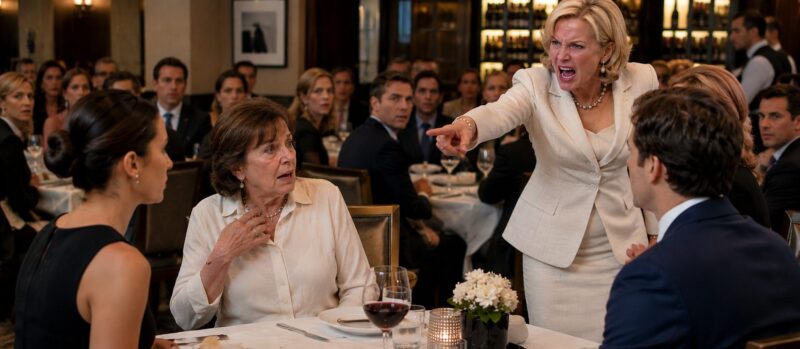
My mother-in-law spent the entire dinner looking down on me, calling me a «poor waitress» and humiliating my mom. Then, she threw a glass of wine right in her face. She thought she held all the cards—until one detail about the restaurant changed everything, and the security cameras captured every single second.
The wine hit my mother’s face before anyone at the table could even react.
One moment, Linda Whitmore was standing beside us at Bellamy’s, one of downtown Chicago’s busiest fine-dining spots. The next, she had flung half a glass of Cabernet across the white tablecloth, right into my mother’s face.
My mom, Patricia Hayes, froze.
Red wine dripped down her cheek and soaked into the cream blouse she had bought specifically for my engagement dinner.
“Linda!” my fiancé, Daniel, shouted.

His mother barely even looked at him. Her eyes stayed locked on me.
“This is what happens,” she said, her voice sharp and cutting, “when people forget their place.”
The entire dining room went dead silent.
I had worked at Bellamy’s for three years. I started as a server right after college because I wanted to earn my own income and learn the family business from the ground up. Linda knew I worked there. What she didn’t understand was why the managers treated me with so much deference, why I could walk into the kitchen during peak dinner service without anyone stopping me, or why the executive chef regularly ran new menu concepts by me.
She genuinely believed I was just a low-class waitress marrying above my station.
Linda leaned in closer. “Daniel could have married someone from a respectable family. Instead, he picked a poor waitress whose mother clearly doesn’t know how to behave in a place like this.”
My mother quietly wiped the wine from her face with a napkin.
I stood up.
Across the dining room, Marcus Reed, the general manager, was already heading our way with two security guards right behind him.
Linda actually laughed when she noticed them. “Good. Escort these women out before they embarrass us any further.”
Marcus stopped right beside me. “Ms. Hayes,” he said directly, “do you want me to call the police?”
The smug look vanished from Linda’s face.
I looked at her, keeping my composure. “No,” I said. “Not yet.”
Then, I casually glanced up at the security camera mounted above our section.
Linda’s eyes followed mine.
Bellamy’s private dining section was monitored by state-of-the-art, high-definition cameras with full audio coverage. My father had upgraded the entire system after an expensive theft two years prior.
“My dad owns Bellamy’s,” I told her softly.
Linda just stared.
“In fact,” I continued, “he owns the building, the restaurant group, and the private event company hosting our wedding reception.”
The color completely drained from her face.
At that exact moment, my father, Richard Hayes, stepped out of the back office. His eyes went straight to my mother’s stained blouse, then turned to Linda.
“Marcus,” my dad said, his voice eerily calm, “make sure you save every second of that footage.”
That was when the reality of what she had done finally hit Linda. This wasn’t a private spat she could twist or lie about tomorrow. She had thrown wine in my mother’s face, insulted me, demanded my father’s own employees throw us out, and pulled the whole stunt directly underneath a camera that was recording her every word.
Daniel looked at his mother as if he were seeing her clearly for the first time in his life.
Linda stood frozen for a few seconds before stammering, “It… it was an accident.”
My mother gave a short, disbelieving laugh. “You threw the glass from three feet away.”
“I was upset!”
“You called my daughter poor.”
“I didn’t mean it like that!”
Daniel pushed back his chair, the scraping sound loud against the floor. “How else could you possibly mean it?”
Linda turned toward him, suddenly desperate. “Daniel, sweetheart, you know how stressful tonight has been. I just wanted everything to be appropriate. Your father’s colleagues are here. People notice things.”
That only made it worse. For months, Linda had treated our wedding like a corporate merger. She micromanaged invitations, criticized my dress, questioned if my friends were “formal enough,” and insisted his family control the guest list because they had a «reputation to uphold.» I had tolerated it because Daniel kept promising me she would calm down. Now, he looked completely ashamed of every excuse he had ever made for her.
My dad stepped up beside my mother and draped his jacket over her shoulders. “Patty, are you hurt?”
“My eyes sting, but I’m fine.”
Marcus had a host bring water and a clean towel before turning to Linda. “Mrs. Whitmore, you need to leave.”
She blinked in disbelief. “Excuse me?”
“You assaulted a guest.”
“I am the groom’s mother!”
“That doesn’t change what you just did.”
Linda looked around, expecting someone to jump to her defense, but nearby diners either turned away or openly stared. Her husband, Charles, who had sat silently at the end of the table through the whole confrontation, finally stood up.
“Linda,” he said quietly, “we’re leaving.”
She gaped at him. “You’re taking their side?”
“I’m taking the side of reality.”
Security escorted Linda toward the entrance with Charles following close behind. She never apologized to my mother. She never apologized to me.
At the doors, she turned to Daniel. “You’re going to regret humiliating your own family.”
Daniel answered softly, “You did that to yourself.”
After they left, the dining room slowly returned to normal, but our night was far from over. My father brought us up to his office, where Marcus pulled up the security footage.
The video was even worse than I remembered. Linda’s voice came through crystal clear. She mocked my mother’s clothes, called my family “provincial,” and called me a poor waitress. Then, she threw the wine right after my mother told her to stop talking about me as if I were something to be bought and sold.
Daniel watched the recording twice. The second time, he buried his face in his hands. “I should have stopped this months ago.”
I didn’t offer him empty comfort. He was right.
My father had three copies of the video made: one for the restaurant’s legal counsel, one for secure storage, and the original retained by Marcus. My mother decided against calling the police that night, but she made sure to photograph her ruined blouse and the angry red skin around her eyes.
Then, the real fallout began.
Our reception was scheduled for six weeks later at Bellamy Events, my dad’s private venue. Linda had been bragging to everyone that the Whitmores were footing the bill. They weren’t—my father was. On top of that, she had promised her friends premium wine upgrades, prime seating, and private transport that she had never paid a dime for.
The next morning, Daniel woke up to twenty-three unread messages from his mother. I had zero.
Around noon, Charles called my phone. “Emily,” he said, sounding exhausted, “there’s something else you need to know about Linda and the wedding.”
I looked over at Daniel across the kitchen table. “What is it?”
Charles hesitated. “She’s been telling people your father is her business partner.”
The wine incident hadn’t just been about snobbery. Linda was using my family’s name for social clout—and now we had a paper trail proving exactly who she was.
Charles came over to our apartment that afternoon carrying a heavy leather folder. Daniel let him in without a word.
Sitting at our kitchen table, Charles laid the folder between us. “I should have put a stop to this a long time ago,” he admitted.
Daniel folded his arms. “Put a stop to what?”
“Your mother’s obsession with looking wealthier and more connected than we actually are.”
The Whitmores were comfortable—Charles had a successful accounting practice and they owned a home in Lake Forest—but they were nowhere near as wealthy as Linda liked to project. For years, she had built a facade of old money, exaggerating friendships, inflating their net worth, and using charity galas as social currency.
When Daniel and I got engaged, she saw my family as her next big step up. At first, she truly thought I was just a server. But months before the engagement dinner, our wedding planner accidentally let slip that Richard Hayes, owner of Bellamy Hospitality Group, was my father.
Instead of backing off or apologizing for how she had treated me, Linda doubled down.
Daniel stared at his father. “She knew?”
“Not the full scope,” Charles said, nodding slowly. “But she knew your father owned the restaurant group.”
A cold, sharp anger replaced my initial embarrassment. Her insults weren’t just born out of ignorance—they were calculated.
“Why keep calling me a waitress then?” I asked.
Charles looked down. “Because she liked the narrative. She was telling her social circles that Daniel had fallen for a humble, working-class girl and that she was personally taking you under her wing. It made her look generous.”
Daniel stood up so fast his chair screeched against the floorboards. “Are you kidding me?”
Charles opened the folder. Inside were printed emails, text threads, and screenshots Linda had sent to vendors and charity contacts. One email claimed Richard Hayes was considering investing in a luxury wellness club run by one of her friends. Another promised that Bellamy’s would cater a high-end charity gala at cost due to her “family ties to ownership.” The worst was a message to a wine distributor boasting that she could “influence purchasing across the entire Hayes restaurant portfolio” once the wedding was official.

I read through the documents twice before calling my dad.
Forty minutes later, he arrived with his attorney, Rebecca Sloan. Rebecca immediately sorted Linda’s actions into two categories: the personal lies about who was paying for the wedding, and the corporate liability of pretending she had authority over my father’s business.
“We need to nip this in the bud before anyone acts on these promises,” Rebecca advised.
That evening, Bellamy Hospitality Group issued formal, no-nonsense notices to every vendor and organization Linda had contacted. The statement was strictly factual: Linda Whitmore was not an employee, had no authority to negotiate on behalf of the company, and could not promise investments, discounts, or partnerships.
Within an hour, Linda called Daniel. He put her on speaker.
“How could you do this to me?!” she shrieked. “You made me look like a liar!”
“You are a liar,” Daniel replied flatly.
“I was trying to help your future!”
“By pretending Emily’s dad was your business partner?”
Silence stretched over the line before she pivoted. “Emily put you up to this. She’s been turning you against me from day one!”
Daniel sounded bone-weary. “Mom, I defended you for a year. Every time you insulted Emily, I claimed you were just ‘adjusting.’ Every time you stepped out of line with the wedding, I claimed you were just excited. Last night, you threw wine in Patricia’s face.”
“She provoked me!”
“She told you to stop disrespecting her daughter.”
“She embarrassed me!”
“No, Mom. You embarrassed yourself.”
Linda burst into tears, but the waterworks didn’t work on Daniel anymore. He calmly told her she was uninvited from the wedding and hung up.
The consequences snowballed quickly. The charity committee dropped Linda from gala planning after realizing her claims were bogus.
While my father refused to post the restaurant footage publicly—stating it was «evidence, not internet entertainment»—Linda forced our hand locally. She began telling relatives that my mom had attacked her first and that Bellamy’s staff had edited the video to cover for the owner’s daughter.
That was the last straw for my mother. She filed a formal police report for battery.
Bellamy’s handed over the raw, unedited footage to law enforcement. The two camera angles left zero room for interpretation: there was no struggle, no accidental spill, and no provocation. Linda had deliberately thrown a glass of wine across a table.
Because my mom wasn’t severely injured, the legal process played out quietly through paperwork and attorney meetings rather than high-stakes court drama. Linda’s lawyer scrambled for a plea deal. My mother didn’t want to send her to jail; she simply wanted Linda to pay for her medical checkup and the ruined blouse, accept a strict no-contact order, and sign a formal confession and apology.
Writing that apology was agonizing for Linda—admitting wrong was far harder for her than paying a fine—but she ultimately signed it to avoid a trial.
As the wedding approached, Daniel’s family splintered. A few relatives boycotted, claiming we were being cruel, while others admitted off the record that Linda had been a toxic menace for years. Daniel made his boundary crystal clear: “If you come, come to support us. If you’re coming to lecture us, stay home.”
Six weeks after the restaurant incident, I stood in the bridal suite above the Bellamy Events ballroom while my mom zipped up my dress.
The wine stain had never fully come out of her cream blouse, but she had kept it in her closet anyway.
“Why keep it?” I had asked her earlier that week.
She had smiled gently. “To remind myself that expensive silk might stain easily, but real character doesn’t.”
Downstairs, the ceremony was intimate and stunning. No scenes, no passive-aggressive remarks, and no one caring that the bride had once worked as a server in her father’s restaurant.
During the reception dinner, Marcus approached our table. “Mrs. Whitmore—” he started automatically before catching himself. He laughed. “Force of habit, Emily. Sorry.”
“All good, Marcus. What’s up?”
“There’s someone in the lobby asking for Daniel.”
My stomach dropped. “Linda?”
Marcus nodded. Daniel started to get up, but I caught his hand. “You don’t have to do this.”
“I know,” he said, looking toward the lobby doors. “Let’s face it together.”
We walked out to the entrance. Linda stood behind the glass doors in a plain dark blue dress. No flashy jewelry, no audience to impress. For the first time since I’d met her, she looked small and uncertain.
When Marcus unlocked the door, she held out an envelope. “I’m not here to cause a scene. I just wanted you to have this.”
Daniel made no move to take it. “What is it?”
“A card.”
“You were told not to come, Mom.”
Her eyes shifted nervously to me. “I was hoping Emily might convince you to let me stay.”
Even now, she wanted to make me the gatekeeper of her relationship with her son.
“No,” I said firmly.
A flicker of her old resentment flashed across her face, but then her eyes caught the security camera mounted directly above the lobby desk. The anger melted away instantly. The irony was hard to miss: the exact type of camera she had once dismissed was now a permanent reminder that her actions had real consequences.
“I’m trying to make peace,” she whispered.
Daniel looked at her with a quiet resolve. “Peace requires honesty. You signed an apology your lawyer wrote for you.”
“What more do you want from me?” she cried softly.
“Nothing tonight,” Daniel said. “I don’t want revenge, and I don’t want to fight. I want to go back inside and celebrate my wedding.”
“Am I ever going to be a part of your life again?”
Daniel took a deep breath. “That depends entirely on how you act moving forward.”
For once, Linda had nothing to say. She handed the envelope to Marcus, turned, and walked out into the Chicago night.
We went back to our party.
Over the next few months, Linda began seeing a therapist at Charles’s insistence. She eventually sent my mother a genuine, handwritten letter of apology without a single excuse attached. My mom accepted it, though she chose not to rebuild a relationship with her.
Daniel started meeting his mother for coffee every few weeks to test the waters. I chose not to go, and Daniel respected that.
Linda and I remain distant, but the disrespect stopped. She no longer makes comments about my clothes, my family, or our background. Whether she’s genuinely changed or just finally learned where the boundaries are, I don’t really care—the result is the same.
I worked at Bellamy’s for another year before transitioning into corporate operations, where Marcus became one of my closest professional mentors. My father never handed me a single promotion I didn’t earn, and that meant more to me than anything Linda had ever assumed about my worth.
The security footage sits in a legal file cabinet. We never posted it online, because the people who mattered had already seen it.
Whenever people ask me when I knew my marriage with Daniel would last, I don’t think about our vows. I think about that night at the restaurant—not the wine, and not the dramatic reveal of who owned the building. I think about Daniel standing beside me after his mother was escorted out, looking her in the eye and meaning it when he said:
“I should have stopped this months ago.”
That’s the difference between shame and true growth. Shame disappears when the crowd goes home. Growth is what happens after the cameras stop rolling.





