The First Thing I Heard
The first thing I heard after my son suspended me from my own company was laughter.
Not loud laughter. That might have been easier to bear.
It was the uneasy, nervous kind—the sound people make when they know they’re witnessing something cruel but are too afraid to take a side.
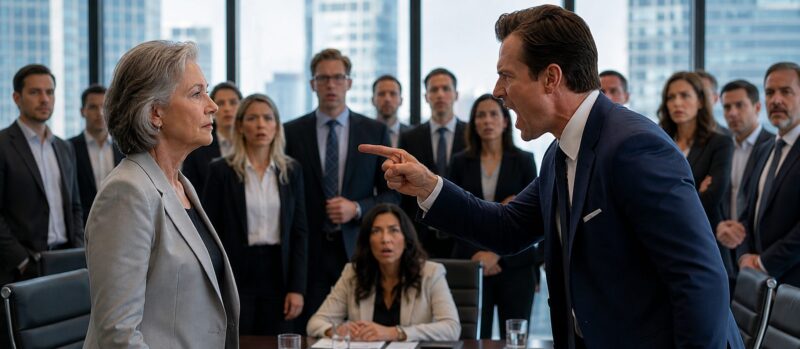
My son Daniel stood at the head of the conference table, his face flushed red.
“You’re suspended until you apologize to my wife.”
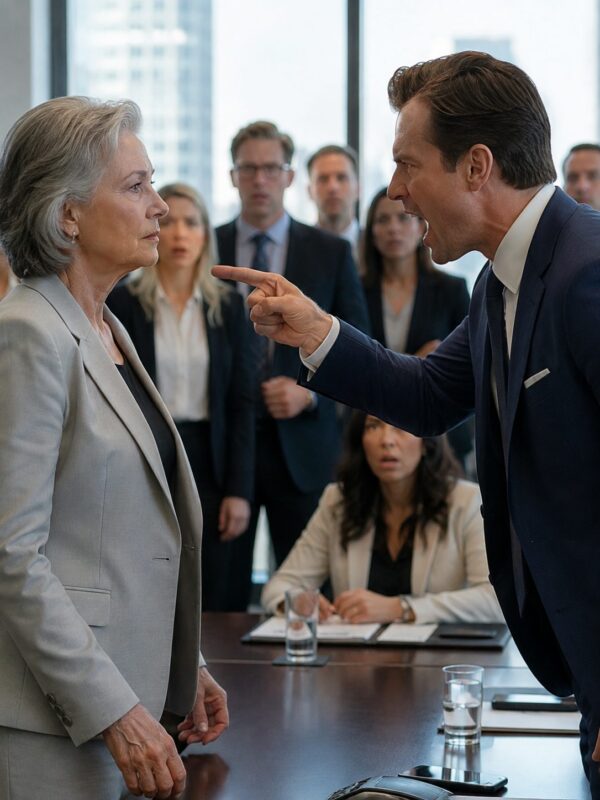
Forty people filled the room. Some had worked for me longer than Daniel had been alive. Others were young architects whose promotions I had personally championed.
And beside my son stood his wife, Natalie, arms crossed over an ivory designer jacket, watching me with a faint, triumphant smile.
Daniel looked powerful.
I suppose they expected me to yell. Maybe cry. Maybe remind everyone that Solis Architecture existed entirely because I had spent thirty-two years building it from the ground up.
Instead, I closed my leather portfolio, slipped my phone into my purse, and looked straight at Daniel.
“Fine.”
His eyebrows rose. That single, calm word confused him more than any argument could have.
Then I walked out.
Behind me, Natalie whispered something, and Daniel replied. I couldn’t catch the words, but I heard them laugh.
That was when I realized something neither of them understood: they thought I was walking away from the company.
I wasn’t. I was finally walking toward it.
Thirty-Two Years
My name is Eleanor Solis, and I am sixty-five years old.
Thirty-two years ago, my late husband David and I started Solis Architecture out of a rented apartment where our kitchen table doubled as a conference room and an old ironing board occasionally served as a drafting surface.
David was brilliant. He could stare at an empty plot of land and see a finished building before anyone else even imagined it.
I was different. I saw budgets, deadlines, contracts, and people. David dreamed, and I made sure those dreams survived reality.
When Daniel was born, we couldn’t afford a nanny. His bassinet sat right beside my drafting table, and more than once, I negotiated construction contracts while rocking him with one foot. Some nights David and I slept three hours; some months we paid our employees before we paid ourselves. During a brutal recession, I sold a bracelet my grandmother had given me simply because payroll was due on Friday.
Daniel never knew. Children rarely understand what their parents sacrifice until they become parents themselves—and sometimes, they never do at all.
By the time Daniel was eighteen, Solis Architecture occupied two floors of a downtown office building. At twenty-five, he had a graduate degree we paid for entirely. At thirty-five, he had a corner executive office.
And five years ago, when David died suddenly from a heart attack, Daniel stood beside me at the funeral and whispered, “Mom, I’ll help you protect everything Dad built.”
I believed him. Perhaps that was the most expensive mistake of my life.
The Aftermath
David died on a Thursday afternoon, working late on plans for a civic center he would never see completed. I buried him the following Friday, and Monday morning, I returned to work.
People later called that strength. It wasn’t. It was sheer necessity. Grief doesn’t make payroll, explain missed deadlines to clients, or protect forty families whose mortgages depend on a company’s survival.
So I kept going. Over the next four years, our revenue nearly doubled, we won three major industry awards, and we secured the largest private commercial project in company history.
Wanting Daniel to feel the business belonged to his future too, I eventually transferred twenty-five percent ownership to him while keeping seventy-five percent for myself.
Daniel hugged me tightly. “You won’t regret this.”
I smiled. “I know.”
I only wish David had been there to stop me—or perhaps, as I would soon discover, he already had.
The Paper Cuts
Natalie entered our lives quietly, arriving like perfume: pleasant at first, then slowly impossible to ignore. She called herself a “corporate image strategist,” and she excelled at making Daniel feel important.
At our first dinner together, I gave her my mother’s pearl necklace. Natalie rolled the pearls between two fingers and smiled. “It’s very vintage.”
A small sentence. A tiny insult. Easy to overlook.
Over the next two years, those small insults multiplied. Paintings David had chosen vanished from reception. Furniture was replaced without my input. Our corporate logo was changed. Then came Natalie’s friends as consultants—a branding specialist, a social media director, and an executive presence coach—none of whom understood architecture, though all billed the company generously.
Whenever I questioned Daniel, he leaned back and smiled patiently. “Mom, businesses evolve. You have to loosen your grip.”
That became his favorite phrase. Loosen your grip. On my company. My reputation. My life’s work.
Then Natalie began attending design meetings, soon interrupting them, and eventually leading them. Daniel supported every single step.
One afternoon, my assistant of fourteen years entered my office looking deeply uncomfortable. “Mrs. Solis, Natalie told me I report to her now.”
I stared at her. “Did Daniel approve that?”
She nodded.
I walked straight into Daniel’s office. “Daniel. You reassigned my assistant without asking me?”
He sighed, barely looking up. “Mom, this is exactly what I mean.”
I stood there for a few seconds, said nothing, and left. Parents can see betrayal almost anywhere except inside their own children.
The Twenty-Million-Dollar Pitch
Everything finally shattered during a twenty-million-dollar client presentation. Natalie insisted on leading it, and I was invited to simply “observe.”
I sat at the back while she presented a luxury mixed-use development. Then the primary rendering appeared on the screen, and my stomach tightened instantly.
I knew that building—the proportions, the façade, the structural rhythm. It looked nearly identical to a celebrated tower in Dubai.
I waited, hoping she would explain it was reference material. She didn’t.
“This is an original concept developed by our team,” Natalie smiled to the client.
I stood up, interrupting. “That design is substantially similar to an existing building in Dubai. Presenting it as original work exposes this company to copyright litigation and serious reputational damage.”
The client slowly shut his notebook. Daniel whispered my name in warning.
“I won’t allow this company’s name to be attached to stolen work,” I said.
The meeting ended ten minutes later. We lost the client.
The instant the door closed, Natalie spun around. “You did that deliberately to humiliate me!”
“You humiliated yourself,” I replied.
Her expression shifted into something venomous, and she delivered the sentence that ended what little patience I had left. “This company doesn’t need some bitter old woman surviving on her dead husband’s reputation.”
Nobody moved. I looked at Daniel, waiting for him to defend his father, his mother, the company that fed him.
Instead, he stared fixedly at the carpet. “Natalie, that was too far,” he muttered.
That was all. Not Don’t speak to my mother that way. Just too far.
Something inside me became completely still.
The Safe
That night, I went home and opened the safe in my study. While I knew I owned seventy-five percent and Daniel owned twenty-five, grief had kept me from reading the partnership documents carefully after David’s death.
At 1:17 in the morning, I found the clause. I read it twice, then a third time.
Any partner whose conduct materially endangered the financial, legal, or reputational interests of Solis Architecture could be removed from executive authority by majority vote.
I controlled the majority.
At 1:43, I called Marcus Bell, our family attorney. He answered on the fourth ring.
“Eleanor? What’s wrong?”
“I need you tomorrow morning.”
A pause. “Is this about Daniel?”
I froze. “How did you know?”
“Come to my office at seven.”
The Evidence
Marcus arrived at my house the next morning carrying three boxes. By noon, my dining room looked like a crime scene made of paperwork: unauthorized contracts, inflated consulting invoices, altered insurance policies, and suspicious reimbursement accounts.
Then Marcus found a company called N.L. Strategic Holdings, registered to Natalie, which had received fifty-three thousand dollars in payments from Solis Architecture with almost no supporting documentation.
Worse still was a folder of printed emails between Daniel and Natalie. One subject line read TRANSITION PLAN.
Natalie’s message said: We need to retire the old woman before she realizes how much authority she’s already lost.
Daniel had responded: Just keep pushing. Eventually she’ll explode in front of people. Then we’ll have what we need.
They weren’t simply disrespecting me. They were constructing a case against me, discussing medical evaluations, competency assessments, and forced retirement to claim I was mentally unfit.
And why? Marcus revealed a draft acquisition proposal from a competitor offering thirty-eight million dollars for the firm—a sale Daniel stood to profit from massively if he gained enough authority to approve it.
My son had been preparing to sell the company his father and I spent our lives building.
Marcus watched me closely. “He’s still your son.”
I looked toward David’s photograph on the bookshelf. “No,” I said quietly. “Today he’s my business partner.”
Taking Back the Office
By six the next morning, I entered Solis Architecture wearing a pearl-gray suit and the diamond earrings David had given me for our twentieth anniversary.
By seven, every corporate password had changed. Every signature privilege Daniel possessed was frozen, and every financial authorization connected to Natalie was suspended. Two security officers stood near the elevators.
At 7:45, Daniel and Natalie arrived laughing.
At 7:51, I heard Daniel shouting down the hall: “Why can’t I access the company accounts?”
I stepped out of David’s old office—a room I had left untouched for five years, but into which I had permanently moved that morning.
Daniel stopped dead. “Mom?”
“Good morning.”
Natalie’s face tightened. Then Marcus stepped out behind me, a folder tucked under one arm.
Daniel looked at security, then demanded, “What is this?”
Marcus opened the folder. “Daniel, your mother did not simply walk out yesterday. She took back her signature.”
“You can’t suspend me,” Daniel scoffed.
“I don’t need to,” I said. “Your executive authority has been revoked under Section Fourteen of the partnership agreement.”
“I own twenty-five percent!” Daniel shouted.
“I own seventy-five,” I replied calmly.
The Deception Unravels
Marcus laid the documents across the table: unauthorized payments, emails, contracts, and the acquisition proposal.
When Natalie saw the financial records regarding N.L. Strategic Holdings, her expression shifted into genuine confusion. “I don’t own a company called N.L. Strategic Holdings.”
Daniel snapped at her, “Stop.”
“I’m serious. I never registered it,” Natalie insisted.
Marcus studied her. “The registration uses your full legal name, and you approved invoices.”
“I thought the money you asked me to sign for was related to branding,” Natalie said, her voice trembling as she looked at Daniel. “Daniel… what did you do?”
The hallway outside had fallen completely silent as employees gathered beyond the glass walls.
Daniel lunged forward, but security grabbed him as Natalie pulled out her phone and rapidly scrolled. Her face turned white. “Oh my God. I kept everything.”
She handed her phone to Marcus. “Messages from Daniel.”
Marcus scrolled through the messages, his expression hardening. The truth came apart all at once: Daniel had created N.L. Strategic Holdings using Natalie’s identity, opening the bank account, authorizing the payments, and routing the money. Natalie had blindly signed two documents without reading them, but Daniel was the mastermind.
Worse yet, Marcus found another message Daniel had forgotten Natalie still possessed: Once the sale closes, I’ll take care of the divorce. She won’t know what hit her.
Natalie read it over Marcus’s shoulder, her body going completely still. She looked at Daniel, her voice hollow. “You were going to leave me? You put that company in my name?”
She slapped him across the face with a crack that echoed through the room.
Daniel turned his fury toward me. “This is your fault! You never trusted me! You never treated me like Dad!”
The room fell dead silent. The wound beneath everything had finally surfaced.
“Your father loved you,” I said, my throat tightening.
“He respected you! That wasn’t a competition!” Daniel slammed his fist against the table. “It was to me! I spent my entire life being David Solis’s son and Eleanor Solis’s child. I wanted one thing that was mine.”
“So you decided to steal ours?” I asked.
He looked away. That was answer enough.
David’s Final Order
Marcus quietly picked up his folder and removed a sealed envelope made of old paper, bearing David’s handwriting.
“What is that?” I whispered.
“Something David left with me,” Marcus replied, explaining that he had been instructed not to deliver it unless a specific condition occurred: if Daniel ever attempted to remove me from management or force a company sale.
I opened the envelope and read David’s letter, which spoke of his fears that Daniel might try to take control. But even more critically, Marcus presented an accompanying document: the original instrument granting Daniel his ownership interest.
Daniel scoffed, “I know what it says.”
“No,” Marcus corrected, turning to the final page. “When your father authorized Eleanor to transfer twenty-five percent to you, he attached a protective condition: any deliberate attempt by the beneficiary to remove Eleanor Solis from executive authority, compel a sale, or undermine her controlling interest triggers immediate compulsory redemption of all transferred shares at the original transfer price.”
Daniel’s face drained of color. “What original price?”
“One dollar,” Marcus said plainly.
The son preparing to make millions selling our company had triggered a clause reducing his stake to a single dollar because he had signed the paperwork years earlier without reading the fine print.
But David’s letter contained one final instruction, urging me not to return the shares to family, but instead to transfer the redeemed shares into an employee ownership trust for the people who helped us survive everything.
Marcus confirmed that David had established the trust before he died, waiting for this exact moment. A woman near the conference-room door started crying, followed quietly by others.
Daniel sank into a chair, his voice cracking. “Mom. Please.”
That nearly broke me. I walked toward him, knelt until we were eye-level, and touched his cheek.
“Daniel, yesterday you suspended me in front of my employees and demanded that I apologize to your wife,” I said softly. “You thought I had nowhere else to go. You forgot something your father never did: this company was never our throne. It was our responsibility.”
I stood and looked at Marcus. “Execute the buyback.”
The Aftermath
Three weeks later, forensic accountants had fully untangled the mess. Daniel had diverted nearly six hundred thousand dollars over eighteen months through layered consulting contracts and falsified expenses. Even worse, digital records proved that Daniel—not Natalie—had swapped in the copied Dubai design the night before the presentation, deliberately engineering my public objection to paint me as disruptive and unfit.
Six months later, Daniel pleaded guilty to financial crimes to spare our employees a public trial, receiving prison time. Natalie filed for divorce and returned my mother’s pearls through Marcus with no note.
Solis Architecture more than survived; the employee ownership trust transformed the company. Revenue increased, turnover fell, and the civic center David had been designing when he died was finally revived and built by the city.
On opening day, I stood outside the completed David Solis Civic Center beneath a clear October sky. Near the entrance was a small bronze plaque bearing four words I’d chosen: Built for those who stay.
Marcus handed me a small envelope—a final letter from Daniel, expressing deep remorse and stating he no longer wanted his shares back, but simply wanted to become someone who didn’t need a clause to protect against.
As I stood there reflecting, elderly Thomas Reed, David’s first accountant, approached me.
“Mrs. Solis,” he said, offering his hand. “I’ve wanted to tell you something for a long time about David.”
“What is it?” I asked.
Thomas smiled. “David didn’t write that shareholder clause. Not originally. You did.”
I stared at him in disbelief as he explained how I had insisted on a succession provision thirty years earlier during our first major financing round, protecting either spouse from being pushed out by a future heir. David and Marcus had merely strengthened and modernized it over the years.
I’d completely forgotten. For months, I had believed David saved me from beyond the grave. In a way, he had—but the final truth was that a younger version of me had protected the woman I would eventually become, writing my own rescue long before I ever knew I’d need it.
I looked up at the building bearing his name and laughed through my tears.
For years, Daniel accused me of holding on too tightly. Maybe he was right; I had held onto contracts, the company, and David’s standards. But the one thing I finally released was the belief that loving someone meant allowing them to destroy what you built.
Family can deserve forgiveness, but forgiveness and authority are not the same thing. Love doesn’t require surrender, and motherhood doesn’t mean handing your child the match and quietly watching him burn down your house.
That afternoon, I signed the final documents permanently transferring Daniel’s redeemed shares into the employee trust.
Marcus looked at me. “Second thoughts?”
I smiled. “None.”
Then I signed my name: Eleanor Solis. The same signature my son believed he could take away, the same signature David had protected, and the same signature my younger self had unknowingly defended decades earlier.
Outside, employees gathered beneath the civic center’s glass façade as someone called my name. I walked toward them—not as Daniel’s mother, not as David’s widow, not as the old woman Natalie once mocked, but as the woman who had built something, nearly lost it, and learned that strength sometimes means refusing to rescue people determined to betray you.
I stepped into the sunlight. Behind me, the doors of the David Solis Civic Center opened for the first time, and for the first time in five years, I no longer felt as though I was continuing David’s work.
I felt as though I was finally continuing my own.





