By five o’clock, the life I had been preparing to step into no longer existed.
I stood alone in my office on the forty-second floor of Whitaker House with my phone pressed to my ear, watching snow begin to feather over Manhattan. Below me, traffic moved in thin red ribbons. Behind me, my assistant, Nora Bell, had stopped asking questions. She had worked for me for eight years and knew when a canceled dinner meant a scheduling hiccup and when it meant something had cracked open.
This was the second kind.
«Brielle has been informed that there has been a family emergency,» Nora said carefully. «Her mother wants to know whether the proposal is postponed or canceled.»
«Canceled.»
Nora looked at me. I turned away from the window.
«Permanently.»
She gave a small nod and typed something into her phone. «What about the conservatory?»
«Cancel the florists. The musicians. Dinner.»
«The photographer?»
I almost laughed. Of course there had been a photographer. My mother had planned the evening down to the exact angle at which Brielle would stand when I opened the ring box.
«Cancel him, too.»
Nora hesitated. «And your mother?»
«I’ll tell her myself.»
That was the first decision I made that evening that felt entirely like mine.
The second was taking the ring from my pocket and locking it in my desk. Not returning it—not yet. Just removing its weight from my body. For three months, I had carried that future with me everywhere. Now the empty space in my pocket felt almost frightening.
Nora slipped her phone into her bag. «Do you need me to stay?»
«No.»
She reached the door, then stopped. «Ethan.»
I looked at her. She rarely used my first name during work hours.
«Whatever happened today,» she said, «you don’t have to solve all of it tonight.»
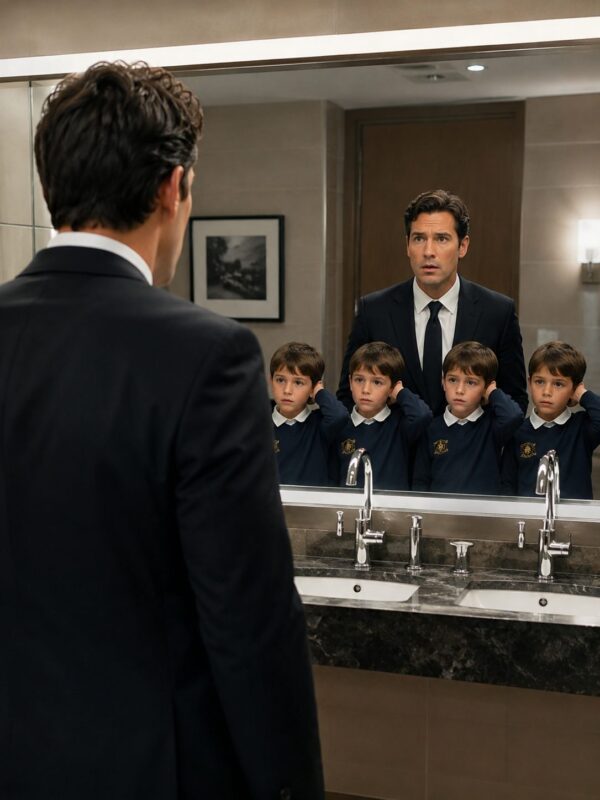
I almost told her she was wrong. Six years had already been lost, and every instinct in me wanted names, dates, documents, and explanations. But when I thought of four boys standing at a restaurant sink, staring at me with wary curiosity, I understood that speed and urgency were not the same thing.
«I know,» I said.
I didn’t. But I wanted to.
The Tribeca apartment had belonged to my grandfather before he moved permanently to Connecticut. It was warmer than the hotel suite I usually used downtown and less formal than my place near Central Park, which was why I had sent Mara there.
No staff. No photographs of my family on every wall. No memories of the life from which she had disappeared.
I bought groceries before I went—not because I had any idea what four six-year-olds ate, but because standing in a market with a basket gave me something simple to do. Milk. Bread. Eggs. Pasta. Apples. Cereal. Then I added chocolate cookies, removed them because they seemed presumptuous, and put them back.
At the apartment door, I stood with two paper bags in my arms for nearly a minute before knocking.
I could hear voices inside. One boy laughing. Another saying, «You cheated.»
«I did not.»
«You moved the blue one.»
«You weren’t looking.»
«That still counts.»
Then Mara’s voice cut through: «Boys, lower your voices. We’re guests.»
The door opened. Mara wore the same black restaurant trousers and gray sweater I remembered from college—or perhaps I only thought I remembered it. Six years had done strange things to memory.
«You came,» she said.
«I brought groceries.»
Her gaze moved to the bags. «You didn’t have to.»
«I know.»
That answer seemed to surprise her. For a moment neither of us moved. Then she stepped aside.
The boys were sitting cross-legged on the living room rug, playing a board game I didn’t recognize. Without their matching uniforms, they were much easier to tell apart. Milo, the bold one, had changed into a red sweatshirt. Mason wore glasses. Max had a front tooth missing. Micah was quieter than the others and sat with his knees tucked beneath him.
They looked up when I entered. Milo pointed toward the kitchen.
«There are only tiny spoons.»
«There should be normal spoons.»
«We looked.»
«They’re in the second drawer.»
«We looked there, too.»
I set the bags down and opened the drawer. Tiny spoons. Nothing else. I frowned, and Mara crossed her arms.
«Your apartment appears to have been designed by someone who eats exclusively with dessert spoons.»
«It belonged to my grandfather.»
«That explains absolutely nothing.»
I glanced at her. For one second, I saw the Mara I had known: the one who could make me laugh during economics lectures, the one who had once convinced me we should spend an entire rainy Saturday making homemade ravioli despite neither of us knowing how.
Then the moment disappeared, and she looked away first.
I found the actual silverware in a cabinet beside the refrigerator. My grandfather, for reasons known only to him, had stored forks and spoons vertically inside a ceramic pitcher. The boys thought this was hilarious.
For twenty minutes, the apartment became strangely ordinary. We unpacked groceries. Max asked whether the cookies were for everyone. Mason examined the kitchen and announced it needed «better organization.» Milo wanted to know whether I owned the whole building.
Micah said nothing until I placed a carton of milk in the refrigerator, then looked up at me. «Do you live alone?»
The question was so simple I almost answered too quickly. «Yes.»
«Do you like it?»
I glanced at Mara. Her face changed slightly.
«I thought I did,» I said.
Micah accepted this as enough. Children, I discovered immediately, had a way of asking questions adults spent years avoiding.
After dinner, Mara put on an animated movie for the boys, and they piled onto the sofa beneath blankets. I stayed in the kitchen. I didn’t know what role I was allowed to have—host? Stranger? Possible father?
Mara closed the sliding glass doors between the kitchen and the living room, though we could still see the boys through the glass. «They’re safe,» she said. «We can talk.»
I nodded and sat across from her at the small breakfast table. For several seconds, neither of us spoke.
Finally, Mara asked, «How much do you know?»
«Nothing.»
«That isn’t possible.»
«My mother told me you left New York. She said you didn’t want contact.»
Mara stared at me. «That’s what she told you?»
«Yes.»
«She told me you had chosen your family.»
My hands tightened beneath the table. «What does that mean?»
«That you knew I was pregnant and wanted nothing to do with it.»
The room seemed to shrink. «I never knew you were pregnant.»
She studied my face, watching disbelief turn into uncertainty. «You’re telling me no one told you?»
«No one.»
«I sent letters.»
«I never received them.»
«Emails.»
«Nothing.»
«I called your office.»
«I changed offices after my grandfather’s stroke.»
«I called the house.»
My stomach tightened. «Which house?»
«Your parents’ home.»
Of course. Mara looked through the glass doors toward the boys. «They told me you didn’t want to speak to me.»
«Who?»
«Usually your mother’s assistant.»
«Celeste?»
«I don’t remember her name.»
I did. Celeste Grant had worked for my mother for almost twenty years, scheduling holidays, medical appointments, and family dinners. Nothing entered my mother’s life without first passing through Celeste.
Mara folded her hands together. «At first, I didn’t believe them.»

«Why didn’t you come find me?»
Her eyes returned to mine. «I did.»
The answer landed softly, which made it worse. «When?»
«June seventeenth. Six years ago.»
I remembered that week. My grandfather had undergone emergency heart surgery, and I had spent four days traveling between the hospital, Whitaker House, and meetings with the board. «You came where?»
«Your family office.»
«What happened?»
«I waited downstairs for almost two hours.» Her voice remained calm, but I could hear the effort beneath it. «Eventually a woman came down. Elegant. Blonde. Maybe in her fifties.»
My mother. I knew before Mara said it. «She said you had asked her to speak for you.»
My throat went dry. «What exactly did she say?»
Mara hesitated. «That you were aware of the pregnancy. That you believed we were too young. That your responsibilities to your family and company made parenthood impossible. She said financial support could be arranged privately.»
I pushed back from the table and stood, the movement startling Mara. «Sorry,» I muttered, walking to the window.
The snow had thickened. Across the street, warm rectangles of light glowed in neighboring apartments where people were eating dinner, folding laundry, and living ordinary lives.
«What did you tell her?»
«I told her I didn’t want your money.»
«That sounds like you.» Mara almost smiled. Almost. «I asked for five minutes with you.»
I closed my eyes. «She said you had already left.»
«I was at Mount Sinai with my grandfather.»
«I know that now.»
I turned. «How?»
«I looked up the date after I saw you on television a year later talking about his recovery.»
Six years ago, Mara had learned in hindsight that at least one part of the story told to her might have been wrong, yet she still hadn’t contacted me. The question must have shown on my face, because she answered before I asked.
«I had four infants by then, Ethan.» Her voice softened. «I was twenty-four. My mother had just died. I was living with my aunt in Newark, working remotely whenever I could, sleeping in pieces. You were everywhere in business magazines beside your mother and your grandfather, building an entire world that clearly didn’t include us.»
«Because I didn’t know.»
«I understand that tonight.» She looked down at her hands. «But I didn’t understand it then.»
I sat again. Four infants—the thought was almost impossible to imagine. «You had them alone?»
«My aunt helped until she got sick. Then my friend Rachel moved in for a year.»
«What about your father?»
«He died when I was in college. You know that.»
I did. I remembered attending the funeral, and I remembered Mara holding my hand so tightly my fingers went numb. «I’m sorry.»
She gave me a tired look. «For which part?»
«All of it.»
«That’s too much for one apology.»
«I know.»
We sat in silence until I finally asked the question I had been afraid to voice since the restaurant: «Are they mine?»
Mara’s expression did not change. No hesitation, no drama. Just certainty. «Yes. They’re yours.»
My chest tightened. «How certain?»
She gave me a look that would once have made me laugh. «Ethan.»
«I’m not accusing you of anything.»
«I know exactly when they were conceived.»
My ears warmed despite everything. «All right.»
«Also, they all have your chin.»
«I noticed.»
«And your left-handed neck thing.»
«I noticed that, too.»
For the first time, Mara laughed. It was small and exhausted, but real.
Then the glass door slid open, and Milo stood there holding a blanket. «Mom?»
«Yes?»
«Max says the apartment makes weird noises.»
«It’s the radiator.»
Milo looked at me. «Is that true?»
«Yes.»
He considered this. «Are you sure?»
«Pretty sure.»
«Okay.» He went back to the sofa.
Mara watched him disappear, then said quietly, «We should still do a test.»
«Yes.»
«For them.»
I understood. Certainty mattered differently when four children were involved.
«No lawyers,» she added.
«Agreed.»
«No press.»
«Absolutely.»
«And no one tells them anything until we know what happens next.»
I looked toward the living room. «Do they know who I might be?»
«They know you’re someone I used to know.»
«Milo probably knows more.»
«He usually does.»
I almost smiled. «DNA test tomorrow?»
Mara nodded. «Tomorrow.»





