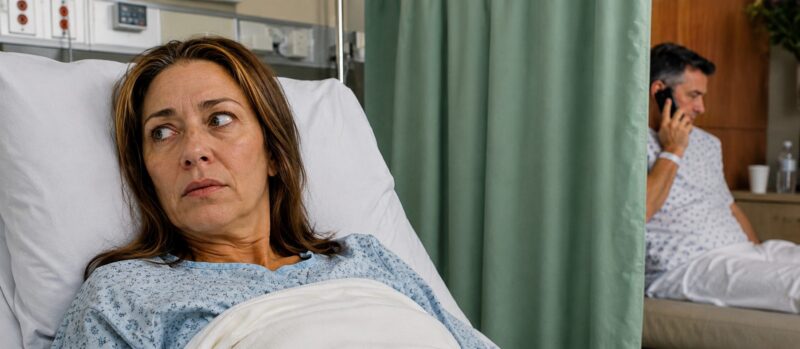
“I swear to you, the second I’m out of here, that house is yours. Sarah doesn’t matter. After twenty-two years, she’s basically a piece of furniture—wherever you leave her, she just sits there.”
Sarah Miller stood frozen behind the green privacy curtain of the Boston hospital room. The words hit her harder than the deep, throbbing pain in her freshly stitched left side.
Just three days earlier, she had gone under the knife to donate a kidney to her husband, Victor Vance. Victor was a 60-year-old real estate developer who had spent the better part of a year hooked up to dialysis machines. Sarah, a 58-year-old retired elementary school teacher, hadn’t hesitated for a single second the moment doctors told her she was a match.
Victor, apparently, had hesitated about something else entirely.
“Rita, listen to me,” Victor continued, assuming Sarah was passed out from the painkillers. “The Brookline place is in Sarah’s name, but I’ll handle it. My lawyer will draft a deed transfer and it’s done. Three stories, a landscaped yard, a two-car garage. It’s the absolute minimum you deserve for putting up with me these past two years.”

Sarah looked down at her left hand. Her wedding ring, loose from recent weight loss, slid off without any resistance. She set it quietly on the bedside tray.
Beyond the curtain, Victor chuckled, though the laugh ended in a sharp wince of post-surgery pain.
“Guilty? For what? She gave me the kidney because that’s just who she is—she lives to nurse me. She doesn’t know how to do anything else.”
Sarah didn’t shed a tear.
At 10:00 AM, the floor nurse walked in to check her blood pressure. Sarah calmly asked for her regular clothes, a pen, and a sheet of paper. Then she requested to see her surgeon, Dr. Salcedo.
“I’m signing myself out.”
Dr. Salcedo assumed it was just a reaction to the pain medication. He spent twenty minutes trying to talk her out of it, stressing that it had only been three days since her nephrectomy. They needed to monitor her kidney function, watch her blood pressure, check the incision, and guard against infection.
Sarah listened patiently, never interrupting.
“Is Victor’s new kidney working?” she asked softly.
“It started functioning in the first hour,” Dr. Salcedo confirmed.
Sarah nodded. “Then I’ve done what I came here to do.”
Before leaving the floor, she walked slowly to Victor’s bedside. He was asleep, his smartphone resting on his chest. Sarah picked up her wedding ring and laid it gently over his wristwatch.
She left no note.
That afternoon, she walked into the quiet, three-story house in Brookline alone. She packed a single suitcase with old photos of her parents, her personal documents, a small box of handwritten keepsakes, and a sealed manila envelope from an oncology clinic that she had kept hidden since December.
She didn’t touch Victor’s clothes. She didn’t touch the furniture.
At 8:30 PM, Sarah locked the front door for the last time and walked across the street to the bus stop. Sitting on the bench, she stared up at the lit windows of the home where she had spent the last twenty-two years of her life.
At 9:17 PM, a brilliant orange flash burst through the living room curtains.
Neighbors poured into the street, shouting and dialing emergency services. Sarah didn’t move.
As the first fire sirens echoed in the distance, she stepped onto the approaching bus, pressing one hand gently over her side.
The next morning, she returned just long enough to stand on the sidewalk and take clear photos of the charred, smoldering remains.
Her neighbor Teresa ran up to her in pure terror. “Sarah… did you lose everything?”
Sarah looked toward the ruins. “No, Teresa. I lost everything three days ago in a hospital room.”
Victor was discharged nineteen days later carrying a bag of immunosuppressants, a strict schedule of lab work, and the absolute certainty that Sarah would eventually come crawling back.
“She always comes back,” he told Rita, the 32-year-old woman he’d been secretly seeing for two years.
Rita was waiting for him in a private car, dressed up as if they were heading to a celebration.
“Take me home first,” Victor told the driver.
Two blocks from the Brookline property, the smell of damp, burned timber and stale smoke filled the air. Victor told the driver to pull over immediately.
All that remained of his home were blackened brick chimneys, a collapsed staircase, and the scorched shell of the garage. Wet ash covered the front lawn.
Rita stared, her mouth agape. “You said this was a three-story luxury home!”
“It was.”
“What about the insurance?” Rita demanded.
Victor hesitated. “The policy is in Sarah’s name.”
Rita slowly looked him up and down—his poorly buttoned coat, trembling hands, and the bag of post-transplant meds. “How much do those prescriptions cost every month?”
“Between co-pays and lab work… thousands. I have to take them for the rest of my life.”
Rita took a step back toward the car. “Victor, I’m not a full-time nurse.”
“I never asked you to be!”
“No, but you promised me a lifestyle. A house. Travel. You said Sarah was going to sign the deed over.”
“She will!” Victor insisted, his voice cracking.
Rita pointed at the smoldering wreckage. “Sign what?” She hailed another cab and left without looking back.
Over the next few weeks, Victor searched desperately for Sarah. He checked her sister’s apartment, called her former teaching colleagues, and visited the community center where she used to volunteer. No one had answers for him.
When he called the insurance company, he got another massive shock. The home had been insured for $4.1 million, and the full payout had already been transferred directly to the sole policyholder: Sarah.
“I’m her husband!” Victor yelled into the phone.
“Sir, you aren’t listed as a beneficiary,” the claims manager replied.
“Where’s the money?!”
“That information can only be disclosed to the primary account holder.”
Panicking, Victor went to see Lucinda, Sarah’s older sister. Lucinda met him in the hallway of her apartment building and refused to let him inside.
“Where is she, Lucinda? I’ve been searching for weeks!”
Lucinda stared at him. “Do you honestly not know?”
“No!”
“Sarah canceled her cell plan,” Lucinda said coldly. “She donated most of her personal belongings.”
“To who?”
“A shelter for young women aging out of foster care in South Boston.”
A cold heaviness settled in Victor’s stomach. “And the insurance money?”
Lucinda pressed her lips together. “That too. All four million dollars. The shelter director cried when Sarah signed the paperwork.”
Victor leaned against the wall. “Where is my wife, Lucinda?”
Lucinda’s voice dropped. “She didn’t walk away to punish you, Victor. She walked away because she’s dying.”
Victor stared at her. “What are you talking about?”
“She’s in hospice care in Tlalpan.”
At the facility, Dr. Herrera handed Victor a thick medical file.
Diagnosis: Advanced terminal cholangiocarcinoma—cancer of the bile ducts.
Date of first diagnostic scan: December 9.
Victor turned pale. “That’s impossible. Her donor surgery was three weeks ago!”
Dr. Herrera closed the folder. “Sarah knew she had terminal cancer nearly three months before the transplant. She hid her new symptoms after her initial donor evaluation was finished. She also refused pre-operative cancer treatment because starting it would have disqualified her from donating.”
Victor dropped his bag of medication onto the floor. “Why would she do that?”
The doctor looked down the quiet corridor toward Room 214. “You’ll have to ask her yourself, Mr. Vance. While she still has the strength to answer.”
Sarah was awake.
The room was simple: a single window, a vinyl armchair, three fresh sprigs of flowers in a glass vase, and an oxygen concentrator humming in the corner.
Victor froze in the doorway. The woman in the bed looked far smaller than the wife he remembered. Her skin had taken on a faint yellow tint, her cheeks were hollow, and her dark hair was pinned back in a neat, short braid.
When she saw him, she didn’t look surprised. “Your coat is buttoned wrong,” she said softly.
Victor looked down, his hands trembling. “Sarah…”
“Sit down,” she said gently. “You’ll get lightheaded standing there.”
Victor ignored the chair and rushed closer. “How long did you know?”
“Since December 9.”
“And you never told me? Not a word?”
“No.”
“Why, Sarah? Why?”
Sarah closed her eyes for a moment, waiting for a wave of pain to pass. “Did you take your 8:00 AM anti-rejection medication?”
“I took it at 8:10.”
“That’s not 8:00 AM.”
“Sarah, please!” Victor broke down, tears streaming down his face. “You were dying, and you walked into an operating room to give me an organ. You could have died on that table!”
“So could you.”
“How did you hide a terminal diagnosis from an entire surgical team?”
“My main donor clearance was completed in October,” Sarah explained, her voice weak but steady. “When I started experiencing severe fatigue and abdominal pain in December, I went privately to an out-of-network clinic. By the time the biopsy came back, your transplant was already on the schedule. I didn’t forge any labs. My routine bloodwork was still passable, so I just didn’t disclose the new symptoms. When the coordinator asked if anything about my health had changed, I said no.”
Victor felt sick to his stomach. “You lied to the surgeons just to stay eligible.”
“Yes. If I had started chemotherapy, the transplant would have been canceled immediately.”
Victor collapsed into the vinyl chair and buried his face in his hands.
For eleven months, Sarah had driven him to dialysis three times a week. She had learned how to cook strict, low-sodium meals, monitored his blood pressure daily, and helped him dress when he was too weak to button his own shirts. He had treated that devotion like it was just her job.

“Why didn’t you let me make the choice?” he sobbed.
“Because you would have said no.”
“Of course I would have!”
“Exactly.”
“So you took away my chance to save you!”
Sarah gave him a faint, sad smile. “There was no saving me, Victor.”
“I’m alive because part of your body is inside me while you lie here dying!”
“My illness wasn’t your fault.”
“But you could have bought yourself more time!”
“I chose how I wanted to spend the time I had left.” Sarah looked at him. “And I chose to give you a future.”
Victor raised his head, his eyes red. “And did you also choose to burn our house to the ground?”
“Yes.”
The blunt answer left him speechless.
“That was our home for twenty-two years!”
“It was a house deeded solely in my name.”
“It was our life!”
“Our life ended the moment I heard you tell your mistress I was nothing more than a piece of furniture.”
Victor went completely still. “You… heard that call?”
“Every word,” Sarah replied. “The address. The garden. The garage. Your promise that you’d sign my house over to Rita.”
“I was on pain meds! I was disoriented—”
“You were conscious enough to explain that I only existed to take care of you because I didn’t know how to do anything else.”
Victor had no defense.
Sarah looked toward the window. “I taught elementary school for thirty-four years. I helped hundreds of children learn to read. I took care of my parents as they died. I ran our household, paid our bills, and nursed you through end-stage kidney disease.” Her eyes returned to him. “And you reduced my entire existence to a servant who brings you water.”
“Forgive me,” Victor choked out. “Sarah, please.”
“It’s a little late for that.”
“Is that why you destroyed everything? Revenge?”
Sarah stayed quiet for a moment. “I didn’t want another woman sleeping in my bed, using my mother’s china, and treating my death like a convenient doorway into a better life. I made a dangerous, destructive decision, and I’m not proud of it. But I couldn’t allow the home I built to become a trophy for your mistress.”
“And the insurance money?”
“Given to the shelter.”
“Why?”
“I volunteered there for years. When foster kids turn eighteen, they get aged out of the system with no family, no savings, and nowhere to go. That money will fund housing and education for them for years to come.”
Victor ran a shaking hand through his hair. “Did you leave anything for me?”
The question slipped out before he could stop it.
Sarah looked at him. There was no rage in her eyes—only deep pity.
“Yes,” she whispered. “I left you a kidney.”
A strangled sob escaped his throat.
“Rita left me,” Victor confessed quietly.
“I assumed she would.”
“She said she wasn’t a nurse.”
Sarah let out a small, tired laugh. “At least she was honest with you from the start.”
Victor lowered his head. “I was going to leave you anyway.”
“I know. Bank transfers, hotel reservations, a retainer for a divorce lawyer. You were never very careful with your financial paper trail. I’ve known about Rita since June.”
Victor stared at her. “You knew for six months? And you still took me to dialysis three times a week?”
“You were dying, Victor.”
“That makes no sense!”
“To you, maybe not.”
“Were you planning some elaborate revenge that whole time?”
“No,” Sarah said softly. “I planned to leave quietly once your transplant was successful. I had already found a small one-bedroom apartment near the botanical gardens. I just wanted to spend my remaining time walking through the park, reading, and visiting Lucinda.”
“Then why did you change your mind?”
“Because hearing you talk about me like an object broke something inside me that couldn’t be fixed.”
Victor stared at the floor. “Do you regret burning the house?”
“I regret letting pain drive me toward destruction,” Sarah admitted. “I don’t regret making sure my home never became Rita’s reward.”
Victor rested his elbows on his knees. “I don’t even know who you are anymore.”
Sarah looked directly at him. “That’s the tragic truth, Victor. You never bothered to find out.”
He began to cry—heavy, ragged sobs that shook his entire body. “Sarah… I’m so sorry. For Rita. For the house. For saying those awful things. For treating everything you did for me like it meant nothing.”
Sarah slowly reached out her frail hand. Victor grabbed it with both of his.
“I forgive you,” she said quietly.
“I don’t deserve it.”
“Forgiveness isn’t about what the other person deserves,” Sarah whispered. “Sometimes it’s just refusing to carry hatred with you when you leave.”
“Let me fix this,” he begged. “Tell me what to do.”
“You can’t fix a twenty-two-year marriage in a single afternoon.”
“Then tell me how to make it right.”
“Take your anti-rejection meds on time.”
Victor let out a broken laugh. “Sarah…”
“I’m serious,” she said firmly. “Eight in the morning. Eight at night. Not 8:10. Your life depends on small, boring routines.”
“Like me,” he whispered, tears pouring down his face. “According to me.”
“Like me,” Sarah said softly. “According to you.”
Victor looked down at her hand—the same hand that had graded thousands of papers, cooked his meals, managed their home, and signed the consent form that saved his life.
“Where’s your wedding ring?”
“I left it on your watch at the hospital.”
Victor reached into his coat pocket and pulled out the gold band he’d been carrying around. He placed it gently on her blanket.
“Keep it,” she said.
“Why?”
“To remind you that something small and seemingly light can carry immense weight.”
Dr. Herrera walked in to check Sarah’s oxygen levels. Seeing how exhausted she was, he quietly motioned for Victor to step out.
Victor leaned closer to her. “Are you afraid?”
Sarah looked up at the ceiling. “Yes.”
It was the first time in twenty-two years he had ever heard her admit to being afraid.
“What do you do when you’re scared?” he asked.
“I think about my old students,” Sarah whispered. “The ones who struggled for months to read, and then one day everything just clicked. That moment always felt like a miracle.”
“Do you think about me?”
Sarah turned her head slowly. “Yes. After everything.”
Victor pressed his forehead against her knuckles. “I don’t know how to live with this guilt.”
“Learn.”
“I don’t know if I can.”
“You can,” Sarah whispered. “It’s just that now, no one is going to do it for you.”
At 3:48 PM, Sarah’s breathing slowed.
“Sarah?” Victor stood up quickly.
She opened her eyes one last time. “Eight o’clock sharp,” she whispered.
“I promise.”
She brushed her fingertips against his tear-streaked cheek, then closed her eyes for the last time.
The memorial service took place a week later. Lucinda was there, alongside Teresa, several retired teachers, and the staff from the South Boston shelter.
Four young adults Victor had never met stood together near the back. One of them, an eighteen-year-old with a backpack, walked up to Victor. “Mrs. Vance paid for my first semester of college.”
After the service, Lucinda handed Victor a small envelope. Inside was a single sheet of paper written in Sarah’s neat handwriting: the transplant center’s phone number, her nephrologist’s name, and one underlined sentence:
Do not skip your checkups out of pride.
That night, Victor set two daily alarms on his phone.
Months later, he sold his car to cover his medical expenses and debts. He scaled back his real estate business, worked shorter hours, and stopped treating his employees like servants.
Every Sunday, he organized his immunosuppressants into a weekly pillbox. Every morning at 7:58, an alarm went off. At 8:00 AM sharp, he drank a glass of water and took his dose.
In the noon compartment of that pillbox, he kept Sarah’s wedding ring.
Whenever colleagues asked why he was so rigid about his health schedule, Victor always gave the same quiet answer:
“Because the life I’m living didn’t start on the day of my transplant. It started on the day I realized, far too late, what someone was willing to give me.”
And every morning at 8:00 AM, he drank the water to the very last drop while, deep inside him, Sarah’s kidney kept doing its quiet, vital work—asking for nothing in return.