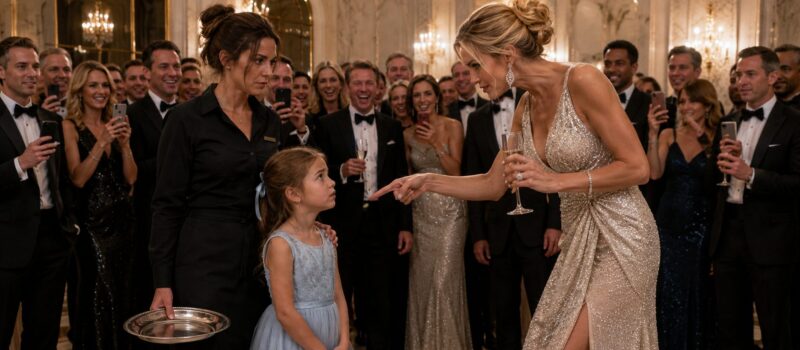
For several seconds after Adrian Vale spoke my mother’s name, the ballroom felt completely suspended in time.
Then the final note drifted away.
Lucia stood frozen in the center of the polished floor, one foot pointed delicately behind her—the exact finish my mother had taught me. She blinked up at the crowd. Two hundred people stared back. Her expression shifted from deep concentration to uncertainty.
“Did I do it wrong?”
That small, innocent question shattered the spell.
I rushed across the floor before anyone else could move, dropped to my knees, and pulled her into a tight hug.
“You did it beautifully.”
“Grandma Rose always said not to wobble on the last turn.”
“You didn’t wobble.”
“A little bit.”
“Only a tiny bit.”
She smiled.
Around us, applause broke out—not the roaring, mocking laughter I had dreaded when Celeste made her cruel challenge, but a quieter, remarkably respectful wave of sound.
Lucia leaned close to my ear. “Do I get the million dollars now?”
Despite everything, a laugh slipped past my lips. “No, sweetheart.”
“Good.”
I pulled back, surprised. “Good?”
She nodded solemnly. “That sounds like way too much money to carry around.”
Adrian let out a sound that might have been a chuckle, though his face remained ashen. The elderly woman beside him didn’t laugh at all. She was staring straight at Lucia—not at her borrowed dress, not at her scuffed shoes, but right at her face. Specifically, her eyes.
I recognized that look instantly. It was the same look strangers had given me all my life, searching my features for clues about who I resembled.
The woman took a single, cautious step forward. “Rosalind had those eyes.”
My stomach tightened. “My mother’s name was Rose.”
“Yes,” she whispered. “I suppose it was.”
Adrian turned sharply. “Grandmother.”
So that was who she was. Eleanor Vale.
Even I knew the name; everyone in Boston did. The Vale empire had started generations ago in shipping before expanding into construction, venture capital, medical tech, and a dozen other industries. Eleanor herself had spent decades funding conservatories, youth symphonies, and arts initiatives.
I had seen her picture in magazines plenty of times—always poised, silver-haired, and elegant beside politicians or museum trustees. Here, beneath the chandeliers, she looked simply old, and profoundly astonished. Her hands trembled around her small evening bag.
Celeste finally pushed her way forward, her voice lacking its usual brittle snap. “Adrian, can someone please explain what is going on?”
Adrian looked around, seemingly remembering the hundreds of guests, the raised smartphones, and the orchestra members pretending not to listen.
His expression hardened. “Not here.”
He turned to the room. “Ladies and gentlemen, I think we’ve turned a private family moment into enough of a public spectacle for one evening.”
There was no anger in his voice—he didn’t need it. People slowly lowered their phones.
“I’d appreciate it if anything recorded during the last few minutes remained private,” he added. “Especially anything involving a child.”
It worked better than an order ever could. Guests immediately slipped their devices into purses and pockets.
Lucia tugged my sleeve. “Mama, can I get my rabbit?”
I looked down. Her stuffed rabbit was still sitting right where she’d left it by the champagne table.
“Yes, go ahead.”
“I can get him.” She hurried across the floor.
One of my coworkers, Marta Ruiz, was standing near the service doors with tears shining in her eyes. As Lucia reached her toy, Marta crouched down. “There’s a chocolate éclair in the kitchen with your name on it.”
Lucia’s face lit up. “My whole name?”
“Every single letter.”
Lucia looked back at me hopefully. Ordinarily, I would have panicked about abandoning my station, my supervisor, or the tray I’d left unattended. But normal rules had evaporated the moment that violin started playing.
“Go with Marta,” I told her.
“Can Rabbit come?”
“Rabbit is definitely invited.”
Marta met my gaze and gave me a subtle nod that communicated a silent I’ve got her. Watching Lucia vanish safely through the service doors let the tension in my chest finally release.
I turned back around. Celeste was still standing there, uncharacteristically lost. Her champagne glass was gone.
“I owe you an apology,” she murmured, swallowing hard. “And Lucia.”
“You do.”
She dropped her gaze. “The million-dollar challenge was supposed to be a joke.”
“It wasn’t.”
“I know that now.”
“You should have known it before.”
She took the rebuke without arguing. Behind her, two women who had laughed earlier suddenly found the floral arrangements intensely fascinating.
Celeste looked at them, then back at me. “I spend too much time in rooms where people say outrageous things just because everyone expects a laugh.”
“That explains it,” I said quietly. “It doesn’t excuse it.”
“No. It doesn’t.”
Something flickered across her face—embarrassment, certainly, but also a sudden, raw realization. She nodded once and moved away.
I expected Adrian to follow her, but Eleanor stepped toward me instead. Up close, I caught the faint, clean scent of lavender.
“My name is Eleanor,” she said.
“I know.”
That almost coaxed a smile out of her. “Of course you do.” She glanced toward the kitchen doors. “Would you be willing to step somewhere quieter?”
Every survival instinct I possessed screamed at me to grab our coats, catch the late train home, and pretend the entire surreal evening was just a fever dream induced by exhaustion and expensive champagne.
Then I heard my mother’s voice echoing in my memory: Some songs carry memories too painful to explain.
All my life, Rose Bennett had been a woman with an invisible past. Whenever I asked about grandparents, she gave vague answers about people being gone or life taking different directions. She never lied badly enough for me to push, simply growing quiet until I stopped asking.
Now, a ninety-year-old matriarch was looking at me as if my face had just unlocked a door she thought was sealed forever.
“Yes,” I said.
Adrian led us down a quiet hallway into a wood-paneled library. The transition was jarring—one moment we were surrounded by glittering chandeliers and hundreds of guests; the next, by deep green walls, heavy bookshelves, and the steady ticking of an antique clock.
Adrian closed the door. Eleanor remained standing, and so did I.
Finally, she broke the silence. “When did Rose die?”
“Four years ago.”
Eleanor closed her eyes. Adrian moved to steady her, but she raised a hand. “I’m fine.” She wasn’t. Neither was I.
“How?” she asked.
“An aneurysm.” The clean medical word still felt inadequate for something that had split my universe cleanly in half. “She was teaching a morning class, complained of a headache, and by that evening—” I stopped.
Eleanor opened her eyes again. “She was still dancing?”
“Right up until the end.”
A soft, sad smile touched her lips. “Of course she was.”
I folded my arms. “You keep talking as though you knew her.”
“I did.”
“Then tell me who she was.”
Adrian looked at his grandmother, who seemed to gather her strength.
“Your mother was born Rosalind Evelyn Vale.”
The room seemed to tilt sideways. I sank into the nearest chair, not by choice, but because my knees simply gave out.
“No.”
Eleanor nodded. “Yes.”
“My mother was Rose Bennett.”
“She became Rose Bennett.”
Adrian pulled a chair close to mine. “My grandfather had two daughters—Helena, my mother, and Rosalind, my aunt.”
I looked back and forth between them, trying to force my brain to process the math. “So you’re saying…”
“If we’re right, you and I are first cousins.”
I stared at him, picturing the society pages, the buildings bearing the Vale name in polished brass, the philanthropic foundations, and the man sitting across from me in a custom tuxedo. Then I contrasted it with memories of my mother in paint-stained sweatpants, fixing a sputtering radiator with duct tape.
I almost laughed. “That’s impossible.”
Eleanor sat across from me. “Rosalind disliked mushrooms, loved old Fred Astaire movies, and always counted the stairs whenever she climbed them.”
My breath caught.
“She hated mushrooms,” I whispered.
“I know.”
“She counted stairs because she believed odd numbers brought good luck.”
“I know.”
There are facts you can look up online—birthdays, schools, corporate registries. But there are other facts that exist only in kitchens and childhood bedrooms. My mother always reached the top of the stairs and whispered the final count: Thirteen. Seventeen. Twenty-one. If the count landed on an even number, she would deliberately step down and back up to make it odd. I had never shared that quirk with a single soul except Lucia.
Eleanor pressed on. “When she was nervous, she had a habit of rubbing the side of her left thumb.”
My eyes filled with sudden, hot tears. I looked away, realizing my own left thumb was currently pressed tightly against my forefinger. I dropped my hand into my lap.
“What happened?” I asked. “Why did she leave?”
Eleanor’s gaze drifted toward the dark window. “She was twenty-one. She had trained as a dancer her entire life. My husband believed dance was a wonderful hobby but an unreliable career. Rosalind believed the uncertainty was the entire point.”
It sounded so profoundly like my mother that my chest ached.
“She was offered a place with a small touring company,” Eleanor continued. “Nothing glamorous, and she would have earned next to nothing. She was thrilled.”
“And you told her no.”
Eleanor took her time answering. “I asked her to wait. My husband was recovering from major surgery, Helena was planning her wedding, and the family business was navigating a difficult transition. Everything felt unstable.”
“So you wanted Rose to stay.”
“Yes.”
“Did she?”
“For three months.”
“And then?”
“She met Thomas Bennett.”
My father. I sat up straighter. “You knew my father?”
“I met him twice.”
The revelations were stacking up too fast to digest. My father had been a quiet, cheerful man who repaired instruments, took local accompaniment gigs, and possessed a magical knack for turning everyday stress into a joke.
“You met him?” I echoed.
“He accompanied one of Rosalind’s rehearsals. He was kind, incredibly clever, completely unimpressed by wealth, and deeply in love with her.”
Against my will, a smile broke through my tears. “He was unimpressed by almost everything except cinnamon rolls.”
Eleanor’s expression softened into a genuine smile. “He brought me one once.”
Adrian leaned back near the fireplace. “What happened after they met?”
“Rosalind left with the touring company anyway. Thomas followed a few months later when he secured work with them.”
“You said she vanished.”
“She wrote letters at first,” Eleanor said, her hands folding neatly in her lap. “Then they became less frequent. There had been hurt feelings on all sides—pride, misunderstandings. My husband wrote to her too formally; Helena wrote too emotionally. I tried to act as a bridge, even though I refused to admit that perhaps Rosalind didn’t want to be reeled back in.”
Families rarely fracture because of one monumental catastrophe; usually, they crumble beneath the weight of a hundred unrepairable things left unsaid.
“Eventually,” Eleanor continued, “the company dissolved. They moved frequently. Your mother stopped using the Vale name entirely. And one year, our holiday card was returned marked undeliverable.”
“You never found her?”
“We tried.” There was quiet shame in her voice, but no melodrama. “A private investigator located Thomas years later. He assured us Rosalind was safe and happy, but explicitly stated she did not want contact.”
I went very still. “My father told you that?”
“He passed along what he insisted was her direct request.”
Anger flared briefly, then dissolved into confusion. My father had loved my mother fiercely. If he protected her privacy like that, he had a compelling reason.
“Did you respect it?” I asked.
Eleanor nodded. “I did.”
“Even though she was your daughter?”
“Especially because she was my daughter.”
The weight of that answer lingered in the room. I looked at Adrian. “Did you know any of this?”
“Only fragments. My mother rarely speaks of Rosalind. I knew there had been an aunt who left long ago, and that Grandmother spent years trying to track her down.”
“Did you know her last name became Bennett?”
“No.”
“Then why did the song trigger anything for you?”
He glanced at his grandmother. “Grandmother still plays it every Christmas Eve.”
Eleanor’s eyes glistened. “Only once a year.”
“She told me it was composed exclusively for her daughters,” Adrian added. “It was never published or performed outside our home.”
I thought of that haunting melody echoing through our cramped apartment late at night—my mother humming while doing dishes, Lucia dancing barefoot on the threadbare rug. A private Vale family composition had somehow become the gentle soundtrack of my ordinary, working-class childhood.
“And the dance?” I asked.
Eleanor inhaled slowly and stood up. For a second, I worried she was exhausted, but she stepped into the open space between the chairs. Though she was elderly, the way she positioned her feet was instantly familiar.
“One step,” she murmured, moving her right foot.
“A turn.” Her hand traced a graceful arc in the air.
Then she dropped her shoulders slightly, one arm drifting toward the floor.
“The falling star,” I whispered.
Eleanor looked at me. “That’s what Rosalind called it.”
“I composed the melody,” she added softly, “but my girls invented the choreography together. Both of them.”
Suddenly, the dance my mother had passed down to me wasn’t just ours. It belonged to two sisters who had once danced together in a sunlit room while their mother played the piano.
“Where is Helena?” I asked.
Adrian watched me carefully. “My mother lives just outside Concord.”
“She’s alive?”
Eleanor blinked. “Of course.”
I stood up so fast my chair scraped loudly against the wood floor. “My entire life, my mother told me she had no family left.”
Pain shadowed Eleanor’s face. “She may have genuinely felt that was true.”
“But it wasn’t.”
“No.”
The distinction felt agonizing. I walked over to the bookshelves, resting my fingertips against the cool wood as my mind raced. I thought of every school holiday where other kids talked about their grandparents, every quiet Christmas that was just the two of us, and every time Rose expertly dodged questions about her past.
“She had a sister twenty miles away,” I said, my voice tight.
“Yes.”
“And she never told me.”
“Yes.”
I turned back to face them. “Why?”
Eleanor gave a quiet, helpless answer. “I don’t know.”
It was the first thing she had said that I trusted completely—not because it brought comfort, but because it didn’t offer any easy illusions.
A sharp knock interrupted the silence. Marta peeked her head into the library, looking apologetic.
“Sorry to interrupt,” she said, looking at me. “Lucia has finished her éclair and would like official, parental permission for a second one.”
A watery laugh broke through my emotions. “Absolutely not.”
From out in the hallway, Lucia’s voice piped up: “Marta said you’d say that!”
Marta grinned. “She knows you.”
“I’m coming out.”
Eleanor stepped toward me. “Please wait.”
I paused.
“There is something I want you to see.”
“Tonight?”
“No,” Eleanor said, looking genuinely tired. “Not tonight. Tonight, you should take your little girl home.”
The unexpected kindness of her tone nearly undid me.
“I have photographs,” she continued gently. “Letters, Rosalind’s old music books, and things I kept because throwing them away felt like erasing her entirely.”
I looked at her, unsure what to feel. “Why would I want any of that?”
“Perhaps you won’t.” She reached into her evening bag and pulled out a simple white card, sliding it across a small table. There was no fancy corporate crest—just her name and a private phone number written in dark blue ink. “But if you ever decide that you do, call me.”
I picked up the card. Adrian walked me out to the service corridor, stopping just before we reached Lucia.
“One more thing,” he said.
I waited.
“I’m sorry about how all of this started tonight.”
“So am I.”
“Celeste is sorry, too.”
“That’s between her and her conscience.”
He gave a slow nod. “Fair enough.”
I studied him for a moment. “Are we really cousins?”
His mouth curved into a wry smile. “Apparently.”
“This is completely ridiculous.”
“Entirely.”
“Do you have any idea what I’m supposed to do with any of this tomorrow?”
“No idea at all.” He shoved his hands into his pockets, looking less like a billionaire tech host and more like a guy who had just stumbled into a family reunion at his own engagement gala. “But whatever you decide, just know you don’t owe us a relationship simply because of a song.”
For the first time all evening, I genuinely liked him. “Thank you.”
Around the corner came Lucia, marching briskly with her stuffed rabbit tucked firmly under one arm.
“Mama!”
“Use your walking feet, please.”
She instantly slowed down to an exaggerated, silly military march. Marta followed closely behind, carrying our coats. As I helped Lucia bundle up, she glanced up at Adrian.
“Are you the man who knows Grandma’s song?”
Adrian crouched down to her eye level. “I think your grandma happened to know my grandma’s song.”
Lucia considered this deeply. “So both grandmas knew it.”
“That seems to be the case.”
“Families are super confusing.”
Adrian laughed. “You have no idea.”
On the train ride home, Lucia fell fast asleep against my shoulder long before we crossed the river. I sat beside the dark window, turning Eleanor’s crisp white card over and over in my hand.
Boston slid past outside in blurs of amber and neon light. I had expected to feel radically transformed by the night’s events, but I didn’t. I still had eighty-three dollars in my checking account until payday. My kitchen faucet still leaked. Lucia still needed school permission slips signed. I still had to report for the early morning breakfast shift in a few hours.
Nothing about my daily survival had changed—except for the entire landscape of where I came from.
For three full days, I didn’t call the number.
On the fourth day, I found Lucia sitting on the living-room rug, examining my mother’s old wooden music box. It hadn’t worked properly in years; the internal mechanism was completely stripped. Still, Lucia was turning the tiny brass key over and over.
“Mama?”
“Yes, honey?”
“Was Grandma Rose really part of Mr. Adrian’s family?”
I sat down on the rug beside her. “I think so.”
“Then does that mean they’re our family, too?”
Children possess an infuriating, beautiful talent for asking the exact questions adults are trying hardest to avoid.
“I don’t know yet.”
Lucia nodded sagely, then handed the music box to me. “You should find out.”
I traced the faded, hand-painted roses across the wooden lid—a box my mother had kept on her dresser my entire life. Turning it over, my fingers brushed against two faint letters scratched deeply into the wood, letters I had looked at a thousand times without ever understanding their significance:
R.V.
Rosalind Vale.
I picked up my phone that very afternoon and called Eleanor.
Two days later, Lucia and I stood outside the stately Beacon Hill townhouse. No red carpets, no flashing photographers, no champagne. Just a polished brass knocker and a vibrant pot of white hydrangeas beside the door.
Eleanor opened it herself, wearing comfortable gray trousers and a soft blue cardigan. Lucia whispered loudly, “She looks like somebody’s grandma.”
I squeezed her hand. “She is somebody’s grandma.”
Eleanor pretended not to hear, though the corners of her mouth twitched into a smile. Adrian was waiting inside, along with a longtime household manager named Margaret who seemed entirely capable of orchestrating a formal tea service and a complex logistics operation with equal precision.
After hot chocolate for Lucia and coffee for us, Eleanor led us upstairs to a quiet music room at the end of the hall. A grand piano sat beside tall windows, and the walls were lined with framed photographs.
Eleanor stopped in front of one specific frame.
Two teenage girls stood side by side in dance attire. One had dark hair and a serious, focused expression; the other had lighter hair pulled back into a messy knot, one eyebrow playfully arched as if the photographer had just cracked a ridiculous joke.
My knees went weak.
Lucia looked from the photograph up to my face. “Mama.”
“I know.”
It was my mother. Young—maybe seventeen at most—yet unmistakably Rose.
Eleanor gently touched the edge of the frame. “Helena is on the left. Rosalind is on the right.”
I stepped closer, realizing my mother had never once shown me a picture of herself from her youth. Not a single one. In the image, she looked fierce, brilliant, and vibrantly alive.
Lucia pointed excitedly. “Grandma has my eyebrows.”
Eleanor laughed softly. “She certainly does.”
She walked over to a low wooden cabinet. “I had this brought down from storage after your call.”
Inside were vintage music folios, bundles of old letters tied with silk ribbons, past recital programs, and several pairs of battered, worn-out dance shoes. Eleanor pulled out a thin blue folder. “This was Rosalind’s.”
My mother’s distinct handwriting covered the margins—counts, corrections, little sketched-out stars. I recognized every stroke.
As Eleanor turned the pages, a folded envelope slipped free and fluttered down onto the carpet. I reached down to pick it up, then froze.
My name was written across the front. Not in some unfamiliar formal script, but in my mother’s unmistakable handwriting:
For Emma.
I stared at it, breathless.
Eleanor sat down slowly on a nearby chair, looking suddenly pale. “I’d completely forgotten that was tucked inside.”
My mouth felt dry. “How did you get this?”
“Not the way you think.” She shook her head. “That folder arrived in the mail twenty-one years ago.”
I turned the heavy envelope over. It was still perfectly sealed.
“You had this for over two decades?”
“I had the folder,” Eleanor whispered, staring at my name as if seeing it for the first time. “Rosalind made me promise never to search for you. She told me that if you ever managed to find your way back to our family on your own terms, there would be things you deserved to know.”
My fingers trembled around the paper. Lucia had gone quietly still beside me. I slipped the envelope safely into my purse—I couldn’t open it here, not yet.
But as I lifted the blue folder again to pack it away, my eyes caught a final note written right beneath the space where the envelope had rested.
Four lines in my mother’s handwriting. The first three were musical notes. The fourth was a simple sentence:
For Emma, when she is old enough to decide whether this family belongs to her.
And for the first time since that chaotic night in the ballroom, I understood something far more terrifying than any hidden secret: my mother hadn’t simply hidden her past out of fear. She had always known there might come a day when I would find my own way home.
I carried my mother’s letter home unopened.
For the entire train ride, it rested inside my purse beside a half-eaten sleeve of crackers, Lucia’s purple hair ribbon, two grocery receipts, and Eleanor Vale’s card. It seemed absurd that something capable of completely rearranging thirty-four years of my life could sit so quietly among such ordinary things.
Lucia was exhausted after our visit, leaning against the window with her stuffed rabbit tucked beneath her chin.
“Are you going to read Grandma’s letter?”
“Yes.”
“When?”
“After you’re asleep.”
She considered this for a moment. “Can you tell me what it says tomorrow?”
“The parts that are meant for both of us.”
“That’s fair.”
A few minutes later, she murmured, “Mama?”
“Yes?”
“I like Great-Great-Grandma Eleanor.”
The title startled me. “Great-Great-Grandma?”
“That’s what Mr. Adrian said she is.”
Of course she was. Eleanor was my grandmother, and Lucia’s great-grandmother. I hadn’t even fully adjusted to having one living grandmother yet, while Lucia had already mapped out the entire family tree.
“You don’t have to call her that just yet.”
“I know.” She yawned deeply. “But she makes really good hot chocolate.”
Apparently, profound blood relationships could be established entirely through cocoa.
By eight-thirty, Lucia was fast asleep. At nine, I washed the dishes. At nine-fifteen, I inexplicably reorganized the refrigerator. At nine-thirty, I folded a mountain of laundry.
Finally, at ten o’clock, I sat down at the kitchen table.
The envelope lay directly in front of me. The thought I couldn’t escape was simple: my mother had touched this paper. Her fingers had folded it; her pen had formed my name. Twenty-one years ago, while I was thirteen and complaining about braces and algebra, Rose had written something she believed I might not read until adulthood.
Maybe she had intended to tell me herself. Maybe life had simply run out of time.
I broke the seal. There were six pages. The very first line made me cry.
Dear Emma,
If you are reading this, then something has happened that I spent years wondering whether I should hope for or fear: you have found the Vales.
I pressed a hand over my mouth as the old kitchen clock ticked steadily above the stove. I kept reading.
First, I need you to know that I did not leave because I was unloved.
That surprised me. I slowed down.
Families rarely fit into the clean stories we tell about them. The Vales were not villains, and I was not a heroine escaping a terrible place. We were simply stubborn people who loved one another badly for a while.
A wet laugh escaped me. That was pure Rose. Even from the grave, she refused to let things be simple.
I was Rosalind Evelyn Vale until I was twenty-two. I loved my mother. I loved my sister. I loved my father, although we disagreed about nearly everything that mattered to me at twenty-one. I also wanted a life that belonged to me before it belonged to the expectations attached to my name.
She went on to describe the touring company—small theaters, drafty church halls, school auditoriums, and six dancers traveling in a van that broke down constantly. She had earned barely enough to survive, and she had loved every second of it.
My father entered the letter several paragraphs later.
Thomas Bennett played piano as if music were a conversation he had been waiting all day to continue. He also owned exactly one decent jacket and believed coffee counted as breakfast.
I laughed again. “That sounds like you,” I whispered to the empty kitchen.
When I married him, I took his name partly because I loved him and partly because, if I am truthful, I was tired of being recognized before anyone even knew me.
That was how Rose Bennett had been born—not from fear, and not from disgrace, but from a deliberate choice.
Then came the painful part. Her father had written asking her to return home after the touring company dissolved, but Rose had refused. Helena had written, too.
Your aunt Helena and I had always been close in the way sisters sometimes are—so close that we believed we could say careless things without doing permanent harm.
My breathing slowed. I knew what was coming before my eyes reached the words.
She wrote that if I kept leaving whenever life became difficult, I should not expect home to remain exactly as I had left it. She meant that life changes. I read it as: Do not come back.
I closed my eyes. One sentence. That was all it took. Not a curse, not a threat, not a dramatic betrayal—just a sentence written in frustration by one sister and read in crushing loneliness by another.
Rose continued:
I was proud. Helena was proud. Mother tried to carry messages between us until I finally asked her to stop.
Years passed. Then I was born. My mother wrote that becoming a parent changed her understanding of Eleanor almost overnight.
I suddenly understood how terrifying love can be when the person you love gets to make choices you cannot control.
I thought of Lucia dancing beneath the ballroom chandeliers. Yes. I understood that, too.
Rose had sent Eleanor a photograph of me when I was a baby, but received no answer. For years, she assumed Eleanor had finally accepted the distance between them, only to discover much later that the reply had been sent to an old address and returned to Boston unopened. By then, time itself had built an insurmountable wall.
When my father eventually spoke to the family’s private investigator, Rose had asked him to pass along a message that she was well, but wanted no contact.
Why?
Her answer spanned nearly a full page. She had been happy, then embarrassed by how long she had stayed away, and finally terrified that returning would drag money, expectations, resentment, and questions into the small, peaceful life she had built. Above all, she hadn’t wanted me growing up wondering whether every opportunity came because of the Vale name.
That may have been unfair of me, she wrote. Perhaps I confused protecting your freedom with making a decision on your behalf.
I reread that sentence three times. It was the closest thing to an apology, and somehow that made it far more meaningful than if she had simply begged for forgiveness.
On the final page, her handwriting shifted—becoming more hurried.
When you are old enough, I will tell you.
I stopped. She had planned to tell me herself.
I want you to meet them first as yourself. Emma Bennett. Thomas’s daughter. My daughter. A person who has already learned what matters to her. Then, if you choose them, you will know you did not choose them because you needed their name.
At the very bottom, she had added a postscript:
There is one more thing. The song was never mine alone. Mother wrote the melody. Helena and I made the dance. I taught you my half.
My half.
I sat up straight in the quiet room. There was another ending.
I remembered the choreography—the falling star, the turn, the final pose. Had it always been incomplete?
Helena remembers the rest. At least, I hope she does.
The final line was simple: If you ever meet my sister, ask her how the stars come home.
I remained at the kitchen table until past midnight.
The next morning, Lucia found me asleep with my head resting on my folded arms. She poked my shoulder.
“Mama.”
I lifted my face, groggy. “What?”
“You have paper stuck to your cheek.”
I peeled away one of Rose’s handwritten pages. Lucia giggled, and I got up to make pancakes before school.
I didn’t explain everything—six-year-olds don’t need to inherit the unresolved echoes of the adults who came before them. I simply told her that Grandma Rose had been born with a different family name, that she had a sister, and that sometimes people who love each other stop talking for so long that they forget how to bridge the gap.
Lucia dumped an alarming amount of syrup onto her pancake. “Why didn’t they just say sorry?”
“Adults can be surprisingly bad at simple things.”
She nodded sagely, as though this completely confirmed a suspicion she’d held for a long time.
Three days later, Adrian called while I was on my break behind the hotel kitchen, eating plain yogurt straight from the container.
“Grandmother told me about the letter,” he said.
“She told you what was in it?”
“No.” That mattered to me. “She said it belonged to you.”
I appreciated Eleanor a little more for that.
Adrian hesitated for a second. “My mother knows about you, by the way.”
I stopped eating. “How?”
“I told her.”
“What on earth did you say?”
“That a woman named Emma Bennett showed up at the gala with her daughter, performed Rosalind’s secret choreography, and nearly gave Grandmother a heart attack.”
“That feels like quite an understatement.”
“I try my best.”
“Did Helena believe you?”
“Not immediately.”
I waited.
“She wants to meet you.”
The words settled heavily in the space between us. “Do I want to meet her?”
“I can’t answer that for you.”
“No.”
“You don’t have to decide today.”
I glanced through the small glass window of the service door, watching chefs rush past beneath bright lights while a dishwasher laughed across the room. Life was stubbornly, inconveniently ordinary.
“My mother told me to ask Helena something,” I said quietly.
“What is it?”
“How the stars come home.”
Adrian went completely silent. Then he said, “I have no idea what that means.”
“Neither do I.”
Helena Vale did not arrive in a chauffeured town car; she pulled up in a beat-up, seven-year-old green Subaru. For reasons I couldn’t entirely explain, that went a long way toward easing my nerves.
We agreed to meet the following Sunday afternoon at Eleanor’s townhouse. Lucia was spending the day with Marta and her family at the science museum, which meant I could have this conversation without worrying about what a little girl might absorb.
When I stepped into the music room, Eleanor was already seated, and Adrian was standing near the window. But right beside the piano stood a woman in her late sixties with sharp dark-silver hair cut neatly to her chin.
Helena. My aunt.
She looked at me; I looked at her. Nobody spoke for a long beat.
Then Helena simply said, “You have Thomas’s mouth.”
Of all the possible ways this could have started, I hadn’t expected that. “You remember him?”
“I met him once.”
“Eleanor said twice.”
“She was there twice. I walked out after five minutes the second time.”
A nervous laugh slipped out of me, and Helena smiled faintly.
“I didn’t like him.”
“My father was universally likable.”
“That was part of the problem.”
Adrian coughed awkwardly into his hand. “Mother.”
“I’m just being honest.” She looked at me again, her expression softening. “I was twenty-four. My little sister was uprooting her entire life, and I blamed the nearest available pianist.”
It sounded so thoroughly, messily human that my last defenses evaporated.
We sat down. Nobody rushed. I told Helena that Rose had passed away. Adrian had already given her the news, but hearing the details directly from me carried a different weight. She asked about my father, about the tiny dance studio, and about my childhood. I answered carefully, honestly.
Then Helena asked the question I had been bracing for.
“Was she happy?”
I thought about it—not because the answer was hard to find, but because it deserved complete accuracy. “Mostly.”
Helena’s eyes glistened. “Mostly is pretty good.”
“She worried about money.”
“So did we, once upon a time, though nobody believes that now.”
“She worked too hard.”
“That definitely sounds like her.”
“She sang while she cleaned.”
“Badly.”
“Terribly.”
Helena let out a sharp, unexpected laugh, and Eleanor joined in. The sound of their shared laughter briefly unsettled me. They possessed pieces of my mother that existed long before I was ever born. I had spent my entire life believing I was the sole keeper of Rose Bennett’s memory, yet here were people who remembered her losing her baby teeth and cutting her own bangs. I wasn’t sure if that felt like losing something or gaining it—probably a bit of both.
Finally, I reached into my bag and pulled out the folded letter.
“She told me to ask you a question.”
Helena’s expression instantly shifted, becoming still and guarded. “What question?”
“How do the stars come home?”
For a long moment, she didn’t move at all. Then she stood up, walked slowly over to the grand piano, and rested her hand on its polished mahogany edge.
“She remembered.”
“What do you mean?”
Helena sat down on the piano bench. “After the falling star, Rosalind always wanted the dance to end right there. She thought it was dramatic and poetic.”
Eleanor smiled softly from her chair. “You wanted another eight counts.”
“I wanted structural symmetry.”
“You were sixteen.”
“I happened to be correct at sixteen.”
Adrian looked over at me. “They do this remarkably often.”
Apparently, being a cousin meant sharing the universal experience of watching older relatives resurrect ancient, petty arguments.
Helena placed her fingers on the ivory keys. “The falling star wasn’t the actual ending.”
She began to play the familiar melody. I knew every single note by heart. But then she reached the exact place where my mother’s recording always stopped. Instead of resolving into silence, Helena kept playing.
Eight measures of music I had never heard before unfolded from the piano. They were gentler, lifting upward instead of descending, as though walking back into a warmly lit, familiar room. My throat tightened.
Helena struck the final, resonant chord.
“That,” she said quietly, “was how the stars came home.”
“Why didn’t my mother ever teach me that part?”
Helena looked down at her hands resting on the keys. “Because it was mine.”
The answer was so spare and direct that I almost missed its weight.
“The dance had two halves,” she explained. “Rosalind fell. I reached and returned. Then we switched places.”
Eleanor added softly, “Neither sister could ever complete it entirely alone.”
I stared at the piano. My mother had carried half a dance in her bones for more than thirty years, while Helena had carried the other half.
“Show me.”
Helena blinked up at me. “What?”
“The steps.”
“I am sixty-eight years old.”
“So?”
Adrian hid a grin behind his hand. Helena narrowed her eyes at him, kicked off her shoes, and stood up. “Fine. All right.”
She stepped into the open space of the music room. Slowly at first, she demonstrated: a turn, two crossing steps, an arm rising overhead. Then came a motion mirroring the falling star, but entirely reversed. Her body lifted, an arm reached upward, and she turned toward the empty space beside her where another dancer should have been standing.
The meaning needed no translation. One sister fell; the other reached out to catch her. Then they traded places.
My mother had never taught me the reaching part. I finally understood why: it required someone else to be there.
When Helena finished, she was breathing a little heavier. “Well?”
I wiped a stray tear from my cheek. “My mother would probably tell you your timing was late.”
Helena stared at me for a second, and then she laughed—not politely, and not carefully, but a booming, full-bellied laugh that forced her to sit back down. “She absolutely would have.”
That afternoon didn’t fix everything overnight. I didn’t walk out of Eleanor’s house feeling magically absorbed into some high-society dynasty. But they became real to me.
Helena loved aggressively strong tea and had zero patience for people who arrived early. Eleanor cheated shamelessly at gin rummy. Adrian had a nervous habit of staring at his phone whenever conversations got emotionally heavy, even if the screen was pitch black. They were no longer just names attached to a trust fund; they were complicated, flawed, living people.
A week later, Celeste contacted me—not through Adrian, but directly through the hotel. She asked my supervisor to hand-deliver an envelope containing a handwritten note:
Emma,
I behaved abominably toward you and Lucia. I’ve replayed that evening enough times to realize that what I casually called a joke was really just me treating another human being as a prop in my own performance.
I am truly sorry. I don’t expect you to make me feel better by immediately forgiving me.
I’ve also contacted the guests whose videos I could identify, asking them to take down any footage of Lucia. Adrian’s office handled the rest. We can’t control the entire internet, but most people have complied.
Celeste
There were no flowers, no lavish gifts, and no convenient excuses. I folded the note and tucked it into my locker. I wasn’t ready to be her best friend, but I finally realized I didn’t need to carry any lingering hatred toward her, either.
Adrian and I spoke more often after that—not every day, and sometimes not for weeks. He never offered me money, and I never asked for a dime. Eventually, he suggested an official DNA test just to button everything up.
“For absolute certainty,” he said.
“I already believe Eleanor.”
“So do I.”
“Then why?”
He shrugged casually. “Families are built on emotion. Laboratories are wonderfully boring.”
I smiled. “Boring sounds pretty nice right now.”
We used an independent clinic. Three weeks later, the paperwork confirmed what the music already had: Eleanor Vale was my biological grandmother, Helena was my aunt, and Adrian was my cousin. Lucia carefully studied the family tree Adrian drew for her and declared that it desperately needed stickers, so we added them.
That should have drawn a neat final line under the mystery. But it didn’t.
One Saturday afternoon, Helena showed up at my apartment carrying a dusty cardboard box. “This was sitting forgotten in my attic.”
Inside were old photographs, childhood recital programs, yellowed letters, and a pair of scuffed pink ballet slippers. Right at the bottom sat a small, leather-bound notebook. I recognized my mother’s handwriting instantly.
“My mother gave you this?” I asked.
“No.” Helena looked troubled. “I found it tucked away after she left Boston. I thought it was mine because we bought identical notebooks in bulk.”
I opened it. The first few pages contained choreography notes, followed by journal fragments, grocery lists, favorite song titles, and a recipe for lemon cake. Near the back, I found a page dated exactly three days before Rose left town.
One sentence had been underlined twice: I keep thinking Helena understands why I have to leave, but I have never actually had the courage to ask her.
I looked up at my aunt. She was reading it right over my shoulder, and the color drained from her face.
“I didn’t,” Helena whispered.
“Didn’t what?”
“Understand.” She sat heavily on the sofa beside me. “I honestly thought she was abandoning our world simply because she found our lifestyle embarrassing.”
“And she genuinely thought you were glad to see her go.”
“I thought she desperately wanted to disappear.”
There it was—thirty years of unyielding distance summarized in two terribly wrong assumptions.
I turned the page to another entry: If I ever come back, I want it to be because we finally learned how to speak to each other plainly.
Helena covered her eyes with her hand for a long moment. “She was always much better at giving advice than actually following it.”
“Aren’t we all?”
I almost closed the notebook, but something written on the inside back cover caught my eye—an address. It wasn’t Eleanor’s townhouse, and it wasn’t the old Vale estate.
It was an address I knew intimately. I stared at it, frozen.
“What is it?” Helena asked.
“This was my mother’s dance studio.”
The tiny studio we had lost six years ago after the commercial building was sold out from under her. Beneath the address, Rose had written a date from the year before she died, followed by a final line: Inquired about buying the building. Still far too expensive. Maybe someday Emma can make this place what I never could.
My chest tightened painfully.
Helena read the line over my shoulder. “Did you have any idea?”
“No.”
There was a final note scribbled beneath it in a different, unfamiliar handwriting—a name and a phone number: Martin Shaw.
Helena frowned. “Who is that?”
“I have no idea.”
The answer came two days earlier than expected. Martin Shaw had managed the commercial block for its previous owner, and he remembered my mother instantly when I called.
“Rose Bennett?”
“Yes.”
“Dance teacher. Tough as nails in negotiations.”
“That sounds like her.”
He chuckled softly over the line. “She tried to buy that building three separate times.”
I closed my eyes. Of course she had.
“Did she ever come close?”
“Closer than she probably realized.”
“What does that mean?”
“The old owner liked her grit. He was quietly willing to give her first option if the property ever came back on the open market.”
I sat up straight in my chair. “It’s back on the market?”
“It is now.”
I looked through my apartment window to where Lucia sat at the kitchen table, crayons scattered everywhere as she drew. The old studio. The place where my mother had poured her heart out teaching kids, the place where I had learned the falling star, and the place I had assumed was gone forever.
“How much?” I asked.
He named a figure. My heart instantly sank; it might as well have asked me to purchase the moon.
Then Martin added, “Oh, by the way—your mother left something with me before she passed.”
“What do you mean?”
“A letter.”
My fingers tightened around the phone. “Addressed to whom?”
“You.”
I almost laughed out loud at the sheer absurdity of it. Another letter. Another piece of Rose waiting patiently in a dusty corner I had never thought to check.
“What does it say, Mr. Shaw?”
“No idea. It’s still sealed in an envelope.”
I looked back across the room at my daughter. Lucia had just finished a drawing of three women holding hands beneath a sky full of crooked, clumsy stars—one with silver hair, one looking remarkably like me, and the smallest one wearing a familiar blue dress.
“Mr. Shaw,” I said softly, “when can I come pick it up?”
Because for the second time in a month, my mother had left me a message from the past. And this time, it was waiting for me right inside the very place where our family’s real story had always lived.





