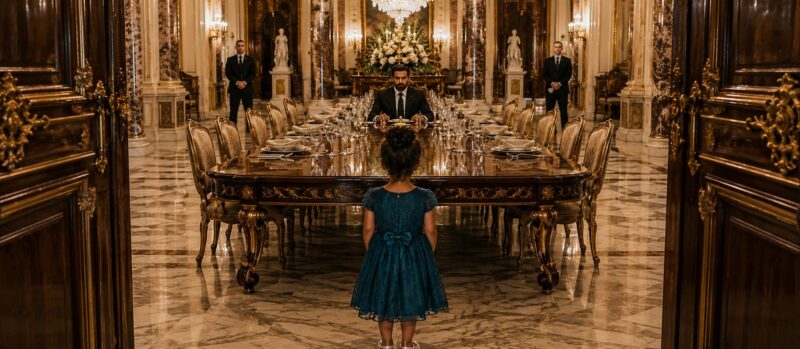
Amara leaned toward me until one of her dark curls brushed the sleeve of my shirt.
Her voice was barely louder than the hum of the crystal chandelier above us.
«Mommy says your little girl still leaves a chair for you too.»
For several long seconds, I heard nothing.
Not the quiet movement of the guards in the hallway.
Not the faint clink of silverware from the kitchen.
Not even Grace’s sharp intake of breath.
Only those nine words.

Your little girl still leaves a chair for you too.
I looked at Grace. She had gone completely pale.
«Grace.»
«Sir—»
«How do you know that?»
Amara, entirely unaware that she had just changed the temperature of the room, calmly tore her dinner roll in half.
Grace looked down at her daughter, then back up at me.
«Amara, sweetheart, would you go with Mr. Marcus for just a minute?»
«No.»
Marcus, one of the few men in my organization who could remain expressionless through almost anything, actually blinked in surprise.
Amara pointed right at her plate. «I’m eating.»
To my own surprise, I nearly smiled. «She can stay.»
Grace swallowed hard. «Mr. Hale, this isn’t a conversation I wanted to have in front of her.»
«Then don’t have the difficult parts.»
Amara dipped a piece of bread into her potatoes. «I like potatoes.»
«I can see that,» I said quietly. Then I looked back at her mother. «Tell me what you can.»
Grace stood beside the table for another moment before slowly pulling out a chair three seats away and sitting down.
I had never seen her sit in my dining room. In fact, I doubted anyone else ever had.
For nearly a year, she had moved through my house quietly and efficiently—arranging flowers, managing linens, and remembering which rooms I preferred left untouched. She knew not to disturb my study before seven. She knew I disliked lilies because their scent reminded me of hospitals. She knew the small sitting room upstairs was never to be opened.
I had always assumed those things came from basic observation.
Now, I wondered how much she had known before she ever walked through my front door.
«Do you remember a woman named Lena?» she asked.
My hand tightened around the edge of the table. «My wife?»
«Yes.»
I stared at her. «You knew Lena?»
«A little.»
Her answer was far too careful. «How?»
Grace looked down at her hands. «During the final months of her illness, I worked evenings at the private care center she used.»
The memory came rushing back, fragmented and imperfect. White corridors. Muted lights. Too many cups of coffee. People introducing themselves while I just nodded, entirely unable to register their names. Lena had always hated when I stayed overnight. “You can’t frighten an illness into leaving, Julian,” she would say.
I remembered nurses, assistants, specialists, and visitors. But I remembered nothing clearly except Lena.
Grace continued softly, «I wasn’t assigned to her every evening, but enough that we talked.»
«You never told me.»
«You never asked.»
That should have angered me. Instead, it landed with an uncomfortable, undeniable accuracy.
Grace added, «And when I came to work here, I wasn’t certain whether telling you would help anything at all.»
I glanced over at Amara. She had decided her peas were completely unacceptable and was meticulously lining them up along the rim of her plate.
«My daughter,» I said, my voice dropping. «You know Sophie?»
Grace nodded.
My chest tightened at the sound of her name, even though I had been the one to say it. Sophie Hale. Eight years old now. Six when her mother died. Six when I had convinced myself that staying away was the kindest thing I could possibly do for her.
«Where have you seen her?»
«Rebecca and I stayed in contact.»
Lena’s older sister. The woman who had taken Sophie home two years earlier. The woman who had stood in my study while I stared blindly through the windows, saying, “She needs stability, Julian.”
What I had heard instead was: She doesn’t need you.
Maybe Rebecca had meant it that way. Maybe she hadn’t. At the time, I hadn’t bothered to ask. I had simply signed the temporary guardianship papers before the funeral arrangements were even complete.
Then, weeks turned into months. Every time I thought about calling, I imagined Sophie surrounded by the ordinary things I could never give her: school mornings, neighborhood kids, a backyard without security cameras, and a house where nobody lowered their voice when her father walked through the door.
I told myself I was giving her peace. But the truth was far less noble.
I had been terrified that she would look at me and ask why her mother had gone away. I had been terrified that I wouldn’t know what to say.
So, I said nothing. For two solid years.
Grace studied me carefully. «Rebecca and I became friends after Lena passed. We weren’t close before, but grief creates strange bridges sometimes.»
«Does Sophie know you work here?»
«Yes.»
That genuinely surprised me. «And Rebecca allowed it?»
Grace gave me a faint, tired smile. «Rebecca doesn’t control where I work.»
«That isn’t what I meant.»
«I know.»
Amara suddenly piped up. «Sophie has yellow boots.»
Grace closed her eyes. «Amara.»
«What? She does.»
I looked down at the little girl. «You’ve met her?»
Amara nodded enthusiastically. «She lets me use the purple crayon.»
There was something almost unbearable about discovering the tiny pieces of my daughter’s life through a three-year-old. Yellow boots. Purple crayons. Ordinary information. To me, it was priceless.
«What else?» I asked before I could stop myself.
Grace looked at me. «Mr. Hale—»
«What does she like?»
Amara considered the question with great seriousness. «Pancakes.»
I waited.
«And rabbits. But not real rabbits, because one jumped at her once.»
Grace’s mouth twitched. «Sophie said it hopped toward her. It did not attack her.»
«It was big,» Amara insisted.
«Anything else?» I asked.
Amara thought hard. «She draws.»
I already knew that. At six, Sophie used to leave drawings everywhere. On my desk. In my shoes. Once, she even slipped one inside a folder containing paperwork worth several million dollars. I had been halfway through a high-stakes meeting when a crooked purple castle slid across the mahogany table. Everyone had frozen. Sophie had burst through the door right after and announced, “Daddy, that’s where we live when you’re not grumpy.”
I had kept that drawing. It was still locked in my safe.
«What does she draw?» I asked softly.
Amara looked at Grace, who answered this time.
«Houses, mostly.»
I lowered my eyes. «Three windows?»
Grace went quiet. Then she nodded. «Usually.»
The exact same three windows Sophie had drawn since she was four. One for her. One for Lena. One for me.
I pushed my plate away. Suddenly, I wasn’t hungry anymore.
«Why did you come here, Grace?»
Her expression shifted. There it was—the question she had undoubtedly expected from the exact moment Amara had waltzed into the dining room. She glanced toward Marcus and the other guard.
«Would you prefer privacy?»
«No.» Marcus had worked for me for twelve years. He knew more about my life than most of my actual relatives.
Grace folded her hands in her lap. «I saw the position listed through the household agency.»
«That doesn’t answer my question.»
«No. It doesn’t.» She looked at Amara, then back at me. «I recognized the address.»
My voice remained dangerously quiet. «And?»
«And I applied deliberately.»
Marcus shifted his weight near the door. I raised one hand without looking at him, telling him to hold his ground.
Grace continued, «I didn’t come here to steal anything. I didn’t come here to report on you. Rebecca didn’t send me.»
«Then what did you come for?»
«To see.»
«See what?»
«What kind of man was actually living in this house.»
Amara lifted her water glass with both hands. Grace automatically reached out to steady it.
I stared at her. «You applied for a job in my home because you were curious?»
«No.» For the first time, there was absolute firmness in her voice. «I applied because Lena once asked me something.»
My pulse skipped a beat. «What?»
Grace hesitated. «Near the end, she talked about you a lot more than you probably realize.»
I looked away. That was information I wasn’t quite prepared to receive.
«She worried,» Grace continued, «that if you lost her, you would mistake shutting everyone out for strength.»
I let out a humorless laugh. «That certainly sounds like Lena.»
«She said you had a chronic habit of deciding what other people needed without ever asking them.»
That sounded even more like her. I could almost hear Lena’s voice echoing in my ear: Julian Hale, you are not a mind reader. Stop behaving like a badly dressed fortune-teller.
For the first time in years, the memory didn’t hurt as sharply as I expected. It simply made me miss her fiercely.
«What did she ask you to do?» I asked.
Grace’s expression softened. «The truth is, she told me that if our paths ever crossed afterward, I should remind you of something.»
«What?»
«That silence and protection are not the same thing.»
I looked toward the empty end of the table. For two years, I had built my entire existence around the belief that they were.
Grace sighed softly. «When the agency listed this house, I nearly ignored it. I thought it would be entirely inappropriate.»
«It was.»
«Yes.» Her immediate agreement caught me off guard. «But I also knew Sophie was asking questions Rebecca couldn’t answer.»
«About me?»
«Yes.»
«Why didn’t Rebecca ever contact me?»
Grace’s eyes narrowed slightly. «Why didn’t you contact Rebecca?»
There were very few people on this earth who would dare answer one of my questions with another. Marcus suddenly became unusually fascinated by the hallway carpet.
I looked at Grace for a long, heavy moment. Then I muttered, «Fair.»
Her shoulders relaxed by half an inch. «Rebecca believed you wanted distance. You believed Rebecca wanted you gone. Neither of you ever spoke plainly.»
«She told me Sophie needed stability.»
«She did.»
«She told me my home wasn’t suitable for a child.»
«At that time, was she wrong?»
The answer arrived immediately, without hesitation. «No.»
Two years earlier, armed men came to my house at all hours. Phones rang straight through dinner. Security details changed on a weekly basis. I had routinely conducted ruthless business ten feet from the room where Sophie kept her stuffed animals neatly arranged by height. Lena had complained about it for years. I had always promised I would reorganize my life. Later.
Later had become a dangerously casual word in our marriage.
Grace said gently, «Rebecca wasn’t saying Sophie should never see you again. She was saying Sophie needed a stable environment while everyone was still grieving.»
«I signed guardianship papers.»
«Temporary papers.»
I looked at her sharply. «I know what I signed.»
«Do you?»
I almost answered, then stopped cold. I remembered the office. Thomas, my attorney, placing crisp documents in front of me. Rebecca crying silently in the corner. Me signing page after page after page.
I hadn’t even bothered to read half of them.
That sudden realization sat like lead in my chest.
Amara tugged on Grace’s sleeve. «Can I have more bread?»
Grace looked toward me for permission. I silently pushed the bread basket a little closer. «Take two.»
Amara smiled brightly. «You’re nice.»
Marcus gave a sudden, muffled cough. I snapped my head toward him. «Something funny?»
«No, sir.»
«Good.»
Amara whispered loudly, «He thinks it’s funny.»
«I know he does.»
For the first time that evening, Grace actually laughed. It was small, nervous, but entirely real.
The air in the room felt fundamentally different afterward. Less like a high-stakes interrogation, and more like four people simply sharing a meal.
I leaned back in my chair. «Does Sophie hate me?»
Grace’s laughter vanished instantly. «No.»
The speed and certainty of her answer affected me more than I cared to admit.
«She should.»
«Children don’t keep emotional accounting books the way adults do.»
«I left.»
«Yes.»
«You’re making this sound a lot better than it actually was.»
«No,» Grace met my eyes directly. «I’m telling you the truth without decorating it. You left a massive space in your daughter’s life. She noticed it.»
I swallowed hard. «But she doesn’t hate you.»
«What does she think, then?»
Grace was quiet for several seconds. «She thinks maybe you just stopped wanting to be her father.»
The sentence hit me harder than any physical blow or accusation ever could. I looked down at my own hands. Men had spent years assuming my cold silence meant absolute certainty. They had been dead wrong. Sometimes, silence simply meant there was no language for the deep regret hiding underneath it.
«I never stopped,» I said quietly.
«Then perhaps she deserves to know that.»
I shook my head. «You don’t understand my world.»
«I understand enough.»
«No, Grace. You understand this house. That’s not the same thing.»
«Then change the parts of your world that need changing.»
I looked up sharply. Her expression remained entirely calm. «You make massive decisions every day that affect global companies, real estate, employees, and dangerous contracts,» she said. «Surely you can make a few decisions about where your meetings happen and who is allowed to walk through your front door.»
It sounded impossibly simple.
It wasn’t. But looking at her, I realized it wasn’t impossible either. And that distinction mattered.
Amara had finally finished eating. She scrambled down from her heavy chair. «Thank you for dinner, Mister.»
«You’re welcome, Amara.»
She leaned toward me solemnly. «You should eat tomorrow too.»
«I’ll consider it.»
«No. You have to.»
Grace quickly covered her mouth with her hand.
I looked at the tiny person casually giving orders in my private dining room. «Yes, ma’am.»
Satisfied, Amara reached out and grabbed her mother’s hand.
Before Grace could turn to leave, I spoke again. «You said Sophie still leaves a chair for me.»
Grace stopped in her tracks. «Why?»
Before Grace could answer, Amara piped up. «Sunday lunch.»
Grace elaborated, «Rebecca hosts Sunday lunch at one o’clock sharp. It’s a family tradition Lena started years before she passed away.»
I remembered it well. Lena had insisted on Sunday lunches long before our marriage. No emergency calls. No urgent business meetings. No excuses. I had broken that golden rule more times than I cared to count.
Grace continued, «Rebecca sets four places at the table. Hers, Sophie’s, and usually two spots for occasional guests. But Sophie… she almost always insists on putting out one extra plate.»
«For me?»
Grace nodded. «She doesn’t talk about it much.»
I couldn’t find the words to answer.
Grace led Amara toward the doorway, but then paused, looking back over her shoulder. «There is something else.»
My gaze lifted instantly. She looked uncertain now—far more uncertain than at any point during our entire conversation.
«What is it?»
«About three months ago, Sophie asked me to give you something.»
My heart seemed to skip a beat. «You’ve had something from my daughter for three months?»
«She gave me strict instructions.»
«What instructions?»
«That I shouldn’t give it to you until the exact moment I thought you were finally ready.»
A colder, harsher version of my past self would have demanded it immediately. The man I had been before Amara walked into this dining room certainly would have.
Instead, I heard Lena’s remembered voice echoing clearly in my mind: You always decide what everyone needs without ever asking them.
So, for once, I asked. «What made you decide I’m ready now?»
Grace looked at the empty chair beside me. «Because you finally let someone sit there.»
With that, she turned and left.
I remained alone at the massive table. Marcus stood silently near the door. Several minutes passed before he finally spoke.
«Sir?»
«What is it, Marcus?»
«Your dinner’s getting cold.»
«I know.»
He hesitated. Then, remarkably, he stepped into the room, walked over, picked up the abandoned bread basket, placed the lid back on top, and pulled out the chair directly across from me.
I stared at him. He froze.
«Should I stand back out in the hall, sir?»
«No.»
He remained seated. Neither of us spoke a word.
It suddenly occurred to me that I had been eating alone for years partly because everyone around me simply assumed I wanted to. People become dangerously skilled at obeying the invisible walls you build—even long after you’ve completely forgotten why you built them in the first place.
The next morning, I canceled three major executive meetings. Then, I picked up my phone and called Thomas Avery.
My attorney answered on the second ring. «Julian?»
«I need the guardianship documents from two years ago.»
Silence on the other end. Then, cautiously, «All of them?»
«All of them.»
Another pause. «Is something happening, Julian?»
«Something should have happened two years ago.»
Thomas didn’t ask any more questions. «I’ll bring them over right away.»
At eleven o’clock, Grace appeared at my study door. She carried no cleaning supplies, no dusting rags—only a pale blue envelope.
My name was written right across the front. Not in Lena’s handwriting. In the hesitant, uneven printing of a child.
DAD.
I stood up from my desk before I even realized I was moving. Grace walked quietly across the room and placed the envelope down on the wood.
«She wrote it entirely by herself,» Grace said softly.
«When?»
«Three months ago.»
I reached out and lightly touched the corner of the envelope, but didn’t open it yet. «What if she doesn’t want me to answer?»
«She does.»
«How can you possibly know that?»
«Because she asked me every single Sunday whether I’d delivered it yet.»
I looked up at Grace. «And what did you tell her?»
«That I was waiting.»
«Waiting for what?»
Grace gave me a small, knowing smile. «For you to finally stop hiding behind your own reputation.»
Then, she turned and left the room.
I sat staring at the desk for nearly ten minutes before finally slipping my finger under the flap of the blue envelope.
Inside was a single folded piece of cream-colored paper. At the very top, there was a drawing: a long rectangular table with five chairs around it. Four of them were occupied by simple stick figures. One was entirely empty.
Underneath the drawing, Sophie had written:
Dear Dad,
Aunt Rebecca says people sometimes forget how to start talking to each other after they stop for a while.
So, I thought I would start.
I had to stop reading for a second. I stood up and walked over to the tall study window.
Outside, the estate gardens looked precisely as they had yesterday. The courtyard fountain was running. A groundskeeper was trimming the emerald hedges. A sleek black car sat waiting quietly near the security gates.
My entire empire continued moving forward, while everything inside my chest shifted completely.
Eventually, I walked back to the desk. There were three more lines written at the bottom of the page:
You don’t have to come get me right away.
You can just come have lunch with us.
And:
I still remember you don’t like tomatoes.
I let out a sudden, involuntary laugh. Then, unexpectedly, I brought a hand up and covered my eyes.
Not because I was broken. Not because a single piece of paper could magically repair two lost years of absence. It couldn’t. Nothing could erase that time.
I covered my eyes simply because my little girl remembered that I hated tomatoes. Such an absurd, trivial detail—yet such an extraordinary, monumental gift.
A sharp knock sounded at the heavy oak door. Thomas entered, carrying his worn leather briefcase. He stopped dead in his tracks when he saw the paper trembling in my hand.
His expression shifted immediately. «Is that from Sophie?»
«Yes.»
He slowly closed the study door behind him. «I always wondered when this exact day would come.»
I looked at him hard. «What does that mean?»
Thomas set his leather case down on my desk. «Read the original guardianship agreement before you decide what I mean.»
He flipped open the folder. I turned the pages, scanning the legal headers: Temporary Guardianship. Educational Authority. Medical Decisions. Residential Arrangements.
Then, my eyes locked onto a paragraph I had no memory of ever reading:
Review required after six months.
And another:
Paternal visitation rights to resume at the sole discretion of both parties, with the expressed legal intention of actively maintaining and rebuilding the parent-child relationship.
I stared at the words in absolute disbelief. «Why didn’t you tell me this was in here, Thomas?»
Thomas looked genuinely saddened. «I tried, Julian.»
«When?»
«The very morning after you signed the papers.»
Memory flashed violently backward, though still blurred at the edges. I remembered standing in the grand hallway. Someone—probably a nurse or a family member—had tried to hand me one of Sophie’s small woolen sweaters. In my blind agony, I had snapped something unforgivable in its finality: Take everything out of my sight. Don’t ever mention this house again.
At the exact time, I had meant: I cannot survive hearing her name today.
Instead, everyone in the room had heard: Never speak of her again.
Thomas sat down in the leather armchair. «You weren’t thinking clearly, Julian. You were drowning.»
«And you just let it happen?»
«You were my client. Rebecca had lawful guardianship. There was no immediate emergency. I genuinely believed you needed time to breathe.»
«Two years?»
«I stopped believing that after the first six months.»
«Then why didn’t you—»
«Because every single time I tried to gently raise the subject, you shut down the conversation instantly.»
He was entirely right. I remembered those cold moments vividly. Questions I had violently cut off. Folders I had refused to open. Birthdays and holidays I had buried myself in work until midnight to avoid feeling anything at all.
I sank back into my chair. The truth was far less dramatic than any grand conspiracy—and infinitely more difficult to look in the mirror.
Nobody had stolen Sophie from me. Nobody had intentionally erased me from her life. I had completely misunderstood grief, wrongfully interpreted concern as rejection, and then spent two full years fiercely defending that tragic misunderstanding because admitting the truth meant admitting I could have stepped up much, much sooner.
Thomas slid a second, older folder across the polished wood. «There is one more document you need to see.»
«What is it?»
«Something Lena prepared just before she passed away.»
My hand froze mid-air. «What kind of document?»
«Not legal.» Thomas hesitated, his expression heavy. «She gave it directly to Rebecca. Rebecca gave it to me after the funeral because she didn’t know when you would finally be ready to see it.»
I stared at him in shock. «You’ve had something written by Lena for two years?»
«No.» Thomas opened the folder to reveal a crisp photocopy of a handwritten page. «I only had a copy.»
«Where is the original?»
«Safe with Rebecca.»
I looked down and read the very first sentence written in Lena’s familiar handwriting:
Julian, if you are reading this, it means either you finally learned how to listen, or someone down the road became brave enough to force you to.
Despite everything heavy weighing on my chest, a small, genuine smile touched my lips. Lena. Only Lena.
I kept reading. She wrote deeply about Sophie. About Rebecca. About the cold, hollow house we had built. About how ordinary grief has a way of making us all behave like absolute strangers to the people we love most.
Then, near the bottom of the page, one paragraph was heavily underlined:
I am not asking Rebecca to raise our daughter instead of you. I am asking her to help keep her safe until you finally remember how to be her father, without foolishly trying to be everyone else’s protector at the exact same time.
I stopped reading. Thomas watched me in total silence.
There was one final sentence written right beneath it:
There is something very important kept inside the blue box in the upstairs sitting room. When you are finally ready to bring Sophie back home—not to the old, cold house, but to a much better version of it—open it together with her.
I slowly looked up toward the ceiling.
The small private sitting room upstairs. The exact room nobody had set foot in for two full years. The sanctuary where Lena had kept her personal books, journals, and private treasures during the final months of her life.
I had locked it immediately after the funeral and thrown away the emotional key.
The blue box. I remembered it vividly now—a hand-painted wooden box resting on the top shelf of the mahogany cabinet. I had never once opened it.
Thomas quietly closed his leather briefcase. «Do you actually know what’s inside it, Julian?»
«No.»
«Does Rebecca know?»
«No.»
I looked back down at Lena’s handwriting, feeling the immense weight of her words settling deep into my soul. For two years, I had convinced myself that the hardest part of losing my family had already happened.
I had been entirely wrong.
The hardest part wasn’t the loss itself. The hardest part was realizing that there was still a family waiting for me to choose them—and that upstairs, inside a locked room I had stubbornly refused to enter, my wife had left one final, loving choice waiting for me to find.
The Lunch Julian Had Waited Two Years to Ask For
I did not open the blue box that day.
For most of my adult life, hesitation was something I regarded as a weakness. Business rewarded certainty. People trusted decisions made without a trembling hand. But family, I was beginning to understand, did not operate by the exact same rules.
Some doors deserved to be opened very carefully. Some answers belonged to more than one person.
Lena’s note had been clear: Open it with her. With Sophie.
So, I left the upstairs sitting room locked. Instead, I sat down and wrote a letter.
It took me four hours. I had negotiated high-stakes corporate contracts covering forty pages with far less difficulty than it took to write six simple paragraphs to my own daughter.
The first version sounded like a stiff corporate lawyer.
The second sounded like a guilty man desperately trying to defend himself.
The third was even worse because I awkwardly tried to sound cheerful.
Finally, I crumpled all three drafts and threw them into the fireplace. Then, I picked up a fresh pen and began again.
Dear Sophie,
Thank you for starting the conversation.
I stared at the sentence. It was simple. So, I kept going.
I should have started it a long time ago. I thought staying away was protecting you from a life that had become too complicated. I didn’t ask whether that was what you actually wanted. That was my mistake.
I paused. Mistake seemed entirely inadequate. But it was honest language an eight-year-old could understand.
I would like to have lunch with you.
I still don’t like tomatoes.
I remember that you used to steal the olives right off my plate. I don’t know whether you still do, but I would love to find out.
Love,
Dad
I almost signed it Julian. Habit. Distance. Formality.
Instead, I scratched it out with a firm stroke and wrote Dad.
Grace delivered the letter to Rebecca. I didn’t ask her to persuade anyone. I didn’t call Rebecca myself. I didn’t send a driver, nor did I have Thomas contact her attorney. Those were the methods I relied on when I wanted to force an outcome.
This could not be an outcome. It had to be a genuine choice.
Two days passed. Then three.
On the fourth morning, Grace entered the breakfast room carrying coffee. I looked up too quickly. She noticed it instantly.
«No letter,» she said smoothly.
I turned back to the financial pages of the newspaper. «I didn’t ask.»
«No, you didn’t.» She poured my coffee. «But you’ve been staring at the exact same paragraph for ten minutes.»
I folded the newspaper with a sharp snap. «You’ve become remarkably comfortable in my home, Grace.»
«Yes, I have.»
«I’m seriously reconsidering that.»
«No, you aren’t.»
She walked away before I could think of a retort.
At 11:23 that morning, my phone rang.
It was Rebecca.
I stared at the screen, watching the name light up. I had never deleted her number. For two solid years, it had remained sitting quietly in my contacts like an unopened door. I pressed accept.
«Hello.»
«Julian.» Her voice sounded almost exactly as I remembered it: calm, direct, and tired in a way that felt all too familiar.
«Rebecca.»
A heavy pause followed. Neither of us seemed to know which person had the right to speak first.

Finally, she said, «Sophie received your letter.»
«All right.»
«She wants to have lunch.»
My grip tightened around the phone until my knuckles turned white. «When?»
«This Sunday.»
I glanced over at the calendar on my desk, even though I already knew Sunday was three days away. «Where?»
«The botanical garden café.»
Public. Neutral. Bright. A safe place filled with families and children, completely detached from my dark world.
«Fine.»
«There are conditions.»
«Tell me.»
«No armed guards sitting at the table.»
I glanced through the open study doorway, where Marcus was standing thirty feet down the hall. «Agreed.»
«No business calls.»
«Agreed.»
«You come completely alone.»
I hesitated. Rebecca caught it instantly. «Julian.»
«Marcus can remain outside the perimeter of the gardens.»
«That is not alone.»
«He stays locked in the car.»
Another tense pause. «Fine.»
«And Rebecca?»
«Yes?»
«If Sophie changes her mind at the last second, you don’t have to bring her.»
Silence on the line. Then, her voice softened just a fraction. «I’ll tell her.»
Sunday arrived with a persistent rain. Not a dramatic storm with thunder and lightning, just a steady spring drizzle that slicked the asphalt and made the city streets smell clean and damp.
I arrived twenty minutes early. Marcus drove the car, remaining almost entirely silent the entire way. When we reached the main entrance of the gardens, I reached for the door handle.
«Stay right here,» I instructed.
He nodded. «Sir?»
I looked back over my shoulder. Marcus—a hardened man who had once handled tense standoffs with senators without changing his expression—looked genuinely uncertain.
«What is it?»
«Your tie.»
I looked down. «What about it?»
«It’s crooked.»
I quickly adjusted it. «Better?»
«No.» He killed the engine, got out of the car, walked around, straightened it himself, and stepped back. «There.»
I stared at him deadpan. «If you ever tell a single soul about this, you’re fired.»
«Yes, sir.» A corner of his mouth twitched upward.
I stepped out into the mist and entered the gardens. For twenty years, I had walked into rooms fully prepared to be noticed, feared, and accommodated. That afternoon, I wanted desperately to blend in.
The café sat right beside the massive glass conservatory. Families occupied most of the tables. A toddler pressed his face curiously against a window pane. Two elderly women shared a pastry near the corner. Someone had left a wet umbrella dripping beside the counter.
Everything was wonderfully, heartbreakingly ordinary. I had forgotten just how frightening ordinary life could feel when you were terrified you didn’t belong in it.
At 12:58, Rebecca appeared. She had cut her hair a bit shorter since I last saw her. She wore a tailored beige coat and carried a large umbrella.
Walking right beside her was Sophie.
My daughter had grown. That was my very first thought—not something poetic or grand, just the stark, grounding truth: She grew.
Of course she had. Children do that whether their fathers are watching them or not.
Her hair was still Lena’s exact shade: chestnut brown with golden streaks that caught the faint light. And she was wearing yellow boots. Amara had been right.
Sophie saw me standing by the table and stopped dead in her tracks. Rebecca murmured something quietly to her. Sophie answered with a nod, and then they continued walking toward me.
I stood up. I had rehearsed half a dozen greetings in my head, but every single one of them vanished.
«Hello, Sophie.»
«Hi, Dad.»
She remained standing close to Rebecca. I didn’t lunge toward her, didn’t reach out my hands, and didn’t beg for a hug. That restraint was perhaps the most difficult thing I had forced myself to do in years.
Rebecca pulled out a chair. Sophie sat down. I took the seat directly across from her.
There happened to be tomatoes sliced up in the side salad. Sophie noticed them before anything else.
«You still hate them?» she asked, pointing.
«Yes.»
She looked at me suspiciously. «You said that in your letter.»
«I wanted you to know some things haven’t changed.»
She considered this seriously. Then, very deliberately, she picked the tomatoes out of my salad and placed them right onto her own plate.
My throat suddenly felt tight. «You still steal food.»
«They’re not stealing if you don’t want them.»
«An interesting legal theory.»
«Aunt Rebecca says you’re always talking like a lawyer.»
Rebecca almost smiled behind her coffee cup. «I have never said that exact phrase.»
«You said he argues about everything.»
«That is entirely different.»
For the first time, Sophie smiled. It was only a small, hesitant smile, but it was purely hers. I would have gladly given away entire commercial buildings just to see it again.
Lunch started awkwardly. Of course it did. There was no magical, cinematic moment where two lost years of silence simply vanished into thin air.
Sophie talked about school. She liked science classes, but utterly despised handwriting practice. She had a new friend named Priya who could whistle loudly right through her fingers. She was taking piano lessons and firmly believed that musical scales had been invented specifically to torture children.
I mentioned casually that the mansion’s old piano remained upstairs.
She stopped chewing. «Mom’s piano?»
«Yes.»
«You kept it?»
«I kept everything.»
Her eyes drifted downward. «Oh.»
I instantly regretted saying it. Everything made it sound like a museum—like I had preserved dead objects instead of nurturing relationships.
So I quickly added, «Though… some things probably shouldn’t have been kept exactly the same.»
Sophie looked up. «Like what?»
«The dining room.»
Rebecca became completely still, listening.
I continued, keeping my eyes on my daughter. «I’ve been eating alone.»
Sophie frowned. «Why?»
It was almost the exact same innocent question Amara had asked. But I answered it differently now.
«Because I got used to it.»
«That sounds boring.»
«It was.»
«Grace says Amara ate dinner with you.»
I glanced at Rebecca, who shrugged faintly. «Apparently, palace news travels fast.»
«She ate all the bread,» I noted.
Sophie laughed out loud. «She always does that.»
The conversation grew easier after that. Not easy, exactly—just easier. There is a distinct difference.
After we finished eating, Sophie wanted to go walk through the botanical greenhouse. Rebecca began to stand up to accompany us, but Sophie looked over at her.
«You can stay here and drink your tea.»
Rebecca glanced at me, then back at Sophie. «Are you sure?»
«Yes.»
Rebecca slowly sat back down. It was a small act of trust—measured in twenty short minutes. I understood its immense value.
Sophie and I walked side by side through the warm, humid conservatory. The air fogged the glass panels around us. Massive tropical leaves hung heavy over the stone pathway, and water trickled quietly beneath a wooden footbridge. Sophie kept herself half a step ahead of me.
«You have gray hair,» she observed suddenly, stopping to look at me.
I reached up and touched my temple. «Just three.»
«Definitely more than three.»
«Your math skills need some work.»
«I can count just fine.»
We reached a wooden bench overlooking a pond. Sophie sat down. I remained standing until she patted the empty space beside her, and then I sat.
She studied a school of tiny orange koi fish swimming in the water. «Dad?»
My chest tightened sharply. It was the first time she had called me that aloud, out in the open.
«Yes?»
«Did you… did you not want me anymore?»
There are some questions in life that deserve months of preparation. That one certainly didn’t allow any.
I leaned forward, resting my elbows on my knees. «No.»
She waited. I realized immediately that a single word was nowhere near enough.
«No,» I repeated, looking straight into her eyes. «I wanted you every single day.»
«Then why didn’t you ever come get me?»
There was no answer that made me look noble or wise. So, I gave her the absolute truth.
«I was afraid.»
She looked genuinely surprised. «Of Aunt Rebecca?»
Despite the gravity of the moment, a faint smile touched my lips. «No.»
«Well, she can be pretty scary when somebody leaves wet cups on the wooden furniture.»
«I remember.»
«Then what were you afraid of?»
I looked back out at the fish pond. «After your mother died, everything in our house reminded me that I didn’t know how to make things feel normal again.»
Sophie was quiet, listening intently.
«I thought if you lived with Aunt Rebecca, you would have school, friends, quiet mornings, and a regular, safe life.»
«I did.»
«I know.»
«But you still could have visited me.»
«Yes, I could have.»
«Why didn’t you?»
I took a deep breath, letting the humid air fill my lungs. «Because after a while, I convinced myself that you might be much happier if I just stayed away.»
She frowned deeply. «Who told you that?»
«Nobody.»
«That was pretty silly.»
«Yes,» I admitted softly. «It was.»
A long pause stretched between us. Then she muttered, «Adults make things so complicated.»
«Constantly.»
«Grace says you boss everybody around.»
«I don’t boss everybody.»
She stared at me skeptically. I quickly reconsidered. «Well… most people.»
She smiled faintly. Then, her expression turned serious again.
«I was really mad at you.»
«You had every right to be.»
«I tore up your birthday card.»
I blinked. «What birthday card?»
«The old one. The one you mailed me when I turned six.»
I remembered that card—a ridiculous, elaborate pop-up castle covered in silver glitter.
«I taped it all back together,» she added.
«Why?»
She shrugged, kicking a pebble with her yellow boot. «Because I was still mad at you, but I still wanted the card.»
I nodded slowly. «That actually makes complete sense.»
«Are you mad at me?» she asked.
«No.»
«You’re not?»
«Never.»
She thought about that for a moment, weighing it carefully. Then she asked, «Can I still be mad at you sometimes?»
«Yes.»
«For how long?»
«As long as you need to be.»
That seemed to surprise her more than anything else I could have said.
We sat together in quiet companionship. Eventually, she shifted and leaned slightly against my arm. Not fully—it was barely a touch, just the side of her shoulder brushing against my sleeve.
I remained completely, perfectly still. There were ruthless men in my world who would have interpreted stillness as fear. In a way, they would have been right. I was terrified that if I moved even an inch, she would pull away.
She didn’t.
When we walked back to the café, Rebecca looked at us searchingly, but didn’t say a word.
Before we parted ways near the exit, Sophie stopped. «Can we have lunch again next week?»
«Yes.»
She narrowed her eyes playfully. «You have to ask Aunt Rebecca first.»
I looked over at Rebecca. «May I please have lunch with Sophie again?»
Rebecca studied me for a long beat. «Ask Sophie.»
I looked back down. «May I have lunch with you again?»
Sophie considered it with theatrical dramatic flair. «Maybe.»
Then she broke into a wide grin.
The second lunch happened the following week. The third took place two weeks after that.
I learned quickly that rebuilding a shattered relationship wasn’t achieved through some grand, cinematic gesture. It was achieved through sheer repetition. Showing up when you promised. Calling precisely when you said you would. Remembering that her school play started at six, not seven. Knowing what ice cream flavor she actually liked now, rather than the one she loved when she was five. Listening patiently when the subject was boring—especially then.
Sophie began calling me on Wednesday evenings. At first, Rebecca hovered nearby in the hallway. Later, Sophie started calling directly from her bedroom, spending fifteen passionate minutes explaining a complicated drama between two girls at school whose names I repeatedly confused.
«You’re not even listening to me.»
«I am, I am.»
«Who is Maya?»
«The girl who borrowed Priya’s colored markers.»
«No! That’s Alice.»
«I have officially failed as a father.»
«Yes, you have.»
«Give me another chance.»
She would sigh dramatically and start the entire story over from the beginning.
Back at the mansion, things were shifting too.
I officially moved all professional business meetings entirely out of the main residence. The east wing office became the sole space where professional visitors were received, and absolutely no business appointments took place past five o’clock.
I told Marcus that half of the visible security presence inside the main family house had to disappear.
He stared at me, dumbfounded. «Disappear, sir?»
«Relocate.»
«To where?»
«Somewhere children don’t have to walk past six armed men wearing earpieces just to grab a glass of orange juice.»
Marcus nodded slowly. «I’ll reorganize the rotation.»
«You disagree?»
«No, sir.»
«You certainly look like you disagree.»
«I was just thinking that this should have probably happened about five years ago.»
That earned him a sharp, lingering stare. He didn’t blink or withdraw the statement.
Grace, meanwhile, became increasingly impossible to manage. One evening, she caught me hauling heavy boxes out of the upstairs sitting room myself.
«You do realize we employ a full household staff,» she noted dryly.
«I’m aware.»
«You pay people specifically to move heavy things.»
«I know.»
«And yet, here you are, carrying boxes by yourself.»
«Yes.»
«Personal growth is honestly exhausting to watch.»
I looked at her flatly. «Go away, Grace.»
She just smiled and walked out of the room.
I still hadn’t opened the blue box.
Sophie knew about it now. At our fourth lunch together, I finally told her the truth.
«Your mother left something behind for us.»
«For both of us?»
«That’s exactly what she wrote on the label.»
«What’s inside?»
«I don’t know.»
«Did you peek?»
«No.»
She looked genuinely impressed. «I honestly thought you peek at everything.»
«I’m learning a brand-new concept called restraint.»
«Is that like patience?»
«Apparently.»
«Do you have any?»
«Not nearly enough.»
She laughed, shaking her head.
We mutually agreed to open the box together the very first time she felt ready to step foot back inside the mansion.
That milestone took another month. The request came directly from Sophie herself during a Wednesday evening phone call.
«Dad?»
«Yes?»
«Does my old bedroom still have the glowing stars?»
I closed the open ledger I had been reviewing. «Yes, they’re still there.»
Glow-in-the-dark stars covered her entire ceiling. I had once spent three painstaking hours placing them precisely according to an astronomical chart, until Lena gently told me that a six-year-old child didn’t care whether the constellation Cassiopeia was geographically accurate.
«Can I come see it?»
«Whenever you want.»
«Saturday?»
I didn’t answer immediately because I was desperately trying not to sound too eager.
Sophie noticed the pause. «Dad?»
«Yes. Saturday.»
Rebecca came with her on Saturday. So did Grace and Amara, at Sophie’s explicit request.
When the town car finally pulled up the front steps, I waited patiently inside the foyer. I didn’t want a rigid row of staff standing at stiff attention. I didn’t want the house to feel like a corporate institution receiving a visiting dignitary. I wanted it to feel like a real home.
Amara ruined any lingering possibility of formal dignity immediately anyway.
The moment the heavy front door swung open, she raced straight into the foyer wearing a bright red sweater and yelled at the top of her lungs, «Sophie!»
Sophie laughed brightly and bent down to hug her.
Rebecca entered right behind them, casting a sharp, analytical eye around the grand hallway. «Fewer guards.»
«Yes.»
«No business meetings?»
«Never on weekends.»
She gave a slow, approving nod. It wasn’t full forgiveness, but it was fundamental acknowledgment. And for now, that was enough.
Sophie walked up the grand staircase slowly. I followed a few quiet steps behind her.
She stopped right outside her bedroom door. The brass nameplate still read SOPHIE.
«You didn’t change anything?» she asked, her voice quiet.
«Not a single thing.»
She pushed the door open. The room smelled faintly of cedarwood and old books. Shelves lined the walls. Her old, well-loved stuffed bear sat propped up against the pillows.
She looked up. The glowing stars still dotted the ceiling. One of them had peeled loose over time and was resting neatly on the bedside table where Grace must have placed it.
Sophie picked up the plastic star. «This one always fell down.»
«I know.»
A small smile touched her lips. Then she opened her closet doors. Her old dresses hung there, far too small now. Her tiny shoes sat neatly in a row. She stared at them for a long moment.
«I’m much bigger now.»
«Yes, you are.»
«We’re going to need new stuff.»
The casual use of the word we nearly undid me completely. «We can arrange that whenever you’re ready.»
She turned around. «Not fancy stuff, Dad.»
«I didn’t say fancy.»
«You buy fancy everything.»
«I am actively practicing restraint.»
She narrowed her eyes playfully. «We’ll make a written list.»
«Under strict adult supervision.»
«Yes.»
An hour later, we stood outside the closed door of the upstairs sitting room.
I turned the brass key and pushed it open. Dust had been kept meticulously away by the staff, but time remained visible in every corner. Lena’s favorite books. Her framed photographs. A soft cream-colored shawl draped neatly over the back of her reading chair.
Sophie reached out and took my hand. She had slipped her fingers into mine without a single word of hesitation in the hallway, and I didn’t comment on it either.
The blue box sat right on the highest mahogany shelf. I reached up and brought it down carefully.
Painted daisies decorated the lid. Sophie gently traced one with her fingertip. «Mom painted these.»
«I know she did.»
We sat down together on the plush rug. Rebecca remained quietly out by the doorway, while Grace cleverly took Amara downstairs for a snack to give us absolute privacy.
I looked down at my daughter. «Ready?»
She nodded.
I lifted the lid.
Inside were photographs—dozens and dozens of them. Lena had apparently printed every single ordinary, messy, beautiful moment that I had been too blind to appreciate properly back then.
There was Sophie asleep soundly on my chest when she was just an infant. Lena laughing effortlessly beside the kitchen sink. The three of us wading into the ocean on a trip I barely remembered taking. Me wearing a ridiculous kitchen apron while Sophie proudly held a wooden cooking spoon.
Beneath the stack of photographs were several thick envelopes.
One marked SOPHIE.
One marked JULIAN.
One marked BOTH OF YOU.
Sophie opened her envelope first. I respectfully looked away while she read through the pages. After a few quiet minutes, she leaned her head against my shoulder.
«Mom says I shouldn’t ever let you choose my clothes,» she whispered.
«That is deeply, profoundly unfair.»
«She says you think the color beige is an entire personality.»
From the doorway, Rebecca let out a sudden, genuine laugh. «I always truly liked your sister, Julian.»
Sophie carefully folded her letter back up. Then, I reached into the box and opened mine.
Lena’s familiar handwriting filled four pages. She didn’t spend them writing a melodramatic goodbye. Instead, she spent them giving clear, loving instructions:
Remember birthdays.
Stop taking phone calls at dinner.
Let Sophie win at card games sometimes—but not every time, or she’ll figure it out.
Don’t turn our house into a cold museum.
Keep living.
I laughed more than I cried. It was so precisely, perfectly Lena.
Then I reached the very final paragraph. My smile slowly faded.
There is one thing I couldn’t settle for you, Julian, because it has to be entirely your decision. Rebecca knows where the legal papers are kept. Thomas knows exactly what they mean. Don’t be angry with either of them for waiting. You told me once that everything you’ve built was meant to keep your family safe. If that is true, decide which parts of that empire are actually worth keeping.
I looked up toward Rebecca, who was standing quietly in the hall.
«What papers?» I asked.
She didn’t answer immediately. Instead, she walked across the room and sat down opposite us.
«Sophie, sweetheart, would you like to take your photographs downstairs and go show them to Grace?»
Sophie looked back and forth between us, sensing the shift in the air. «Is this boring adult stuff?»
«Yes, it is,» Rebecca said gently.
«Very,» I added.
Sophie carefully gathered up her pictures. At the doorway, she turned back around and pointed a finger at us. «No arguing.»
Rebecca and I answered in unison: «We won’t.»
Sophie vanished down the hallway. I waited until her footsteps faded completely out of earshot.
«What papers, Rebecca?»
Rebecca folded her hands neatly in her lap. «Lena changed her personal will shortly before she passed away.»
«I know about the financial arrangements.»
«No,» Rebecca said calmly. «You know about the money. There was another document attached.»
«What kind of document?»
«A family letter of intent attached directly to the guardianship plan.» Rebecca’s voice dropped. «She didn’t want Sophie permanently raised away from you forever.»
«I’ve learned that much.»
«She also didn’t want Sophie returning blindly to the dangerous life you were living back then.»
I sat in silence.
Rebecca continued, «She listed specific conditions.»
«What conditions?»
«Ordinary ones, mostly. Home needs to actually be a home, not a corporate office. Predictable schedules. No business visitors wandering through private family rooms. Dedicated time with Sophie that isn’t interrupted every five minutes by a crisis.»
«All of that is entirely reasonable.»
«There was one more thing.»
I waited, my pulse steady.
Rebecca looked directly into my eyes. «Lena wanted you to finally choose between being the feared man everyone ran from, and being the father Sophie could actually depend on.»
The room grew heavy and quiet.
«That’s not a binding legal condition,» I said.
«No, it isn’t.»
«Then what are these papers, really?»
Rebecca stood up, smoothing down her coat. «Ask Thomas.»
«Rebecca.»
She reached the doorway and stopped, looking back over her shoulder. «The original documents are locked in his vault.»
«Why haven’t I ever seen them before?»
«Because Lena instructed him to show them to you only when you finally asked the right question.»
I almost laughed out of sheer frustration. «And what question is that?»
Rebecca glanced toward the hallway where Sophie had gone down to play, then looked back at me.
«Not ‘How do I get my daughter back?'»
She paused, letting the words sink in.
«The real question is: ‘What kind of life do I want her to come back to?'»
With that, she turned and left me sitting alone beside the open blue box.
For years, I had treated every difficult choice in my life as a simple problem of acquisition. What did I need to obtain? Who did I need to strong-arm or convince? Which locked door needed kicking open?
But Lena, even in her absence, had deeply understood the fatal flaw in that entire philosophy.
Sophie wasn’t a prize to be recovered. She was a growing person deciding whether there was genuine room for me in the life she had built while I was gone.
And somewhere inside Thomas Avery’s vault was a document my wife had deliberately written to force me to confront the one question my money, my influence, and my fear could never answer for me:
What kind of man was I truly willing to become if my daughter chose to walk back through my front door?





