The first thing I remember clearly wasn’t the shovel.
It was my daughter kicking.
One small, frightened movement beneath my ribs while the earth tightened around my chest. That tiny kick was the moment I understood I could not afford to die.
«You brought another man’s child into my family.»
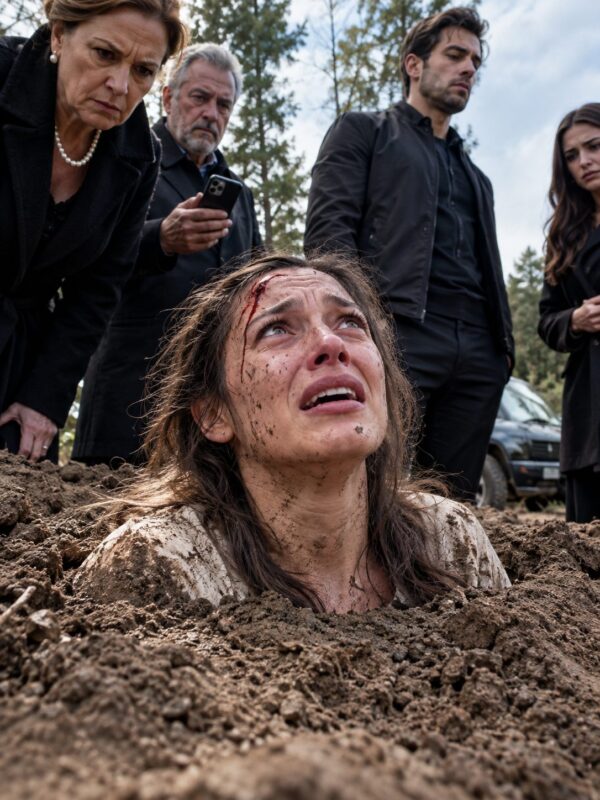
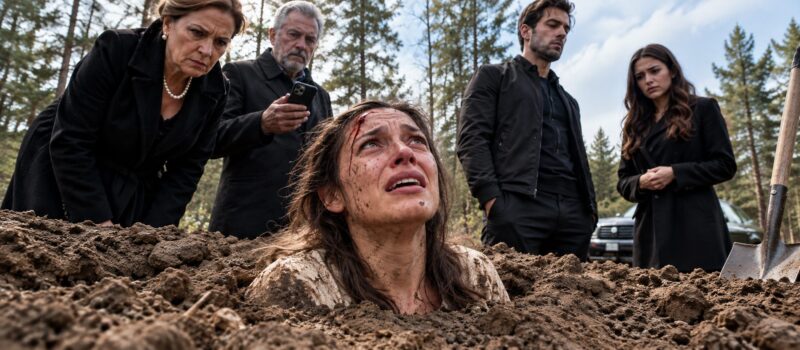
My mother-in-law, Vivian Caldwell, stood above me at the edge of the shallow pit, gripping a shovel with both hands. The late-afternoon sun was behind her, reducing her expensive cream coat and perfectly styled blond hair to a dark silhouette. She looked less like the elegant woman who chaired charity luncheons in three counties and more like something carved onto an old gravestone.
«You thought you could humiliate Ethan,» she continued. «You thought you could make fools of all of us.»
«It’s his baby!» My voice broke as I twisted against the loose soil packed around my waist. «Ethan, look at me.»
My husband stood several feet away. He had dirt on the knees of his trousers. His wedding ring caught the sunlight, and I stared at it. Four years earlier, he had slipped that ring onto his finger and whispered that there was nothing in this world powerful enough to turn him against me.
Now he couldn’t even look me in the eye.
«Ethan,» I begged.
His jaw tightened. «You know me.»
Nothing.
«You know I would never cheat on you.»
His father, Richard Caldwell, stepped forward and ripped my phone from my hand. I had managed to keep it tucked inside the waistband of my jeans during the drive into the woods, waiting for a moment when they weren’t watching. I never got it.
Richard looked at the screen. «No signal anyway.» He tossed the phone toward Vivian. She caught it, then dropped it beneath her boot. The sound of the glass cracking was strangely quiet.
«There,» Vivian said. «Now there won’t be any more hysterical calls.»
«Hysterical?» I stared at her. «You kidnapped a pregnant woman.»
Vivian smiled. «You’re family.»
«You dragged me into a truck!»
«You were becoming unreasonable.»
Richard lifted another shovel of dirt. I tried to move. «Don’t—» But he dumped it beside my hip. Cold soil spilled across my stomach, and I gasped.
«Stop!»
Another shovel. «STOP!»
My heart began hammering so violently that the world pulsed at the edges of my vision. «Please.» That word was for Ethan. Only Ethan.
He finally looked at me, and somehow the emptiness in his expression frightened me more than Vivian’s anger. «Maybe you should have thought about the consequences before humiliating me.»
I stared at the man I had shared a bed with the previous night. A cut on my forehead had begun dripping again, and warm blood slid through my eyebrow and into my left eye. I blinked against it.
His sister, Sloane, stood behind him. Thirty years old. Pale. Shaking. Silent. For half a second, our eyes met. There was terror in hers. Not rage. Not disgust. Terror.
«Sloane,» I whispered. She looked away.
Vivian noticed. «Don’t start feeling sorry for her.»
«I’m not,» Sloane said quickly. Her voice sounded wrong.
Vivian turned back to me. «She’ll stay here until she’s ready to tell us the truth.»
«I already told you the truth.»
«The laboratory says otherwise.»
«The laboratory is wrong!»
Vivian gave me a cold smile. «Science doesn’t make emotional excuses, Mara.»
I looked at Ethan again. «Did you actually call the clinic?»
He said nothing.
«Did you?»
His silence answered me.
Three days earlier, Vivian had arrived at our house carrying a white envelope. Inside was a report from Westbridge Genetic Diagnostics: PATERNITY EXCLUSION. Probability of Ethan Caldwell being the biological father: 0.00%.
I had laughed when I first read it. Actually laughed. Because it was so absurd that my brain refused to understand the danger. «That isn’t possible,» I had said. Vivian hadn’t laughed, and Ethan hadn’t either. The baby had been conceived naturally after nearly a year of trying. There had been no donor, no fertility clinic, no separation, no affair. There had never been another man.
«I want another test,» I had demanded.
Vivian folded the report. «We already have the answer.»
«No, you have a piece of paper.»
«From an accredited laboratory.»
«Then someone made a mistake.»
Vivian studied me. «Or you did.»
That was the beginning. Three days later, they had me buried to my shoulders in the woods.
The soil rose another inch, and breathing became harder. «I’m done.»
Richard laughed. «With what?»
«With all of you.»
«You have no idea what you’re interfering with.»
«Then explain it.» His eyes narrowed. Good girl, I thought. Keep him talking.
Richard stepped closer. «Your brother is protecting this family.»
«By killing his wife?»
«Nobody said anything about killing.»
«You buried her!»
«Your mother lost her temper.»
I almost laughed. «Lost her temper?»
Richard glared at me. «You should have taken the opportunity to tell the truth.»
«There is no other truth.»
«The baby isn’t Ethan’s.»
«Yes, she is.»
«We have proof.»
«You have paper.»
His expression flickered. Tiny, but I caught it. «So let’s do another test.»
Silence. I smiled despite the blood on my face. «That scares you, doesn’t it?»
Richard’s jaw tightened. Sloane turned toward him. «Why?»
«Sloane—»
«Why not another test?»
«Because we already have one.»
«Then another one should say the same thing.»
Richard looked at her, and that was when I knew. He knew the report was fraudulent too. Maybe not everything, but enough.
«You’re all involved.»
«Mara—»
«You know.» He looked toward the window, not at me. That was confirmation.
I laughed softly. Richard’s eyes snapped back. «What’s funny?»
«You’re terrible criminals. You took my phone but left a satellite beacon.»
He moved fast. I had expected anger; I had not expected panic. He lunged for me. Sloane shoved him, and Richard slammed into the table. I rolled off the cot and hit the floor, pain exploding through my side. The beacon slipped from my hand.
Richard saw it. Everything stopped. He stared at the black device, then at me. «Where did you get that?»
I said nothing. His face changed—not to confusion, but recognition. «You activated it?»
Sloane looked at him. «You knew what it was too.»
Richard lunged. I kicked the beacon beneath the cot. Sloane grabbed the fireplace poker. «Stay back!»
«You idiot,» Richard snarled.
«Don’t come closer.»
«You have no idea what Ethan has done.»
The sentence surprised all of us. Sloane lowered the poker an inch. «What does that mean?»
Richard’s chest heaved. For the first time, he did not look powerful; he looked terrified.
«Dad?»
Richard looked at me. Then he said five words that shattered the story I thought I understood.
«The DNA report wasn’t about Mara.»
Silence. Sloane frowned. «What?»
Richard rubbed both hands across his face. «It was never supposed to go this far.»
I stared at him. «What are you talking about?»
He sat heavily in the chair. «Ethan found something.»
My mouth went dry. «What?»
«A file.»
«What file?»
Richard looked toward his daughter. «Your grandfather’s trust documents.»
Sloane laughed nervously. «What does Grandpa’s trust have to do with Mara’s baby?»
«Everything.»
The engine outside was still running, but nobody else entered. I wondered whether Vivian or Ethan was waiting in the truck.
Richard continued. «The Caldwell Heritage Trust transfers controlling voting authority to the first biological grandchild of my line once that grandchild produces an heir.»
I blinked. «That makes no sense.»
«It was your grandfather’s obsession. Bloodline. Continuity.»
Sloane folded her arms. «I’ve never heard of this.»
«You weren’t supposed to.»
«Why?»
Richard looked at her. «Because when Ethan learned Mara was pregnant, the trust attorneys began the succession review.»
I felt cold. «What review?»
«DNA verification.»
My pulse slowed. Some primitive part of me understood before my conscious mind did. Sloane whispered, «Whose DNA?»
Richard did not answer.
«Dad.»
«Mine.»
The room went silent.
«And Ethan’s,» he added.
Sloane stared at him. «What happened?»
Richard looked down. «The test showed Ethan was not my biological son.»
I stopped breathing. Sloane’s face emptied. «No.»
Richard nodded once. «No.»
«Sloane—»
«No. Mom would never—»
Richard laughed, but there was no humor in it. «Wouldn’t she?»
My mind raced. «So Ethan discovered that he wasn’t biologically your son.»
«Yes.»
«And if the trust attorneys found out…»
«He would lose his claim to a controlling block worth hundreds of millions.»
I stared at him. «And he blamed my pregnancy.»
«Your pregnancy triggered the audit.»
Sloane stepped backward. «So the paternity report…»
Richard closed his eyes. «Ethan changed the samples.»
I felt physically sick. «He took his own failed paternity result—»
«And replaced the names.»
The report Vivian had thrown onto my kitchen counter—MARA VALE CALDWELL. FETAL SAMPLE. ETHAN CALDWELL. PATERNITY EXCLUSION.—had never been our test. The original laboratory result had been comparing Ethan to Richard. Probability of paternity: 0.00%.
Ethan had simply turned his own family secret into an accusation against me.
«He made Mom think Mara cheated,» Sloane whispered.
Richard’s eyes hardened. «He panicked.»
«He tried to kill her.»
«He wanted time.»
«To do what?»
«Stop the audit. Destroy the original files. Move assets.»
I stared at Richard. «And you helped.»
He looked at me, and I could hear my own heartbeat. «No.»
Sloane covered her mouth. «This has to be wrong.»
But it wasn’t. My father had donated genetic material anonymously as a twenty-two-year-old engineering student, years before meeting my mother and years before I was born. He had never known a pregnancy resulted. Ethan had never known. I had never known.
The man I had married—the father of my daughter—was my biological half-brother.
I ran from the room and vomited in a bathroom sink. For days I could barely function. Doctors were called, along with genetic counselors and attorneys. Hope underwent testing, and so did I. The results were conclusive: Ethan and I shared one biological parent. My father.
I felt as if Vivian had buried me a second time. This time there was no beacon, no shovel, no obvious way out. I stared at Hope sleeping in her crib and wondered how the universe could be so cruel.
But the genetic counselor sat across from me and explained something I desperately needed to hear: None of this belonged to Hope. She had not done anything wrong. She was healthy, her expanded genetic screening showed none of the major recessive conditions doctors feared, and she was just a little girl who liked blueberries, hated socks, and laughed whenever dogs sneezed. That was who she was. Not a scandal, not a trust clause, not a mistake made in a fertility clinic decades before her birth. A child. My child.
Perhaps the most astonishing part of the entire story came months later when investigators reconstructed the timeline. Ethan had discovered the H-17 file before my pregnancy. He knew—not all of it, but enough. He knew an anonymous donor had been involved in his conception, and he knew George might not be his father.
Six weeks before burying me, he had secretly unsealed part of the donor record and seen the surname: Vale. He had known there was a possibility. That was why he researched my emergency beacon, why he started asking about my father, and why he panicked when the pregnancy triggered a succession audit. He was not only afraid of losing the Caldwell fortune; he was terrified that a complete DNA investigation would reveal that he had married the daughter of his biological father. And instead of telling me, instead of testing privately, instead of protecting our unborn child, he tried to erase us both.
That revelation destroyed whatever fragment of my old marriage remained inside me.
At his sentencing hearing, Ethan asked to speak to me. I almost refused, but then I went. A wall of glass separated us. He looked older, smaller, nothing like the man who once filled every room he entered.
«You know,» he said.
«Yes.»
His eyes closed. «I didn’t know when we met.»
«I believe that.»
«I didn’t know when we married.»
«I believe that too.»
«I only found the file after you became pregnant.»
«Before or after you forged the report?»
He looked away. «Before.»
I nodded. There it was. The final truth.
«You could have told me.»
«I was scared.»
«So was I when you buried me.»
His face twisted. «I never meant—»
«Don’t.»
He stopped. «You don’t get to tell me what you meant. You get to live with what you did.»
Tears filled his eyes. «What are you going to tell Hope?»
«When she’s old enough, the truth.»
«About me?»
«All of it.»
He lowered his head. «Will you tell her I loved her?»
I stared through the glass. «You stood over her mother while she was buried in dirt.» His face crumpled. «You don’t get to rewrite that as love.»
I stood.
«Mara.»
I paused. «I did love you.»
For a moment I remembered a different Ethan: barefoot in our first apartment, burning pancakes, dancing with me in the kitchen, crying when the first pregnancy test turned positive. Maybe some of it had been real. That was the hardest truth of all. Monsters were easier when every memory became a lie; human beings were more complicated. Sometimes people who once loved you became people capable of destroying you.
I looked at him one final time. «Maybe you did. But when love was tested, you chose fear.»
Then I walked away.
Hope is seven now. She climbs trees, builds strange machines from cardboard, and keeps screws and batteries in her pockets. She has my eyes and my father’s habit of tilting her head whenever she is solving a problem.
Vale Systems created a wilderness safety foundation in my father’s name. Every year we distribute thousands of emergency beacons to hikers, field researchers, domestic violence shelters, and rural workers. On each device, beneath the serial number, are five small engraved words: YOU STILL HAVE A WAY OUT.
Sloane runs the foundation with me. It took years before I trusted her completely—trust should take time when it has been broken.
Richard died three years ago. Before he passed, he wrote Hope a letter. I sealed it; she can decide whether to read it when she turns eighteen.
Vivian remains in prison. She has sent me nine letters. I have opened none, not because I am afraid of what they say, but because I no longer require anything from her. Not an apology. Not an explanation. Not remorse.
Some people imagine closure as a door somebody else finally shuts for you. It isn’t. Sometimes closure is realizing you can walk away while the door is still wide open.
A few months ago, Hope found the old beacon in my jewelry box. The original one. Scratched. Dented. Still stained faintly with Georgia clay from the clearing.
«Is this the thing that saved you?» she asked.
I considered the question, then shook my head. «No.»
She frowned. «But you said it called for help.»
«It did.»
«So it saved you.»
I sat beside her. «The beacon helped people find me.»
«What saved you then?»
I placed my hand over hers. «You.»
She laughed. «I wasn’t even born.»
«I know.»
«That makes no sense, Mom.»
«It will someday.»
She rolled her eyes in the dramatic way seven-year-olds do, then ran outside. I watched her through the window as sunlight caught her hair.
For years, when I remembered that clearing, I remembered Vivian holding the shovel. Richard stealing my phone. Sloane standing frozen. Ethan refusing to meet my eyes. I remembered dirt crushing my ribs, blood sliding into my eye, terror.
Now I remember something else first.
A kick. One tiny movement inside me. A message without words: Stay alive.
So I did.
They accused me of bringing another man’s child into their family. They buried me to preserve their bloodline. They fabricated science, stole my identity, prepared my disappearance, and nearly killed me to keep a thirty-four-year-old secret underground.
And in the end, the truth was stranger than every lie they invented. The woman who condemned me for carrying “another man’s child” had built her own family around a child secretly conceived with an anonymous donor. The husband who accused me of betrayal already knew the real DNA scandal might be his. The fortune he tried to protect passed beyond his reach because he attacked his own unborn daughter. And the battered little object they dismissed as worthless recorded the words that sent them all to prison.
Sometimes I still dream of that grave. In the dream, the dirt reaches my shoulders, the trees become dark, footsteps disappear, and I am alone.
Then I feel Hope kick. And every time, I remember the truth.
They did not leave me in that forest to die. They left me there to disappear.
There is a difference. Because dying would have ended my story. Disappearing would have allowed them to write it for me: The cheating wife. The unstable woman. The runaway. The liar. The embarrassment who abandoned her husband.
That was the grave they truly built. Not one made of dirt. One made of lies.
And that was the grave I refused to stay inside.
My name is Mara Vale. I survived. My daughter survived. And the family that tried to bury the truth learned something my father had understood long before any of them met me: When someone takes your phone, your freedom, your reputation, and almost your life, you only need one signal to escape.
Sometimes that signal travels through a satellite. Sometimes it comes from the people brave enough to return and dig.
And sometimes—it is a tiny heartbeat beneath your own.





