My thirteen-year-old son, Evan, had been dreaming about the exact same bicycle for months.
Every time we drove past the sporting goods store on Route 9, he would glance toward the display window:
Matte black frame.
Orange lettering.
He knew the gears, the model, and even the price down to the last cent. But there was one thing he never did—he never once asked me to buy it.
That was just Evan.
So when he walked into the kitchen one evening standing unusually straight, like he had rehearsed what he wanted to say, I instantly suspected something was coming.
“I got a job,” he announced.
I looked up from the counter. “A job?”
“At Sal’s diner on Cherry Street. Saturdays. Washing dishes.” He hesitated for a second. “I want to buy the bike myself.”
I smiled. “You don’t have to do that, honey. We can save up for it together.”
He shook his head immediately. “No. I want to earn it.”
He explained that Sal would pay him in cash every Saturday, and that he had already accepted the offer. To most people, it probably just sounded like a normal thirteen-year-old wanting a taste of independence. But to truly understand what happened later, you have to understand Evan.
His father, Marcus, had died suddenly three years prior. It was one of those devastating medical emergencies that gives a family zero warning and no proper goodbye. One afternoon, Marcus was standing in our driveway showing Evan how to change a tire; less than two weeks later, I was wearing black and accepting casseroles from neighbors while my ten-year-old son squeezed my hand so tightly it hurt.
Evan changed after that. Not in the way people usually imagine grief changing a child—he didn’t act out or get angry. Instead, he became responsible.
Too responsible.
He started taking out the trash without being asked. If he saw I was exhausted, he would make his own sandwich rather than asking what was for dinner. At birthdays and Christmas, he stopped requesting gifts altogether.
“I’m good, Mom,” he’d say. “I don’t need anything.”
At first, I thought he was just growing up. Later, I realized the heartbreaking truth: at ten years old, Evan had silently decided he was now the man of the house. He had seen me crying in the kitchen when he thought I was asleep. He had seen me shifting bills around the kitchen table, desperately trying to make the numbers work. And somewhere inside that little boy’s heart, he made a firm decision: I will not become another thing Mom has to worry about.
So when he said he wanted to work for his own bike, it sounded completely, quintessentially like him.
“All right,” I said softly. “But school comes first. If the job ever becomes too much, you tell me.”
“Deal.”
He grinned and hugged me tight. For a fleeting second, all I could think was: Marcus, you should see him.
Every Saturday after that, Evan left the house wearing his oldest jeans and scuffed sneakers. He’d return home smelling faintly of dish soap, fryer grease, coffee, and syrup, his hands dry and red from hours spent in scalding water.
Sometimes, while eating dinner, he’d flex his fingers and wince.
“How much have you saved so far?” I’d ask.
“Almost enough.”
At first, that made total sense. One month passed, then two, three, and five. Still, no bicycle.
That was when I finally started quietly doing the math. Evan had told me Sal paid around sixty dollars every Saturday. Even accounting for an occasional missed shift, he should have earned well over a thousand dollars by then. The bike cost roughly six hundred. He should have been riding it months ago.
So where was it? And where was all his money going?
At first, I came up with harmless, reassuring explanations. Maybe he had changed his mind and wanted something more expensive. Maybe there was a girl. Maybe he was secretly buying me a surprise gift and didn’t want to ruin it. Thirteen-year-old boys were allowed to have secrets, I kept reminding myself.
Then the really strange things started happening.
One night, I got up for a glass of water and walked past Evan’s bedroom. His door was cracked open, and a light was still on. I glanced inside.
He was sitting on the carpet beside his bed, counting money. A lot of money. Dollar bills were spread out across the floor in front of him as he carefully counted them under his breath.
Something about the sight immediately made me uneasy. Then he looked up and saw me.
Panic flashed across his face—real, unadulterated fear. In a frantic blur, he grabbed every bill, shoved them into his backpack, zipped it shut, and hugged the bag tightly against his chest.
“Mom. Hey.”
I stood in the doorway. “What is all that money?”
“My bike money.”
“That looked like an awful lot of bike money, Evan.”
“It isn’t.” He laughed awkwardly. “Sal pays me in small bills, so it just looks like more than it is.”
Then he used those exact same two words again: “Almost there.”
I knew deep down that something was wrong. I just didn’t know what, and I wasn’t ready to accuse my grieving thirteen-year-old of something when I didn’t even have the facts.
“Okay,” I said, stepping back. “Don’t stay awake too late.”
“I won’t.”
I barely slept a wink that night.
A few weeks later, things escalated. Evan normally came home from the diner by 6:30 PM. That particular Saturday, 7:00 PM passed. Then 7:30. I tried calling his cell phone, but it went straight to voicemail.
By 8:00 PM, I was pacing the kitchen, imagining every terrible nightmare that could happen to a thirteen-year-old walking home alone after dark.
Then the back door finally clicked open. I took one look at him and froze.
His sneakers were caked in thick mud. His jeans were filthy. The shoulder of his jacket was completely ripped open, and a nasty scrape ran down the side of his face.
“Evan!”
He avoided my eyes. “What happened?!”
“Nothing. I fell.”
“You fell?”
“Near the creek.” He tried to brush past me. “I slipped on the bank. It’s not a big deal.”
“Come here. Let me see your face.”
“I’m fine, Mom.” He pulled away sharply.
Nothing about the scene added up. That didn’t look like a simple, clumsy fall—it looked like the aftermath of a physical struggle.
Then I asked the question that would haunt me for days: “Where’s your paycheck?”
Evan stopped dead in his tracks. He stared down at his muddy shoes. “I put it somewhere safe.”
My stomach tightened into a knot. “Where?”
“It’s safe, Mom. That’s all.”
“What does that mean?”
Looking thoroughly exhausted, he whispered, “Can I please just take a shower?”
He hurried upstairs, and a moment later, I heard the shower running. I stood alone in the kitchen with my hand clamped over my mouth.
By that point, all the innocent explanations I had manufactured were completely collapsing. A secret gift didn’t explain torn clothing. A school crush didn’t explain hidden cash and sheer terror. Something serious was happening.
Either someone was targeting my son… or Evan was entangled in something far bigger than I could comprehend.
And then the worst thought imaginable crept into my mind—the one I immediately hated myself for thinking: What if my son got mixed up with something dangerous? What if the diner job was only part of the story? What if an older kid or an adult pulled him into something illegal?
Drugs? Stealing?
He was thirteen, fatherless, and trying way too hard to act grown. Wasn’t that precisely the kind of kid predators targeted? I despised myself for even considering it, but panic has a ruthless way of writing the darkest possible stories when you’re kept in the dark.
That night, I resolved to confront him head-on. No more almost there. No more vague, dodging answers. I was going to sit him down and force him to tell me everything.
I never got the chance.
Two days later, Sal called.
I was at work when my phone buzzed with an unknown number. “Hello?”
“Is this Evan’s mother?” The caller was an older man with a rough, gravelly voice, though not unfriendly.
“Yes. Who is this?”
“This is Sal. I own the diner where Evan works.”
My stomach immediately plummeted. “Did he do something wrong?”
There was a heavy, agonizing silence on the other end. Finally, Sal answered, “I honestly don’t know how to answer that.”
“What is that supposed to mean?”
Another long pause. Then he asked, “Do you know what Evan actually does with every single paycheck I give him?”
My mouth went completely dry. “He’s saving up for a bicycle.”
“That’s what he told you?”
“Yes.”
Sal let out a long, heavy sigh. “Ma’am, you should probably sit down.”
I grabbed the edge of my desk. “Why?”
“Because everything that boy has told you about that money is a lie.”
My knees went weak. The bike, the savings, almost there—months of intricate deception.
“What is he doing?” My voice was barely a whisper. “Sal, please. What is my son doing with the money?”
Right then, I heard shouting echoing loudly in the background. A voice I recognized instantly—Evan. But it wasn’t the calm, mature tone he used around me; he sounded terrified.
“Please, Sal! Don’t tell my mom!”
Then another voice shouted—an adult man. Something suddenly crashed. The sharp sound of breaking glass and shattering ceramic plates hit the floor.
“Evan?!” I bolted upright so fast my office chair rolled backward across the floor. “What is happening? Sal!”
He came back on the line, breathing heavily. “Ma’am, you need to get down here right now.”
“What happened?!”
“Your son tried to do it again, and this time—” Sal stopped himself. “Just get here. Now.”
The line went dead.
I barely remember the drive. I left work without my coat, blew through red lights, and prayed out loud the entire way: Please, God. Not Evan. You already took Marcus. Please don’t take my son, too.
Sal’s words kept playing on an endless loop in my head: He tried to do it again.
Do what? Steal? Had Evan been skimming money from the register? Was that where all the cash came from? Had someone caught him in the act? Was he hurt? Was that crashing sound I heard the noise of his body hitting the floor?
By the time I screech-parked in the diner lot, jumped out of the car, and sprinted inside, I had imagined every single horror imaginable.
Then I saw Evan, and my knees almost gave out completely.
Every terrifying scenario I had cooked up was entirely wrong. My son wasn’t seriously injured, but he was sobbing. Evan never cried; he hadn’t shed a single tear in front of me since his father’s funeral. Yet there he stood, tears streaming down his face.
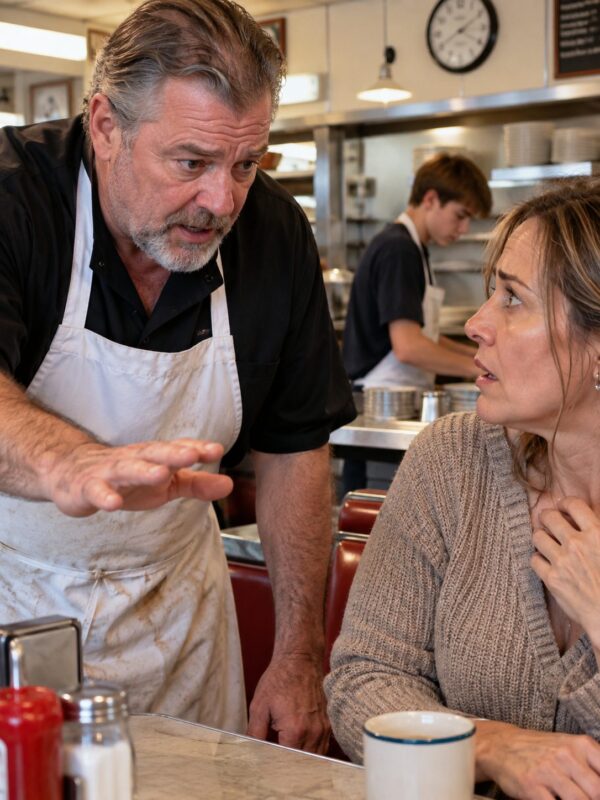
In his hands was a crumpled fistful of cash, and he was desperately trying to hand it to a woman sitting in a nearby booth. She was crying, too. On the table in front of her were legal notices, prescription bottles, and a child’s drawing.
Sal stood between them. A plastic tray of broken dishes lay scattered across the linoleum floor—that was the crash I had heard over the phone. Just plates.
I gripped the back of a nearby table for support. “Evan?”
He spun around. The second his eyes locked onto mine, his face utterly collapsed. “Mom…” He started sobbing harder. “I’m sorry.”
I rushed forward and grabbed him. “Sorry for what?! What happened here?”
“I didn’t want you to know.”
“Know what?”

Sal stepped forward, looking thoroughly exhausted with wet eyes of his own. “I think my phone call gave you the completely wrong impression.”
I stared at him in a daze.
“I’ve been trying to figure out how to tell you this for weeks,” Sal said, placing a gentle hand on Evan’s trembling shoulder. “Your son hasn’t done a single bad thing.”
I looked back and forth between Evan and the weeping woman in the booth.
Sal continued softly. “He’s been doing something I’ve never seen most adults have the character to do.”
“I don’t understand.”
Sal took a deep breath. “Every Saturday, Evan works hard in my kitchen.”
I nodded slowly.
“I pay him sixty dollars.”
“Yes.”
“And every Saturday, immediately after I hand him his cash, do you know what he does with it?”
I slowly shook my head.
Sal gestured toward the woman in the booth. “He gives it all away.”
Her name was Carla. She had two young children—a boy around six and a little girl around four. Her husband had recently walked out, she had lost her job, and she had fallen dangerously behind on rent. To make matters worse, her youngest son suffered from severe asthma, and keeping his prescription inhaler filled had become a financial impossibility.
Carla would occasionally bring her kids to Sal’s diner because it was warm. Sal, noticing their situation, would quietly slip them french fries or a small plate of food without charging them a dime.
Evan had noticed, too. Of course he had—he noticed everything.
He saw Carla nervously counting out loose coins before ordering. He saw her splitting a single plate of food between her two children. He heard the little boy coughing in the booth.
And most importantly, he recognized the exact expression on Carla’s face. He had seen it mirrored on my face after Marcus died. Evan knew what pure, crushing fear looked like on a parent desperately trying to hide their panic from their kids.
So, one Saturday months ago, right after Sal handed over his weekly wages, Evan didn’t pocket the money. Instead, he walked straight over to Carla’s table, laid every single dollar down, and said, “This is for your kids.”
When she tried to refuse, he simply walked away.
The following Saturday, he did it again. And the Saturday after that. Every single week for six months.
My thirteen-year-old son had been standing over a greasy dish sink for hours until his skin cracked and bled… only to hand every single dollar he earned to a struggling mother and her babies.
There never was going to be a bicycle. The bike story was just his elaborate cover. The large stash of cash I found in his bedroom? He had been counting it to make sure Carla had enough to cover her bills. Sometimes, Sal explained, Evan even kicked in his own allowance money, especially when the little boy needed his expensive asthma medication refilled.
Then, another piece of the puzzle clicked into place.
“The torn jacket,” I gasped.
Evan lowered his head in shame.
“And the mud. What really happened?”
He wiped his face with his sleeve. “There were some older kids hanging out near the creek.”
My stomach dropped into my shoes. “They saw you giving Carla money through the diner window one day?”
Evan nodded. “They figured out I carried cash every Saturday. That night, they waited for me.”
My hands went ice cold. “They tried to rob you?”
“I ran,” Evan said quietly, pointing to his ripped jacket. “I slipped climbing up the steep creek bank. That’s how it tore.”
“And your face?”
“Same thing.”
I could barely catch my breath. “But you told me your paycheck was safe!”
“It was,” he whispered, his voice cracking. “I still had the money hidden.” He looked over at Carla. “I ended up giving it to them the next week just to get them to leave me alone.”
I covered my mouth in horror. My little boy had been cornered and chased. He had fallen, come home covered in mud and scrapes, and lied right to my face—all because he was terrified that if I found out, I’d make him stop helping Carla.
“Why?” My voice finally broke completely. “Evan, why didn’t you tell me?”
He started crying all over again. “Because you would’ve stopped me.”
I opened my mouth to argue, but the words died in my throat. Because he was right.
“We don’t have a ton of money either,” he continued, his voice trembling. “I knew you’d say we couldn’t afford to give our money away. But they had so much less.”
He looked up at me, his eyes shining with tears. “And I remember, Mom.”
“Remember what?”
“After Dad died… I remember you crying when you thought I was asleep.”
Fresh tears spilled down my cheeks.
“I remember when the power almost got shut off,” Evan said. “I remember Mrs. Delgado bringing us groceries, and that lady from church paying our heating bill.”
I remembered every single moment of it. Those terrifying first months after Marcus passed were dark times, and kind strangers had literally kept us afloat.
Evan looked toward Carla’s table. “When I saw them, they looked just like we used to look. And I had a job. I had money.” He shrugged helplessly. “So I figured maybe I could be the person who helps this time.”
I was crying openly now. “I did want that bike,” he admitted softly, looking down at his raw, overworked hands. “I really did. But this mattered so much more.”
And then he said the words that completely undone me: “Dad would’ve done it.”
I stared at him, stunned.
“You always told me Dad helped everybody,” Evan sniffled. “You said he’d give someone his own winter coat if they needed it.” His lower lip quivered. “So I thought… if I can’t have Dad here anymore, maybe I can at least try to be like him.”
I sank weakly into the nearest chair. “I’m so sorry I yelled, sweetheart.”
He looked so achingly young in that exact second—just a thirteen-year-old boy, stripped of the heavy armor of the «man of the house» he tried so hard to wear.
“I just wanted to be like Dad,” he whispered.
I crossed the room, pulled him tightly against me, and buried my face in his hair, holding him closer than I had in years. “I’m not angry with you, baby. I am so, so proud of you.”
He cried into my shoulder. “Do you hear me, Evan? I have never been prouder of anyone in my entire life.”
Carla eventually walked over, wiping her own tears. She explained that she had repeatedly tried to refuse Evan’s money every single week, begging him to keep it, save it, or buy the bicycle he always stared at. But Evan would simply leave the cash neatly on her table and bolt straight back into the kitchen dish pit before she could hand it back.
His weekly earnings had helped keep her lights on, bought fresh groceries, and paid for her son’s life-saving inhaler.
Sal finally explained his panicked phone call. He had watched this quiet act of heroism unfold for months and deeply admired the boy. But after the older teenagers began shaking Evan down near the creek, Sal knew the situation had crossed a dangerous line.
That afternoon, Carla had found out about the mugging attempt and flatly refused to take another dime from Evan. Evan, stubborn as ever, insisted she take it anyway. Carla pushed the cash back; Evan shoved it right back toward her. As their emotional argument escalated over the booth, someone accidentally bumped a tray of clean dishes, sending them crashing to the floor. That was the chaos I heard over the phone.
When Sal said Evan had “tried to do it again,” he meant Evan was stubbornly trying to force his entire paycheck into her hands once more.
Sal shook his head with a mixture of awe and respect. “In forty years of running this diner, I’ve never seen a kid with a heart like that.” He looked at me. “And I figured the mother who raised him deserved to know.”
In the weeks that followed, our lives shifted in wonderful ways. Carla and her kids naturally became part of our extended family. But I quickly realized she didn’t need to survive indefinitely on a thirteen-year-old boy’s Saturday dishwashing wages—she needed long-term stability.
And by then, three years out from Marcus’s death, I had finally reached a professional and financial place where I could actually help.
I made a few phone calls. A friend of mine helped Carla land a stable, proper job downtown, and I helped guide her through assistance programs she qualified for. Within a couple of months, she was entirely caught up on her rent, and her son’s inhaler was no longer a stressful choice between medicine and groceries.
As for Evan? Sal gave him a well-deserved raise, along with some solid life advice.
“You can help whoever you want, kid,” Sal told him, pointing a finger at him. “You earned that money fair and square. But next time someone comes looking for trouble, you tell an adult. You don’t have to carry the whole world on your shoulders. Even people with big hearts need backup.”
Evan nodded. And since Carla flat-out refused to take another paycheck from him once she got back on her feet, Evan simply channeled his energy elsewhere: he started volunteering every Sunday at a downtown community food shelter.
He still happily gives away part of whatever he earns. The only difference now is that he doesn’t have to hide it in secret.
And that bicycle? The matte black one with orange lettering that started this whole journey?
I bought it for his birthday a few months later. When he walked out into the driveway and realized what the wrapped box was, he instantly burst into tears.
“Mom… you didn’t have to do this.”
“I know.”
He looked at me, thoroughly confused.
I smiled softly. “That’s the point.” Then I repeated a phrase Marcus used to live by: “You don’t help someone because you have to, Evan. You help because you can.”
These days, Evan proudly rides that bike down to the shelter every single Sunday. Sometimes people ask me if I regret the months I spent agonizing and worrying over his bizarre behavior.
Honestly? I don’t know. For months, I tortured myself imagining the darkest possible scenarios—convinced my son was stealing, running with a bad crowd, or turning into someone unrecognizable.
I was wrong about almost everything.
Except for one thing: Marcus’s death had fundamentally changed him. I had simply misunderstood the direction. I always feared grief might pull my boy toward something dark and destructive. Instead, it had made him acutely sensitive to the darkness in other people’s lives.
He knew what emotional drowning looked like because he had felt the water rising around his own ankles. And when he saw another family struggling in that same heavy current, he didn’t look away. He reached out a hand.
For three years after Marcus died, I thought my primary job as a mother was to teach Evan how to survive grief—how to stay strong, keep his chin up, and keep moving forward. But somewhere along the way, he taught me a lesson I never consciously managed to teach him.
He took the most devastating loss of his young life and transformed it into profound empathy, fierce awareness, and an instinct for noticing the exact person everyone else blindly walks right past.
His father had been exactly like that, too. Marcus would have given the shirt off his back to a stranger.
And apparently, so would his son.
Sometimes, I watch Evan riding that black-and-orange bicycle down the street toward the shelter, and my mind drifts back to Marcus. I like to think, in some quiet way, he can see him—the incredible boy we created.
Thirteen years old. Hands still slightly calloused and rough from washing dishes. And a heart exponentially bigger than I ever could have imagined.
Evan told me once he did everything because he wanted to become like his father. But watching him now, I realize the truth is much simpler:
He already is.





