With just eleven dollars and forty cents to my name, I stared down at the baby formula sitting on the counter, priced at nineteen dollars and twenty-six cents.
With one of my twin brothers wailing against my chest and a line of impatient strangers breathing down my neck, I looked up at the cashier and whispered, «Can I owe you the rest until Friday?»
My name was Lily Carter, and I was only ten years old that freezing December evening inside Mercer Market on Pittsburgh’s East Side.
The cashier, Maria Benson, looked down at my handful of crumpled bills, then back up at the register screen.
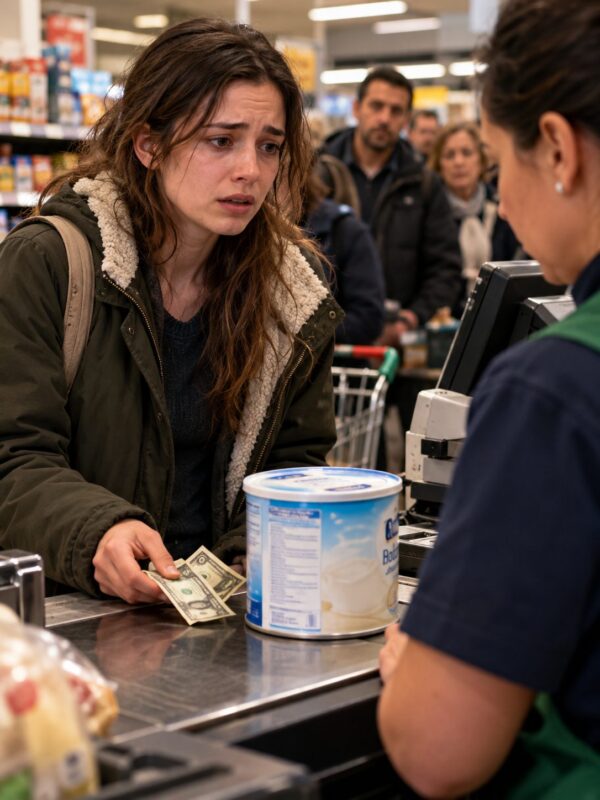
«You’re short seven dollars and eighty-six cents, sweetheart.»
«I know.»
My throat tightened up. «My aunt gets paid on Friday. I swear I’ll bring the rest back. I promise.»
Inside the battered double carrier strapped across my chest, Owen cried harder. His twin brother, Noah, slept right beside him, bundled in a blanket with a torn corner.
Behind me, someone muttered, «Where are her parents?»
I heard it.
I just pretended I didn’t.
«My brothers haven’t had enough formula since yesterday,» I told Maria, my voice shaking. «I’ve been watering down their bottles so it would stretch.»
Her expression softened instantly. For a split second, I thought she might help me out.
Then, her eyes flicked nervously toward the manager’s station.
«I’m sorry,» she whispered.
I understood. Grown-ups always had their rules.
Slowly, I pushed the can of formula back across the counter. «It’s fine. I shouldn’t have asked.»
I scooped up my loose change and turned to leave.
That’s when a man stepped right into my path.
He was wearing a sharp charcoal coat and black leather gloves, carrying the kind of quiet authority that made grown men nearby instantly stop talking.
I didn’t know his name yet.
Everyone else did.
Daniel Mercer owned and controlled more than four hundred supermarkets, distribution centers, trucking companies, warehouses, and commercial real estate properties spanning multiple states.
And those were just his legal businesses.
People all over Pittsburgh also whispered about the men who worked for him after midnight, debts that vanished along with the people who owed them, and a criminal organization powerful enough that even police officers lowered their voices when they said his name.
Daniel Mercer wasn’t simply rich.
He was the mafia boss everyone knew and nobody wanted to cross.
He had been walking through the store with one of his lieutenants when he saw me leave the register empty-handed.
«Excuse me,» he said.
I spun around instantly, wrapping one arm protectively across both babies.
That made him stop.
«I’m not going to hurt you.»
«I know.»
(I didn’t, really.)
His eyes dropped to the twins. «What’s your name?»
«Lily Carter.»
He nodded toward the can of formula. «Do your brothers need that?»
«Yes.»
«Then take it.»
Heat rushed into my face. «I don’t have enough money.»
«I heard.»
My eyes dropped to the floor. For the very first time, the feared Daniel Mercer looked genuinely uncomfortable.
He crouched down until we were almost eye-to-eye. «I wasn’t trying to embarrass you.»
I studied him carefully. «Do you work here?»
Behind him, the cashier looked like she might faint.
Daniel almost smiled. «Something like that.»
He handed Maria a black card. «Ring up the formula.»
I shook my head. «No.»
His lieutenant actually turned his head to look at me in disbelief.
Daniel blinked. «No?»
«I can’t take it for free.»
The entire checkout lane went dead silent.
So, I held out my eleven dollars and forty cents. «You can take this now,» I said. «And I’ll pay you the rest someday.»
Daniel stared at me, dumbfounded. «How will you find me?»
I tightened my grip around my brothers. «I’ll remember your face.»
Something about that answer made him go completely still.
Then I added a promise he would remember for the next nineteen years. «When I’m grown up, Mr. Mercer, I’ll repay you for more than just the formula.»
PART 2
Daniel Mercer stared at me for so long that I started to wonder if I had said something wrong.
Then, he slowly peeled off one black glove.
He held out his hand. Not for my money—for mine.
I hesitated before placing my tiny fingers into his warm palm.
«Deal,» he said.
His hand was warm, but his voice wasn’t. «But you keep your eleven dollars and forty cents.»
I immediately shook my head. «That wasn’t the deal.»
One of the men behind him made a sound that might have been a laugh before quickly catching himself.
Daniel glanced over his shoulder. The man instantly went silent.
Then Daniel looked back at me. «What if I take just one dollar?»
I considered it. «No.»
«Five?»
«You said the formula costs nineteen twenty-six.»
«Yes.»
«So you take seven eighty-six.»
He stared at me hard. «You’ve already done the math.»
«I know subtraction.»
This time, Daniel actually smiled. Not a big smile, but enough to completely soften his face.
«All right, Lily Carter.» He nodded toward Maria. «Take her eleven forty.»
Maria looked horrified. «Mr. Mercer—»
«Do it.»
I carefully counted the money onto the counter: five, five, one, and then the change.
Maria handed me the receipt. Daniel picked up the formula and handed it directly to me.
I held it tight against my chest alongside Owen and Noah. «Thank you.»
«You’re welcome.»
«I’ll pay the rest.»
«I believe you.»
I turned and started walking toward the door.
Then Daniel called out after me, «Lily.»
I stopped and turned back. «Where do you live?»
Every muscle in my body locked up.
He noticed my reaction immediately. «Forget I asked.»
I gave a curt nod and left.
The automatic doors slid open, and the freezing December wind hit my face. I started walking.
I had barely gone half a block when a sleek black sedan began creeping along slowly right beside me.
I stopped dead in my tracks.
The passenger window rolled down. Daniel Mercer was sitting in the back.
My stomach dropped straight to my shoes. «I told you I didn’t need a ride.»
«You didn’t.»
«Then why are you following me?»
«Because it’s fourteen degrees outside.»
«I know.»
«You’re carrying two babies.»
«I know.»
«And a can of formula.»
«Yes.»
He looked genuinely tired. «Lily, get in the car.»
«No.»
He stared at me, baffled. «Why?»
«My aunt says never get into cars with strangers.»
Daniel leaned his head back against the leather seat. For the first time, the most feared man in Pittsburgh looked completely defeated by a ten-year-old girl.
«Your aunt is right.»
The window rolled back up. The sedan pulled ahead.
I waited until it disappeared into traffic before I started walking again.
What I didn’t know was that Daniel’s driver had simply turned onto the next street, doubled back, and shadowed me from half a block away all the way home.
Home was the ground floor of a narrow brick duplex on Mellon Street.
The windows leaked a constant draft of cold air, the kitchen linoleum curled up sharply at the edges, and one of the stove burners didn’t work.
But it was home.
My aunt Denise was crashed on the couch when I walked in, still wearing her blue scrubs from the night shift at the nursing home, her sneakers still on her feet.
I hated waking her up. So I didn’t.
I boiled water, carefully measured the formula, and fed Owen first because his wails were the loudest. Then I fed Noah.
For the first time since yesterday morning, both babies drank until they were completely full.
Afterward, I sat on the cold kitchen floor with one twin against each leg and cried quietly.
Not because Daniel Mercer had frightened me.
Because somebody had seen us. And being seen was rare.
After Mom passed away, adults loved to say things like, Poor Lily. Such a tragedy. She’s so mature. Such a responsible little girl.
Nobody ever understood that «responsible» was just what adults called children when they needed them to stop needing things.
Mom had died six months after the twins were born. That June, Owen needed tubes put in his ears, and the copay vanished into another mysterious «community assistance grant.»
It never occurred to me that these things might be connected. Why would they?
Daniel Mercer had bought me formula once. Rich men didn’t remember ten-year-old girls from grocery store aisles. At least, that’s what I believed.
Life didn’t suddenly become easy. It just became survivable. And there is a big difference between the two.
Denise still worked grueling hours. I still helped raise the twins. We still counted every single penny for groceries.
ولكن there was food. There was heat. There was medicine. For the first time, small emergencies stopped turning into full-blown catastrophes.
By thirteen, I was babysitting. By fifteen, I took weekend shifts at a local bakery. By sixteen, I applied to every single scholarship program my guidance counselor put in front of me.
I discovered I was good at school. Very good.
Numbers were easy. Systems made sense. People were much harder.
At seventeen, I won a full academic scholarship to Carnegie Mellon University.
Denise sat at the kitchen table holding the acceptance letter, reading the first paragraph three times over before looking up at me. «Your mother would lose her mind.»
I laughed, and then she started crying. I did too.

Owen and Noah—both seven by then—ran around the kitchen shouting that their big sister was going to be «a famous college person.»
I majored in economics and data science. Not because I dreamed of making a killing on Wall Street, but because I had spent my entire childhood watching how a single unexpected expense could completely destroy a family standing right on the edge.
Money fascinated me—not wealth, but fragility.
I wanted to know why one household could weather a five-hundred-dollar emergency while another completely collapsed. Why profitable businesses failed overnight. Why people fell into terrible debt traps. Why systems supposedly built to help people forced them to prove absolute desperation before offering a shred of relief.
I wanted to understand the machinery ticking underneath ordinary human suffering.
After college came graduate school, followed by a competitive fellowship, and eventually a job in financial risk analysis.
By twenty-seven, I was working for a federal task force specializing in complex corporate fraud, money laundering, shell companies, and financial crimes cleverly hidden inside legitimate businesses.
I rarely told people what I actually did for a living. Denise just told the neighbors I was «some kind of government accountant,» which was close enough.
Then, by twenty-nine, I was reassigned back to Pittsburgh.
And that was the exact moment Daniel Mercer reentered my life—not in a grocery store aisle, but across a federal conference room table.
PART 4
The name on the case file read: Mercer Holdings Group.
At first, I figured it was just a coincidence. Mercer wasn’t an uncommon name.
Then I opened the corporate profile.
Supermarkets. Distribution centers. Trucking. Warehouses. Commercial real estate.
My breath caught in my throat.
Right at the top of the organizational chart: DANIEL A. MERCER — Chairman.
I stared hard at the photograph attached to the file.
He was older now, with silver at his temples and deeper lines carved around his mouth. But it was the exact same pair of eyes.
I suddenly remembered black gloves, a charcoal wool coat, a single can of formula, and seven dollars and eighty-six cents.
I snapped the file shut and immediately walked over to my supervisor’s desk.
«I know him,» I said.
Helen Ortiz, my supervisor, looked up from her paperwork. «How?»
«He helped me out once when I was a kid.»
Helen raised an eyebrow. «That close?»
«No.»
«Family?»
«No.»
«A family friend?»
«No.»
«Have you had any contact with him since?»
«No.»
She studied my expression intently. «Then write up a disclosure memo.»
«I should probably recuse myself.»
«From what?»
I hesitated. The active investigation wasn’t targeting Daniel personally—at least, not yet.
A subsidiary trucking company had been flagged for suspicious freight invoices and suspected organized cargo theft. Mercer Holdings sat several corporate layers above it.
Helen leaned back in her chair. «We’re not investigating your childhood memories, Lily.»
«I know.»
«If the scope of the case changes, we’ll revisit it then.»
I gave a firm nod, walked back to my desk, and opened the file again.
For the next five months, I just did my job. Nothing more, nothing less.
And slowly, a deeply troubling picture began to emerge.
Someone had been systematically using Mercer distribution routes to smuggle stolen pharmaceuticals and falsify shipping logs.
The operation was remarkably sophisticated. The invoices were clean enough to pass ordinary internal audits. Drivers changed frequently, routes shifted constantly, and warehouses rotated inventory.
But patterns don’t just disappear simply because the paperwork looks pristine. They hide.
And I was exceptionally good at finding hidden patterns.
Eventually, the digital trail led upward. Not to Daniel directly, but to his nephew, Vincent Mercer.
Vincent ran logistics across three states. He had carved out a private criminal network right inside his uncle’s legitimate businesses, exploiting company trucks, warehouses, and employees.
Worse yet, someone high up inside Daniel’s core organization was covering for him.
The case blew wide open: search warrants, subpoenas, and extensive financial tracing followed.
Then, something completely unexpected happened. Daniel Mercer requested a voluntary meeting with federal investigators.
Helen attended the meeting, and I sat right beside her.
I forced myself to stay entirely neutral when he walked into the room. He wore a sharp navy suit this time instead of a charcoal coat. No gloves. No visible security detail.
He sat down across the table and calmly scanned the room.
His eyes landed on mine.
They stopped for perhaps two agonizing seconds. Then they moved on.
He didn’t recognize me.
Of course he didn’t. I had been a ragged ten-year-old kid, and nineteen full years had passed.
Helen kicked off the proceedings. «Mr. Mercer, you’re aware we are examining suspicious activity within Mercer Logistics?»
«Yes.» His voice was deeper now, but still remarkably calm.
«Are you aware of unauthorized cargo moving through your transit routes?»
«I am now.»
«And prior to today?»
«No.»
Helen slid a glossy photograph across the table toward him. It was Vincent.
Daniel’s expression didn’t even flicker.
«Your nephew,» Helen noted.
«Yes.»
«Did you authorize any off-the-books shipments for him?»
«No.»
«Any cash arrangements?»
«No.»
«Protection payments?»
«No.»
«Were you aware that he was maintaining close ties with organized crime syndicates?»
Daniel looked straight at her. «This is Pittsburgh.»
Helen waited.
He continued, unflinching. «People maintain relationships with people they probably shouldn’t.»
«That isn’t a direct answer.»
«No, it isn’t.» His eyes hardened slightly. «But I did not know.»
We spent two solid hours questioning him. He answered almost everything, declined a few specific questions on the advice of his counsel, handed over corporate records voluntarily, and agreed to preserve all digital data.
As the meeting wrapped up, Daniel stood up to leave.
Then, his gaze drifted over toward me once more. This time, he lingered.
I quickly started packing up my papers.
He spoke quietly: «Have we met before?»
My heart slammed against my ribs.
Helen looked sharply between the two of us.
I answered as evenly as I could. «Once.»
Daniel frowned, trying to place it. «When?»
«Mercer Market.»
His face went completely still.
I kept my eyes locked on his. «Nineteen years ago.»
For a moment, absolute silence hung in the room.
Then, quietly, he said: «Eleven forty.»
I almost smiled. His defense attorney looked utterly confused, but Daniel didn’t look away.
«Lily Carter,» he said softly.
I gave a small nod.
In that instant, his eyes changed. For one fleeting second, the ruthless corporate chairman vanished. The feared mafia boss from the old newspaper clippings disappeared entirely.
And all I saw was the stranger who had once crouched down beside a grocery store register to look a terrified little girl in the eye.





