My nine-year-old son had been getting his hair cut at the same neighborhood barbershop for nearly two years.
Then, one Saturday, a new barber stopped halfway through the cut, stared intently behind Ethan’s ear, and quietly told me,
“Check that when you get home. Somewhere private.”
Ten minutes later, I found a tiny black object hidden right against my son’s skin.
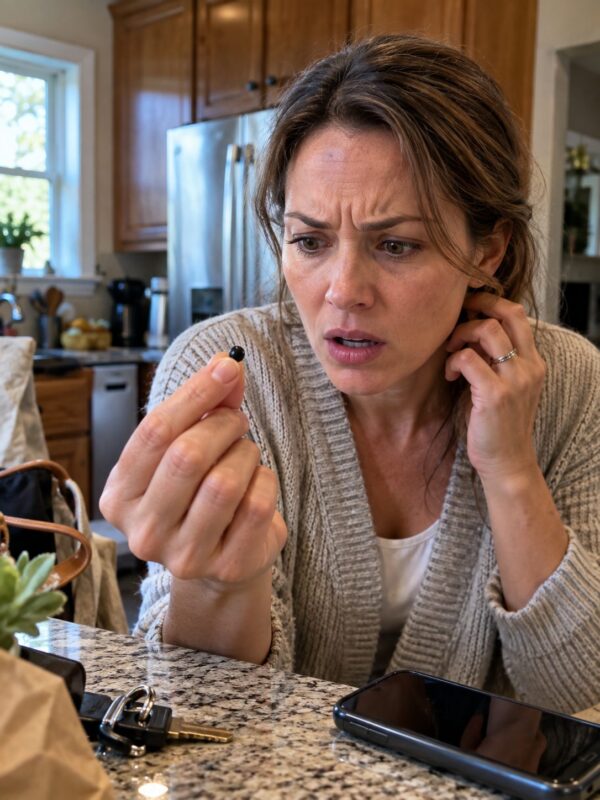
Twenty minutes after that, two police cars were parked outside my house.
And before the day was over, I learned that someone had been exploiting my son’s grief over his late father to set up something far more sinister than I ever could have imagined.
It began like any other Saturday morning.
Tony had been cutting Ethan’s hair since he was seven. Ethan trusted him, which meant a lot because my son has never been quick to warm up to people.
We arrived a little before ten. Tony was still finishing up with another customer when Ethan dramatically flopped into one of the waiting chairs.
“Mom, I’m starving.”
“You ate two waffles an hour ago.”
“That was basically yesterday.”
Another barber laughed. I hadn’t seen him before. He was younger than Tony, maybe around thirty, with tattoos covering both forearms.
“I can take him,” he said, flashing a grin. “Before he starves to death in the lobby.”
I hesitated. Tony noticed.
“He’s good, Megan,” Tony called out. “That’s Marcus. He’s been helping out here for a few weeks.”
Ethan shrugged. “Fine.”
So I nodded. “Okay.”
Marcus settled him into the chair, snapped the cape around his neck, and started cutting. Everything was normal for about fifteen minutes.
Ethan chattered nonstop—soccer, school, a kid in his class who had eaten a crayon on a dare. Marcus joked right along with him, asking all the usual kid-friendly questions. I sat nearby, tapping away at work emails on my phone, glancing up every few minutes.
Then Marcus began trimming around Ethan’s left ear.
The clippers stopped dead. At almost the exact same second, Ethan stopped talking, too. That sudden silence was what caught my attention.
Marcus moved Ethan’s hair aside with his fingers. Then he stared. Not the quick, casual look someone gives a mole or a scratch—he was studying something.
Finally, he looked up and caught my eye in the mirror. His easygoing expression had completely vanished.
“What is it?” I asked.
Marcus gave the smallest, most subtle shake of his head. Then he finished the haircut, but the joking was entirely over. He worked quietly, quickly, and an uncomfortable knot started tightening in my chest.
When he finished, Ethan jumped down and immediately bolted for the door.
“Mom! Can I get a quarter for the candy machine?”
Before I could answer, he was already outside, staring through the glass at the gumball machine.
Marcus brushed loose hair off the chair. Without looking directly at me, he said softly,
“Check behind his left ear.”
I frowned. “For what?”
Another customer had just walked through the front door. Marcus lowered his voice to a bare whisper.
“When you get home. Somewhere private. Look carefully.”
My stomach plummeted. “Marcus, what did you see?”
He shook his head again. “Not here.”
That was all he would say.
I paid, grabbed Ethan, and drove home, spending the entire trip watching him anxiously through the rearview mirror. He looked totally fine. He was talking at top volume again, thrilled because the candy machine had somehow given him two gumballs instead of one.
Ten minutes later, we were standing in our kitchen.
“Hold still for a second,” I said.
Ethan immediately looked worried. “Did he mess up my haircut?”
“No. I just want to check something.”
I gently pushed the freshly trimmed hair away from his left ear. At first, I saw nothing out of the ordinary. Then I noticed a tiny, flesh-colored patch tucked right into the crease where his ear met his skull. It blended almost seamlessly with his skin.
I touched it. There was something hard underneath.
Every protective instinct in my body flared at once. Carefully, I lifted the edge of the patch. Beneath it was a tiny black disc—smooth, hard, and barely larger than a grain of rice. It looked almost like a tiny piece of dark glass.
I had no idea what it was, but I knew one terrifying thing: it did not belong behind my child’s ear.
“Ethan,” I said, forcing my voice to stay steady. “Who put this here?”
His whole demeanor shifted instantly. The bright, talkative boy in front of me seemed to shrink.
“I don’t know.”
“Ethan, look at me.”
He stared at the linoleum floor. “Who put it there?”
His voice became a tiny squeak. “Maybe the man from school.”
My blood ran cold. “What man?”
He still refused to look at me. “The one who knew Dad.”
The room seemed to tilt sideways. Because Ethan’s father, Ryan, had been dead for three years.
Ryan had died when Ethan was six. It happened fast—he fell ill in the spring, and by the end of the summer, he was gone.
Ethan had understood death in the fragmented, abstract way a six-year-old does. As he grew, he seemed to re-process the loss at every new age and milestone. For three years, I had been the one keeping Ryan alive for him through photos, home videos, stories, and little memories.
But when a child loses a parent that young, a cruel process begins: their memories start to fade. Ethan used to remember Ryan’s laugh, his scent, the way he tickled him. Over time, those sharp memories softened, until eventually, I couldn’t tell if Ethan actually remembered those things himself or just remembered me talking about them.
Lately, the questions had ramped up. What food did Dad like? Was Dad good at soccer? What did Dad want to be when he grew up? And several times that week, Ethan had asked about the storage unit where I kept Ryan’s old belongings.
“Are there boxes of Dad’s things there?”
“Lots of them.”
“Can we go?”
“We will. I promise.”
I had thought it was heartbreakingly sweet—my son simply wanted to know his father. Standing in my kitchen with a strange, foreign object peeled off my son’s skin, it no longer felt sweet at all.
I dropped the disc into my palm. “Ethan, I need you to tell me everything about this man.”
His eyes widened. “Am I in trouble?”
“No, but first I’m calling someone.”
I dialed 911. The dispatcher’s calm, steady voice was the only thing keeping me from completely falling apart. I told her what I had found—that a stranger had apparently planted a device behind my son’s ear, and that the same man had been lingering around his school.
“Do not remove the object,” she instructed. “Leave it exactly where it is. Are you inside your home?”
“Yes.”
“Are the doors locked?”
I looked toward the front entrance. “Not the front one yet.”
“Lock it right now. Keep your son beside you and stay away from the windows. Officers are on the way.”
I threw the deadbolt with Ethan holding tightly to my hand. We sat together at the kitchen table.
“Am I in trouble?” he whispered again.
“No, buddy. You did nothing wrong.”
His chin began to tremble. “He told me not to tell you. He said it was a secret.”
“I know. But Ethan, you can always tell me the truth. You will never, ever be in trouble for telling me something like this.”
About twenty minutes later, two police cruisers pulled up out front.
The lead officer introduced herself as Officer Patel. She had a calm demeanor and kind eyes. She carefully examined the object behind Ethan’s ear without disturbing it, then crouched down eye-level with him.
“That’s a sharp soccer jersey,” she said smoothly. “You any good?”
Ethan offered a small shrug, but some of the intense tension finally left his shoulders. Then she gently started asking him about the man.
Slowly, the details came out. Ethan had first seen him down the block from school—not right at the exit gate, but closer to the corner where I normally picked him up after soccer practice. The man had approached him and shown him an old photograph. In the picture, the man stood beside Ryan, both of them younger, smiling, with their arms slung over each other’s shoulders.
“He knew Dad,” Ethan said.
To a nine-year-old boy desperate for any anchor to a father he barely remembered, that photograph had been all it took. The man had told him stories—specific things about Ryan that I had apparently never mentioned.
“He knew stuff you didn’t even know, Mom.”
That stung—not because Ethan had done anything wrong, but because a stranger had mapped out the exact empty space inside my child and ruthlessly stepped right into it.
Officer Patel kept pressing gently. “Did he ever follow you home?”
“I don’t think so.”
“Did he try to get you into a car?”
“No.”
“Did he give you anything else?”
Ethan hesitated. Just for a fraction of a second, but everyone in the room caught it.
“Ethan?” I prompted softly.
He grabbed my hand tighter and pointed toward the front hallway. “I hid it.”
My stomach dropped into my shoes. “Hid what?”
He pointed at the heavy canvas umbrella stand beside the coat closet.
One of the backup officers immediately stepped in, guiding Ethan and me back into the kitchen. Officer Patel and her partner approached the closet. I heard the door creak open, boxes being shifted aside, and then total silence.
A few minutes later, Officer Patel walked back into the kitchen. Her expression was unreadable.
“We found a black case hidden behind some winter boots,” she said, holding her hands about a foot apart to show its size. “Does it belong to you?”
“No. I’ve never seen it before in my life.”
After that, everything accelerated. More officers arrived, and the heavy, chilling word evidence entered the conversation. Suddenly, my safe home didn’t feel like my home anymore.

Officer Patel sat Ethan down once more, kindly asking me to let him speak for himself. And the rest of the dark puzzle spilled out.
The man had approached Ethan four times over the past two weeks. He genuinely knew real, intimate details about Ryan: he knew Ryan had coached Ethan’s early soccer teams; he knew Ryan used to call him Buddy; he even knew about a specific fishing trip Ryan had promised to take him on when he got older. These weren’t generic details scraped from an online obituary. Whoever this man was, he really had known my husband.
Two days prior, the man had handed Ethan the black case.
“He said to hide it somewhere you wouldn’t find it,” Ethan whispered nervously, looking up at me. “He said it was really important.”
Then the man had stuck the black disc behind his ear, covered it with the skin-colored patch, and called it their «secret key.»
“He told me not to tell anyone… especially you.”
Ethan swallowed hard. “And he said he’d see me Monday.”
Officer Patel leaned forward. “Why Monday?”
“To talk again,” Ethan said. Then he added quietly, “He said the key belonged to Dad. He said you might try to throw Dad’s stuff away.”
That sentence shattered something deep inside me. I dropped straight to my knees in front of my son.
“Ethan, look at me.”
He met my eyes.
“I would never, ever throw away your father’s things. Do you understand me? Never.”
He nodded, but the lingering uncertainty on his face broke my heart. For two weeks, someone had systematically poisoned my son’s mind, teaching him to doubt me.
Officer Patel asked one final question: “Did the man tell you what to call him?”
“Derek.”
The trap was set for Monday afternoon.
An officer kept watch near the school grounds, while detectives waited quietly in unmarked cars. I sat in the passenger seat of one of them.
About ten minutes after the final bell rang, Derek appeared.
I hadn’t seen him since before Ryan died. He looked older now, with graying hair, but otherwise entirely ordinary. And that was what disturbed me the most. He stood across the street, smiling warmly as the children poured out, looking precisely like a friendly uncle waiting to walk his nephew home.
Two detectives stepped out and approached him. Derek immediately played the innocent bystander. He claimed he was just there visiting family, that he only wanted to drop off a few keepsakes that had belonged to his late brother, Ryan.
Then a detective held up a single photograph pulled from my porch security camera—showing him lurking near our property days earlier.
Derek took one look at the image and blurted out, “That doesn’t prove I put it there.”
The detective hadn’t even accused him of putting anything anywhere. He had simply shown him a photograph. An innocent person would have asked what the camera was or why they were being stopped. Derek had instinctively defended himself against an accusation that hadn’t been spoken yet.
That single, fatal mistake sealed it. He was placed under arrest that evening.
I expected watching him get hauled away to feel like a triumph. It didn’t. Mostly, I just felt hollow, tired, and deeply sad.
A few days later, Ethan asked if he could speak to Derek.
“No,” I answered before the question was even fully out of his mouth.
When I consulted our detective, she explained that if it was allowed at all, it would need to be brief, controlled, and strictly supervised. Ethan kept asking—not whining or throwing tantrums, but with a quiet, deadpan seriousness that unnerved me.
Eventually, I asked him why he needed to see him.
“I want to ask him why he said you’d throw Dad’s things away.”
Hearing that broke through my defenses. Of everything Derek had done, that was what cut Ethan the deepest—the vile lie about me. So, I agreed.
Under police supervision, with me sitting rigidly beside him in a sterile interview room, Ethan spoke to Derek one last time.
Derek tried to put on his old, warm, avuncular smile. “Hey, Buddy.”
Hearing Ryan’s special nickname for Ethan come out of Derek’s mouth made my skin crawl.
“I never wanted to scare you,” Derek said smoothly. “I just wanted to tell you about your dad.”
Ethan stared at him, completely deadpan. “You told me to lie to my mom.”
Derek stumbled, shifting gears into a patronizing explanation. “Well, sometimes grown-ups have complicated situations and—”
Ethan cut him off flatly. “My dad wouldn’t make me lie to my mom.”
Derek froze. For once, in all his manipulation, he had nothing left to say.
I squeezed Ethan’s small hand under the table. And for a fleeting second, I saw pure Ryan looking back at me.
On the quiet drive home, Ethan broke the silence. “Was Dad really angry at Uncle Derek before he died?”
This time, I didn’t sugarcoat the truth. “Yes.”
“Why didn’t you tell me?”
I gave him the gentle answer first. “You were six years old, and your dad had just passed away. I thought you were already carrying way too much.”
Then I gave him the heavier, harder truth. “And honestly? Sometimes talking about your dad hurt me too much, so I avoided it. I told myself I was protecting you, but sometimes… I was just protecting myself.”
Ethan looked over at me from the passenger seat. “I like hearing about him, Mom.”
“I know.”
“Even if it makes me sad.”
I swallowed hard and nodded. “Me too. I’d rather be sad and hear about your dad than not hear about him at all.”
That conversation changed everything. Because I finally understood what my protective silence had actually created: every time I avoided speaking of Ryan, I left a wide, echoing void inside my son. And empty spaces always get filled by something. This time, Derek had tried to fill them with poison.
That very weekend, I took Ethan to the storage unit. My decision. Nobody else’s.
We pulled Ryan’s heavy cardboard boxes down one by one. The first held his old baseball glove, his watch, and crumpled preschool Father’s Day cards. At the very bottom sat Ethan’s tiny plastic hospital identification bracelet from the day he was born, resting right beside Ryan’s hospital wristband labeled FATHER.
Ethan stared down at it in awe. “You really kept all of this?”
I smiled through the hot tears streaming down my face. “I kept way too much.”
We spent hours sitting right there on the dusty concrete floor. Photos, fishing gear, concert stubs, old birthday cards, and a god-awful yellow Christmas tie Ryan had once proudly worn.
And we shared stories. So many stories.
I told Ethan how terrified Ryan had been of holding a newborn, so much that he practiced carrying a five-pound bag of flour around the house beforehand—until the bag split open, dumping flour everywhere, and Ryan seriously tried to blame the imaginary baby.
I told him about the night Ryan chased a raccoon off our back porch wearing nothing but athletic socks, accidentally locked himself outside, and had to pelt our bedroom window with pebbles to wake me up.
I told him how panicked Ryan had been the first time baby Ethan caught a fever, staying awake all night checking the thermometer every twenty minutes.
Ethan laughed. Then he cried a little. Then he laughed again. I did, too.
Near the bottom of one old box, tucked inside a forgotten tax folder, I found a manila envelope. Inside were copies of old bank statements, financial records, and legal papers—actual concrete proof Ryan had gathered exposing Derek’s shady financial dealings. Across the front, written in Ryan’s sharp handwriting, was a single sentence:
Derek knows I kept copies. Don’t destroy these.
I sat on that storage unit floor, laughing and crying simultaneously. It was so perfectly, stubbornly Ryan. Even while sick, he had known his brother wouldn’t stop. Derek had spent weeks manipulating a child and planting fake digital traces, while the actual, undeniable truth had been sitting mere feet away all along, quietly waiting.
We handed everything over to the police. Between Ryan’s recovered documentation, Derek’s forged paperwork, our porch security footage, and the damning evidence that he had weaponized a minor to plant false items, the case against him was airtight. Derek had tried to use my son to bury Ryan’s truth for good; instead, he had led investigators straight to his downfall.
A few weeks later, Ethan needed another trim.
“Tony?” I asked him as we walked up.
Ethan shook his head. “Marcus.”
I had already called Marcus beforehand to properly thank him. His explanation for what he did was simple: his brother worked in commercial security systems, and Marcus had spent enough time around workshops to instantly recognize that the weird black disc behind Ethan’s ear wasn’t normal.
More than that, though, he had read the kid’s body language. “He kept rubbing his ear, and when I uncovered that thing, his face went pale. A kid shouldn’t look terrified just because someone found a little hidden object behind his ear.”
Then Marcus had added something that stuck with me: “I figured it was better to speak up and be wrong than stay quiet and be right.”
“You may have saved both of our lives,” I told him over the phone.
Marcus paused. “I just told his mom to look. You were the one who actually looked.”
When we walked back into the barbershop, Ethan marched right up and climbed into Marcus’s chair.
Marcus grinned in the mirror. “Back already, huh?”
Ethan grinned right back. “Check behind both ears this time.”
Marcus laughed out loud. “Both ears. Every single haircut until you’re forty.”
I laughed, too, standing there watching my son act like a carefree nine-year-old again. It nearly brought me to tears.
When we got home later that day, we opened up another box of Ryan’s things.
For three years, I had convinced myself that protecting Ethan meant helping him march forward without living in the shadow of a ghost. Don’t dwell. Don’t make him sad. Keep life moving.
I had misunderstood my son completely. Ethan wasn’t trying to live in Ryan’s shadow; he was trying desperately to memorize his father’s face before the images blurred away entirely. He wasn’t trapped in the past—he was simply reaching out for something that felt like it was slipping through his fingers. And I hadn’t always made it easy for him to hold on.
Derek had understood that desperate longing long before I did. He saw the exact chink in my armor, the exact vulnerable space inside my son, and he nearly used it to shatter our family completely.
But now, when Ethan asks about Ryan, I answer. Everything he wants to know. When I don’t know an answer, I just tell him honestly.
Sometimes we pull up old videos on the TV. Ethan studies his father’s facial expressions like a student memorizing for an exam—because in a way, he is. Sometimes we laugh until our ribs hurt. Sometimes neither of us can find the words to speak.
Ryan is still gone. Nothing in this world will ever change that.
But his memory no longer belongs to whatever manipulative stranger happens to intercept us on a street corner with a convincing story. It belongs to us. To the cardboard boxes on our living room floor. To the old photographs. To the raw, unfiltered stories I will keep telling until Ethan is old enough to pass them down himself.
I can never give my son his father back.
But I can make damn sure he knows who his father truly was—completely, truthfully, and deeply enough that no one will ever be able to weaponize Ryan’s memory against him again.





